
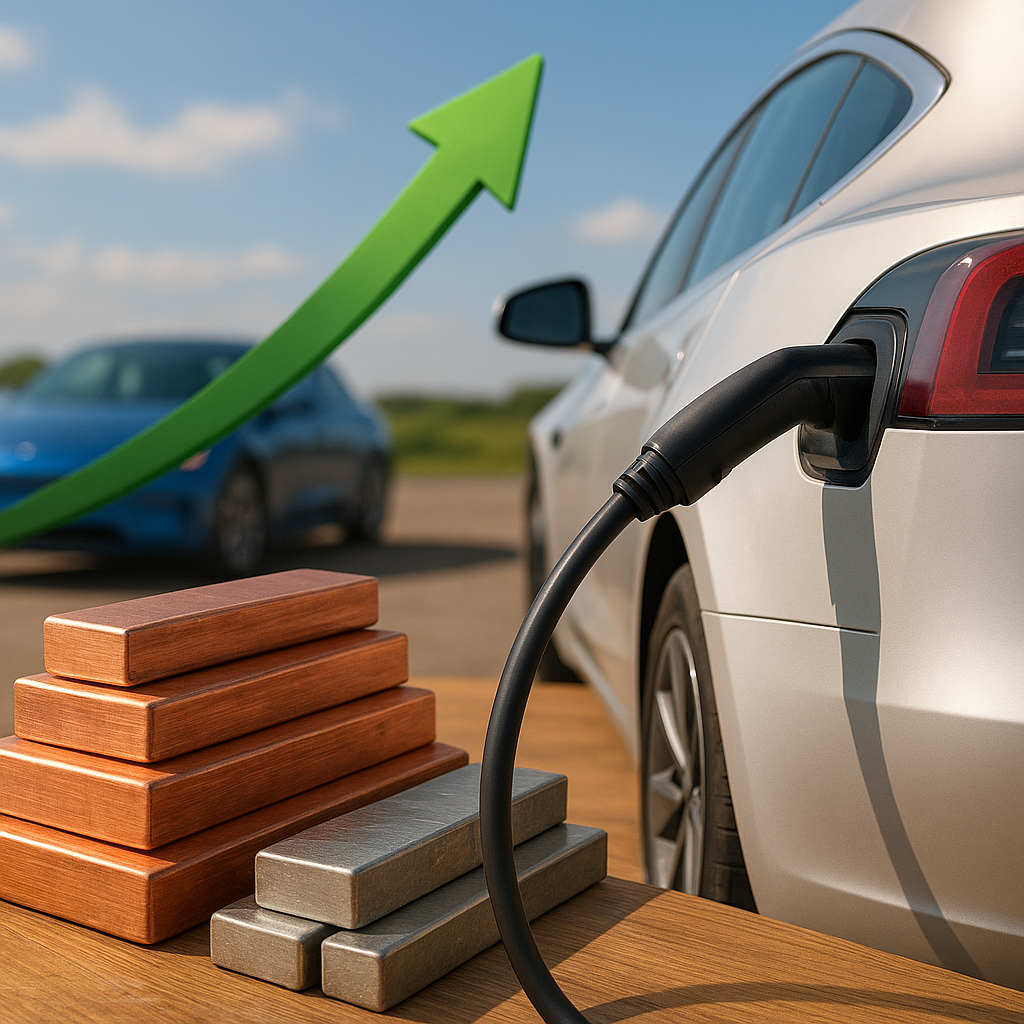
The rapid adoption of electric vehicles is reshaping global commodity markets, with growth in EV sales translating directly into stronger demand for certain key metals. This article examines how increasing EV penetration accelerates the need for copper and nickel, explores the technical reasons behind that demand, analyzes supply-side constraints and market responses, and considers the environmental and policy implications of the shift to electrified transport. Below are the dynamics and practical challenges driving a structural change in metal markets.
The connection between electric mobility and metal consumption
Electric vehicles do not simply replace internal combustion engine platforms; they reconfigure vehicle architecture around electric powertrains and energy storage systems. That transformation increases per-vehicle consumption of certain metals. Two of the most affected metals are copper and nickel. The first is essential for electrical conductivity across motors, wiring and charging infrastructure, while the second is a vital ingredient in many lithium-ion batteries, especially high-energy chemistries used in longer-range EVs.
How per-vehicle metal intensity rises
- Wiring and motors: EVs often contain three to four times more copper wiring than internal combustion vehicles because copper is used extensively in traction motors, inverters, and high-voltage harnesses.
- Charging infrastructure: Residential and public chargers, substations, and grid upgrades increase industrial copper demand beyond the vehicle itself.
- Battery cathode composition: Many high-nickel cathodes (NMC 811, NCA) use larger shares of nickel to achieve higher energy density, translating into higher metal volumes per kilowatt-hour.
- Battery pack components: Beyond cathodes, nickel-based alloys and copper current collectors magnify consumption.
Because EV adoption targets millions of new vehicles annually, even small increases in per-vehicle metal intensity compound into large aggregate demand growth.
Copper: the backbone of electrification
Copper is fundamental to electrification because of its excellent electrical conductivity and relative cost-effectiveness. A typical internal combustion vehicle contains about 20 kilograms of copper, while a battery electric vehicle can contain between 60 and 100 kilograms, depending on design and vehicle class. That difference means a shift to EVs materially ups global copper requirements.
Where copper is used in the EV ecosystem
- Electric motors and generators — windings and busbars
- High-voltage cabling and connectors within the vehicle
- Charging stations, transformers and grid interconnections
- Renewable energy installations and transmission lines supporting electrified transport
Forecasting agencies and commodity analysts estimate that EV adoption could contribute tens of percent of incremental copper demand over the next decade. This is not only in passenger cars but also in buses, trucks, and two/three-wheeled EVs in emerging markets. The cumulative effect adds pressure to supply chains that were already challenged by other electrification trends.
Market impacts and supply chain responses
Rising demand has several direct consequences:
- Price pressure: Copper prices respond to tighter supply/demand balances, affecting upstream investment decisions.
- Exploration and development: Higher prices incentivize new projects, but mine timelines are long, often a decade from discovery to production.
- Substitution and efficiency: Manufacturers invest in copper-efficient designs and recycling to temper demand growth.
Policymakers and utilities also must plan grid reinforcement and local distribution upgrades, which multiply copper needs beyond vehicle counts. The interplay between EV deployment and power-sector expansion makes copper demand more persistent and geographically diffuse.
Nickel: enabling higher-energy batteries
Nickel plays a pivotal role in modern lithium-ion battery cathodes. Nickel-rich chemistries, such as NMC (nickel-manganese-cobalt) formulations that increase the nickel share to boost energy density, have become popular because they help reduce cost per kWh and enable longer vehicle ranges. As automakers pursue lighter, higher-range EVs, the demand for nickel rises accordingly.
Battery chemistry trends
Battery makers shift toward higher nickel content to achieve two goals: increase specific energy and reduce reliance on expensive cobalt. For example:
- NMC 111 (historical): modest nickel share
- NMC 532/622: intermediate nickel increases
- NMC 811 and NCA: high-nickel chemistries favored for longer range
Each transition pushes per-kWh nickel usage upward. For large-scale EV adoption, battery capacity installed annually measured in GWh multiplies nickel requirements.
Supply-side constraints and environmental concerns
Nickel supply faces distinct challenges from copper. Not all nickel deposits are equally suitable for battery-grade material; many nickel mines produce nickel in forms (sulfide vs laterite) that require complex processing to create the refined products needed for cathodes. Converting laterite feedstock to battery-grade nickel often requires energy-intensive hydrometallurgical or pyrometallurgical processes.
Environmental and social governance (ESG) concerns around nickel mining — such as deforestation, high energy use, and local community impacts — add regulatory hurdles. These factors can lengthen project lead times and increase costs, reinforcing the need for recycling and more efficient battery chemistries.
Recycling, substitution and technological responses
To alleviate pressure on primary resource extraction, several market and technological strategies are advancing. Effective recycling programs can recapture copper and nickel from end-of-life batteries and electronic waste, reducing the need for virgin material. At the same time, battery chemistries and pack designs aim to lower material content or substitute less critical elements.
Recycling and circularity
- Hydrometallurgical processes can recover cathode metals with high yield if collection systems are in place.
- Direct recycling approaches seek to refurbish cathode materials with lower energy inputs than full refinement.
- Automotive OEMs and governments are forming closed-loop initiatives to secure critical materials and reduce environmental footprints.
Scaling recycling requires policy support, standardized battery designs for disassembly, and investments in industrial recycling capacity. While recycling will not eliminate the need for new mining in the near term, it substantially reduces incremental demand and improves supply resilience over decades.
Substitution and optimization
On the technology side, researchers and OEMs pursue alternatives and optimizations:
- Lower-nickel chemistries (e.g., LFP — lithium iron phosphate) are gaining traction in certain segments where cost and cycle life outweigh energy density priorities.
- Advanced cathode coatings and formulations enhance performance with less nickel or minimize cobalt.
- Vehicle electrification strategies, like modular battery packs and vehicle-to-grid capabilities, can optimize system-level material needs.
Thus, while the trend toward nickel-rich cathodes has been strong, market segmentation and regional policy choices lead to a mixed demand picture across different geographies and vehicle classes.
Policy, investment and geopolitical implications
Governments seeking to accelerate EV adoption often combine incentives with industrial policies targeting critical minerals. Securing supplies of copper and nickel becomes a strategic priority. That has several implications:
- Domestic mining and processing: Countries may incentivize local projects to reduce dependence on foreign supplies and to capture value-add in refining and battery manufacturing.
- Trade and diplomatic tensions: Resource-rich countries might leverage exports geopolitically, while consumer economies seek diversified sourcing.
- Investment flows: Higher prices and state support attract capital to exploration, processing plants, and recycling infrastructure.
These policy choices influence timelines and costs. For example, subsidies for domestic refiners shorten processing chains but require significant budgetary and regulatory commitments. International cooperation on sustainable mining standards can help mitigate environmental impacts while ensuring reliable supply.
What this means for markets and manufacturers
Automakers, suppliers, and investors must embed metal risk management into strategic planning. Actions include securing long-term offtake agreements, investing in recycling plants, and diversifying battery chemistries across product lines. Utilities and grid operators will need to factor in the copper-intensive nature of EV infrastructure when planning transmission, distribution and local charging networks.
- Manufacturers: hedge raw-material exposure through contracts and vertical integration.
- Investors: prioritize projects that balance production capacity with ESG considerations.
- Policymakers: design incentives that recognize material constraints and support circular economy measures.
In the near to medium term, expect price volatility as markets adjust. In the longer run, recycling, technological innovation and expanded mining capacity can stabilize supply, but only if social and environmental costs are managed.
Final considerations on the transition to electrified transport
The surge in EV sales is a primary driver of accelerating demand for copper and nickel, with implications that reach beyond automotive factories into energy grids, raw-material markets, and environmental policy. Managing this transition responsibly requires coordinated efforts across industry, government and civil society to scale sustainable mining, expand recycling, and deploy a mix of battery technologies that align with regional needs. The metal-intensive nature of electrification underscores that decarbonizing transport involves not only software and batteries but also complex physical supply chains that must evolve in tandem with the vehicles they support.
