
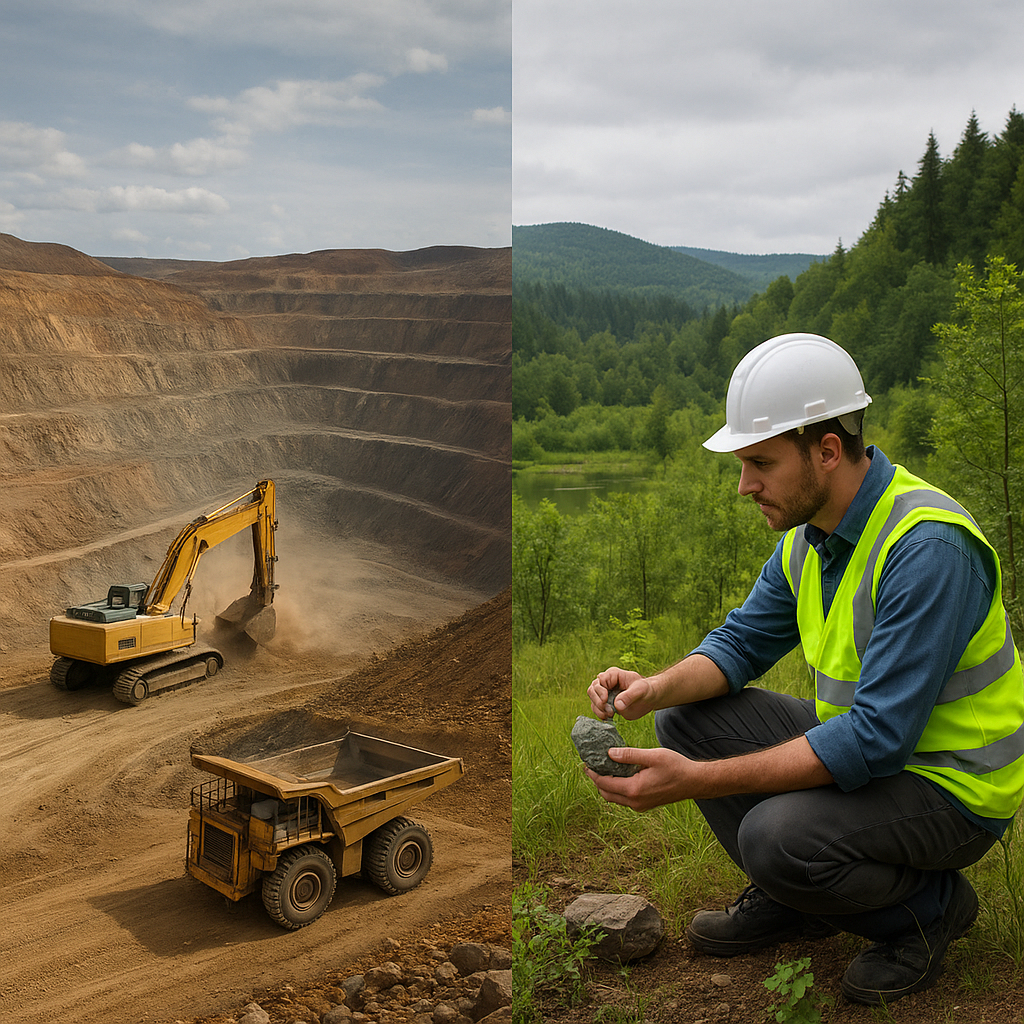
The pressure of environmental, social and governance frameworks is reshaping the way companies search for and evaluate mineral resources. As investors, regulators and communities insist on more responsible practices, mineral exploration no longer means simply finding an ore body: it means aligning discovery efforts with long-term ESG commitments, minimizing environmental footprints, fostering social license and embedding sustainability into early-stage decisions. This article examines how exploration strategies, technologies and business models are shifting under these pressures and what that means for the future of the extractive sector.
Drivers of change: why ESG matters for exploration
Exploration historically prioritized geological potential and cost efficiency. Today, that calculus has expanded to include non-technical risks and value drivers. Several forces are accelerating this shift:
- Investors: Institutional investors and asset managers increasingly screen portfolios based on ESG metrics. Projects with weak social or environmental credentials face higher capital costs or exclusion from certain funds.
- Regulation: Governments and supranational bodies are introducing stricter permitting, disclosure and climate-related reporting regimes that affect project timelines and feasibility.
- Markets: End-users demand responsibly sourced materials, particularly for critical minerals used in energy transition technologies, pressuring supply chains to demonstrate traceability and low-impact sourcing.
- Communities and civil society: Local stakeholders and NGOs can delay or block projects that lack meaningful engagement or show potential for significant environmental harm.
These pressures create a new risk landscape. Exploration teams must evaluate not only geology and economics but also potential liabilities related to carbon, biodiversity, water impacts and community relations. The result is a strategic reorientation toward projects that are not only ore-rich but also ESG-resilient.
Operational shifts in mineral exploration
In practice, companies are adapting exploration workflows to reduce environmental impact and improve stakeholder outcomes. Key operational changes include:
- More selective, intelligence-led exploration: Rather than broad, footprint-heavy campaigns, firms are investing in advanced geoscience and remote-sensing methods to prioritize high-probability targets. This reduces unnecessary land disturbance and drilling.
- Low-impact field methods: Techniques such as directional drilling, smaller drill pads, reduced-viscosity drilling fluids, and no-blast approaches are being deployed to minimize landscape disturbance.
- Enhanced baseline studies: Early and rigorous ecological, hydrological and social baseline assessments are becoming standard to inform site selection and mitigation strategies.
- Community-first engagement: Exploration teams are front-loading consultations, joint planning and benefit-sharing agreements to secure a community license to operate and reduce conflict risk later.
- Lifecycle thinking from day one: Consideration of eventual closure, rehabilitation and potential reuse of areas is integrated into exploration planning to avoid creating future liabilities.
These operational shifts imply higher upfront costs and longer lead times for exploration projects, but they also reduce the probability of later-stage stoppages, protests or financing withdrawals — a trade-off that many firms now consider worthwhile.
Financial and regulatory implications
The infusion of ESG into exploration affects capital flows, contractual structures and legal compliance. Notable implications include:
Access to capital and risk repricing
Exploration is capital-intensive and often speculative. As financiers incorporate ESG criteria into underwriting, projects perceived as high-risk from a social or environmental standpoint face stricter lending terms, reduced equity appetite or exclusion from ESG-aligned funds. Conversely, projects demonstrating robust ESG due diligence may access green or sustainability-linked financing at more attractive rates. This dynamic incentivizes explorers to present comprehensive ESG risk mitigation plans alongside technical and economic models.
Permitting and disclosure
Regulators increasingly demand detailed environmental impact assessments, climate risk disclosures and public consultation records even at early exploration stages. Failure to meet evolving disclosure standards can delay or block exploration activities. Companies must therefore build compliance capacity earlier in the project timeline and maintain high standards of transparency toward authorities, investors and communities.
Insurance and contractual conditions
Insurers and service providers are adjusting terms to reflect ESG exposure. Policies may exclude coverage for activities that threaten protected habitats or fail to respect indigenous rights. Exploration contracts with local partners now commonly embed ESG clauses, including monitoring, remediation obligations and grievance mechanisms to manage reputational and legal risks.
Technologies enabling ESG-aligned exploration
New and improved technologies are central to reducing the environmental footprint of exploration and enhancing stakeholder trust. Prominent technological enablers include:
- Remote sensing and geospatial analytics: High-resolution satellite imagery, hyperspectral sensors and airborne geophysics enable more targeted prospecting with fewer ground disturbances.
- Unmanned aerial systems: Drones perform mapping, environmental monitoring and even sample transport in sensitive areas, minimizing vehicle traffic and habitat disruption.
- Data-driven decision making: Machine learning and integrated geological models improve target selection and reduce wasted drilling — creating fewer scars on the landscape.
- Low-impact drilling technologies: Innovations that reduce waste, water use and emissions during drilling are becoming standard in ESG-focused exploration campaigns.
- Digital traceability platforms: Blockchain and secure data systems help establish provenance and reporting chains for future mined material, meeting supply chain stakeholders demands.
Adoption of these technologies allows firms to demonstrate measurable reductions in impact and improved monitoring — essential evidence when seeking permits or capital under ESG frameworks.
Social innovation: partnerships and new models
Social dimensions of ESG are prompting innovation in how exploration interacts with local and indigenous populations:
- Co-management and benefit sharing: Exploration agreements increasingly include revenue-sharing, training programs and local procurement commitments to ensure communities accrue tangible benefits early on.
- Free, prior and informed consent (FPIC): Many projects adopt FPIC processes not only to meet legal requirements but to build durable relationships that reduce conflict risk.
- Capacity building: Companies invest in local technical training so communities can participate in monitoring and decision-making, improving project legitimacy and long-term outcomes.
These social innovations change the power dynamics around prospecting. Exploration teams must engage as partners, not just claimants of geological opportunity.
Commodity focus and strategic repositioning
ESG imperatives are also altering which commodities attract exploration budgets. Demand growth for green technologies raises interest in critical minerals — lithium, cobalt, nickel, copper and rare earths — but sourcing these responsibly is non-trivial. Firms often pivot toward:
- Near-surface, lower-impact deposits that can be developed with smaller footprints and less complex processing.
- Brownfield and brown-site exploration that seeks resources adjacent to existing infrastructure, reducing new land disturbance.
- Urban and secondary sources such as recycling and urban mining, which can complement traditional exploration and reduce reliance on high-impact primary extraction.
Strategic repositioning also includes partnering with downstream industry to ensure that material demand aligns with responsible sourcing commitments, which can de-risk projects and create preferential offtake arrangements.
Measuring and reporting ESG performance during exploration
To satisfy stakeholders, explorers must quantify impacts and transparently report results. Key measurement areas include:
- Emissions and energy intensity of exploration activities
- Land disturbance metrics (area disturbed, rehabilitation rates)
- Water usage and potential impacts on local resources
- Community engagement outcomes and grievance logs
- Biodiversity baseline and monitoring results
Standardized reporting frameworks and third-party verification increase credibility. Companies that provide consistent, accessible data reduce investor uncertainty and build trust with regulators and stakeholders.
Challenges and tensions
Despite advances, several tensions complicate the integration of ESG into exploration:
- Cost vs. access: Smaller junior explorers may lack resources to implement comprehensive ESG programs, yet are often the source of new discoveries. This creates an uneven field where well-capitalized firms can outcompete based on ESG compliance rather than geology alone.
- Standardization gaps: ESG metrics and disclosure requirements vary across jurisdictions, making universal compliance difficult and increasing reporting burdens.
- Trade-offs in resource choice: Some critical minerals are concentrated in regions with complex social or environmental contexts, forcing difficult decisions between global decarbonization needs and local impact avoidance.
- Greenwashing risk: Superficial commitments without substantive action can lead to backlash, undermining long-term trust.
Navigating these challenges requires thoughtful strategy, adequate resourcing and an honest engagement with trade-offs.
Emerging indicators of success
Companies that successfully adapt exploration practices under ESG pressures typically show several common features:
- Early integration of ESG into exploration planning and budgets
- Active and documented community engagement with tangible benefit flows
- Deployment of technology to reduce footprint and improve monitoring
- Transparent reporting and third-party verification of environmental and social performance
- Strategic partnerships covering finance, offtake and local development
These indicators signal to investors and regulators that a project is both technically viable and socially acceptable, improving chances for long-term success.
Looking ahead: the future of exploration in an ESG world
The trajectory is clear: exploration will continue to evolve from a purely geological endeavor into a multidisciplinary exercise that balances discovery with planetary and social stewardship. Firms that combine cutting-edge technology with robust governance, meaningful community partnerships and rigorous environmental planning will lead the next wave of discoveries. The industry must also innovate finance, policy and collaboration models so that ESG compliance is feasible even for smaller explorers and so that the global demand for critical minerals can be met responsibly. As this transformation unfolds, transparency, adaptability and a commitment to shared value will define which projects — and which companies — succeed.
