Hornblende is a common and scientifically important rock-forming mineral from the amphibole group. Its dark, elongated crystals appear across a wide range of geological settings and serve as a recorder of the physical and chemical conditions under which rocks form and transform. In this article I discuss its composition and physical properties, where it is found, how it is used by geologists and industry, and several intriguing connections between hornblende and broader Earth processes.
Basic nature and properties
At its simplest, hornblende is a member of the amphibole group — a family of complex, double-chain inosilicates that incorporate variable amounts of iron, magnesium, calcium, sodium and aluminium in their crystal structures. The informal name hornblende is used by field geologists and mineralogists to describe the common dark green to black amphiboles that occur in many igneous and metamorphic rocks, even though it does not correspond to a single fixed chemical formula. A useful way to think of hornblende is as a compositionally flexible mineral that reflects local chemistry during rock formation.
Key physical properties that help identify hornblende in hand sample or thin section include:
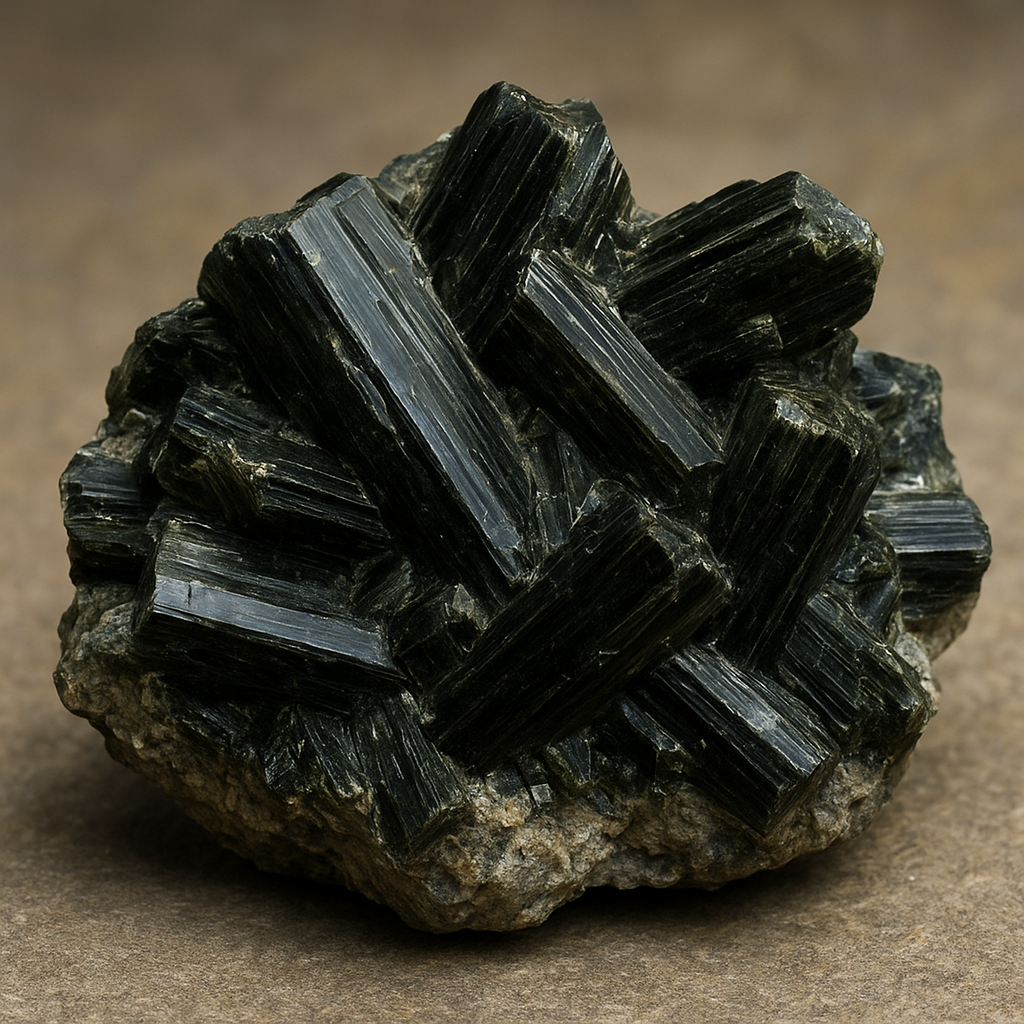
- Color: typically dark green, brownish green or black.
- Crystal habit: elongated, prismatic crystals or granular aggregates.
- Cleavage: two good cleavages intersecting at about 56° and 124° (a diagnostic amphibole angle).
- Hardness: about 5–6 on Mohs scale.
- Specific gravity: moderate (≈2.9–3.4), depending on Fe/Mg content.
- Optical behavior: marked pleochroism in thin section, moderate birefringence and variable extinction angles under cross-polarized light.
Hornblende contains structural hydroxyl (OH) groups; this makes it a water-bearing mineral. That hydrous component strongly influences the stability of hornblende in magmas and metamorphic reactions, and makes the mineral a key indicator of volatile budgets in geological systems.
Where hornblende occurs
Hornblende is widespread and appears in a variety of geologic environments. Because it forms over a broad range of temperatures, pressures and chemical compositions, its presence can point to important geological processes.
Igneous rocks
In igneous settings, hornblende is common in intermediate to mafic compositions where magmas are relatively water-rich. Typical igneous host rocks include:
- Andesites and dacites in volcanic arcs (subduction-related systems).
- Basalts and basaltic andesites where water and alkalis permit amphibole stability.
- Gabbros and diorites in intrusive bodies, especially where magmas crystallized slowly and retained volatiles.
Hornblende is especially abundant in volcanic arcs such as the Andes and the Cascades because subduction introduces water and other volatiles into the overlying mantle wedge, promoting amphibole-bearing magmas. In plutonic rocks, hornblende may be an early or intermediate crystallizing phase and can be critical in determining magma evolution by removing Fe, Mg and other elements from the melt.
Metamorphic rocks
Among metamorphic rocks, hornblende is a defining mineral for the amphibolite facies. Typical occurrences include:
- Amphibolites: Rocks derived from mafic protoliths that have been metamorphosed to amphibolite facies.
- Hornblende schists and gneisses: where calcium and aluminium allow amphibole to coexist with plagioclase and other phases.
- Contact metamorphic rocks (hornfels and skarns) produced where igneous intrusions chemically interact with carbonate-rich country rocks.
During regional metamorphism, hornblende forms under moderate to high temperatures and pressures, and its composition records the bulk chemistry of the protolith and the pressure‑temperature (P‑T) path experienced during metamorphism.
Surface and weathering environments
Hornblende is not as resistant to chemical weathering as some other mafic minerals (e.g., pyroxenes or olivine). It commonly alters to chlorite, clays and iron oxides at the Earth’s surface. The weathering products contribute to soil chemistry and the distribution of secondary minerals in saprolite and regolith.
Analytical and practical uses
Although hornblende is rarely a commodity mineral in the way that quartz or feldspar are, it has many uses for scientists and some indirect economic roles.
Petrology and geochemistry
Geologists exploit hornblende as a tool for interpreting magmatic and metamorphic histories. Several practical applications include:
- Geothermobarometry: Because amphiboles incorporate elements sensitive to pressure and temperature, calibrated chemical relationships allow hornblende compositions to be used to estimate crystallization P‑T conditions in magmatic and metamorphic rocks.
- Trace-element partitioning: Hornblende preferentially hosts elements such as Ti, Al and rare earth elements (REE) under some conditions, so its presence affects the evolving chemistry of magmas.
- Argon geochronology: Amphiboles can be dated by K–Ar or Ar–Ar methods to determine cooling ages of plutons and metamorphic terranes, although they are sometimes susceptible to argon loss, so interpretations require care.
- Hydrous history of magmas: The OH in hornblende makes its presence and breakdown reactions key to understanding the volatile budget of magmas, degassing behavior and eruption style.
Economic geology and ore deposits
Hornblende itself is not typically an ore mineral, but it plays an important role in ore-forming systems. For example:
- Skarn deposits: Hornblende commonly forms in calcareous rocks altered by intrusions; skarns can host significant concentrations of metals such as copper, tungsten, iron and gold.
- Indicator mineral: In some hydrothermal systems, the presence and chemistry of hornblende can mark fluid compositions and temperature gradients relevant to mineralization.
Materials and collectors
Specimens of well-crystallized hornblende are valued by mineral collectors and museums for their distinctive dark prismatic crystals. Rare translucent pieces with attractive green tones may be cut as collectors’ stones, but hornblende is not a widely used gemstone because transparency and clarity are typically poor. In industrial terms, hornblende does not have large-scale applications because it breaks down during processing and is present in mixed mineral aggregates rather than as a pure commodity.
Identification and microscopy
In the field, hornblende is often recognized by its color, crystal habit and the characteristic amphibole cleavage angles. In petrographic microscopes, hornblende exhibits important optical characteristics:
- Pleochroism: Distinct color changes when the stage is rotated, often from green to brown to nearly colorless in thin section.
- Interference colors and birefringence: Moderate, though lower than many feldspars and micas.
- Extinction and cleavage traces: Cleavage at ~56°/124° is visible and can be diagnostic under cross-polarized light.
Electron microprobe and X-ray diffraction analyses are commonly used for precise composition and structural characterization. Such data allow classification within the amphibole group and tie mineral chemistry to tectonic and petrologic interpretations.
Geologic significance and interesting connections
Hornblende is more than a descriptive mineral: it acts as a recorder of processes deep within Earth and of surface‑to‑subsurface interactions. A few especially interesting aspects are:
Water transport and volcanic behavior
Because hornblende is hydrous, its breakdown during heating or decompression releases water and can promote melt production or explosive volcanic behavior. The presence of hornblende in arc magmas is often taken as evidence that magmas inherited volatiles from subducted slabs or hydrated mantle sources. Conversely, hornblende stability limits mark compositional and volatile thresholds that control whether magmas erupt effusively or explosively.
Metamorphic P–T histories
In metamorphic terranes, the chemistry of hornblende can be used to reconstruct pressure-temperature paths, which helps geologists unravel tectonic histories such as continental collision, subduction and mountain building. Variations in aluminum, sodium and calcium in hornblende often reflect changes in pressure, whereas iron-magnesium ratios can signal temperature shifts and redox state.
Amphiboles and health considerations
The amphibole group includes several fibrous species that were historically mined and used as asbestos, with recognized health hazards. Hornblende, in the sense used by geologists for dark, non-fibrous amphiboles, is normally not the hazardous fibrous type associated with asbestos-related disease. Nevertheless, when dealing with finely divided or friable amphibole-bearing rocks it is prudent to follow modern safety guidelines for dust control and sampling to minimize inhalation risks.
Field examples and global distribution
Hornblende-bearing rocks are found on every continent. Some typical geological settings and examples (generalized) include:
- Volcanic arcs (e.g., Andesitic suites of convergent margins) where amphibole-bearing andesites and pyroclastics are abundant.
- Plutonic complexes where hornblende-bearing diorites and gabbros form part of the intrusive suite.
- Regional metamorphic belts (e.g., amphibolite-facies terrains within orogenic belts) containing hornblende gneisses and amphibolites.
- Skarn zones adjacent to intrusions in carbonate terranes, commonly hosting hornblende formed by metasomatic reactions.
These widespread occurrences mean that hornblende is a routine component of many geologic maps and petrologic studies, used as a visible marker for particular rock types and processes.
Practical identification tips and cautionary notes
For students and field geologists trying to identify hornblende, some practical tips:
- Look for the characteristic cleavage angle (~56°/124°) rather than assuming all dark minerals with a prismatic habit are hornblende.
- Check for pleochroism in thin section; hornblende’s color changes with orientation are striking compared with many other dark minerals.
- Consider whole-rock context: hornblende is more likely in intermediate magmas or in amphibolite-facies metamorphic rocks than in high-silica, water-poor granites.
- Avoid equating dark color with hornblende alone — biotite, pyroxene and opaque oxides can be confused in hand sample without cleavage or optical evidence.
When analyzing hornblende compositions, be aware that the informal name conceals compositional diversity. For precise scientific work, classification according to systematic amphibole nomenclature is recommended, and analytical tools like electron microprobe analysis give the detail needed for rigorous geothermobarometry and petrogenetic interpretation.
Closing observations
Hornblende is a versatile and informative mineral. Though it rarely has direct industrial value, it occupies a central role in understanding magmatic and metamorphic systems because of its chemical flexibility and its incorporation of volatile components. From indicating the history of mountain belts to recording the water content of magmas that fuel volcanic eruptions, hornblende remains a vital subject of study in modern geology and petrology.