
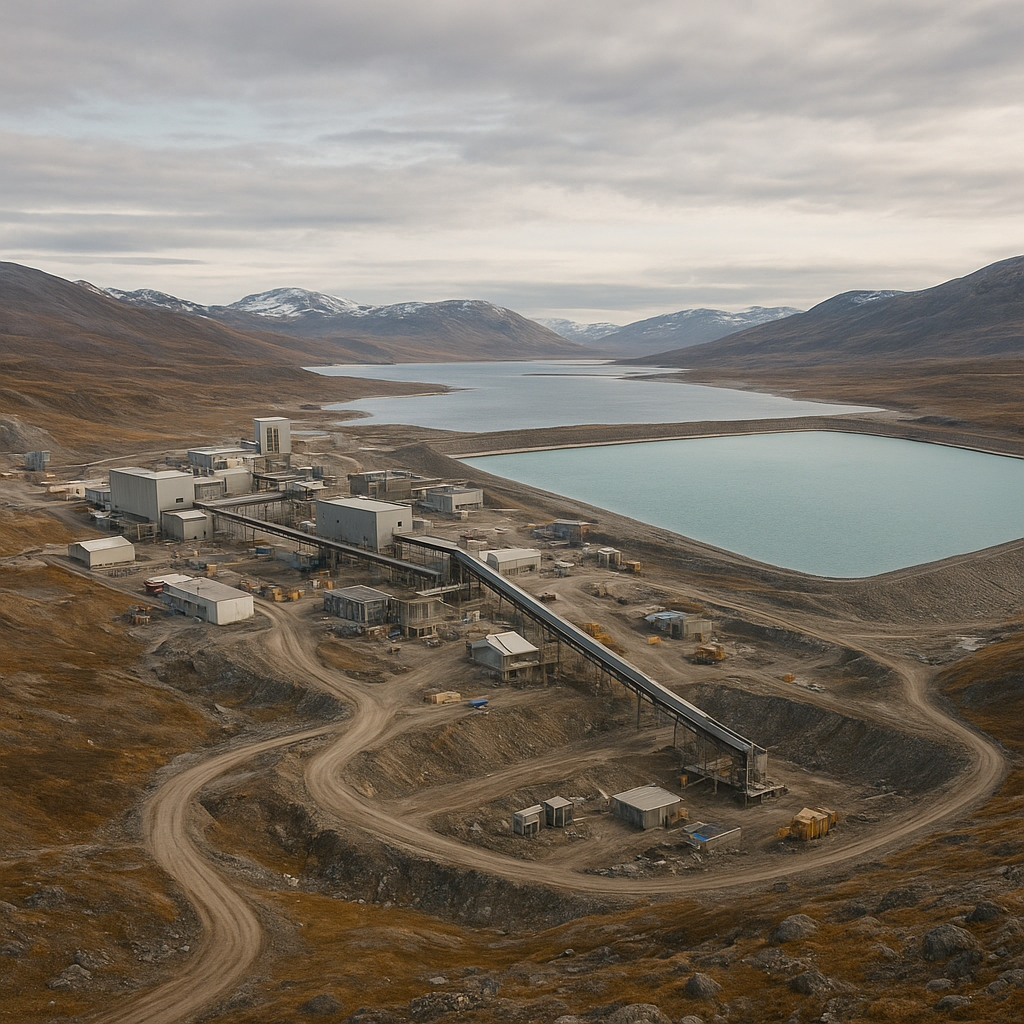
The Hope Bay mine complex is one of Canada’s most remote and intriguing gold projects, located in the high Arctic where geology, logistics and community relations come together in a challenging operating environment. This article describes where Hope Bay sits on the map, what is produced there, why the project matters economically, and several striking or unexpected facts about mining in one of the northernmost gold districts in the world. The narrative highlights the geological setting, the main deposits and mining methods, the role of local communities, and the environmental and technical adaptations required to work in the Arctic.
Location and geological setting
Hope Bay is situated in the western part of the Kitikmeot region of Nunavut, on the mainland coast of the Canadian Arctic. The project occupies a classic northern greenstone belt that hosts multiple gold-bearing zones within Archean-age volcanic and intrusive rocks. The area is remote: access is primarily by air, with seasonal ice roads and marine resupply possible in favorable summers. The region’s geology is an important reason the site is mined — it contains a concentration of structurally controlled, vein-hosted gold deposits typical of orogenic gold systems.
The deposits within the Hope Bay district form part of a contiguous mineralized corridor. Among the best-known deposits are the Doris, Boston and Madrid zones, each displaying its own structural and lithological complexity. Mineralization is commonly expressed as discrete veins, shear-hosted shoots and stockwork zones with free-milling gold, which allows conventional milling and gravity recovery processes to be effective. The presence of coarser visible gold in some shoots has required careful metallurgical planning to avoid nugget effect and to maximize recovery.
Key geological characteristics
- Vein- and shear-hosted gold in metamorphosed volcanic and sedimentary sequences, typical of greenstone belts.
- Structural controls — faults, folds and shear zones concentrate mineralization into mineable shoots.
- Variable continuity and nuggety distribution in places, requiring detailed infill drilling and selective underground mining methods.
- Permafrost and shallow overburden in places influence both geology mapping and engineering design.
The local name for the mineralized corridor is often referred to by geologists as the Hope Bay Greenstone Belt. Understanding the structural framework has been critical to delineating resources and planning underground development and stopes that are both safe and economically viable.
Mining operations and what is produced
The primary product of Hope Bay is gold. Mining methods at the site combine surface and underground approaches depending on the deposit geometry. In places where mineralization outcrops or lies near surface, open-pit mining has been used; for high-grade, deeper shoots, underground mining using longhole stoping and cut-and-fill methods are common. Ore is processed on-site in a conventional mill that typically includes crushing, grinding, gravity concentration and carbon-in-pulp or similar leach circuits, followed by smelting or shipment of concentrates according to the operator’s flowsheet.
Because the deposits often contain coarse gold, careful metallurgical design and mill operation are necessary to limit losses and maximize payable metal. Mobile and modular processing components have been employed in the past to adapt capacity seasonally or to support multiple deposits across the property. Ore handling, tailings management and water use are engineered to operate reliably in freezing conditions and to meet regulatory standards.
Logistics of running a northern mine
- Most personnel arrive by fixed-wing aircraft and use on-site lodges and camp facilities. Fly-in/fly-out rotations are common.
- Bulk fuel and heavy equipment are delivered by sealift during the short Arctic summer when sea lanes are navigable, and by winter ice roads when available.
- Reliance on diesel generation is typical, although efficiency measures and renewable options are increasingly explored.
- Cold-climate engineering — heated buildings, insulated pipelines and permafrost-aware foundations — is integral to operations.
Production tonnages fluctuate based on the stage of mine life, the number of active deposits and development rates. The economic life of a mining complex like Hope Bay is extended by drilling success and the addition of satellite deposits, which can be tied into existing mill and infrastructure to improve returns.
Economic significance and regional impacts
Hope Bay plays several important economic roles. At the most immediate level it creates jobs — both direct positions at the mine and indirect employment in logistics, contracting and services. For remote northern communities, these jobs can represent a major portion of local employment opportunities beyond traditional subsistence activities. Mining projects in the Arctic also generate government revenues through royalties and taxes, and they stimulate investment in local infrastructure such as airstrips, communications and emergency services.
Benefit agreements with Indigenous groups are a central component of modern northern mining projects. These agreements cover a range of commitments:
- Training programs and employment targets for local residents, including specialized trade and technical roles.
- Business development opportunities for local suppliers and contractors.
- Compensation and revenue sharing, depending on the legal and negotiated framework.
- Community investment in education, health and cultural initiatives.
Beyond direct community benefits, the Hope Bay project contributes to the broader Canadian mining sector by advancing Arctic mining expertise. Techniques developed to address permafrost, remote logistics and sensitive environmental conditions are transferrable to other northern projects. The mine also supports regional economic diversification by creating skilled labor pools and encouraging associated service industries.
Environmental management and social responsibility
Operating in a fragile northern ecosystem requires careful environmental stewardship. Permafrost and short growing seasons mean that disturbance can persist for decades without appropriate reclamation. Modern practice at the Hope Bay project emphasizes minimization of footprint, robust water treatment, and progressive reclamation where feasible.
- Tailings and water management systems are designed to prevent contamination, account for freeze-thaw cycles, and limit effects on fish and wildlife.
- Baseline environmental studies and ongoing monitoring of air, water and soil quality are standard practice, often with third-party oversight.
- Wildlife management plans address potential impacts on migratory species, caribou herds and marine life along resupply corridors.
- Community engagement is continuous, with mechanisms for local input on environmental performance and mitigation measures.
Social responsibility also encompasses cultural sensitivity. Project operators typically work with Inuit organizations to respect land use, traditional knowledge and subsistence activities. Incorporating Traditional Ecological Knowledge (TEK) into environmental assessments and monitoring can lead to better outcomes and stronger community relationships.
Interesting facts and practical challenges
Several features of the Hope Bay project set it apart from more conventional mining operations further south:
- Remoteness: The site is accessible only by air for most of the year, and resupply windows are short, tightly coordinated and weather-dependent.
- Seasonal extremes: Extended periods of darkness in winter and continuous daylight in summer affect operations, logistics and workforce scheduling.
- Cold-climate engineering: Buildings and infrastructure require specialized foundations to deal with permafrost thaw and frost heave.
- Unique wildlife interactions: Operations must plan for encounters with polar bears and migratory species, including deterrents and safe wildlife handling procedures.
- Historical continuity: The region has a history of periodic exploration and small-scale mining dating back decades, which has shaped the modern understanding of the district.
One practical challenge is the management of workforce well-being in an isolated environment. Camp life, shift rotations and mental health supports are essential components of a responsible operation. Another is cost: Arctic logistics add a significant premium to capital and operating costs, which must be offset by higher grades or efficient project design.
Exploration potential and future outlook
Hope Bay remains an active exploration and development district because its geology is favorable for additional discoveries. The combination of multiple deposits within trucking distance of a common mill, plus unexplored or under-explored targets along strike and at depth, gives operators options to extend mine life. Exploration techniques — from high-resolution geophysics to deep drilling and advanced structural interpretation — are widely used to chase new shoots and connect known resources.
Beyond pure exploration, improvements in northern infrastructure — such as enhanced shipping, regional air hubs or electrification — could materially improve project economics. Technological advances in remote monitoring, automation and energy efficiency also have the potential to lower costs and environmental footprints. Continued partnership with local and Indigenous communities will be critical to the social license that underpins any long-term expansion or new development.
Selected technical and community features
- Mining methods: A mix of open pit and underground mining tailored to deposit geometry and grade distribution.
- Processing: On-site milling with gravity and leach components to handle coarse and fine gold fractions.
- Infrastructure: Airstrip, winter ice roads and seasonal sealift, plus camp and mill complexes designed for Arctic conditions.
- Community engagement: Employment targets, training, Inuit participation, and culturally appropriate consultation frameworks.
- Mitigation measures: Water treatment, progressive reclamation, wildlife plans and permafrost-aware engineering.
In summary, the Hope Bay mining complex represents a compelling intersection of rich gold endowment, demanding operating conditions and significant socio-economic implications for northern Canada. Its continued development depends on successful exploration, efficient logistics, environmental care and strong partnerships with local communities — elements that together define modern mining in the Arctic.

