
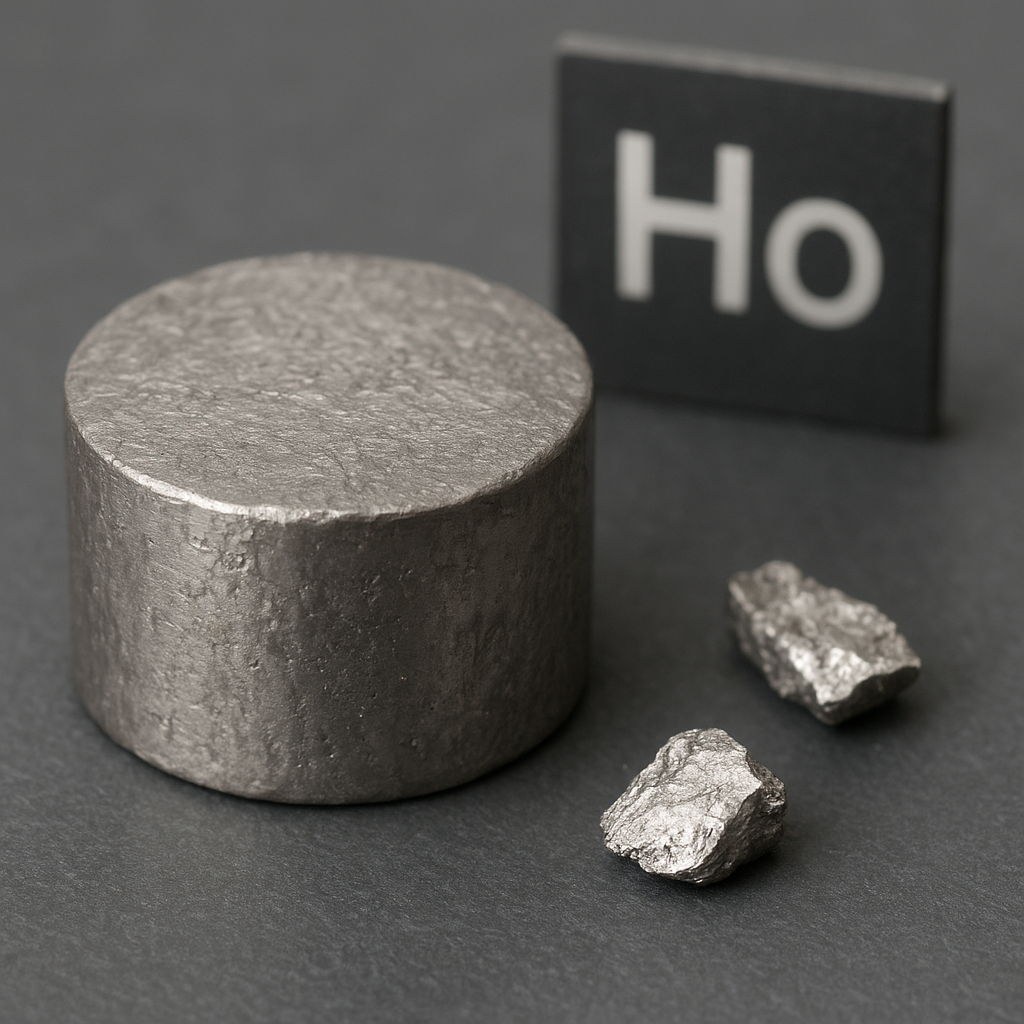
Holmium is a member of the lanthanide series whose unique combination of atomic and magnetic properties has made it a subject of interest across multiple scientific and industrial fields. This article explores where holmium is found, how it is extracted and processed, its principal and emerging applications, and several intriguing facts that connect it to medical therapies, advanced materials, and cutting-edge physics research. The text highlights practical uses as well as the fundamental reasons why this element continues to attract attention from chemists, physicists, and engineers.
Geological Occurrence and Extraction
Holmium occurs naturally only in combination with other rare-earth elements and is never found as a free element in nature. It is commonly associated with minerals such as monazite, bastnäsite, and xenotime. These minerals are mined in sedimentary and igneous deposits worldwide, with notable production concentrated where heavy rare-earth-bearing ores are exploited.
Typical extraction of holmium follows the general pattern used for other rare-earth elements: mineral mining, physical concentration, and chemical separation. After crushing and chemical digestion of ore, rare-earth elements are separated by processes such as solvent extraction and ion-exchange chromatography. Because the lanthanides are chemically similar, achieving high-purity holmium requires careful fractional separation.
- Primary mineral hosts: monazite, bastnäsite, and xenotime.
- Separation methods: solvent extraction, ion-exchange chromatography, and sometimes fractional crystallization.
- Global supply: dominated by countries with large rare-earth processing industries; geopolitical factors influence availability and pricing.
The concentration of holmium in the Earth’s crust is low compared with common metals, which is why it is categorized among the rare-earth elements despite not being exceptionally scarce in absolute terms. Environmental and social issues associated with rare-earth extraction—tailings management, radioactive waste from thorium-containing ores, and local ecosystem disruption—are important considerations in the holmium supply chain.
Physical and Chemical Properties
Holmium has atomic number 67 and belongs to the lanthanide series. In its metallic form it is a silvery, relatively soft metal that oxidizes slowly in air. Chemically, holmium behaves like other lanthanides, commonly adopting a +3 oxidation state in compounds. Its electronic configuration and unpaired 4f electrons give holmium pronounced magnetic characteristics.
Among the notable properties are:
- Strong paramagnetism and a very high magnetic moment per atom compared with many other elements, which makes holmium valuable in magnetic applications.
- One stable isotope, isotope 165Ho, which can be converted into radioactive isotopes by neutron activation.
- Characteristic spectral lines in the visible and ultraviolet range, useful in spectroscopy and calibration of optical instruments.
Holmium’s exceptional magnetic moment arises from its 4f electrons. This property is exploited in specific magnetic alloys and in scientific research that investigates exotic magnetic phases and dipolar interactions. Its absorption of neutrons and behavior under irradiation are relevant to its use in isotope production and some nuclear applications.
Industrial and Technological Applications
Although holmium is not a high-volume commodity like iron or copper, it has several high-value applications that leverage its magnetic, optical, and nuclear characteristics.
Lasers and Optics
Holmium-doped crystals and glasses are widely used as active media in solid-state lasers. The holmium-doped yttrium aluminum garnet (Ho:YAG) laser operates at wavelengths around 2.1 micrometers and is especially important in medical and industrial contexts. Its wavelength is strongly absorbed by water and tissue, which enables controlled cutting, ablation, and lithotripsy.
- Medical use: Ho:YAG lasers are standard in urology for lithotripsy (breaking kidney stones) and in soft-tissue surgical procedures because of precise energy absorption and shallow penetration depth.
- Materials processing: the laser wavelength can be effective for specialized cutting and welding where absorption by specific materials is advantageous.
Magnetic Materials and Cryogenics
Some of holmium’s most interesting applications derive from its magnetic properties. Holmium forms strong magnetic alloys such as holmium-cobalt and is used in materials where large magnetic moments or specific low-temperature magnetic behaviors are needed. In permanent magnet research and specialty cryogenic magnets, holmium-containing materials are sometimes employed to achieve tailored magnetic performance.
Nuclear and Radiopharmaceutical Applications
Because natural holmium can be converted into radioactive isotopes by neutron capture, it plays a role in medical and research contexts. Radiation-emitting isotopes such as holmium-166 are produced by irradiating holmium-165 in a reactor. Holmium-166 is a beta emitter with gamma emissions useful for imaging and has been investigated and applied in treatments such as targeted radionuclide therapy and radioembolization for liver tumors.
- Production route: neutron activation of 165Ho to produce 166Ho.
- Therapeutic use: 166Ho microspheres have been developed for internal radiotherapy where localized beta radiation destroys tumor tissue while allowing imaging of biodistribution via gamma emissions.
Electronics, Magnets, and Alloys
Holmium is used as a minor component in specialized alloys and magnetic materials. Alloys with cobalt and other transition metals can display useful magnetic anisotropy or high coercivity at low temperatures. These properties support niche uses in sensors, research magnets, and magnetic refrigeration experiments.
Metrology and Calibration
Because holmium exhibits sharp spectral lines, it finds use as a calibration standard in spectrophotometry and optical instrument testing. Its emission lines help qualify instruments across ultraviolet and visible ranges.
Medical Uses and Safety Considerations
Holmium’s medical relevance is twofold: as a component of surgical lasers and as a radionuclide for therapy. Ho:YAG lasers are routinely used in hospitals for minimally invasive procedures. Separately, 166Ho-based radiopharmaceuticals enable localized delivery of beta radiation to tumors, a promising approach in interventional oncology.
Safety and toxicity must be considered differently for metallic holmium, common chemical compounds, and radioactive isotopes. Metallic holmium and stable holmium compounds are of relatively low chemical toxicity when handled appropriately, but as with many heavy elements, inhalation or ingestion of powder should be avoided. For neutron-activated isotopes like 166Ho, radiological safety protocols are mandatory: shielding, handling procedures, and waste management follow strict regulations because of beta and gamma emissions.
Research Frontiers and Interesting Facts
Holmium is not just an industrial curiosity—its intrinsic properties have made it valuable in advanced scientific research.
- Quantum gases: ultracold atomic physics groups have cooled holmium atoms to quantum degeneracy, creating Bose-Einstein condensates and studying long-range dipolar interactions. The element’s large magnetic dipole moment opens avenues for exploring novel quantum phases and many-body physics.
- Fundamental magnetism: the complex magnetic ordering exhibited by some holmium compounds provides insights into frustrated magnetism and spin textures that interest condensed-matter physicists.
- Spectral fingerprinting: holmium’s unique spectral lines help astronomers and laboratory spectroscopists identify and calibrate emission and absorption features.
Historically, the element’s name comes from the Latin name for the city of Stockholm, Holmia, reflecting the Scandinavian connections of its early research and isolation. The lanthanides, including holmium, were all teased apart and identified in the late 19th and early 20th centuries through careful spectral and chemical studies.
Environmental and Economic Considerations
While holmium itself is used in relatively small quantities, its production is tied to the broader rare-earth industry, which raises several important environmental and economic questions. Processing rare-earth ores can generate acid wastes and radioactive residues from thorium and uranium present in some deposits. Proper remediation, recycling, and the development of more sustainable extraction methods are active areas of policy and technical development.
The economics of holmium are also shaped by supply-chain dynamics: because rare-earth separation and refining are concentrated in specific regions, geopolitical factors can influence availability and price volatility. Recycling of rare-earth-containing devices and improved extraction from low-grade deposits are strategies to diversify supply.
Practical Tips and Future Directions
For practitioners and researchers interested in working with holmium:
- Choose suppliers that provide detailed purity and impurity profiles, particularly if the application is in lasers or medical isotopes where contaminants can affect performance or safety.
- In medical applications, coordinate with nuclear medicine and radiation-safety professionals when using activated holmium isotopes; dosimetry and clearance protocols are essential.
- For environmental assessments, account for the lifecycle impacts of rare-earth extraction and pursue recycling where feasible.
Looking to the future, continued advances in quantum materials, more sophisticated radiotherapeutic agents, and evolving optical technologies may increase the demand for holmium in niche but high-value roles. Its combination of optical, magnetic, and nuclear properties ensures that holmium will retain scientific relevance across multiple disciplines.