
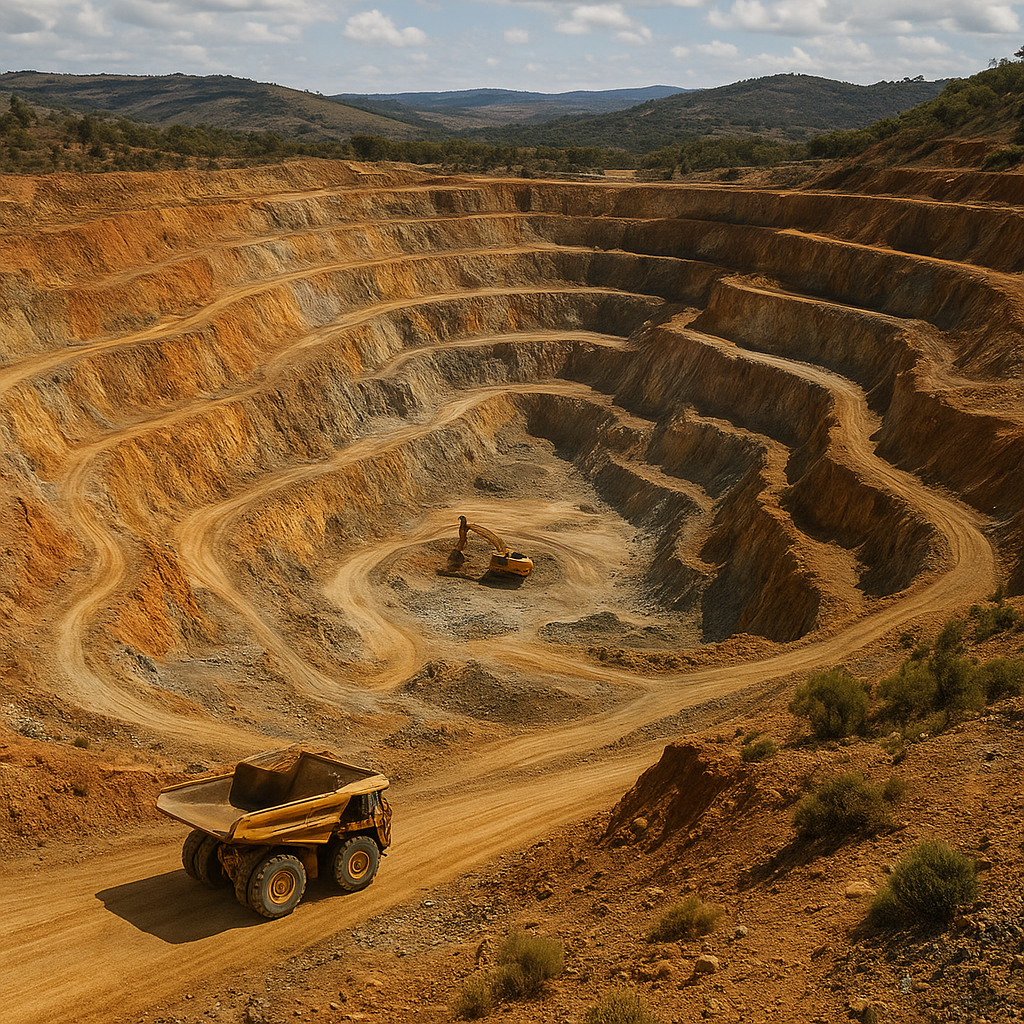
The Hillgrove Mine, perched in the highlands of northern New South Wales, is a notable example of an Australian site where two economically and strategically important commodities — antimony and gold — are produced from the same geological system. Its history weaves together nineteenth-century prospecting, twentieth-century industrial cycles and twenty‑first-century shifts in global demand for critical minerals. The site combines complex geology, evolving mining and processing techniques, and important local economic effects, while also raising modern concerns about environmental management and heritage preservation.
Location and regional context
Hillgrove is situated in the New England Tablelands of northern New South Wales, roughly east of Armidale and within the watershed of the eastern Great Dividing Range. The mine lies in a rural, elevated landscape characterised by rolling hills, farm country and patches of native forest. Its relative proximity to regional service centres means it functions as a significant local employer and point of industrial activity in what is otherwise an agricultural region.
Accessibility and infrastructure
- The mine is accessed by a network of local roads connecting to regional highways. The available transport routes support the movement of heavy machinery and bulk concentrates to smelters or export facilities.
- On-site or nearby infrastructure historically has included ore-processing facilities, workshops, and tailings storage; in some periods ore concentrate was trucked to ports for export.
- Because Hillgrove is located inland, logistics for export require coordinated road and port transport, adding to the cost structure compared with coastal operations.
Geology and the nature of the deposit
The Hillgrove deposit is a polymetallic hydrothermal system. Mineralisation occurs predominantly in vein networks and steeply dipping lodes where sulphide-rich fluids deposited metals into open fractures and fault zones. The most valuable minerals in the system include stibnite (antimony sulphide), gold-bearing sulphides, and other associated sulphides such as arsenopyrite, pyrite and lesser amounts of other metals.
Mineral associations and ore characteristics
- Antimony is commonly present as stibnite (Sb2S3), which forms needle-like crystals and dense sulphide veins. Stibnite is the primary source mineral for antimony extraction.
- Gold often occurs either as free native gold within quartz veins or associated with sulphide minerals that require flotation or gravity separation to liberate it during processing.
- The ore is typically variable in grade and mineralogy, with high-grade shoots interspersed with lower grade halos. This variability influences both mining method and economic feasibility.
Formation and geological setting
The deposit formed through hydrothermal activity related to deep-seated tectonic processes associated with the structural complexity of the New England Orogen. Mineral-laden fluids migrated along faults and fractures, precipitating metal-rich veins when conditions (temperature, pressure, chemistry) changed. This geological model explains the often-irregular distribution of high-grade zones, requiring detailed exploration and selective mining to maximise recovery.
Mining history and operational methods
Hillgrove’s mining story stretches back to the 19th century when prospectors first exploited visible veins of gold and antimony. Over time, operations have shifted between underground workings and open-cut excavations depending on the depth, orientation and width of ore bodies, as well as prevailing economic circumstances. Mining techniques have evolved alongside improvements in geology, engineering and environmental regulation.
Underground and surface mining techniques
- In narrow, high-grade veins, conventional underground methods such as cut-and-fill or shrinkage stoping have been employed to extract ore while limiting dilution.
- Where the ore occurs in broader zones nearer the surface, small open pits and benching techniques have been used to recover lower-grade but bulkier ore bodies.
- Mine planning tends to blend selective stoping to preserve grade with bulk mining where economies of scale are necessary to process lower-grade material profitably.
Processing and metallurgical flowsheet
Processing polymetallic ore requires a combination of physical and chemical methods to separate valuable minerals from gangue. Typical flowsheets for Hillgrove-style ore include:
- Crushing and grinding to liberate minerals from host rock.
- Gravity concentration to recover coarse free-milling gold where present.
- Flotation circuits to produce concentrates rich in antimony (stibnite) and associated sulphides.
- Roasting or smelting of antimony concentrates at specialised facilities to produce antimony metal or antimony oxide; gold is recovered to bullion or concentrate depending on metallurgical choices.
Because antimony and gold have very different metallurgical behaviours, processing plants must be flexible, combining routes that maximise recovery of both commodities while controlling costs and environmental impacts.
Economic importance and market role
Hillgrove’s significance extends beyond local employment to wider economic and strategic considerations. Antimony, in particular, is considered a critical mineral for many industrial applications, and gold retains its long-standing economic value as both an industrial metal and financial asset.
Antimony: an industrially strategic metal
- Antimony is used in flame retardants, lead-acid battery alloys, bearings, solder and certain semiconductor and military applications. Its scarcity in primary supply chains has led many governments to monitor its security of supply.
- As global demand for flame retardants, battery materials and speciality alloys grows, producers like Hillgrove contribute to diversification of supply outside the major producers in China and other jurisdictions.
- Antimony concentrates produced at Hillgrove typically require shipping to smelters capable of producing antimony metal or oxide, and the economic value depends on both concentrate grade and global price cycles.
Gold: revenue stabiliser
Gold mined at Hillgrove can act as an important revenue stabiliser for the operation. Because gold prices are generally high relative to base metals, even modest gold by-product credits can improve the project’s economics. Sales of gold can provide liquidity and offset periods when antimony prices are weak.
Local and regional economic impacts
- Employment: Mining and processing operations create direct jobs on-site and indirect employment in services, transport and maintenance.
- Supplier networks: Local contractors, equipment suppliers and logistics firms benefit from ongoing activity.
- Royalties and taxes: Revenue flows to state and federal treasuries through royalties, corporate tax and payroll taxes, with some portion often reinvested into regional infrastructure.
- Community investment: Some mining companies invest in local community projects, education and heritage conservation as part of corporate social responsibility programs.
Environmental management and community relations
Mining at Hillgrove, like anywhere, requires careful management of environmental risks and engagement with the local community, including landholders and Indigenous groups. The environmental footprint includes mine pits and underground voids, tailings storage facilities, water usage and potential chemical residues from processing.
Key environmental considerations
- Tailings and waste rock: Effective design, monitoring and rehabilitation of tailings storage facilities are essential to prevent erosion, seepage and contamination.
- Water management: Control of surface runoff and groundwater interaction is critical to avoid transporting dissolved metals off-site. Treatment systems may be required to remove suspended solids and metal species.
- Dust and air quality: Crushing, hauling and processing activities generate dust; mitigation includes dust suppression systems and staged rehabilitation.
- Rehabilitation: Progressive rehabilitation of disturbed areas reduces long-term liabilities and can restore agricultural or ecological values to the land once mining ceases.
Social licence and heritage
Community acceptance—often called the social licence to operate—is maintained through transparent consultation, employment opportunities for local people and protection of cultural heritage sites. Indigenous heritage values need recognition and, where necessary, careful management to avoid damage to archaeological or sacred places. Successful community engagement often includes ongoing reporting, local procurement and targeted social investment.
Notable technical and historical features
Historical legacy
Hillgrove has a layered history of exploration and intermittent production. Early operations in the late 19th and early 20th centuries established the area as one of Australia’s more important antimony-producing centres at times, and old workings, adits and heritage structures provide a tangible link to that era. These remnants can be both an attraction and a responsibility, as heritage conservation sometimes needs to be balanced with ongoing resource extraction.
Mining challenges and technical ingenuity
The polymetallic nature of the deposit poses metallurgical and mining challenges that have required innovative approaches. Variable ore grades, the coexistence of sulphide minerals and brittle stibnite veins demand selective mining and careful processing. Companies operating in such contexts invest in detailed geological modelling, trial processing circuits and staged production to optimise recoveries of both ore and by-products.
Interesting mineralogy
Mineralogically, sites like Hillgrove can yield well-formed stibnite crystals and specimens that attract collectors. The coexistence of antimony and gold creates unusual textures in polished sections and hand samples, offering both scientific interest and educational value to students of economic geology.
Future prospects and strategic relevance
The long-term prospects for Hillgrove depend on several interlinked factors: commodity prices (particularly for antimony and gold), the quality and extent of remaining mineral reserves, the cost of extraction and processing, and evolving policy settings related to critical minerals. Global moves to diversify supply chains for battery and specialty metal inputs have increased interest in deposits that can provide alternative sources of antimony.
Opportunities
- Exploration upside: Detailed drilling programs can identify extensions of known lodes and satellite zones that add to mine life.
- Technological improvements: Advances in flotation reagents, gravity circuits and smelting technologies can improve recoveries and reduce costs.
- Strategic demand: If industrial demand for antimony grows, particularly for applications linked to energy or defence, operations like Hillgrove become more valuable.
Constraints and risks
- Price volatility: Antimony markets can be volatile and are strongly affected by global supply dynamics, meaning profitability can swing significantly.
- Environmental regulation: Increasingly stringent environmental standards can raise operational costs and require capital for mitigation and rehabilitation.
- Logistics: Inland location imposes transport costs for concentrate export, and access to specialised smelters for antimony processing can be a limiting factor.
Why Hillgrove matters — broader perspectives
Beyond the immediate financial returns, Hillgrove represents a microcosm of modern resource development where geology, technology, community expectations and geopolitics intersect. The mine’s contribution to local economies, its role in diversifying supply for a critical metal and the technical lessons gleaned from processing polymetallic ores all offer enduring value. In an era when governments and industries are increasingly focused on securing resilient supply chains for strategic materials, operations that can responsibly produce antimony alongside precious metals have renewed relevance.
As mining continues to evolve, Hillgrove’s combination of historical legacy, geological interest and contemporary economic function makes it a compelling case study for students, industry practitioners and policy-makers interested in the sustainable development of mineral resources.

