
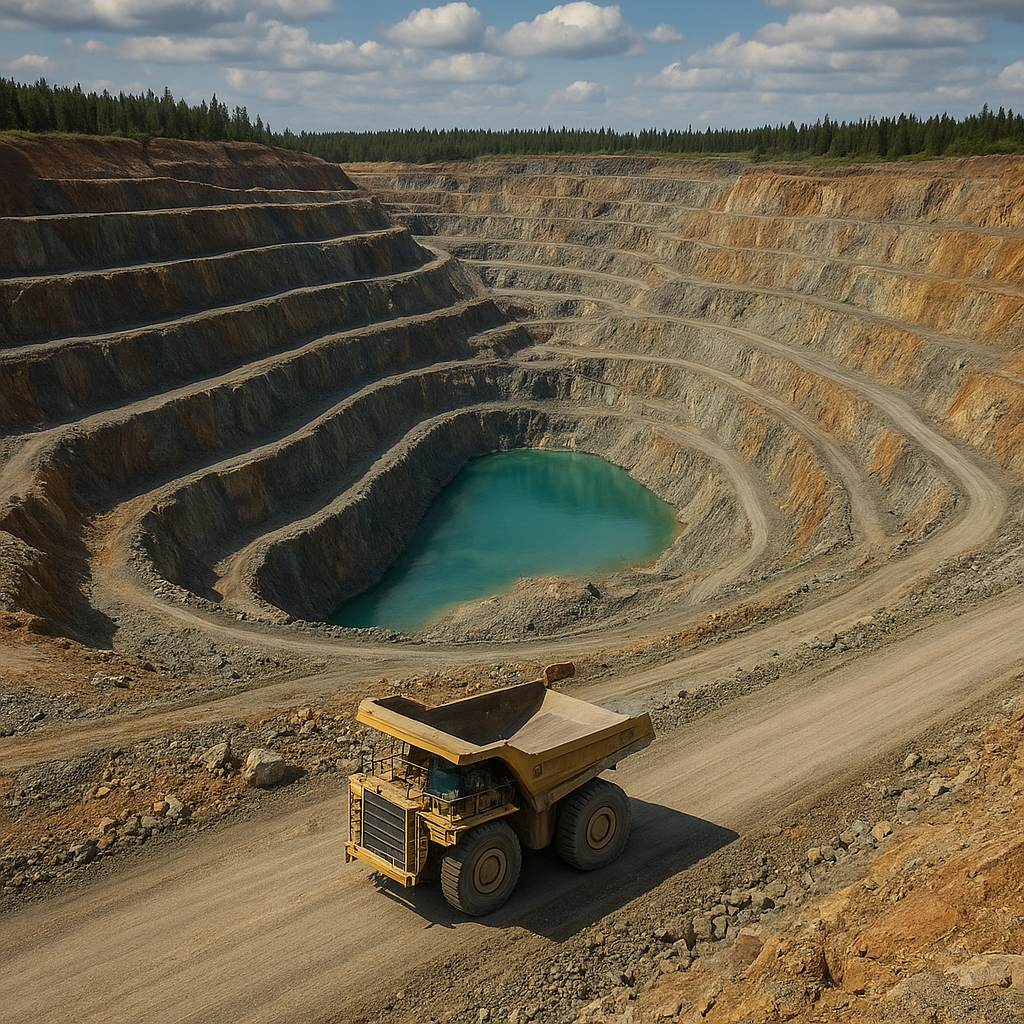
The Hemlo mine stands as one of the notable gold mining stories in Canada: a discovery that transformed a relatively remote region of northern Ontario into a focal point for exploration, extraction and local economic development. Located near the north shore of Lake Superior, the Hemlo deposits yielded significant quantities of precious metal, prompted rapid investment and infrastructure growth in the 1980s and 1990s, and left a legacy that still shapes how mining projects in the region are perceived and managed. This article examines the mine’s location and geology, its mining history and production, the economic importance for the surrounding communities and broader Canadian mining sector, and several lesser-known or especially interesting aspects of Hemlo’s story.
Location and geological setting
The Hemlo gold deposits are situated in the Canadian province of Ontario, on the northern shore of Lake Superior, in a region widely accessed from the small town of Marathon and connected by the Trans‑Canada Highway. The area is part of the larger Superior Province of the Canadian Shield, where ancient Archean rocks host numerous mineral deposits. Hemlo’s gold mineralization occurs within structurally controlled quartz veins and altered host rocks typical of many greenstone‑belt orogenic gold systems.
Geologically, Hemlo can be characterized as an orogenic gold occurrence developed in a complex package of volcanic and sedimentary rocks that experienced multiple deformation and metamorphic events. Hydrothermal fluids migrated through fault zones and fractures, depositing gold along with associated sulfides (often including pyrite and other accessory minerals). The structural controls and repeating vein systems created several stacked or parallel ore shoots, making the deposit amenable to both open pit and underground methods at different times during its life.
Access to the Hemlo area is relatively simple by Canadian standards: paved highway links and proximity to the shore of Lake Superior allowed both transport of heavy equipment and shipment logistics for supplies and concentrates. The physical remoteness, however, still demanded onsite accommodation and services for workers and required mining companies to invest in local power, water and road upgrades.
Mining history and production
The Hemlo discovery was part of a late‑20th‑century exploration surge in Ontario. After initial prospecting and systematic exploration drilling, commercial mineralization was confirmed and development moved forward. Over the course of its operational life, the Hemlo complex produced significant volumes of gold and associated silver, supplying bullion and concentrates to domestic and international markets.
Operations at Hemlo evolved through several stages: initial surface exploration and pre‑production development, construction of milling and processing facilities, and then an extraction phase that combined both surface (open pit) and underground techniques depending on the geometry and depth of ore. Ore processing typically involved crushing, grinding and chemical extraction methods—often flotation followed by cyanidation for gold recovery—together with rigorous ore grade control and metallurgical testing to optimize yields.
Although production varied year to year as resources were delineated and mined, Hemlo’s output placed it among the more important Canadian gold producing complexes of its era. The mine operated at a scale sufficient to require a permanent processing facility and a workforce numbering in the hundreds during peak periods. Like many major discoveries, Hemlo’s visible success spurred follow‑up exploration both along strike and in adjacent greenstone belts, attracting capital and attention to the Canadian Shield.
Economic significance and regional impact
The Hemlo mine delivered multiple layers of economic benefit. For the nearest communities, including Marathon and neighboring townships, the mine created direct employment in trades, operations, and professional services, as well as indirect jobs in accommodation, transport, catering and retail. Payroll and contractor spending helped sustain small businesses and supported municipal revenues. Infrastructure improvements—upgraded roads, power extensions and enhanced communications—benefited residents and later industrial activity.
At the provincial and national levels, Hemlo contributed taxes, royalty streams and export earnings. The sale of gold produced at the site fed domestic refinery and mint circuits, helping Canada maintain a competitive mining-export profile. Investment in Hemlo also reinforced the role of Ontario as a globally recognized mining jurisdiction, encouraging further capital inflow for exploration projects across the province.
Beyond purely financial measures, the mine played a role in workforce development. Many employees received specialized training in underground mining, metallurgical processing and environmental management—skills that transferred to other projects and helped cultivate a regional labour pool with mining expertise. Community partnerships, procurement of services from local suppliers and donations or sponsorships of civic projects were common ways the mining presence extended its economic influence.
Technology, processing and environmental management
From the outset, Hemlo operated with technology and engineered systems appropriate to its orebody and era. Ore was processed in a mill that applied comminution (crushing and grinding), physical separation and chemical leaching to maximize recovery. Metallurgical programs were central: understanding how gold occurred—free gold vs. refractory gold locked in sulfides—determined whether simple gravity separation sufficed or whether more complex flotation and cyanide leaching circuits were required.
Environmental management was an essential component of Hemlo’s operations. Tailings management, water treatment and progressive reclamation were implemented to reduce impacts on local ecosystems. Firms involved in the Hemlo project monitored surface water and groundwater, controlled dust and managed waste rock to minimize acid generation potential. Over time, regulatory expectations tightened and best practices evolved; operators invested in improved water treatment systems, lined tailings facilities and post‑closure landform design to meet contemporary environmental standards.
Engagement with Indigenous communities and other local stakeholders became increasingly important during the Hemlo era. Consultation processes, employment initiatives and benefit agreements were part of the social license discussion, and many modern mines build on lessons learned from Hemlo and similar projects to foster better partnerships and long‑term community benefits.
Interesting facts and legacy
The history of Hemlo includes several aspects that are compelling beyond the basic production statistics. The discovery itself renewed interest in the mining potential of the Lake Superior shore and catalyzed a wave of exploration that extended into adjacent greenstone belts. Hemlo demonstrated how a single meaningful discovery could rapidly change the economic prospects of a remote area.
- Exploration momentum: The Hemlo discovery led to renewed exploration campaigns in the region and attracted capital from both domestic and international investors interested in gold prospects.
- Mining styles: The deposit’s combination of near‑surface and deeper shoots provided a case study in switching between open‑pit and underground mining methods as economic and geologic conditions dictated.
- Labour and skills: Many miners and technical specialists trained at Hemlo subsequently worked across Canada’s mining industry, spreading practical knowledge and operational experience.
- Environmental lessons: Hemlo’s tailings management and closure planning contributed to the evolution of environmental practice in Canadian mining, particularly in northern settings with sensitive aquatic systems.
Another intriguing angle is how Hemlo fit into the broader cycles of gold markets. Periods of strong gold prices justified rapid development and higher production rates, whereas price troughs often led to scaled‑back operations or temporary shutdowns. This dynamic illustrated the commodity‑price sensitivity of mines and underscored the economic importance of cost control, efficient processing and robust reserve estimates.
Social dimensions and community relations
One often overlooked part of Hemlo’s story is the human and social dimension. For local communities, the mine presented both opportunities and challenges. Jobs and local contracts boosted incomes and business activity, but the transient nature of some mining employment and the boom‑and‑bust potential demanded careful municipal planning. Housing availability, health and social services, and long‑term economic diversification became topics of local debate.
Companies operating in the Hemlo area invested in community relations efforts—sponsoring local events, supporting education and participating in infrastructure planning. Over time, regional stakeholders and operators developed frameworks for consultation with Indigenous groups and for collaborative approaches to workforce training and local procurement. These are now seen as important elements of sustainable mining practice.
Continuing relevance and what makes Hemlo interesting
Decades after initial production, Hemlo remains a reference point in Canadian mining history for several reasons. It stands as an example of a high‑quality discovery in a mature mining province that nonetheless yielded unexpected riches. The mine illustrated how geological insight, persistent exploration and timely investment can unlock significant mineral resources even in well‑studied regions.
Several elements make Hemlo particularly interesting:
- Strategic discovery: Hemlo’s identification in a known mining region shows that frontier exploration can still succeed near established districts when new structural or geochemical interpretations are applied.
- Operational adaptability: The shift between mining methods and the responsiveness to metallurgical challenges highlighted operational flexibility and engineering problem‑solving.
- Economic ripple effects: Beyond the mine itself, Hemlo stimulated spending, employment and secondary industries—an example of mining as a catalyst for broader regional development.
- Legacy in best practices: Hemlo’s environmental and social experiences helped shape later expectations for stakeholder engagement, rehabilitation planning and monitoring in northern mining projects.
In a broader sense, Hemlo exemplifies how a single mineral discovery can change geological thinking, economic prospects and community trajectories. Its story is not just about ounces extracted, but about the interplay of geology, engineering, economics and society that characterizes modern mineral projects.
Closing observations
While mines like Hemlo eventually move to closure and reclamation phases, their influence remains long after active extraction ceases. For the region around Marathon and the north shore of Lake Superior, Hemlo provided employment, infrastructure and a legacy of technical expertise. For the mining sector, it remains a case study in successful exploration, adaptive mining operations and the evolving nature of environmental and community responsibilities. The Hemlo complex thus occupies a notable place in Canada’s mining narrative—an emblem of opportunity, challenge and enduring significance for both local communities and the wider industry.
Key themes to remember about Hemlo include its role as a major gold producer in Canada, the geological setting within the Superior Province, and the social and economic effects that flowed from the discovery and subsequent production. The mine’s history also highlights the importance of responsible environmental management and meaningful community engagement—lessons that remain relevant for contemporary and future mining projects.
Finally, the Hemlo story continues to captivate because it blends the romance of discovery with the practical realities of running a modern mine: the technical complexities of ore processing, the human dimensions of workforce and community, and the broader economic forces that govern resource development. That intersection is what makes Hemlo more than a point on a map—it makes it a significant chapter in the ongoing history of mineral resources in northern Ontario.

