
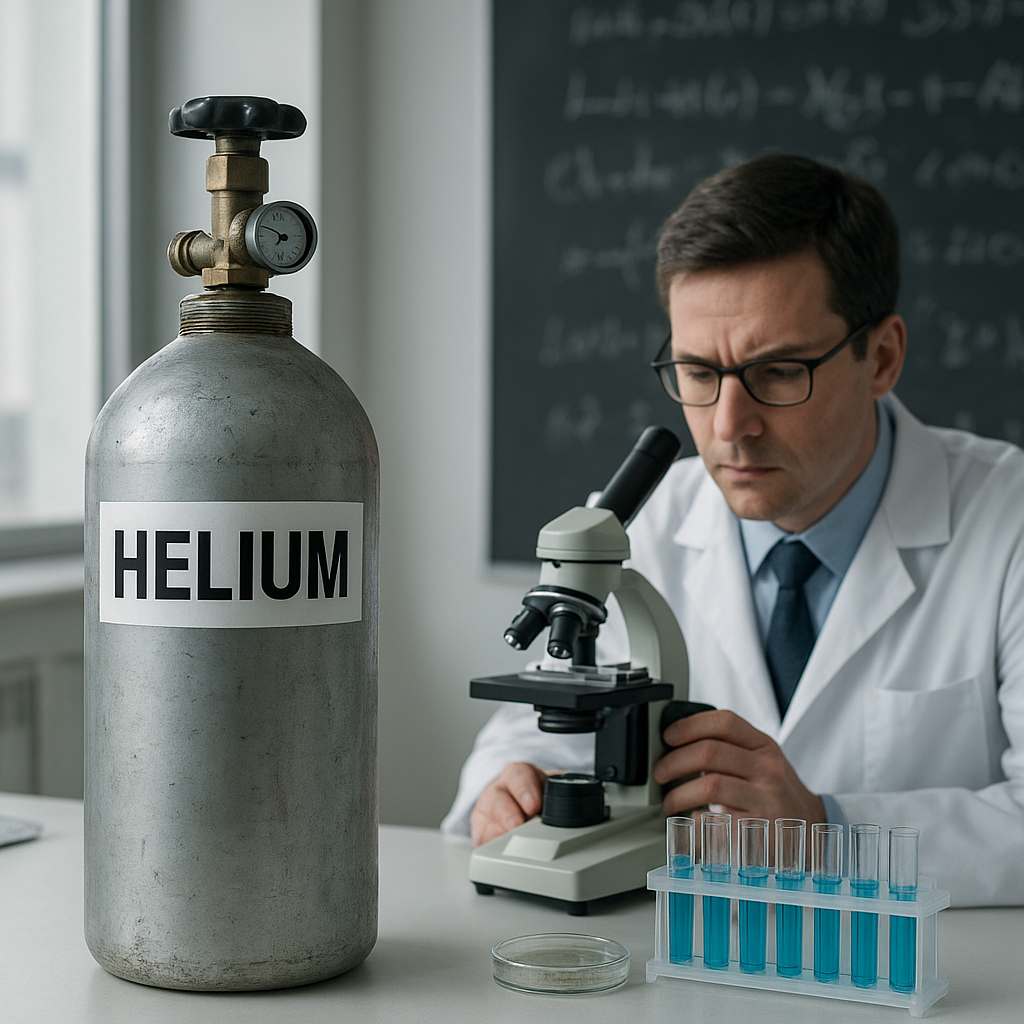
The dwindling availability of helium represents a growing challenge for laboratories, hospitals and high-tech industries that rely on its unique physical properties. This inert noble gas is indispensable for applications ranging from MRI scanners to particle accelerators, and its scarcity has cascading effects on experimental schedules, operating budgets and long-term planning. Understanding the drivers of supply constraints and the practical responses available to the scientific community is essential for minimizing disruption and preserving the pace of research and technological development.
The nature and causes of helium scarcity
Helium is produced primarily as a by-product of the radioactive decay of heavy elements in the Earth’s crust and is commonly extracted from natural gas deposits where it has accumulated in sufficient concentration. Unlike many industrial gases, helium cannot be synthesized economically and is effectively a finite, non-renewable resource once released to the atmosphere. Several interrelated factors create and amplify periods of shortage:
- Geological limits and concentration: Economically recoverable helium occurs only in specific extraction sites and concentrations above a threshold, limiting the number of viable producers.
- Market structure and geopolitics: A few regions and companies dominate global production, so export controls, operational outages or policy shifts in major suppliers can cause wide price swings and availability problems.
- Logistics and storage: Transporting helium requires specialized high-pressure cylinders, cryogenic tanks and secure supply chains. Losses during handling and long-term storage are nontrivial and increase effective scarcity.
- Demand growth: Expanding uses in healthcare, electronics manufacturing and scientific research have raised baseline consumption, occasionally outpacing new investments in recovery and production capacity.
- Industrial and policy decisions: Historically, governments or corporations that controlled strategic helium reserves sometimes sold or repurposed supplies without long-term stewardship, leading to future shortfalls.
The combination of these factors means that shortages are not solely a function of geological scarcity but also of market dynamics, infrastructure and policy choices. Helium’s unique low-boiling-point and chemical inertness make it indispensable in forms and applications that have few perfect substitutes, which magnifies the consequences when supply tightens.
Effects on research and laboratory operations
Research communities feel the impact of helium scarcity across multiple dimensions. Laboratories using helium for cooling, inert atmospheres or analytical techniques must either secure reliable procurement channels or adapt experimental designs. Key effects include:
- Operational disruption: Delays in acquiring cryogens can stall long-term experiments, interrupt cryogenically-cooled instruments and force rescheduling of critical measurements.
- Increased costs: Price spikes translate directly into higher operating budgets for academic departments, hospitals and small companies that lack bulk purchasing power.
- Equipment availability and maintenance: Devices such as superconducting magnet systems and dilution refrigerators require steady helium replenishment. A shortage can shorten instrument uptime, increase maintenance intervals and raise risks of magnet quench or damage.
- Research direction and planning: Limited helium access may bias project selection toward experiments that are less helium-dependent, potentially delaying breakthroughs in low-temperature physics and quantum electronics.
- Training and human resources: Students and technicians face interrupted training schedules or must learn to operate alternative systems, affecting workforce development in specialized fields.
Specific sectors illustrate the significance of these effects. Cryogenics-based physics research, for example, depends on liquid helium to reach millikelvin regimes. Medical imaging centers rely on helium to maintain superconducting magnets in MRI scanners; a sustained shortage can force hospitals to limit scanning capacity or invest in expensive alternatives. Semiconductor fabrication and space science instruments often use helium as a carrier or purge gas; supply interruptions can delay production runs and satellite testing.
Mitigation strategies and technological alternatives
Faced with recurrent shortages, research industries and suppliers have pursued multiple mitigation strategies that reduce consumption, improve resilience and stimulate innovation. Important approaches include:
- Conservation and leak prevention: Rigorous testing, improved seals and inventory controls reduce losses. Proactive maintenance and helium-use audits help facilities lower their baseline consumption.
- Recycling and recovery systems: Closed-loop recovery units capture boil-off helium from magnet systems and return it to high-pressure storage after purification. Many large facilities and hospitals now install on-site recovery to cut dependency on delivered liquid helium.
- Adoption of cryocoolers: Mechanical cryocoolers such as pulse-tube or Gifford-McMahon systems enable superconducting devices to operate without large volumes of liquid helium, though they may add complexity and cost and are not suitable for all temperature regimes.
- Alternative process designs: Researchers redesign experiments to use helium only where strictly necessary, substituting nitrogen or vacuum insulating techniques for some low-temperature applications where feasible.
- Strategic procurement and reserves: Institutions form consortia to negotiate spot and long-term contracts, and some governments maintain strategic helium reserves to dampen price shocks.
- Policy and international cooperation: Coordinated policies on reporting reserves, investing in extraction infrastructure and enabling cross-border trade can make supply more predictable.
While these responses mitigate immediate pressure, they also highlight the need for continued investment in infrastructure and engineering. Recovery systems reduce net demand but require up-front capital and expertise; cryocoolers avoid liquid helium dependence but introduce vibration and maintenance considerations that can affect experimental sensitivity.
Case studies, economic impacts and the path forward
Historical episodes demonstrate how shortages reverberate across research industries. Supply disruptions in the late 2000s and mid-2010s, driven by production outages and shifts in national policies, caused price volatility that forced many institutions to adopt helium recovery or delay investments. In some countries, laboratories reported postponed experiments, and hospitals delayed non-urgent imaging procedures during acute supply constraints.
Economically, helium scarcity raises both direct and indirect costs. Direct costs include higher procurement expenses and capital outlays for recovery infrastructure. Indirect costs manifest as delayed publications, slower commercialization cycles for high-tech products and the opportunity cost of reallocated research funds. Smaller research groups and developing-country institutions are disproportionately affected because they lack the purchasing power or facilities to implement large-scale mitigation systems.
Looking forward, several trends will shape how the research ecosystem adapts to long-term helium constraints:
- Investment in recovery and liquefaction infrastructure will expand as organizations seek to insulate themselves from market volatility.
- Innovations in cryogen-free technologies, including more efficient cryocoolers and superconductors that operate at higher temperatures, will reduce reliance on liquid helium for some applications.
- Expanded extraction from unconventional sources and improved global coordination could increase supply, but these options require regulatory clarity and commercial incentives to scale responsibly.
- Enhanced emphasis on policy measures — such as transparent reserve reporting and export agreements — can stabilize markets and encourage investments in both extraction and conservation.
- Cross-sector collaboration among universities, industry and governments will be crucial to develop standardized recovery technologies and funding models that enable broad adoption.
Ultimately, the interplay between geophysical limits, market behavior and technological response will determine how effectively the research sector navigates helium scarcity. Prioritizing conservation, investing in recovery, and driving innovation in alternative cooling and instrument design can preserve scientific capability while reducing vulnerability. The choices made now by policymakers, facility managers and researchers will influence the availability of this critical resource for decades to come.
