
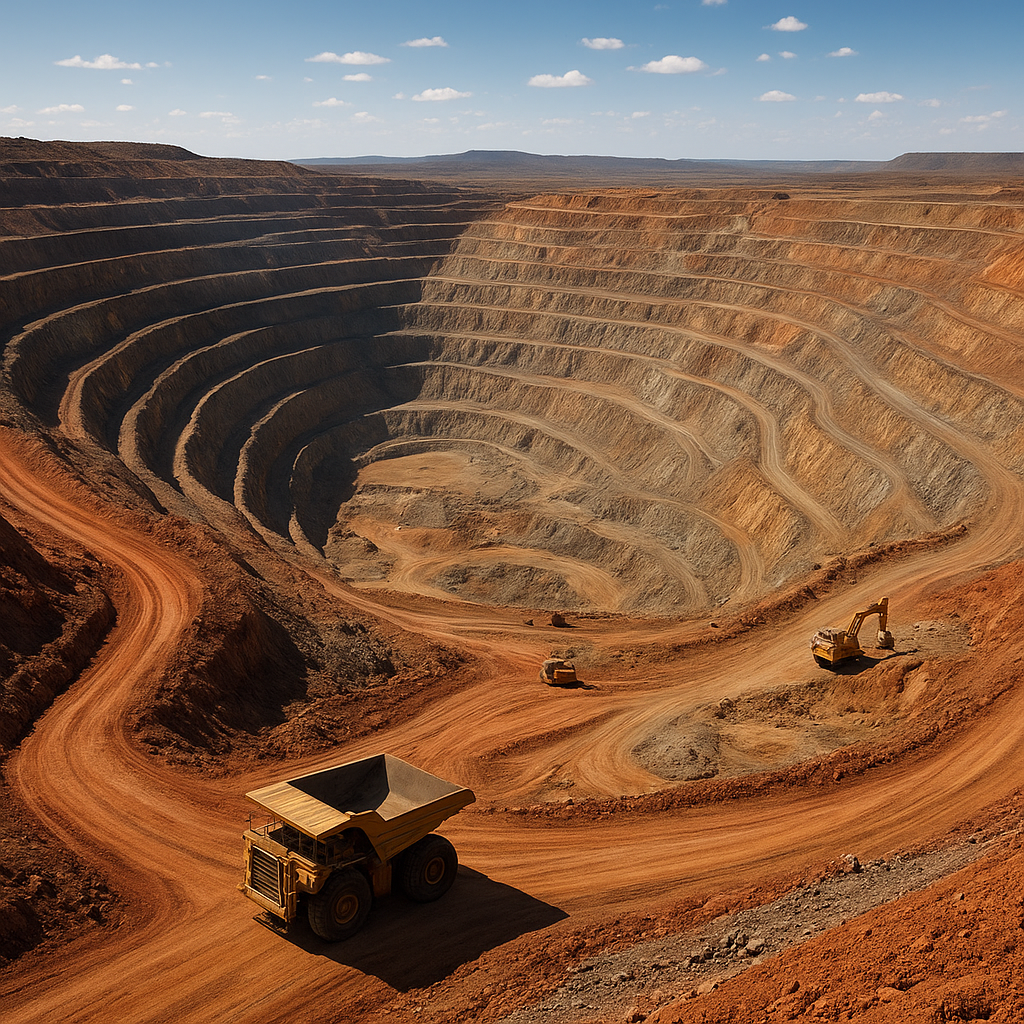
The Harmony Kusasalethu Mine is one of the notable operations within South Africa’s long-standing gold-mining tradition. Located in the heart of the Witwatersrand Basin, the mine combines deep underground extraction, contemporary processing technology and a complex social and economic footprint. This article explores where the mine is situated, what is produced there, its role in the regional and national economy, and a selection of intriguing technical, historical and social elements that give Kusasalethu its particular character.
Location and geological context
Kusasalethu lies in the western portion of the Gauteng province, near the town of Carletonville and to the west of the city of Johannesburg. It is positioned within the world-famous Witwatersrand Basin, a geological formation that has been the epicentre of global gold production for well over a century. The basin’s layered conglomerates and quartz pebble seams host the gold-bearing reefs that mines in this region exploit.
The regional geology is characterized by multiple stacked reefs, variable ore grades and complex structural disruptions such as faults and dykes. These conditions have driven South African mining toward deep-level underground techniques, which are required to access ore that lies several hundreds to a few thousand metres below surface in many parts of the basin. Kusasalethu’s position in this basin places it within a continuum of historic and modern mines that collectively shaped South Africa’s mineral economy.
What is produced and how
The primary product at Kusasalethu is gold, recovered from underground ore through a sequence of mining, crushing, milling and chemical extraction. Mining at Kusasalethu is primarily underground and uses a variety of methods tailored to local ground conditions and reef geometry. Typical methods include mechanised stoping and other selective extraction techniques that balance resource recovery with ground stability and safety concerns.
Ore extracted from the working faces is transported to on-site processing facilities where it undergoes comminution (crushing and grinding) followed by gravity and cyanide leach processes to recover fine gold. The processing circuit combines traditional and modern metallurgical practices to maximise recovery while managing reagent use and tailings volumes. Tailings are handled in containment facilities and engineered storage facilities consistent with regulatory and corporate standards.
Infrastructure and shafts
- Vertical and decline shafts provide access to the underground workings and are essential for personnel movement, material transport and ventilation networks.
- Hoisting systems lift ore and waste rock to surface where processing begins; declines and conveyors support flexible logistics underground.
- On-surface infrastructure includes mills, cyanide detoxification, water treatment, workshops and administrative buildings.
Economic significance
Kusasalethu contributes to both local livelihoods and the national economy in several ways. On the immediate level, the mine is an employer of a significant workforce drawn from the surrounding towns and rural areas. Beyond direct employment, the operation supports a network of contractors, suppliers, transport operators and service providers that amplify its economic impact. This multiplier effect is characteristic of large-scale mining operations in South Africa, where a single mine sustains many secondary businesses and jobs.
At the regional level, revenues from sales of gold generate foreign exchange and support fiscal revenues through taxes, royalties and licensing fees. The presence of the mine also stimulates investment in roads, electricity links and water infrastructure which can benefit neighboring communities. Corporate social investment programs, local procurement initiatives and training schemes further tie mine performance to community welfare and skills development.
From a national perspective, operations like Kusasalethu reinforce South Africa’s standing as a historic and still meaningful gold producer. While global production patterns have shifted and costs at deep-level mines can be high, the cumulative output from Witwatersrand mines remains an important element in South Africa’s mining portfolio. Investments in mechanisation, automation and improved safety protocols also reflect broader industry efforts to sustain competitiveness despite challenging geology and rising operating costs.
Social and environmental aspects
Large mining operations inevitably raise social and environmental issues that require careful management. Kusasalethu has engaged in programs addressing housing, health, education and local procurement to mitigate negative impacts and promote shared benefits. Labour relations in South African gold mining are historically complex and periodically tense; maintaining stable, constructive engagement with unions and communities is a continuous priority for any operator.
Environmentally, the mine must manage water use and quality, tailings integrity, air emissions and land rehabilitation. Water is a critical resource in mining operations—both for processing ore and for dust suppression and other site needs—so treatment and recycling systems are commonly implemented to reduce freshwater withdrawals. Tailings storage facilities require rigorous geotechnical design and monitoring to guard against failure, and modern practice increasingly emphasises progressive rehabilitation and closure planning to ensure long-term land stability.
- Rehabilitation: plans typically include contouring, topsoil replacement and revegetation to restore biodiversity and prevent erosion.
- Water management: treatment plants and seepage control reduce downstream impacts on rivers and groundwater.
- Health and safety: deep-level mining poses risks such as rockfalls, seismicity and heat stress; extensive safety protocols and monitoring are used to mitigate these hazards.
Interesting technical and historical notes
Kusasalethu and neighbouring mines illustrate several fascinating aspects of modern and historical mining:
- Deep mining: Extracting ore at great depth requires integrated engineering solutions for ventilation, cooling, rock support and logistics. The technical ingenuity needed to sustain operations at depth is one of the defining features of South African gold mining.
- Seismicity: mining-induced seismic events are a recognized hazard in deep mines across the Witwatersrand. Mine design and real-time monitoring systems help manage seismic risk and protect workers and infrastructure.
- Technological transition: the industry has trended toward mechanisation and remote operation of equipment to improve safety and productivity. Automation of loading and haulage, along with digital monitoring of underground conditions, is reshaping how mines operate.
- Legacy: the Witwatersrand Basin, including areas around Kusasalethu, has produced an extraordinary proportion of the world’s historical gold. The cultural and economic imprint of this extraction is visible in regional settlement patterns, urban development and South Africa’s industrial heritage.
Community relations and corporate responsibility
For any major mine, fostering constructive relations with surrounding communities is essential. Programs typically include skills training, small-business development, support for schools and clinics, and targeted infrastructure projects. Harmony, as operator, often articulates corporate commitments to sustainable development, local employment and transformation—aiming to ensure that mining contributes positively to community welfare while recognising that the benefits must be managed alongside environmental protection and fair labour practices.
Local procurement policies can help small and medium enterprises gain stable contracts, while vocational training supports worker mobility both within and beyond the life of the mine. Mines also frequently partner with government entities and NGOs to scale up health, education and social services in mining-affected areas.
Challenges and future outlook
Looking ahead, Kusasalethu faces a suite of challenges common to mature deep-level gold mines: declining grades in some reefs, increasing depth and associated costs, and the need for continuous investment in safety and environmental controls. Market volatility in gold prices also affects profitability and investment decisions. Nevertheless, advances in mining technology, improved ore-sorting and processing techniques, and disciplined cost management can extend the economic life of operations.
Several strategic directions are likely to shape the mine’s near-term future: optimising underground layouts to reduce haulage distances, expanding mechanisation where feasible to boost productivity, upgrading processing circuits to improve recovery rates, and strengthening community partnerships to secure a social licence to operate. In the broader context, South Africa’s regulatory environment and energy supply reliability are national factors that influence the competitiveness and sustainability of deep underground producers like Kusasalethu.
Notable facts and snapshots
- Harmony Kusasalethu operates within a mining landscape that has defined modern South Africa’s industrial era.
- The mine exemplifies the engineering responses required to extract value from some of the deepest economically viable gold reefs on Earth.
- Its operations illustrate how extraction, processing and community engagement are interwoven in contemporary mining practice.
- Environmental stewardship and progressive rehabilitation planning are increasingly integral to the mine’s operating philosophy.
In sum, Kusasalethu represents a microcosm of the opportunities and complexities of deep gold mining in South Africa. From its geological roots in the Witwatersrand to the daily work of miners and engineers far below ground, the mine’s ongoing story is one of adaptation—balancing resource recovery, technological progress, social responsibility and environmental care in a sector that remains pivotal to the region’s economic history.

