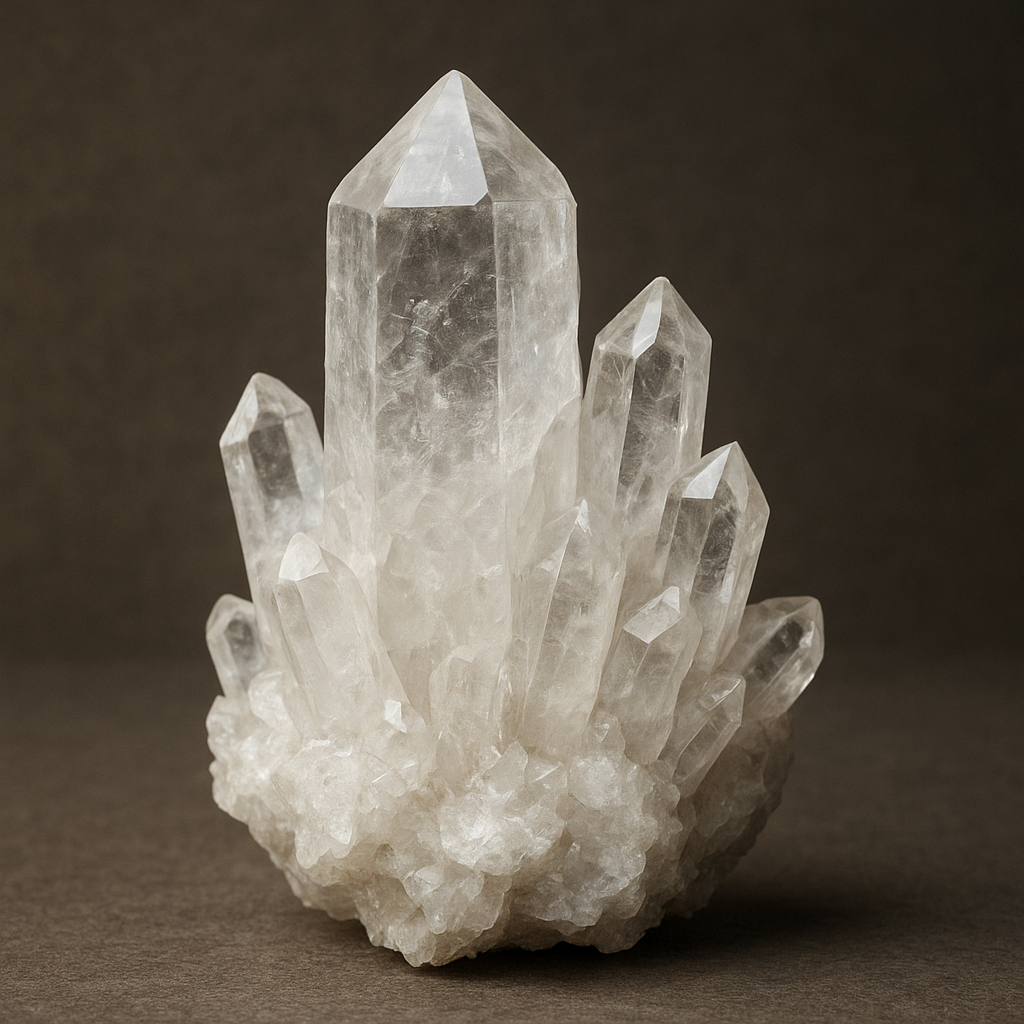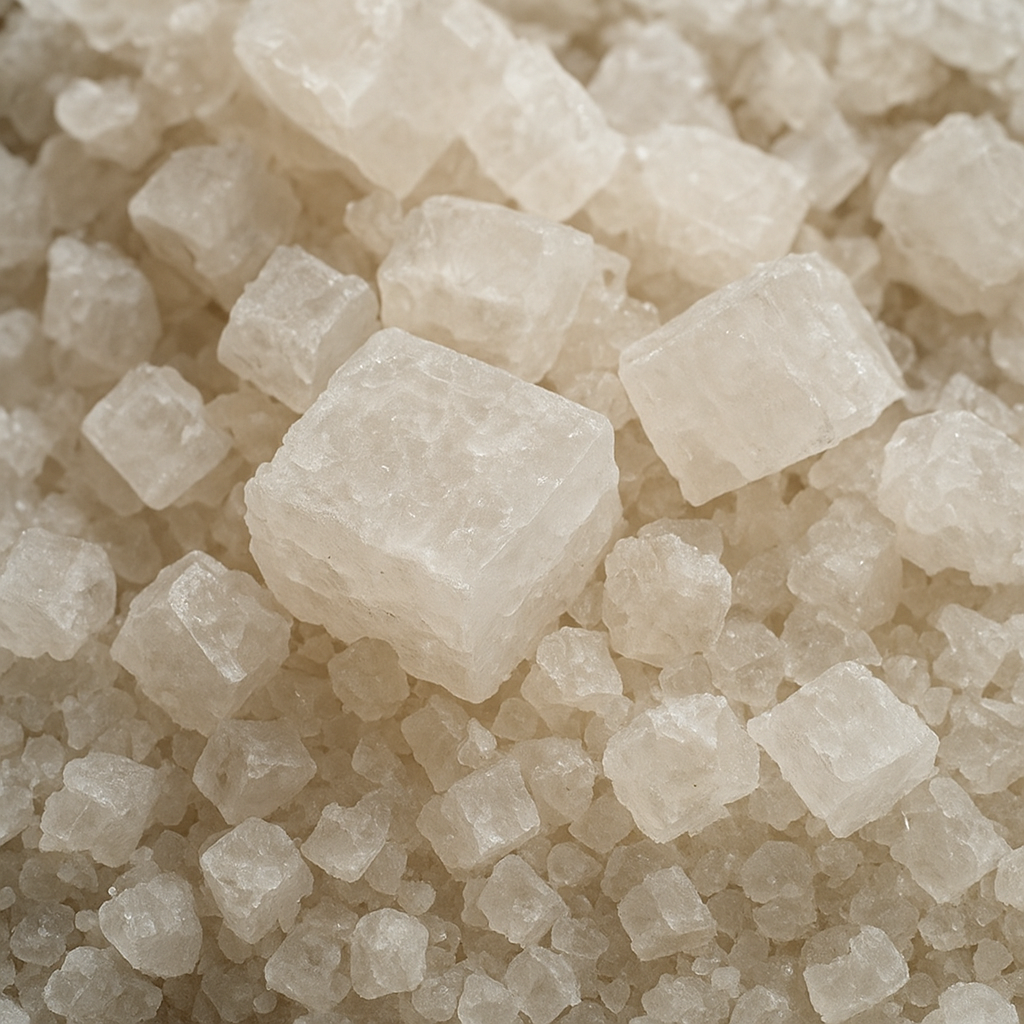
Halite, commonly known as rock salt, is a mineral that has shaped landscapes, economies and cultures for millennia. It is admired by geologists for its simple cubic crystals, studied by chemists for its role as the primary source of table salt, and utilized by engineers and municipalities for practical, everyday functions such as road maintenance. This article explores the mineral’s physical and chemical character, the geological environments where it forms and accumulates, the diverse ways humans extract and use it, and several intriguing natural and historical facets connected to this humble yet powerful substance.
Physical and chemical properties
At its core halite is crystalline sodium chloride, an ionic compound that crystallizes in the isometric system. Its most recognizable habit is perfect cube-shaped crystals and a tendency to cleave in three directions at right angles. Halite has a low Mohs hardness of about 2–2.5 and a relatively low specific gravity near 2.17, making it easy to scratch with a fingernail. Fresh, pure halite is transparent to translucent and colorless, although natural specimens often exhibit a range of colors—white, pink, red, blue, yellow or gray—due to trace impurities, inclusions of clay, iron oxides, or structural defects. The characteristic salty taste is a diagnostic property, although tasting minerals in the field should be done cautiously and only by experienced individuals.
Optically, halite is isotropic and has a refractive index of about 1.544. It dissolves readily in water and is highly soluble compared with many common minerals; this solubility is central to both its formation and the environmental challenges it can pose. Under the microscope or in hand-sample studies, one may observe complex growth patterns such as hopper crystals—stepped, skeletal cubes that form when the outer edges grow more rapidly than interiors—or chevron banding produced by repeated dissolution and reprecipitation.
Formation and geological settings
Halite is an evaporite mineral—one that forms through the evaporation of saline water. Large deposits originate in closed basins where evaporation exceeds inflow, concentrating salts until minerals precipitate. The classic sequence of evaporite precipitation begins with calcite and gypsum, followed by halite, and then more soluble chlorides such as sylvite (KCl) as concentration increases. Over geological time, repeating cycles of marine incursion and evaporation can lay down thick stacks of evaporite beds many meters to kilometers thick.
Evaporite basins and salt flats
Examples of surface and near-surface accumulations include coastal or continental playas and extensive salt flats like the Salar de Uyuni in Bolivia and the Bonneville Salt Flats in Utah. In these settings, halite forms crusts and nodules as shallow saline lakes evaporate seasonally, often producing spectacular flat expanses with polygonal surface patterns. Brine chemistry, climate variability and microbial mats can all influence the texture and purity of the precipitated halite.
Buried deposits, diapirs and salt domes
When buried under sediments, halite behaves as a ductile material under differential pressure, enabling it to flow on geological timescales. This leads to the formation of salt domes or diapirs—bulbous, upward-intruding bodies that pierce overlying strata. Salt domes are significant for structural geology and economic geology: the impermeable nature of salt makes domes excellent traps for hydrocarbons, and associated cavities often host accumulations of oil and gas. Large salt deposits in the Gulf of Mexico, the North Sea and parts of Russia are classic examples where diapirism plays an important role.
Where halite occurs worldwide
Halite is globally distributed wherever past or present evaporative conditions have existed. Notable occurrences include:
- The Permian Basin and North American salt beds—thick evaporite sequences formed in ancient restricted basins.
- The Dead Sea and the Great Salt Lake—modern hypersaline bodies with active halite precipitation and brine extraction industries.
- Salares like Uyuni and Atacama, where surface crusts of halite are prominent tourist and scientific sites.
- Wieliczka and Bochnia in Poland—historic rock salt mines with deep cultural significance and extensive subterranean chambers carved from halite.
- Salt domes along the Gulf Coast of the United States, which are associated with hydrocarbon accumulations and industrial usage.
Other important deposits occur across Europe, Central Asia, China and Brazil, reflecting the broad range of paleoenvironmental conditions that generate large halite beds. Surface halite is ephemeral in humid climates because of rapid dissolution, so extensive preserved deposits tend to reflect arid or buried settings that protect the salt from meteoric water.
Extraction and processing methods
Halite mining and extraction are tailored to deposit type and intended end use. Two principal methods dominate:
- Room-and-pillar mining: This traditional method is used for thick, near-surface rock-salt deposits. Miners carve extensive underground galleries leaving pillars of salt to support the roof. Famous tourist attractions like the Wieliczka Salt Mine in Poland are a legacy of this technique.
- Solution mining: Where salt beds are deeper or where subsurface integrity favors fluid extraction, brine is injected into the deposit to dissolve salt, and the resulting brine is pumped to the surface for processing. This method allows for the creation of large cavities but requires careful management of groundwater and subsidence risks.
After extraction, halite is typically crushed and refined for various uses. For edible salt, additional purification, iodization (where applicable) and granulation steps create table salt and industrial grades. Solar evaporation techniques are also used to produce salt from seawater or brines, especially in warm, arid coastal regions where evaporation ponds can yield large quantities of salt for chemical and food markets.
Major uses and applications
Halite’s uses are remarkably diverse, ranging from essential dietary mineral to industrial feedstock and civil engineering tool. Key applications include:
- Food and seasoning: The primary use of halite is as a source of edible salt—sodium chloride—essential for human and animal nutrition, flavoring, food processing and preservation.
- Chemical feedstock: Chloride ions and sodium are foundational in chemical industries. Electrolysis of brine produces chlorine and sodium hydroxide, precursors to PVC, solvents and numerous organic and inorganic chemicals.
- De-icing and road maintenance: Rock salt is widely applied to roads and sidewalks in cold regions to lower the freezing point of water, improving safety in winter. This application is one of the largest single uses of bulk halite globally.
- Water softening and treatment: Sodium chloride regenerates ion-exchange resins used in water softeners, helping remove calcium and magnesium ions that cause hardness.
- Oil and gas drilling: Brines and salt-based muds help stabilize boreholes and control pressure during drilling. Additionally, salt formations provide sites for underground storage of natural gas and hydrocarbons.
- Industrial processes: Halite is used in metallurgy (fluxing), tanning, textile dyeing and manufacturing processes that require chloride chemistry or controlled salinity.
- Recreational and therapeutic: Salt caves and spas use halite’s perceived therapeutic properties (halotherapy) and their microclimate for respiratory treatments, though clinical evidence varies.
Cultural, historical and economic significance
Salt has been central to human history. The value of salt extended far beyond nutrition; it was a commodity, a form of taxation and sometimes currency. Ancient trade routes—sometimes called salt roads—transported halite across continents, giving rise to cities and influencing geopolitics. The Roman Empire maintained extensive saltworks, and the term “salary” derives from payments to soldiers often made in salt or money for salt.
Mining sites such as the Wieliczka Salt Mine not only produced an essential resource but also became cultural landmarks, with chapels and carvings hewn from halite. In some societies, salt symbolizes purity and hospitality; in others, control of salt resources has driven conflict and colonization. Even today, fluctuations in salt prices can impact local economies, and salt production remains a major industrial activity in coastal and evaporative regions.
Environmental issues and management
While halite is a naturally occurring mineral, its extraction and use have environmental consequences that require careful management. Road salt runoff can elevate sodium and chloride concentrations in surface and groundwater, affecting freshwater ecosystems, soil structure, and infrastructure corrosion. Sensitive wetland and aquatic species can be harmed by increased salinity, and cumulative impacts may alter plant communities and nutrient cycles.
Solution mining poses risks of land subsidence and the creation of sinkholes when cavities collapse or when shallow groundwater is pumped. Brine disposal from industrial processes must be handled properly to avoid salinization of soils and contamination of freshwater supplies. Modern best practices include controlled application rates for de-icing salts, alternative de-icers, containment and treatment systems for brines, and monitoring programs to observe long-term environmental changes.
Interesting phenomena and scientific research
Halite continues to intrigue researchers. Fluid inclusions trapped within crystals preserve tiny pockets of ancient brine and gases, offering windows into paleoenvironmental conditions and the chemistry of formation waters. Studies of isotopic compositions (e.g., chlorine and oxygen isotopes) reveal histories of evaporation, mixing and brine evolution.
Other research explores the mechanical behavior of salt at depth, which is critical for safe design of underground cavities used for hydrocarbon storage or waste isolation. The plasticity of salt makes it useful for long-term containment, but also introduces complex deformation behaviors that must be modeled. Microbial communities living in hypersaline environments associated with halite deposits are another active field of study; extremophiles adapted to high salinity yield insights into life’s limits and potential analogs for extraterrestrial habitats.
Varieties and associated minerals
Halite rarely occurs alone; evaporite sequences host a suite of minerals including gypsum (CaSO4·2H2O), anhydrite (CaSO4), sylvite (KCl), and various magnesium and sulfate salts. Intergrowths and replacement textures produce unique mineral assemblages. In addition, colorful halite varieties arise from mineral inclusions or trapped organisms, and blue halite—occasionally encountered—is believed to owe its color to electron defects and trace impurities.
Applications in art, architecture and tourism
Beyond industrial uses, halite has aesthetic and cultural roles. Carved halite sculptures and chapels, such as those found deep in historic Polish mines, demonstrate its workability and historical importance. Salt blocks and lamps are marketed for interior decoration and as novelty items purported to improve air quality—claims that are debated in scientific circles. Salt caves and wellness centers attract tourists seeking relaxation or alleged respiratory benefits, contributing to local economies.
Practical considerations and safety
Handling halite is generally safe, but considerations depend on context. Inhalation of fine salt dust can irritate the respiratory tract, and prolonged skin contact with concentrated brines can cause dryness or irritation. In industrial settings, precautions protect workers from mechanical hazards, dust exposure and the corrosive nature of saline environments. Environmentally, communities must balance the benefits of road safety against the ecological impacts of salt application, often adopting targeted strategies to minimize harm while maintaining public health.
Emerging trends and future directions
Technological and regulatory trends influence halite’s role in the coming decades. Improvements in de-icing techniques, such as treated salts, brine pre-wetting, and alternative chemicals, aim to reduce environmental loads while preserving effectiveness. Innovations in salt extraction, including more efficient and lower-impact solution mining and circular uses for brine byproducts, are expanding the mineral’s utility. Research into microbial halite weathering, subsurface fluid dynamics in salt formations, and salt’s role in carbon capture storage (as host formations or engineered barriers) may open new scientific and engineering opportunities.
In geological, cultural and industrial contexts, halite exemplifies how a simple mineral can have complex and far-reaching influences. From the cubic symmetry of its crystals to its pivotal role in human history, halite remains a subject of fascination and practical importance in many fields.