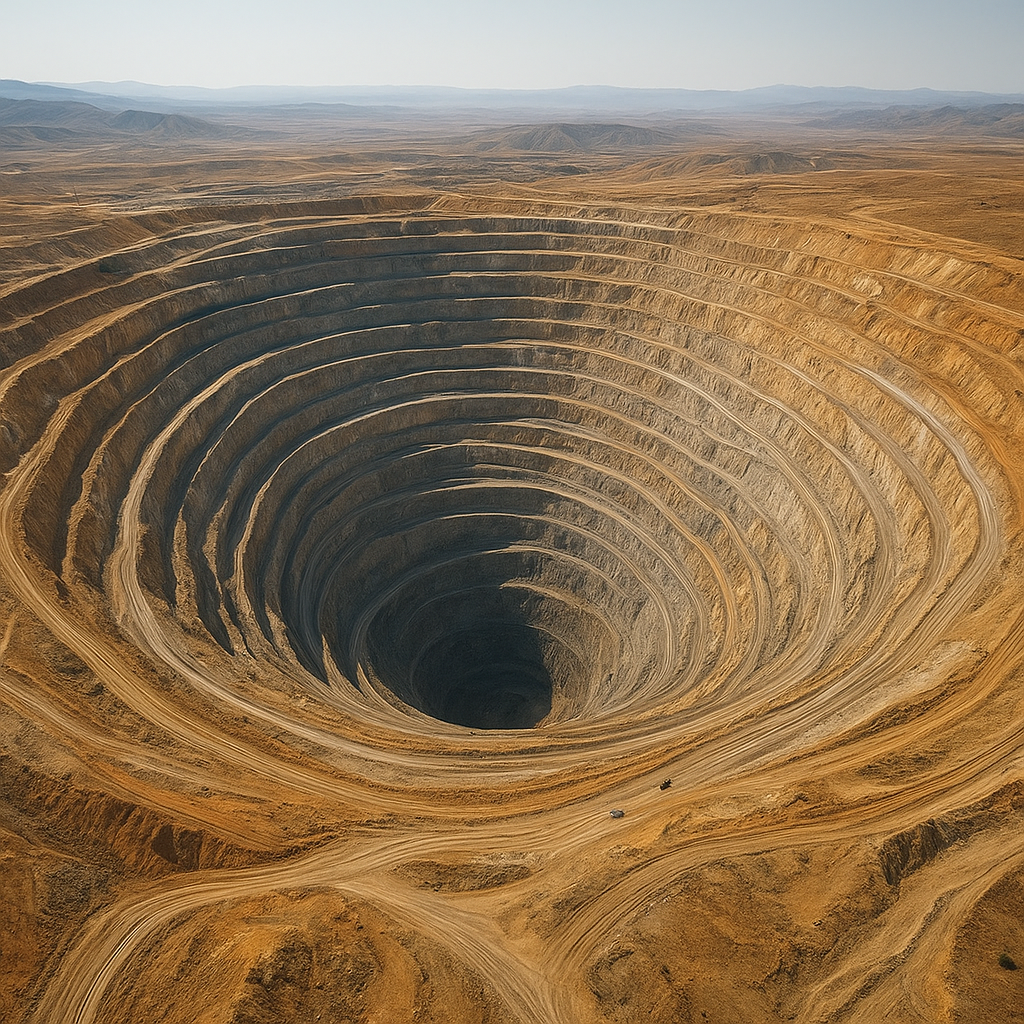
The Grasberg mine is one of the world’s most talked-about mineral operations, combining enormous physical scale with complex geology, contentious politics and profound economic impact. Located high in the central mountain ranges of Indonesian Papua, it has been a major source of copper and gold for decades and remains central to discussions about resource sovereignty, environmental management and regional development. This article outlines where Grasberg sits, what minerals are produced, how it is mined and processed, its broader economic significance and several noteworthy or surprising aspects of its history and operations.
Where Grasberg Is Located and Its Geological Setting
Grasberg lies in the Sudirman Range in the western part of the island of New Guinea, within Indonesia’s province of Papua. The mine complex is situated near the town of Tembagapura and is set in a rugged, high-elevation tropical mountain environment—at several thousand meters above sea level—close to the glaciers and peaks of the central Cordillera. The deposit was first documented by Dutch geologists in the 1930s and later explored and developed on a large scale in the second half of the 20th century.
The deposit itself is a classic example of a porphyry copper-gold system. Porphyry deposits form in subduction-related tectonic settings like the western Pacific “Ring of Fire,” where magmatic fluids concentrate metals in large, disseminated systems. Typically these deposits contain lower-grade but very voluminous copper mineralization intergrown with significant quantities of gold and silver. Grasberg’s geology also hosts high-grade veins and epithermal-style mineralization, which are responsible for the unusually high gold content associated with the copper ore.
Geologically and geographically, Grasberg is unusual for several reasons:
- Its altitude and remote tropical setting create logistical and environmental challenges that differ from most large-scale porphyry mines located in arid or temperate zones.
- The deposit’s combination of very large copper tonnage and exceptionally high gold content makes it globally significant in both commodities.
- The ore body extends to great depth, requiring a long-term transition from large open-pit mining to extensive underground methods.
What Is Mined and How It Is Extracted
Grasberg produces primarily copper and gold, along with by-product silver and small amounts of other metals. Over the decades it has been one of the world’s leading sources of both commodities, contributing not only concentrate shipments of copper but also substantial quantities of refined gold (through concentrate processing and smelting abroad).
Mining techniques at Grasberg evolved with the orebody. The operation began with a massive open pit where hundreds of millions of tonnes of rock were excavated to access the ore. That open pit was among the world’s largest in terms of volume; its sheer size dominated the landscape for many years. As operations deepened and the economics of open-pit stripping became less favorable, the operation shifted increasingly to underground mining, employing block caving and other bulk underground methods to access deep ore zones.
Key elements of the mining and processing sequence include:
- Extraction: Heavy mining fleets, including large electric shovels and haul trucks, are used at surface operations; underground extraction uses block caving to allow controlled collapse and recovery of ore from great depths.
- Comminution and concentration: Crushed ore is milled, and copper-gold minerals are concentrated via flotation and other processes to produce a concentrate suitable for smelting and further refining.
- Logistics: Concentrate and other outputs are transported overland to the port facilities (such as Amamapare on the Arafura Sea) for shipment to refineries and smelters, often outside Indonesia.
The complexity of the ore (with intergrown copper and gold minerals) means metallurgical design and optimization are critical. Over time, processing circuits have been upgraded to improve recoveries of both copper and gold, and to handle variable ore types—from oxide to fresh sulfide ores.
Ownership, Governance and the Indonesian Context
The Grasberg operation has been closely entwined with international and Indonesian corporate and political developments. For many decades, the mine was the flagship foreign investment of an American mining company and operated under long-term contracts with the Indonesian government. After protracted negotiations and changes in Indonesia’s regulatory and political stance toward resource sovereignty, ownership arrangements evolved to increase Indonesian control over PT Freeport Indonesia, the local operating entity.
Today the company structure reflects both international expertise and stronger Indonesian ownership and oversight. The shift to greater national participation is part of a broader global trend in which resource-rich states seek larger stakes in domestic mineral projects, secure value from downstream processing, and increase the share of economic benefits retained nationally.
Such changes have implications beyond simple equity percentages: they affect taxation, royalties, employment policies, local content requirements, and decisions about where concentrate is processed or refined. Grasberg’s contractual and regulatory history is an instructive case of balancing foreign technical investment and domestic expectations of economic benefit.
Economic Significance at Local, National and Global Levels
Grasberg’s economic reach is substantial. On a national scale, it has been a leading source of export earnings, tax revenue and foreign direct investment for Indonesia for many years. The mine’s contribution to government receipts—through royalties, corporate taxation and dividend streams—has funded public spending and regional infrastructure projects. For Papua province and surrounding districts, Grasberg created jobs, urban settlements (notably Tembagapura), roads and basic services that would not otherwise exist in such a remote highland environment.
Globally, Grasberg has been a material contributor to the supplies of both copper and gold. Decisions made at Grasberg—about production levels, mine life extension investments and ore-processing routes—affect commodity markets because of the mine’s scale. Even as global supply has diversified, a disruption at such a large single-source operation can influence prices and supply chains, making Grasberg strategically important to downstream industries.
Yet the distribution of economic benefits illustrates common resource governance challenges:
- Local communities in Papua often argue that monetary and social benefits do not match the scale of extraction and environmental impacts.
- National authorities seek to maximize long-term value, sometimes by insisting on greater domestic processing and ownership, which can require heavy investment and long-term planning.
- International investors demand regulatory certainty and returns on capital-intensive investments that often exceed a single political term, necessitating negotiated compromises and legal stability.
Environmental, Social and Political Dimensions
Operating a mega-mine in a fragile mountain and tropical watershed entails significant environmental responsibilities and risks. Grassberg’s historical tailings management and sedimentation have been a persistent point of contention, with environmentalists and local groups calling for more stringent safeguards and alternative disposal methods. Managing tailings, water quality, biodiversity impacts and deforestation in a way that respects both international best practice and local community livelihoods remains a major operational and reputational issue.
Socially, the mine has been a mixed force. On one hand, it brought employment, health clinics, schools and infrastructure into remote areas; on the other, it has been linked to displacement pressures, cultural disruption and tensions over land rights. The mine exists within a region where some local groups have longstanding political grievances, and occasional security incidents have occurred over the years, complicating operations and community relations.
Regulatory developments in Indonesia have increasingly emphasized environmental standards, local participation and domestic processing. These trends have pushed the company to invest in better environmental management, community development programs and local workforce training—though debates about sufficiency and fairness persist.
Notable and Interesting Aspects of Grasberg
Historic discovery and development
The mineralized area was first noted by European geologists in the 1930s, yet its large-scale exploitation required post-war exploration, infrastructure development and significant capital. The timeline from initial discovery to full-scale production spans decades, reflecting the logistical challenges of access and the capital intensity of such an operation.
Scale and engineering
Grasberg’s open pit and underground workings rank among the world’s most extensive. Moving and processing hundreds of millions of tonnes of rock over decades demanded engineering ingenuity—from high-capacity milling circuits to long-distance concentrate logistics and large-scale underground block caving design. The mine is often cited in textbooks and industry case studies for the scale of its engineering solutions.
Transition to underground mining
As the open pit reached greater depths, the shift to block caving exemplifies how major mines manage the economic imperative of continuing production while controlling costs. Block caving allows recovery of deep, lower-cost ore but requires substantial upfront capital and careful geotechnical planning—an engineering and financial balancing act few projects navigate as successfully at this scale.
Geopolitical and corporate milestones
Ownership transitions, renegotiations of contracts with the Indonesian government, and broader shifts in global mining governance have all left their mark on Grasberg. The mine’s story illustrates how political decisions—about national ownership, export policy and environmental regulation—interact with technical mining choices and corporate strategy.
Human stories and community programs
Beyond the headlines, the mine’s presence has created thousands of personal stories—employees who built careers in the highlands, families moving to new towns, and local entrepreneurs supplying goods and services. Corporate social responsibility programs have attempted to address local needs through education, healthcare and small-enterprise support, with varying degrees of success.
Challenges and Future Outlook
Looking ahead, several themes will shape Grasberg’s trajectory:
- Resource depletion and mine-life planning: As shallow resources are exhausted, long-term extraction depends on deep underground development and efficient metallurgical improvements to process lower-grade or more complex ores.
- Environmental management: Stricter regulations and community expectations will push for improved tailings management, water stewardship and reclamation planning.
- Local and national benefit sharing: Ongoing negotiations between operators, the national government and regional stakeholders will determine how revenues, jobs and infrastructure investments are allocated.
- Market dynamics: Global copper demand—driven by electrification, renewable energy and electrified transport—and gold market behavior will influence investment decisions at Grasberg and the timing of development projects.
Grasberg is simultaneously a geological wonder, an industrial giant and a microcosm of the broader tensions that accompany the extraction of high-value natural resources. Its future will be shaped by engineering ingenuity, market forces and evolving expectations about environmental protection and local entitlement to resource rents. Studying Grasberg provides insight into how modern large-scale mining projects are planned, contested and adapted within complex political, social and ecological landscapes.