
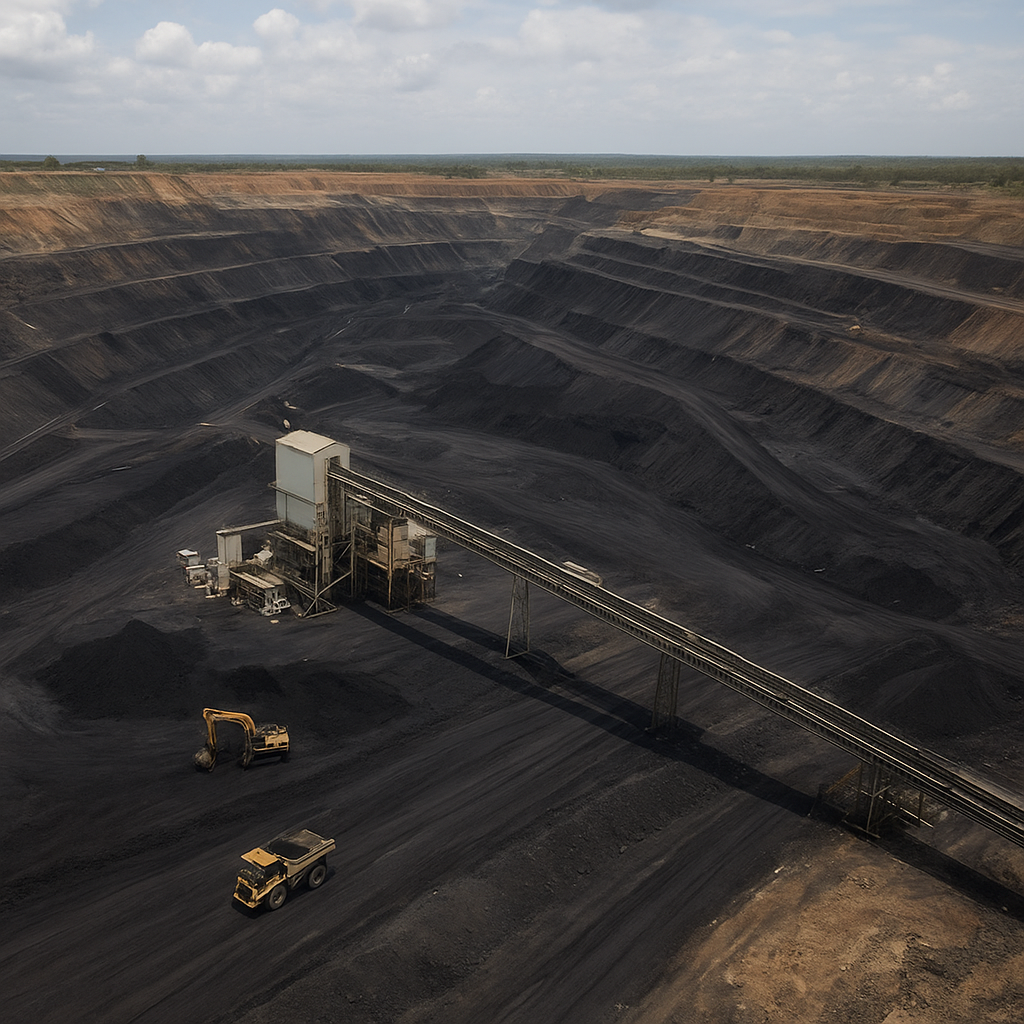
The Goonyella Riverside mine complex sits at the heart of Queensland’s coal country and plays a pivotal role in supplying global steelmakers with high-quality coal. Located in the prolific Bowen Basin of central Queensland, the operation is widely recognised for producing premium metallurgical coal that is essential to the international steelmaking industry. Beyond extraction, Goonyella Riverside has deep links to regional towns, export logistics and technological innovations that shape modern mining practice.
Location and geology
The Goonyella Riverside complex is situated in central-eastern Australia within the Bowen Basin, a major coal-bearing geological province that stretches across central Queensland. The mine lies in the vicinity of the regional service town of Moranbah, which developed to support coal operations across the basin. The Bowen Basin’s sedimentary sequences host multiple economically important coal seams formed during the Permian period; these seams are renowned for producing high-grade coking coal.
Geologically, the coal seams serving Goonyella Riverside are characterized by favourable properties for steel production: low ash content, relatively low sulfur, and strong coking qualities. These attributes make the mine’s product sought after by coke ovens and blast furnaces worldwide. Mining at Goonyella Riverside typically targets specific benches and seam packages where the combination of seam thickness, continuity and coal quality deliver the best commercial returns.
Operations and mining methods
Goonyella Riverside is operated by the BHP Mitsubishi Alliance (BMA), a major joint venture that runs several large coal assets in the Bowen Basin. The complex itself comprises multiple extraction areas and has historically blended open-cut and underground operations to optimise recovery and maintain a steady supply of export-quality product.
Mining techniques
- Longwall mining: For underground sections, longwall technology has been a principal method, enabling high productivity by extracting large, continuous panels of coal. Longwall faces require sophisticated ground control, ventilation and methane management systems.
- Open-cut operations: Where coal seams approach surface or overburden removal is economical, open-cut mining provides efficient bulk extraction and often supports the site’s overall production levels.
- Processing and blending: Coal from different seams and pits is processed, washed and blended to meet strict product specifications demanded by international buyers, especially for metallurgical grades.
Once processed, coal is transported by rail across Queensland’s dedicated coal rail network to export terminals at the coast. The mine’s logistical chain is a finely tuned system linking pit, preparation plant, rail loadout and coastal terminals, enabling shipment to markets across Asia and beyond.
Economic significance
Goonyella Riverside is a cornerstone asset within Australia’s coal industry and contributes substantially to the regional and national economy. Its significance can be viewed across several dimensions:
- Exports and trade: The mine supplies high-value metallurgical coal to international markets, directly supporting Australia’s export earnings. Metallurgical coal commands premium prices compared to many thermal coals because of its essential role in steel production.
- Employment: The operation provides direct employment for mine workers and indirect jobs throughout the supply chain — from contractors and transport operators to service and maintenance providers. The presence of the mine supports local businesses in towns such as Moranbah and surrounding communities.
- Government revenue: Royalty and tax payments from the mine flow to state and federal coffers, funding public services and infrastructure. These flows are particularly important in resource-rich regions where mining is a major economic driver.
- Supply chain influence: The mine’s production underpins steelmaking supply chains globally. Disruptions or expansions at mines like Goonyella Riverside can influence global coal prices and the availability of metallurgical coal for steel producers.
The economic reach of the mine extends beyond immediate outputs; it also supports investment in rail, ports and ancillary infrastructure, and fosters skills and technology development in the mining sector.
Logistics and export pathways
Coal from Goonyella Riverside is moved across Queensland’s integrated rail-and-port system. Queensland’s export terminals at the coastline — including major coal handling complexes near Hay Point — export millions of tonnes of coal each year, and Goonyella Riverside is a significant contributor to that throughput. Efficient rail scheduling, loadout systems and port operations are critical to maintaining the mine’s competitiveness on global markets.
Investment in rail capacity and port infrastructure has been a recurring theme for Bowen Basin producers, as access to additional shipping capacity and more flexible logistics can unlock production growth or provide resilience during market volatility.
Environmental management and sustainability
Modern mining operations at Goonyella Riverside are subject to strict environmental regulation and corporate sustainability standards. Environmental management is multi-faceted and addresses:
- Water management: Protecting local water quality and ensuring sustainable water use are priorities. Mines implement water recycling, sediment control and monitoring programs to mitigate impacts on rivers, aquifers and downstream ecosystems.
- Rehabilitation: Progressive rehabilitation of disturbed land is standard practice — topsoil is conserved, slopes re-shaped and revegetation undertaken to restore landscapes and provide stable long-term land uses post-mining.
- Air quality and dust control: Measures such as water sprays, covered conveyors and dust monitoring help to reduce airborne particulates and protect local communities.
- Greenhouse gas and energy initiatives: Coal mining and coal use are carbon-intensive, so companies increasingly pursue energy efficiency, methane management and emission reduction strategies. BMA and similar operators have explored renewable energy integration, efficient fleet technologies and methane capture to reduce the overall carbon footprint.
Community engagement and transparent environmental monitoring are central to ensuring the social licence to operate. Local stakeholders, Indigenous groups and regulators are typically involved in consultation, land access agreements and impact mitigation plans.
Safety, technology and innovation
Safety is a primary focus in underground and open-cut operations alike. Modern mines deploy a range of technologies to improve safety, productivity and operational certainty:
- Automation and remote operations: Automated longwall control, remotely operated equipment and advanced monitoring systems reduce risk exposure for personnel and improve consistency of production.
- Real-time monitoring: Sensors, ventilation monitoring and geotechnical instrumentation help operators detect hazards early and respond quickly to changes underground.
- Fleet efficiency: Diesel-electric haulage, hybrid vehicles and telematics are used to optimise fuel consumption and reduce emissions from the transport fleet.
- Digital planning: Advanced geological modelling, predictive maintenance and data analytics enhance decision-making across the mining life cycle.
Investment in workforce training, emergency response capability and health programs complements technological upgrades to ensure safer workplaces.
Community and regional impact
Goonyella Riverside has a long-standing relationship with its host communities. The mine’s presence has shaped the development of housing, health, education and services in nearby towns such as Moranbah. Community investment programs often focus on:
- Local infrastructure improvements (roads, utilities, recreational facilities)
- Education and training scholarships or apprenticeships
- Support for local businesses and Indigenous partnerships
- Health and well-being initiatives for mining employees and residents
While the economic benefits are substantial, communities also manage the social impacts of a resource-driven boom-and-bust cycle. Companies and local governments work to build economic diversity, prepare for eventual mine closure and ensure long-term wellbeing for residents.
History and notable milestones
The Goonyella Riverside complex has evolved across decades, reflecting changes in technology, commodity demand and corporate structure. Over time the site has expanded, modernised its equipment and integrated new processing facilities to meet the expectations of demanding international customers.
Several milestones stand out as defining moments for the operation:
- Scaling up production in response to strong global demand for metallurgical coal, especially from Asian steel markets;
- Implementing longwall mining and other mechanised systems that raised productivity and improved cost efficiency;
- Integrating advanced coal preparation and quality control measures to supply consistent coking coal products;
- Participating in regional infrastructure projects that strengthened rail-to-port connectivity and export capacity.
Interesting facts and wider relevance
Beyond its immediate role as a coal producer, Goonyella Riverside illustrates several broader themes about contemporary resource projects:
- Global supply chains: Coal from a Bowen Basin mine can end up in steel mills thousands of kilometres away, highlighting how local operations feed international manufacturing systems.
- Technological evolution: The transition from labour-intensive practices to highly mechanised and digital operations shows how the mining industry adapts for productivity and safety.
- Economic interdependence: The fortunes of regional towns, service industries and ports are closely tied to consistent mine output.
- Environmental stewardship challenges: The mine provides a case study in balancing resource extraction with rehabilitation, emissions management and community expectations.
A single coal complex like Goonyella Riverside can therefore be viewed as more than a source of raw material: it is a node within a global industrial network, a local employer, an engineering endeavour and a focus of environmental and social policy debates.
Outlook and future considerations
Looking ahead, the role of mines such as Goonyella Riverside will be influenced by several converging factors:
- Trends in global demand for steel and corresponding metallurgical coal requirements;
- Technological advances that improve productivity, reduce emissions and extend mine life;
- Regulatory and market pressures to reduce greenhouse gas emissions across mining and steelmaking value chains;
- Community expectations for sustainable development and long-term economic transition planning.
Operators that balance reliable production, environmental performance and community engagement will be better positioned to navigate changing market and policy landscapes. For the Bowen Basin and the broader Queensland economy, the sustainability and competitiveness of major complexes like Goonyella Riverside remain central to regional prosperity.

