
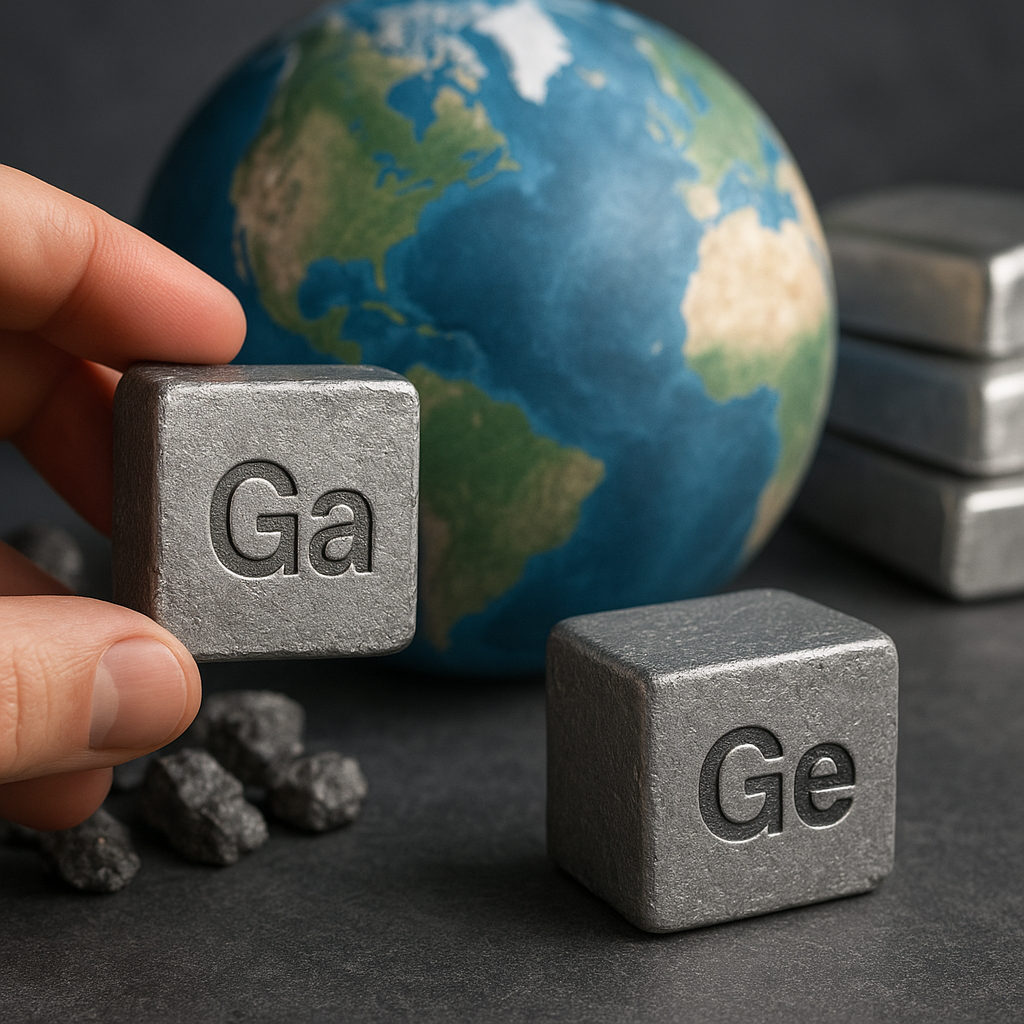
The race for control over strategic materials has shifted from oil and rare earths to lesser-known but indispensable elements such as gallium and germanium. These metals, once curiosities of mineralogy, now underpin the global electronics and clean-energy revolutions. As nations and corporations scramble to secure reliable access, the patterns of trade, investment and technological development are being reshaped. This article explores the causes and consequences of the rising competition for these resources, examining market structures, industrial demand, geopolitical maneuvering and potential paths toward more resilient supply chains.
Strategic importance and industrial applications
Gallium and germanium occupy outsized roles in modern technology despite their relative scarcity. Gallium is central to compounds such as gallium arsenide (GaAs) and gallium nitride (GaN), materials that are prized for their high electron mobility and ability to operate at high frequencies and temperatures. These properties make them essential in advanced semiconductors, particularly in radio frequency amplifiers, 5G infrastructure, satellite communications and power electronics for electric vehicles. Germanium, meanwhile, is valued for infrared optics, fiber-optic systems, and as a substrate or dopant in certain semiconductor devices. It is also used in high-efficiency multijunction solar cells, making it critical to aerospace and concentrated photovoltaic applications.
The convergence of several trends—accelerated deployment of renewable energy, expansion of high-frequency wireless networks, electrification of transport, and robust defense procurement—has dramatically increased demand for these elements. This demand is not just commercial but also strategic: advanced defense systems, secure communications and next-generation sensors frequently require the unique properties of GaAs, GaN and germanium-based materials.
Supply dynamics and major producers
Unlike bulk metals, gallium and germanium are typically produced as by-products of other mining and refining processes, which creates distinctive supply characteristics. Gallium is largely extracted from bauxite residue and as a by-product of aluminum production. Germanium is commonly recovered from zinc ores, coal ash, and as a by-product in certain metallurgical processes. Because their primary production is tied to other commodity cycles, supply cannot be increased quickly in response to sudden demand shocks.
Key producing regions
- China dominates much of the value chain for these metals, from extraction and refining to the production of wafers and compound semiconductors. This concentration gives Chinese firms and the state substantial market influence.
- Other producers include parts of Europe, Russia, and North America, but their output is limited in scale. Some African countries have potential reserves, yet lack processing capacity.
- Specialty recyclers and secondary production facilities contribute a growing share of supply, particularly for germanium recovered from industrial waste streams and end-of-life electronics.
The dependency on a few suppliers creates vulnerability. Export restrictions, trade policy shifts, or industrial accidents in key refining hubs can ripple through global manufacturing. Because processing requires specialized technologies and environmental controls—especially for refining from complex feedstocks—scaling up new capacity is capital- and time-intensive.
Technological drivers of demand
Two interlinked technological trends are the principal engines of demand growth. First, the rollout of high-performance communications, including 5G and emerging 6G research, requires components that operate at higher frequencies with lower loss; GaN and GaAs devices fill that niche. Second, the global push for decarbonization and energy efficiency elevates demand for power electronics in electric vehicles and renewable energy systems, where GaN-based converters promise higher efficiency and smaller form factors.
Photovoltaics using germanium substrates are integral to space-grade and concentrated solar technologies. The aerospace industry’s demand for high-efficiency solar cells is stable and high-value, and defense applications further fortify strategic demand for germanium-based devices. Additionally, infrared optics for thermal imaging, night vision and advanced sensors rely on germanium’s optical properties.
Emerging markets and substitution pressures
- Telecommunications infrastructure and consumer electronics represent large-volume markets where small performance gains translate into significant aggregate demand.
- Defense procurement often prioritizes performance and security over cost, creating a steady baseline demand for high-purity materials.
- Research into alternative materials (for example, silicon carbide replacing GaN in certain power applications) and new manufacturing techniques could moderate demand growth, but substitution is neither immediate nor universal.
Geopolitics and economic competition
The international distribution of refining, manufacturing and innovation capabilities has turned gallium and germanium into geopolitical assets. Countries recognize that control over inputs for critical technologies confers strategic leverage. Trade measures, investment screening, export controls and industrial policy are all being deployed to protect domestic supply and limit competitors’ access.
China’s dominant position has prompted other countries to develop counter-strategies. These include incentivizing domestic production, forming alliances with like-minded partners for secure supply, and investing in downstream capabilities such as wafer fabrication and compound semiconductor manufacturing. The United States and European Union have both listed these materials as critical minerals and are exploring public-private partnerships to bolster supply resilience.
Export controls and targeted sanctions can be double-edged: while they protect national security interests, they can also disrupt global manufacturing networks and prompt other nations to accelerate domestic capacity or seek alternative suppliers. The result is an arms-race-like dynamic in which strategic stockpiling, long-term offtake agreements and investment in processing facilities become commonplace.
Market responses: recycling, diversification and industrial policy
Given the constrained ability to rapidly expand primary production, stakeholders are focusing on three complementary strategies to mitigate risk: diversification of sources, improvement of recycling and secondary recovery, and investment in material substitution where feasible.
- Diversification: Governments and corporations are signing long-term contracts with a broader set of suppliers and investing in mining and refining projects outside dominant regions. Strategic alliances and joint ventures help transfer technology and build local processing capabilities.
- Recycling and circularity: Recovering germanium from fiber-optic waste, coal fly ash, and end-of-life electronics, as well as capturing gallium from semiconductor manufacturing scrap, can provide a meaningful secondary supply. Improving collection systems and refining technologies reduces dependence on virgin feedstocks.
- Industrial policy: Subsidies, tax incentives, streamlined permitting and workforce development programs are being used to attract investment in domestic refining and advanced materials manufacturing.
These measures require time and sustained funding. Recycling technologies must overcome technical and economic barriers to reach scale, and building new refining capacity involves environmental permitting and community acceptance challenges. Nevertheless, the combination of policy support and market incentives can create a more diversified and resilient global supply network over the medium term.
Environmental and ethical considerations
Mining and metallurgical processes for extracting trace elements from complex feedstocks can entail significant environmental risks, including hazardous waste and energy-intensive processing. Increasing production without robust environmental safeguards risks community harm and reputational costs for companies and states. Consequently, investment in cleaner processing technologies, transparent supply-chain tracking and responsible sourcing standards is as much a strategic imperative as an ethical one.
Moreover, electronics waste streams have become a critical source of recoverable metals. Improving e-waste collection, encouraging product designs that facilitate material recovery, and fostering markets for secondary materials are important steps toward a more sustainable supply model.
Outlook: balancing competition with cooperation
Competition for access to gallium and germanium will intensify as technological demand grows and strategic sensitivity increases. However, the interdependence of modern supply chains also creates incentives for cooperation. Multilateral initiatives—ranging from standard-setting for critical mineral governance to joint investments in refining capacity—can reduce the most disruptive elements of competition while maintaining robust markets for innovation.
Private-sector strategies will likely include diversified sourcing, vertical integration into refining and materials processing, and intensified R&D into both recycling and alternative materials. Public policy responses will need to balance industrial competitiveness, environmental protection and geopolitical security. The countries that succeed will be those that combine investment in technology and infrastructure with pragmatic international engagement to ensure that the raw materials underpinning the next wave of technological change remain available, responsibly produced and cost-effective.
