
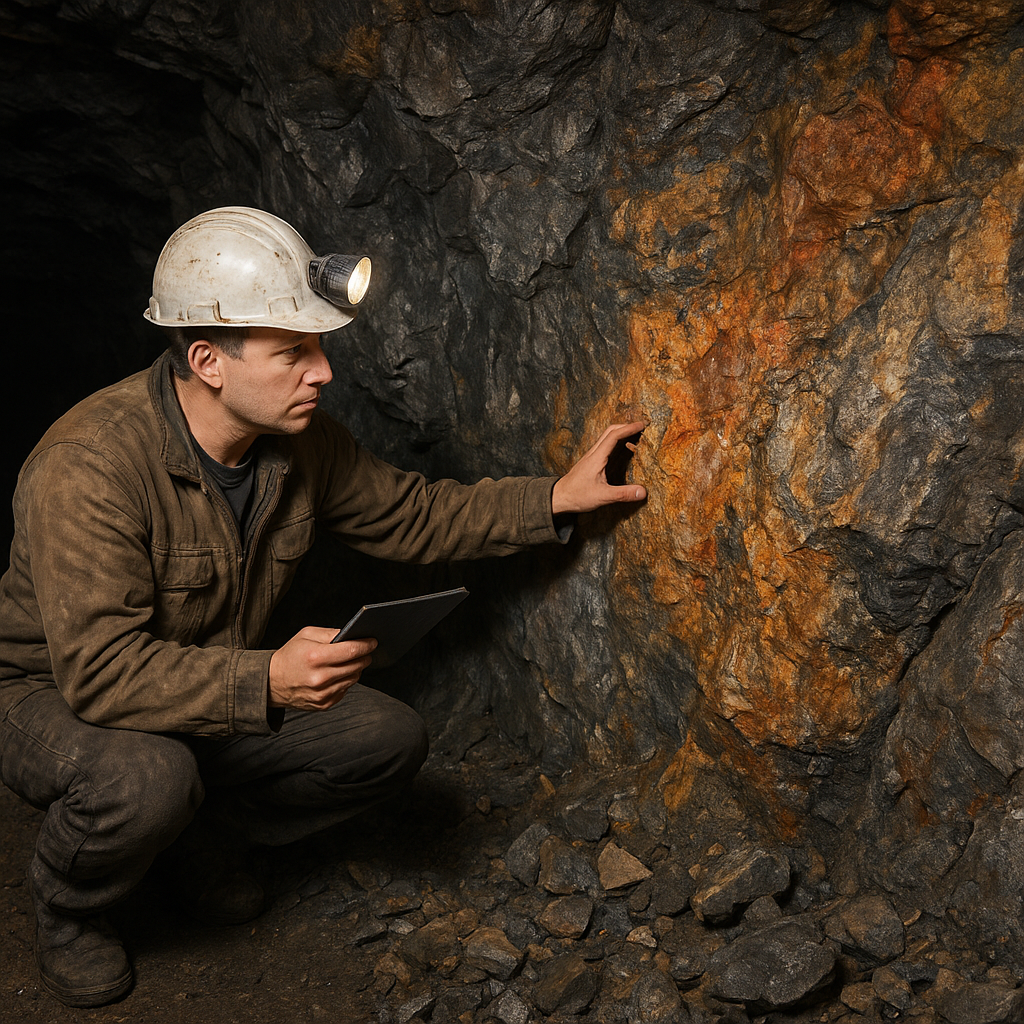
Deep underground metal deposits present a complex interplay of geological processes, engineering constraints and environmental risks. This article examines the principal scientific and technical challenges encountered when exploring, characterizing and exploiting ore bodies located at great depth, and discusses current methods and emerging technologies that help manage those challenges. Emphasis is placed on rock mechanics, hydrogeology, geophysical imaging and mine design for sustainable extraction.
Geological setting and formation mechanisms
Metals concentrated at significant depths often owe their existence to a sequence of prolonged geological events. Many high-grade deposits are the product of prolonged hydrothermal fluid circulation, magmatic activity and regional metamorphism. Deep-seated orebodies may be hosted in competent crystalline basement rocks, metamorphic complexes or in contact zones between intrusive bodies and surrounding lithologies. Understanding the timing and interplay of mineralizing events is critical for targeting and risk assessment.
Types of deep deposits
- Magmatic-hydrothermal systems (e.g., porphyry and epithermal analogues at greater burial depth)
- Stratabound sulfide deposits modified by metamorphism
- Vein-hosted precious metal deposits formed during tectonic fluid flow
- Skarn and contact metasomatic deposits adjacent to intrusions
- Orogenic gold systems related to crustal-scale shear zones
Deep deposits often show complex internal zoning of minerals and physical properties because of variable temperature, pressure and fluid composition during formation. High-temperature mineral assemblages reflect elevated temperature conditions and protracted fluid-rock interaction. The geometry and continuity of the orebody can be strongly influenced by structural controls such as folds, faults and shear zones, which complicates both exploration and extraction.
Exploration and characterization challenges
Detecting and delineating mineralization at great depth requires sophisticated geophysical, geochemical and drilling strategies. Traditional surface exploration techniques become less effective as burial increases and overburden attenuates signals.
Geophysical limitations and advances
- Seismic imaging at mine scales must contend with complex velocity structures and scattering.
- Electromagnetic and gravity methods can identify contrasts in conductivity and density but often lack resolution at depth.
- Integrated inversion of multi-method datasets improves confidence in subsurface models.
Recent advances in full-waveform seismic, borehole geophysics and active-source electromagnetic surveys enable better imaging of deep targets. Passive seismic monitoring and microseismic arrays also provide information about fracturing and stress regimes. Interpretation must incorporate realistic models of rock anisotropy, which often develop in response to tectonic strain.
Drilling, sampling and geochemistry
Exploration drilling into deep targets is expensive and logistically demanding. Core recovery may be hindered by brittle failure, overpressured aquifers or intense ground deformation. Accurate geochemical assays depend on representative sampling and contamination control, especially where mineralization is narrow or structurally complex. In many deep settings, fluids are saline and chemically reactive, producing secondary alteration halos that can both aid and confuse geochemical targeting.
Rock mechanics, stress and mine design
As mining depth increases, so do in-situ stresses and the potential for hazardous behaviour such as rock bursts. Competent rocks that would be stable near the surface can behave in a brittle, suddenly releasing manner when stressed at depth.
Stress regime and induced hazards
- High lithostatic loads increase the risk of sudden failure and seismic events; careful stress mapping is essential.
- Induced seismicity from excavation, blasting or fluid injection must be monitored to reduce risk to personnel and infrastructure.
- Rock bursts and spalling impose strict requirements on ground support and excavation sequencing.
Engineering solutions include mechanized preconditioning (e.g., destress blasting), yielding support systems, and design of pillars and stopes that redistribute stresses. Numerical modelling, from continuum finite-element methods to discrete-element models, assists in forecasting deformation, but models need robust input data on mechanical properties and existing structural fabric.
Ventilation, heat and energy management
Deep mines encounter elevated mine air temperatures and geothermal heat fluxes that necessitate robust cooling and ventilation. Effective control of underground climate is not only a comfort issue but a safety and productivity imperative.
- Large-scale ventilation networks are designed to dilute gases, control dust and remove heat.
- Advanced refrigeration plants and chilled water systems are often necessary at great depth.
- Energy consumption for ventilation and cooling represents a major component of operating costs, motivating efficiency improvements and alternative energy integration.
Ventilation design must consider airflow dynamics, local heat sources, and emergency scenarios. Modern systems incorporate real-time monitoring and adaptive controls to optimize performance. Where appropriate, ventilation on demand and heat recovery systems are being trialed to reduce carbon footprints.
Hydrogeology and geochemical issues
Deep groundwater commonly exists under high pressure and may be chemically aggressive; both aspects pose hazards to mining and processing. Brines with elevated salinity, heavy metals or dissolved gases can corrode infrastructure and present environmental liabilities.
Water inflow and pressure management
- Sudden inflows can flood workings; pre-drainage and grouting are frequently employed to reduce hydrostatic load.
- Hydraulic fracturing for dewatering or preconditioning must be managed to avoid inducing damaging seismicity.
- Accurate hydrological models require coupling of porous flow and fracture network behaviour.
Groundwater interactions also influence ore preservation and metallurgical characteristics. Redox gradients, pH and complexing ligands control metal mobility; understanding these controls aids in predicting secondary enrichment or contamination pathways. Remediation of deep contamination is technically challenging and costly, making prevention through careful water management imperative.
Environmental, health and safety considerations
Deep mining intensifies some environmental and safety challenges. Issues include subsidence at the surface, management of high-salinity effluents, greenhouse gas emissions from ventilation and energy use, and occupational hazards related to heat and seismic events.
Regulatory and social aspects
- Stakeholder engagement is essential since deep projects can affect groundwater resources and surface stability.
- Regulatory regimes increasingly require robust environmental impact assessments that consider cumulative and long-term effects.
- Closed-loop water systems and improved waste management help reduce footprint.
Occupational health programs must adapt to unique risks of deep operations: physiological stress from heat, psychological impacts of remote automated work, and exposure to dust and diesel particulates. Implementation of stringent monitoring and safety protocols is non-negotiable.
Technological innovations and future directions
Addressing deep-deposit challenges relies on integrating novel technologies and multidisciplinary approaches. Automation and remote operation reduce human exposure to hazardous zones, while digital twins and machine learning optimize planning and predict failure modes.
- Robust remote sensing and autonomous drilling platforms increase exploration reach while lowering cost.
- Real-time sensor networks feed predictive models for stress evolution, ventilation demands and seismic risk.
- Advanced materials for ground support and corrosion-resistant alloys extend equipment life in chemically aggressive environments.
Another promising avenue is the combined use of in-situ resource utilization and modular processing, reducing the need to transport ore to the surface. Controlled backfilling and paste technology improve ground stability and minimize surface tailings storage. Integration of renewable energy sources and waste heat recovery can mitigate the large energy demands of deep operations.
Research priorities
- Improving imaging resolution for geological structures at depth using multiphysics inversions.
- Better constrained constitutive models of rock behaviour under extreme conditions.
- Coupled hydro-mechanical-chemical modelling to predict long-term interactions between mining and the subsurface environment.
- Development of resilient, low-emission ventilation and cooling technologies.
Continued collaboration between geoscientists, engineers and local communities will be essential to responsibly exploit deep metal resources. The intersection of traditional geological practice with digital technologies promises to reduce uncertainty and increase the safety and sustainability of deep mining operations, while also highlighting the importance of ongoing monitoring to manage long-term impacts on groundwater systems and surface stability.
