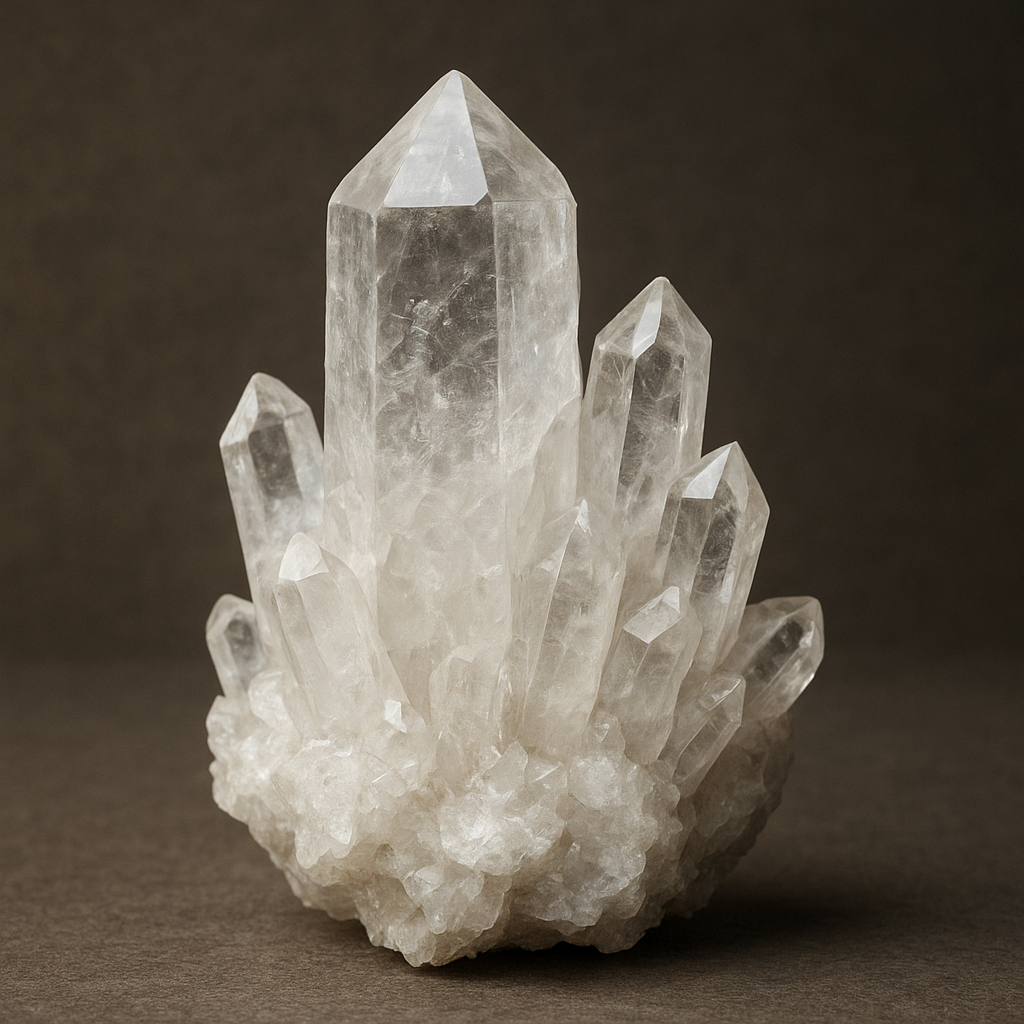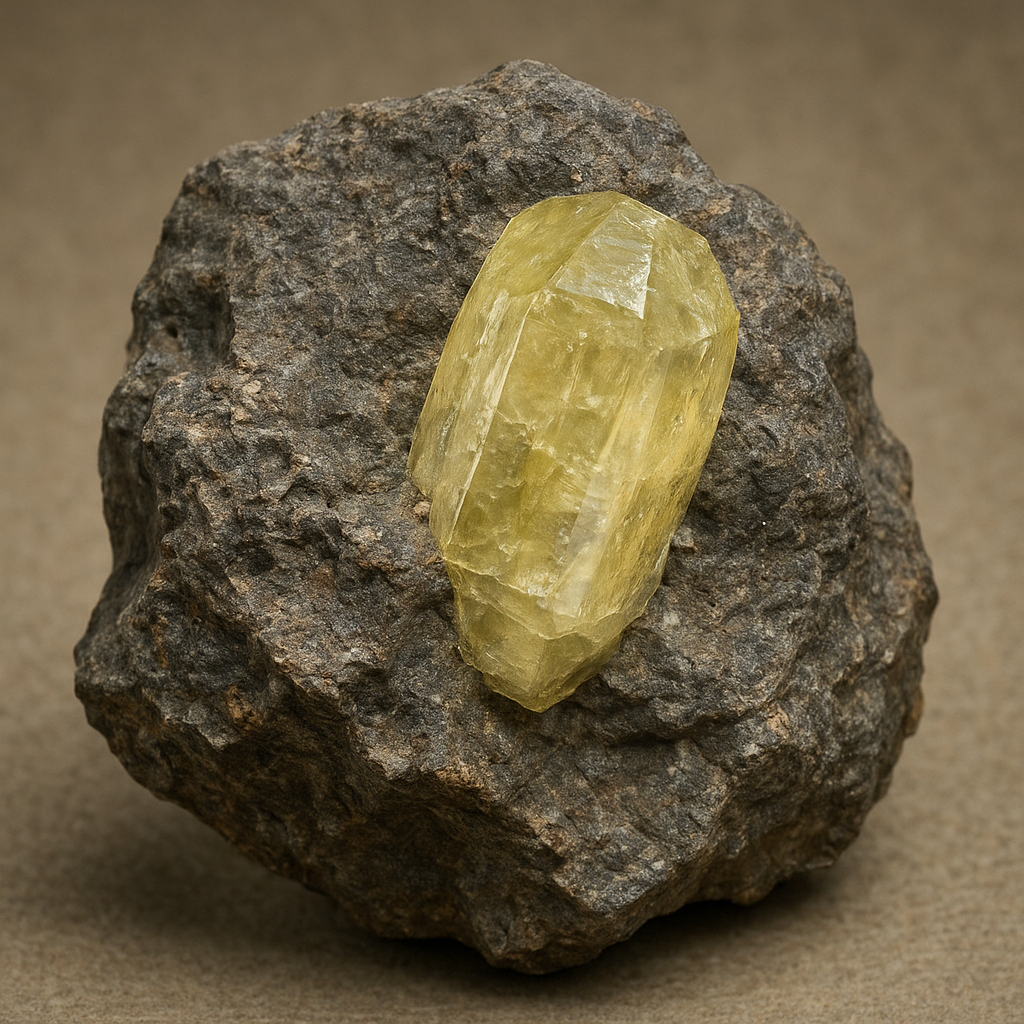
Gehlenite is a member of the melilite mineral group whose presence links high-temperature geological processes, advanced ceramic technology, and even the earliest solid condensates of the solar system. This article explores the mineral’s defining characteristics, natural occurrences, and practical and scientific applications, highlighting why gehlenite remains a subject of interest for mineralogists, materials scientists, and planetary researchers. Throughout the text, several key terms are emphasized to help draw attention to the most valuable concepts.
Mineralogy, Chemistry and Crystal Chemistry
Gehlenite is a calcium–aluminium silicate commonly written by the simplified formula Ca2Al2SiO7, representing the Al-rich end-member of the melilite solid-solution series. In this family the other important end-member is akermanite (Ca2MgSi2O7). The melilite structure is an open framework built from layers of tetrahedrally coordinated silicon and aluminium linked to layers of calcium; the resulting framework produces a relatively low-density, high-temperature stable phase with distinctive thermal and chemical behavior.
Crystallographically, gehlenite belongs to the melilite group and typically crystallizes in a tetragonal or pseudo-tetragonal lattice. Its structure is notable for planar sheets of corner-sharing tetrahedra (SiO4 and AlO4) that create channels and sites for larger cations (Ca2+) between layers. The capacity for substitution (for example, Mg2+ substituting for Al3+ in natural samples, balanced by changes in Si:Al ratio) gives the melilite group a broad solid-solution range and affects optical and thermal properties.
Typical physical properties of gehlenite include a color range from pale yellow to gray or brown, vitreous to resinous luster, and relatively moderate hardness. Specific gravity is modest compared with many oxide minerals, reflecting the framework structure and presence of calcium. Gehlenite can form idiomorphic to subhedral crystals and is often found as granular to massive aggregates in natural settings.
Geological Occurrence and Formation Environments
Gehlenite’s principal interest arises because it is a diagnostic mineral of specific high-temperature, low-silica environments. It is not ubiquitous; instead it forms in a set of distinctive geological and cosmochemical contexts where high-temperature thermodynamic conditions and particular chemical reservoirs prevail.
Contact Metamorphism and Skarns
One common terrestrial setting for gehlenite is in skarn zones and contact-metamorphosed carbonate rocks. When silica-poor limestones or dolomites are invaded by silica-undersaturated, alumina- and calcium-bearing magmatic fluids, high-temperature reactions can produce melilite-group phases including gehlenite. In these skarn assemblages gehlenite is often associated with minerals such as diopside, spinel, garnet, and fayalite, reflecting the Ca–Al–Si system under oxidizing to moderately reducing conditions.
High-Temperature Metamorphism and Impure Limestones
In regional metamorphism where impure carbonate sequences experience elevated temperatures, gehlenite may form transiently or as a stable phase depending on the bulk composition. Its appearance is favored in rocks with excess calcium and aluminium but comparatively low free silica, because the available silica is largely tied into framework tetrahedra rather than forming quartz or feldspar.
Igneous and Pyrometamorphic Contexts
While gehlenite is not a major constituent of typical igneous rocks, it can crystallize from high-temperature, silica-poor magmas or be present in pyrometamorphic settings such as natural burning coal seams or anthropogenic slags and clinker from industrial furnaces. In these environments, rapid heating and cooling and unusual chemistry can stabilize melilite-group minerals temporarily or in altered forms.
Cosmochemical Occurrence: CAIs in Meteorites
One of the most fascinating occurrences of gehlenite is in the oldest known solid materials of the solar system: calcium–aluminium–rich inclusions (CAIs) in certain carbonaceous chondrite meteorites. These CAIs are refractory condensates believed to have formed at very high temperatures in the early solar nebula. Gehlenite appears alongside other refractory minerals (e.g., spinel, hibonite, perovskite) in CAIs and serves as a mineralogical record of condensation sequences and early nebular chemistry. The presence of gehlenite in CAIs provides evidence for local chemical environments with high Ca and Al activity and relatively low silica fugacity in the first few million years of planetary formation.
Industrial, Technological and Scientific Applications
Gehlenite and related melilite phases are not mere geological curiosities: they also play roles in several industrial and scientific domains. Their high-temperature stability, compatibility with calcium-aluminium chemistry, and structural characteristics make them relevant in ceramics, refractories, cement chemistry, and materials research.
Refractories and High-Temperature Ceramics
Because the melilite framework remains stable at elevated temperatures, synthetic gehlenite or gehlenite-bearing materials can be components of refractory products and specialized ceramics. In some formulations gehlenite contributes to thermal shock resistance and stable microstructures under fluxing conditions. Ceramics that must resist chemical attack by slags or molten metals sometimes incorporate melilite phases or tune compositions to avoid deleterious reactions that would destabilize melilite.
Cement and Clinker Chemistry
Gehlenite-type phases are relevant to the chemistry of certain cements and clinkers. In non-Portland, calcium-rich cement systems and in some industrial by-products (e.g., blast-furnace slags), melilite-group minerals can form during firing. Their formation affects hydraulic properties, phase assemblage, and long-term durability. Understanding gehlenite behavior helps engineers design firing regimes that avoid unwanted expansion or reactivity in cementitious materials and also informs strategies for valorizing industrial slags into building materials.
Materials Science and Glass-Ceramics
In glass-ceramic research, controlled crystallization of compositions in the melilite field can yield microstructures with useful mechanical, thermal, or optical properties. Tailoring nucleation and growth to produce melilite crystals in a glassy matrix can yield composites with desirable combinations of stiffness and toughness. Experimental studies sometimes exploit gehlenite as an intermediate phase in designing new functional ceramics or as a model compound to study ion transport and substitution in tetrahedral networks.
Planetary Science and Cosmochemistry
For planetary scientists, the presence of gehlenite in meteorites and its stability relations are a powerful diagnostic tool. Gehlenite’s formation conditions constrain models of nebular condensation, early solar system oxygen fugacity, and the thermal histories of chondritic parent bodies. It helps researchers reconstruct physicochemical conditions in the solar nebula and test hypotheses about mixing, evaporation, and recondensation processes that shaped the first solids.
Identification, Analytical Techniques and Research Methods
Researchers combine field observations, petrography, and advanced analytical techniques to identify gehlenite and study its properties. Because gehlenite often occurs with other minerals in complex assemblages, multiple methods are useful for unambiguous characterization.
- Optical microscopy: Thin section petrography can reveal characteristic crystal habits, birefringence, and associations with coexisting phases.
- X-ray diffraction (XRD): XRD identifies mineral phases unambiguously and can detect melilite-group peaks and lattice parameter changes due to solid solution.
- Electron microprobe and SEM-EDS: These techniques provide major-element chemistry and zoning patterns, which help distinguish gehlenite from chemically similar minerals.
- Raman and infrared spectroscopy: Vibrational spectroscopies give information about the tetrahedral framework and site substitutions.
- Isotopic and trace-element studies: In meteorite research, isotopic ratios and trace-element patterns can fingerprint nebular processes and secondary alteration.
Interesting Connections and Emerging Topics
Several aspects of gehlenite’s story cross disciplinary boundaries, making it a mineral of continuing interest beyond basic classification.
Archaeomaterials and Anthropogenic Geology
Historic and modern industrial processes occasionally produce gehlenite as a reaction product in kilns, slags, or fired clays. The study of kiln wastes and clinker from historical sites can reveal episodes of high-temperature processing and raw material selection. Analyses sometimes find melilite-group phases in archaeological ceramics or metallurgical residues where unusual firing conditions prevailed.
Environmental and Waste Immobilization Studies
Researchers investigating immobilization of problematic wastes (e.g., certain metal-bearing slags or nuclear wastes) sometimes explore calcium-aluminium-silicate matrices because of their structural robustness and chemical durability. While gehlenite itself is not universally proposed as a final waste form, understanding how melilite phases incorporate or exclude specific ions helps guide the design of durable glass-ceramic waste forms and informs long-term behavior models.
Planetary Comparisons and Meteorite Petrology
On a planetary scale, the contrasts between gehlenite occurrences in Earth rocks and in CAIs highlight differences between nebular condensation chemistry and terrestrial metamorphic/igneous processes. Studies that compare gehlenite chemistry from meteorites with that from terrestrial skarns or slags reveal how the same basic structural motif records divergent physicochemical histories. Such comparisons support broader inquiries into planetary differentiation, crust formation, and the nature of early refractory condensates.
Practical Notes for Collectors and Researchers
Collectors of mineral specimens may encounter gehlenite as part of unusual skarn assemblages or within meteorite sections. For researchers, careful sampling and multiple analytical lines of evidence are advisable because melilite-group minerals can be compositionally variable and sometimes fine-grained or intergrown with other phases. When considering gehlenite in an industrial context, account for its sensitivity to bulk composition and thermal history: small changes in chemistry or firing profile can tip the system toward akermanite or other silicates.
In short, gehlenite serves as a mineralogical bridge between high-temperature terrestrial processes, industrial materials, and the earliest solid matter in the solar system. Its presence signals distinctive chemical conditions, and its study continues to yield insight into natural and engineered materials where calcium and aluminium dominate the chemistry. Whether in the contact aureole of a limestone, the microstructure of a refractory, or the oldest inclusions in a meteorite, gehlenite captures a snapshot of extreme conditions preserved in a resilient silicate framework.