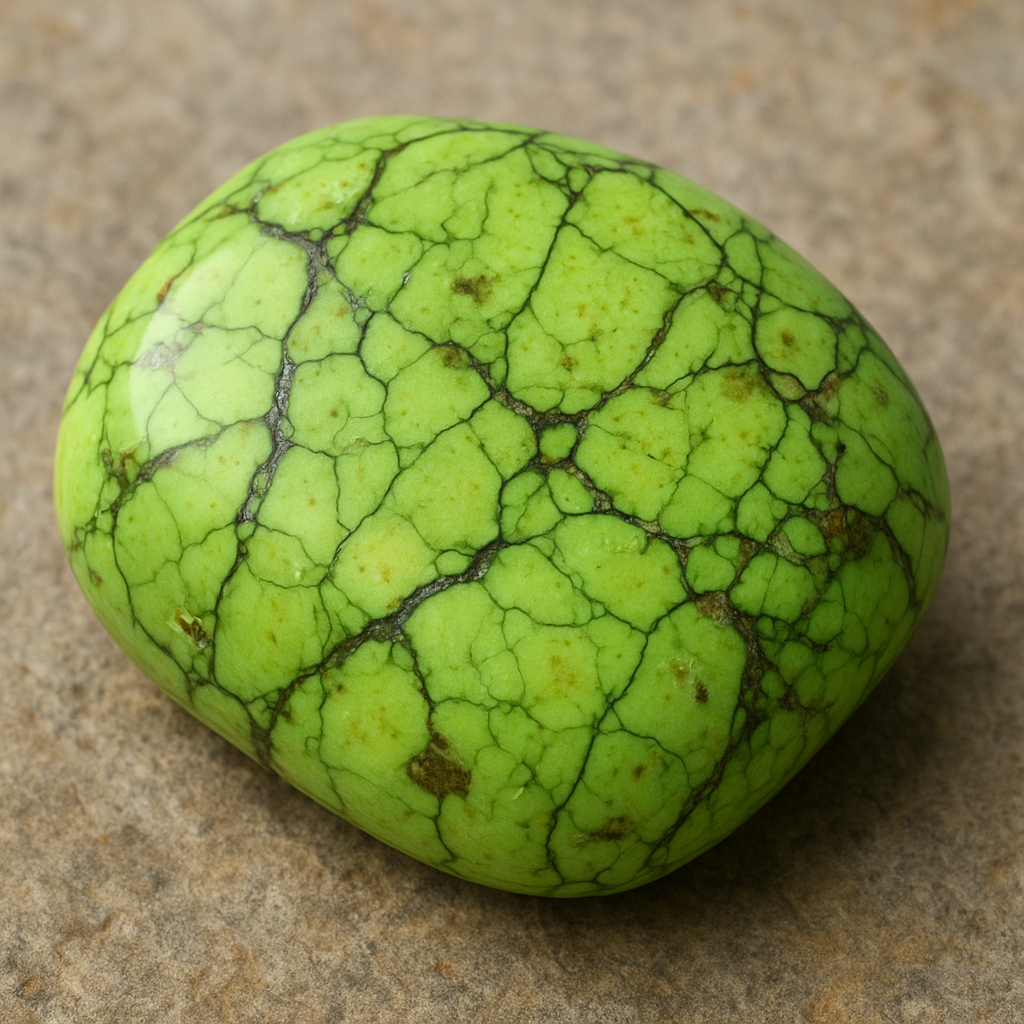
Gaspeite is a striking and relatively rare nickel-bearing carbonate mineral prized by collectors, lapidaries and geologists alike for its vivid apple-green color and intriguing origins. Beyond its aesthetic appeal, gaspeite provides valuable clues about the weathering and supergene processes that affect nickel-rich rocks, and it occasionally contributes to nickel ore in certain deposits. This article explores where gaspeite occurs, how it forms, its uses and handling in the gemstone and mining worlds, and several related topics that highlight why this mineral is both beautiful and scientifically interesting.
Occurrence and geological setting
Gaspeite most commonly forms as a secondary mineral in the oxidation zones of nickel-rich sulfide and ultramafic deposits. It is produced by the weathering and alteration of primary nickel minerals, where carbonate-bearing fluids enable nickel to precipitate as a nickel carbonate. The mineral is named after the Gaspé Peninsula in eastern Canada, its type locality, but it has been found in a number of other nickel-producing regions worldwide.
Notable localities
- Gaspé Peninsula, Quebec, Canada — type locality where gaspeite was first described.
- Western Australia — particularly around nickel fields such as Widgiemooltha, Kambalda and other Eastern Goldfields localities; Australian occurrences are among the most important sources of gem-quality material.
- New Caledonia — a classic nickeliferous island environment with lateritic weathering and secondary nickel minerals.
- Philippines, Indonesia and other tropical nickel laterite regions — where intense weathering can produce nickel carbonates and silicates.
- Scattered finds in parts of Europe, Africa and the United States — typically small pockets associated with oxidized nickel occurrences.
In terms of host rocks, gaspeite tends to be associated with ultramafic rocks (peridotites, serpentinites) and with zones where primary nickel-sulfide minerals have been exposed to oxygenated meteoric waters. It may occur as coatings, nodules, or masses within fracture zones, cavities, or as replacements of earlier minerals.
Physical and chemical properties
Chemically, gaspeite is a nickel-dominant carbonate; its idealized formula is NiCO3, but in nature it commonly contains significant iron and magnesium substitutions, producing a compositional series with magnesite (MgCO3) and siderite (FeCO3). This substitutional chemistry influences color, density and other properties.
- Color: distinctive apple to pistachio green, often the most diagnostic visual feature.
- Luster: vitreous to dull, depending on crystal habit and surface weathering.
- Crystal system: trigonal (rhombohedral) in well-formed crystals, but most specimens are massive or compact.
- Hardness: modest — generally around 4 to 4.5 on the Mohs scale, which makes it softer than many common gem materials.
- Specific gravity: relatively high for a carbonate because of nickel — commonly around 3.5 to 4.0, varying with iron content.
- Reaction to acid: effervesces weakly in cold dilute hydrochloric acid, as expected for carbonates, though the reaction can be subdued compared with calcite due to the nickel content and compactness of specimens.
Because gaspeite often forms as massive aggregates rather than well-formed crystals, many identification tests focus on color, association with nickel-bearing rocks, density and basic chemical behavior. The green hue produced by nickel is distinctive but can be confused with other green minerals, so context and tests matter.
Uses and applications
Gaspeite’s uses fall into three broad categories: mineralogical and geological science, aesthetic/lapidary use, and minor economic contribution to nickel resources.
Scientific and exploration uses
- As a supergene mineral, gaspeite helps geologists understand the oxidative alteration of nickel deposits and the mobility of nickel in near-surface environments.
- Its presence can indicate past fluid pathways and carbonate-rich groundwaters that promoted nickel precipitation, offering clues in exploration for deeper or associated nickel mineralization.
- Gaspeite and related carbonates are used in geochemical studies of element partitioning, isotopic work (carbonate C and O isotopes), and research into weathering rates in tropical and temperate climates.
Lapidary and jewelry
While relatively soft and sometimes brittle, attractive masses of gaspeite are cut and polished into cabochons, beads, rondelles, and inlay pieces. Because the saturated green is rarely matched by more common gem materials, gaspeite occupies a niche market among collectors and designers who seek unusual, natural-colored stones. It is often used in pendants, beads and inlay work rather than high-wear rings due to its modest hardness.
Economic and ore significance
Although gaspeite is not commonly mined as a primary source of nickel, it can contribute to the nickel content of supergene zones. In some Australian nickel deposits, gaspeite and other secondary nickel minerals are recognized in the weathered profile and factored into resource estimates when present in significant volumes. However, its rarity and sporadic occurrence mean it is usually of limited economic importance compared to major nickel ores such as lateritic limonite, garnierite-type silicates, or magmatic sulfides.
Identification, associated minerals and confusion with other green stones
Accurately identifying gaspeite requires a combination of visual, physical and contextual clues. The apple-green color is key, but several other minerals can appear similar. Here are common distinguishing points.
- Associated minerals: serpentine, talc, chromite, goethite, calcite, and other supergene nickel minerals (garnierite, théodore, pandermite in rare cases).
- Common confusions: chrysoprase (green chalcedony colored by nickel), variscite and turquoise (green-blue phosphate minerals), and chrysocolla (blue-green copper silicate). Unlike chrysoprase, gaspeite is a carbonate rather than silica; unlike variscite or turquoise, its chemistry and hardness differ.
- Diagnostic tests: streak (typically a pale green), specific gravity (relatively high), acid reaction (weak effervescence), and context (found in nickeliferous environments).
Because many gem-quality green stones are silica-based and much harder, a simple scratch test against a known standard (or a professional gemological assessment) helps separate gaspeite from lookalikes. For collectors, provenance from a known gaspeite locality and accompanying photographic and specimen records are valuable.
Lapidary work, treatment and care
Working with gaspeite requires care because of its softness and variable toughness. Lapidaries often stabilize gaspeite material with resins or backing to reduce cracking during cutting and polishing. Typical lapidary notes:
- Because gaspeite is softer than many common jewelry stones, it is best suited for low-impact uses such as pendants, earrings and beads rather than daily-wear rings.
- Stabilization with resin or epoxy can enhance durability and polish; however, such treatments should be disclosed to buyers and collectors.
- Avoid harsh cleaning methods: strong acids, prolonged soaking, and ultrasonic cleaners can harm the stone or remove stabilizing treatments.
- Nickel in the stone may cause allergic reactions in sensitive individuals if in prolonged skin contact; mounting designs that limit direct skin contact can reduce that risk.
Exploration, mining and environmental aspects
Gaspeite relates to broader themes in nickel exploration and mining. Its formation signals the mobility of nickel under oxidizing, carbonate-rich conditions and can mark pathways where nickel has been leached from primary sulfides and re-precipitated. From an environmental and resource perspective:
- Gaspeite indicates supergene enrichment processes: understanding these helps exploration geologists map out oxidized zones and evaluate whether further nickel resources may be present at depth.
- Because nickel mining can have significant environmental impacts (deforestation, soil erosion, acid drainage and heavy-metal mobility), the study of secondary nickel minerals like gaspeite contributes to rehabilitation strategies and interpretations of how nickel behaves in near-surface environments.
- Sampling gaspeite-bearing horizons can inform metallurgical planning if supergene nickel becomes a target; however, metallurgical behavior of nickel carbonates differs from more familiar sulfide and laterite ores and may require bespoke processing approaches.
Collecting, market and aesthetic appeal
Among mineral collectors, gaspeite is sought after for both its coloration and its relative rarity. Specimens range from small polished beads to larger museum-quality masses. The collector market treats gemmy, evenly colored pieces as most desirable; massive, mottled or heavily altered material is less valued.
- Specimens from classic or well-documented localities command higher prices, especially when accompanied by provenance information.
- Beads and cabochons are popular in artisan jewelry markets and among designers looking for distinctive green materials.
- Because gaspeite is not widely known to the general public, demand is steady but niche, and prices reflect rarity, color intensity, size and quality of polish.
Scientific interest and related research topics
Gaspeite intersects with several active lines of research in mineralogy and geochemistry:
- Studies of supergene processes and secondary mineral paragenesis in nickel deposits — gaspeite is one piece of a larger puzzle involving precipitation sequences, pH and redox conditions, and fluid chemistry.
- Isotopic studies of carbonate minerals — carbon and oxygen isotope ratios in gaspeite can preserve information about the source of carbonate, temperature of formation and interaction with atmospheric or soil-derived CO2.
- Environmental mobility of nickel — research into how nickel migrates and is immobilized in carbonate phases informs remediation and risk assessments around nickel mining areas.
- Material science interest — the vivid green of nickel carbonates contrasts with other nickel-bearing phases, leading to spectroscopic and structural studies to understand color centers and substitution effects in carbonate lattices.
Cultural and aesthetic notes
While not a mainstream gemstone, gaspeite carries an aesthetic resonance for those who favor natural and unusual materials. Its distinctive green is evocative of verdant landscapes and often used by artisans who favor ethically sourced or geologically interesting materials. In some regional contexts, gaspeite beads and pendants become local signatures that reflect nearby nickel geology and lapidary traditions.
For anyone interested in both the beauty and science of minerals, gaspeite sits at the intersection of aesthetic appeal and geological storytelling: a green stone that tells of buried ultramafic roots, of weathering waters, and of the slow redistribution of metals at Earth’s surface. Whether encountered as a polished cabochon in a market or as a crust on a weathered rock face, gaspeite invites closer examination from collectors, jewelers and geoscientists alike.