
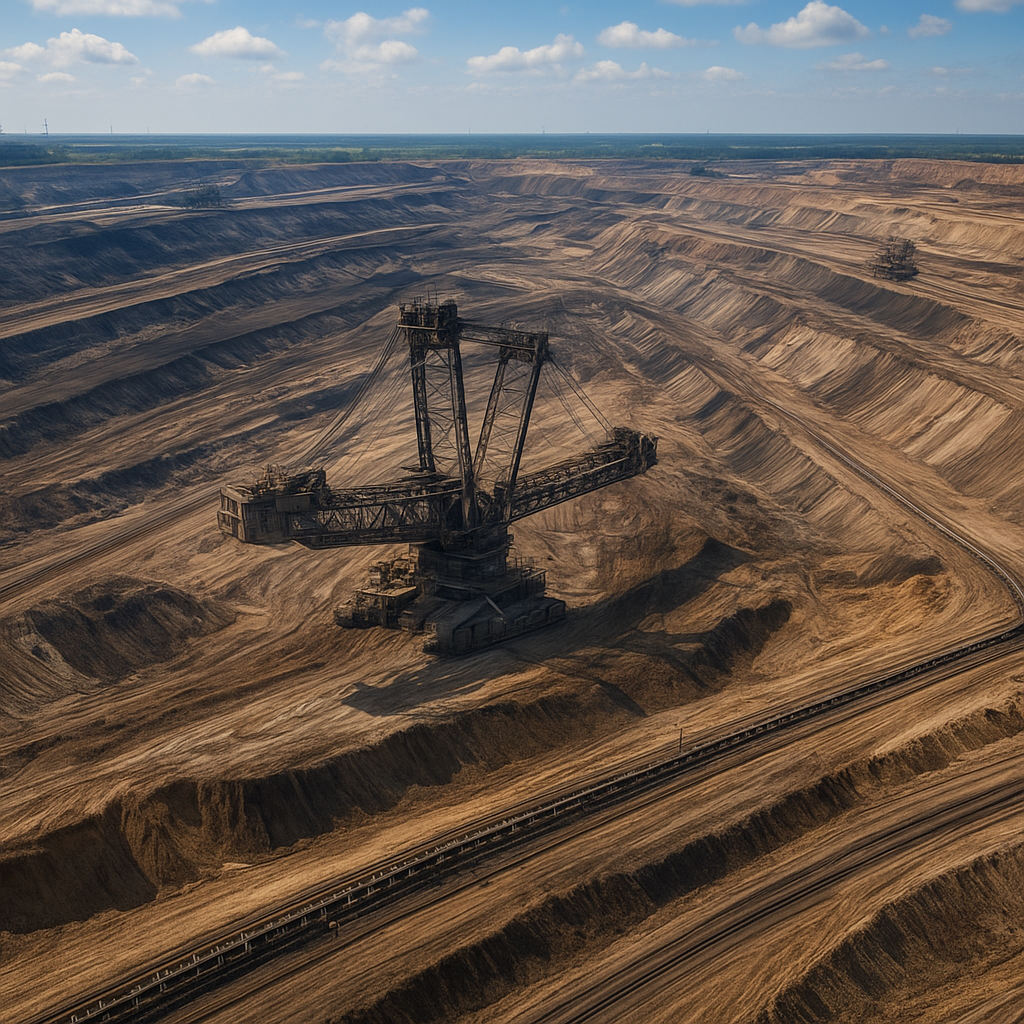
The Garzweiler mine is one of Europe’s most visible examples of large-scale surface coal extraction, a vast landscape reworked by machines, conveyors and human decisions that ripple through local communities, regional economies and national energy policy. Located in the heart of the Rhineland lignite district in western Germany, Garzweiler has been both a cornerstone of electricity production and a focal point for debates about climate, land use and social justice. This article examines where Garzweiler is, what is extracted there, how the mine operates and why it matters economically and culturally — and it highlights several striking facts and developments that make Garzweiler more than just an industrial site.
Location and geological setting
Garzweiler lies in the state of North Rhine-Westphalia, in the Rhineland region of western Germany. The mine sits roughly between the cities of Mönchengladbach and Erkelenz, extending across a patchwork of agricultural fields, small towns and former settlements. It is part of the larger Rhenish lignite mining area, which stretches across a swath of terrain shaped by millions of years of sedimentation. The area sits on shallow Tertiary basins where peat accumulated in ancient wetlands and, under pressure and time, transformed into lignite — commonly referred to as brown coal.
Geologically, lignite is a lower-rank coal with relatively high moisture content and lower carbon concentration compared to bituminous coal. It formed in this region during the Paleogene and Neogene periods, leaving seams that are often close to the surface and therefore amenable to open-cast or open-pit mining. These geological conditions made the Rhineland one of Germany’s most important sites for bulk coal extraction and underpinned the development of a dense network of mines and power plants across the region.
What is mined and how it is extracted
The primary product at Garzweiler is lignite, mined as a raw fuel for nearby power stations operated mainly by the energy company RWE. Lignite from Garzweiler is transported by a system of conveyor belts and heavy haulage to large coal-fired power plants such as Neurath and Niederaussem, where it is combusted for baseload electricity generation. Because lignite has a lower energy density than harder coals, power stations are typically sited close to the mine to minimize transport costs and energy losses.
Garzweiler is an open-pit operation and has been developed in phases. Early workings (sometimes referred to as Garzweiler I) were followed by a much larger expansion (Garzweiler II) that permitted deeper and broader excavation. Mining proceeds in benches and strips: layers of overburden (soil and rock) are removed, often with enormous machines, to expose lignite seams that are then extracted with a combination of bucket-wheel excavators, draglines and heavy trucks. Material movement is largely continuous — soil and waste rock are transported out of the pit by conveyor belts or haul trucks, while lignite is loaded and moved to processing or directly to transport systems feeding the power stations.
- Bucket-wheel excavators: Iconic in scale, these machines are capable of removing thousands of cubic meters of overburden per hour. They are a visual symbol of German opencast mining.
- Conveyor networks: Extensive belts link the pit to nearby plants, enabling steady flows of fuel without the need for long-distance trucking.
- Phase development: The mine has been extended in planned phases, which required careful mapping of seams, groundwater control and progressive expansion of haulage infrastructure.
Economic importance and industrial links
For decades, Garzweiler has been a central part of regional industry and employment. The site provides raw material for several power plants that contribute to Germany’s electricity mix. Although share of lignite in the national generation mix has been declining with renewables’ rise and the planned coal phase-out, lignite-fired plants have historically supplied reliable baseload power, supporting industrial activity and grid stability.
Key aspects of Garzweiler’s economic role include:
- Employment: The mine and its associated logistics, processing and administrative functions employ thousands directly and support many more in supplier industries, construction and services. Local economies around the mine depended for years on the jobs and tax revenues generated by coal extraction and power generation.
- Energy security and industrial supply: Nearby lignite-fired plants have provided consistent electricity to heavy industry in the Ruhr and Rhineland, supporting manufacturing and chemical sectors that are energy-intensive.
- Municipal finance: Mining companies contribute taxes and payments in lieu for municipal services. For many small towns that lost territory to the mine, compensation and tax revenues were vital to municipal budgets.
While these benefits are real, they have to be weighed against shifting national policy priorities, such as Germany’s legally mandated coal phase-out and commitments to reduce greenhouse gas emissions. Decisions about the mine’s future involve complex trade-offs between short-term economic impacts and long-term climate targets.
Social and environmental controversies
Garzweiler has been at the center of social and environmental controversy for many years. The expansion of the open-pit mine required the relocation or demolition of several villages and the resettlement of thousands of residents. These displacements raised emotional and legal conflicts over land rights, heritage and the meaning of place. Notable cases of resettlement brought national attention, with debates amplifying as environmental concerns gained political traction.
Environmental criticisms typically focus on three connected issues:
- Climate impact: Lignite is among the most carbon-intensive fossil fuels per unit of energy produced. Burning lignite contributes significantly to CO2 emissions and thus to climate change. Critics argue that continuing to extract and burn lignite is incompatible with ambitious climate goals.
- Landscape and biodiversity loss: Open-pit mining transforms ecosystems, removes topsoil, disrupts groundwater systems and eliminates habitats for flora and fauna. Even with subsequent reclamation, the original ecosystems are often irreversibly altered.
- Social disruption: Compulsory purchase orders, relocation packages and the dismantling of communities have led to protests, legal actions and sustained activism. The displacement of cultural landmarks and community ties has been a source of grief and resentment for some local residents.
Over the years, the mine has also attracted wide-ranging activism. Environmental groups, local citizens and international climate activists have staged demonstrations, occupied threatened sites and pursued legal avenues to delay expansion. These actions have sometimes led to high-profile confrontations, media coverage and political debate over the pace of Germany’s transition away from fossil fuels.
Technical, operational and reclamation practices
The technical complexity of a mine like Garzweiler is significant. Project planning must integrate geology, hydrology, engineering and logistics. Dewatering and groundwater management are constant concerns: removing water from the pit is necessary to maintain dry working conditions, but it affects local aquifers and can lower water tables, impacting wells and wetlands. Environmental monitoring programs track groundwater, air quality (including dust and particulates), and noise, while companies implement mitigation measures where possible.
Modern reclamation techniques aim to restore post-mining landscapes to new uses. Plans for rehabilitating areas affected by Garzweiler have included creating new lakes, establishing mixed-use recreation areas, and converting terraces into agricultural or forestry land. The profits and technical know-how generated by mining have been used to finance reclamation schemes — though critics point out that restored landscapes rarely replicate original ecosystems and that funding and timetables for rehabilitation can be politically contested.
- Progressive reclamation: Aims to rehabilitate areas as mining advances so that a perpetual barren pit is avoided.
- Lake creation: Deep pits, once mining ceases, are sometimes flooded to create artificial lakes that can serve recreation, biodiversity or groundwater stabilization functions.
- Topsoil management and biodiversity offsets: To preserve soil quality and seed banks, topsoil is often stripped carefully, stored and later reapplied to reclaimed land.
Interesting facts and recent developments
Several features of Garzweiler make it particularly noteworthy:
Scale and machines
The mine’s scale is immediately visible from satellite images: vast benches cut into the landscape, sinuous access roads and long lines of conveyors. Massive machines, including bucket-wheel excavators and conveyor systems, move millions of cubic meters of material over time. These machines have become almost emblematic of post-war industrial Germany’s ability to shape landscapes at enormous scale.
Village resettlement and community memory
Communities displaced by the mine have left behind churches, cemeteries and sometimes entire street patterns that were documented before demolition. In some cases, new villages have been built nearby for residents who accepted relocation, and archives, oral histories and memorials preserve the memory of the old settlements. The emotional resonance of losing one’s home is a dimension of the Garzweiler story that continues to reverberate in regional politics and cultural memory.
Policy conflicts and coal phase-out
Germany’s decision to phase out coal-fired power generation has directly affected Garzweiler. National and state-level policy decisions, court rulings and public protest have influenced the mine’s permitted lifetime and expansion plans. Debates over whether to accelerate the coal exit to meet climate targets put pressure on operators, municipalities and federal authorities to negotiate closures, compensation and conversion strategies for affected workers and regions.
Activism and legal battles
Garzweiler has been the focus of sustained activism, with demonstrations, legal challenges and protests aimed at preventing expansions or accelerating closure. The symbolic power of contested villages and the high-profile images of activists confronting heavy machinery have helped galvanize broader public discussions about energy transition, environmental justice and the social costs of fossil-fuel dependence.
Future land use and transition planning
As coal mining recedes, the transition of the Garzweiler area raises questions about the economic future of the region. Plans for post-mining development emphasize renewable energy projects, recreation, tourism around newly formed lakes, and reforestation. Retraining programs and investment incentives are critical to help former mining workers shift to new sectors. The success of these transition initiatives will be a litmus test for the broader structural transformation required in former coal regions.
Conclusion
Garzweiler is more than a pit in the ground; it is a crossroads of energy policy, economic livelihoods and environmental concern. Its lignite fuels power stations that have supported regional industry, while its expansion and operation have prompted social upheaval and environmental debate. The site’s future — whether long-term mining, managed closure, or rapid phase-out — will continue to influence how Germany balances short-term energy and economic needs with long-term climate commitments and community welfare. Observers inside and outside Germany will watch Garzweiler as an emblematic case of how industrial landscapes are decommissioned, repurposed and remembered.

