
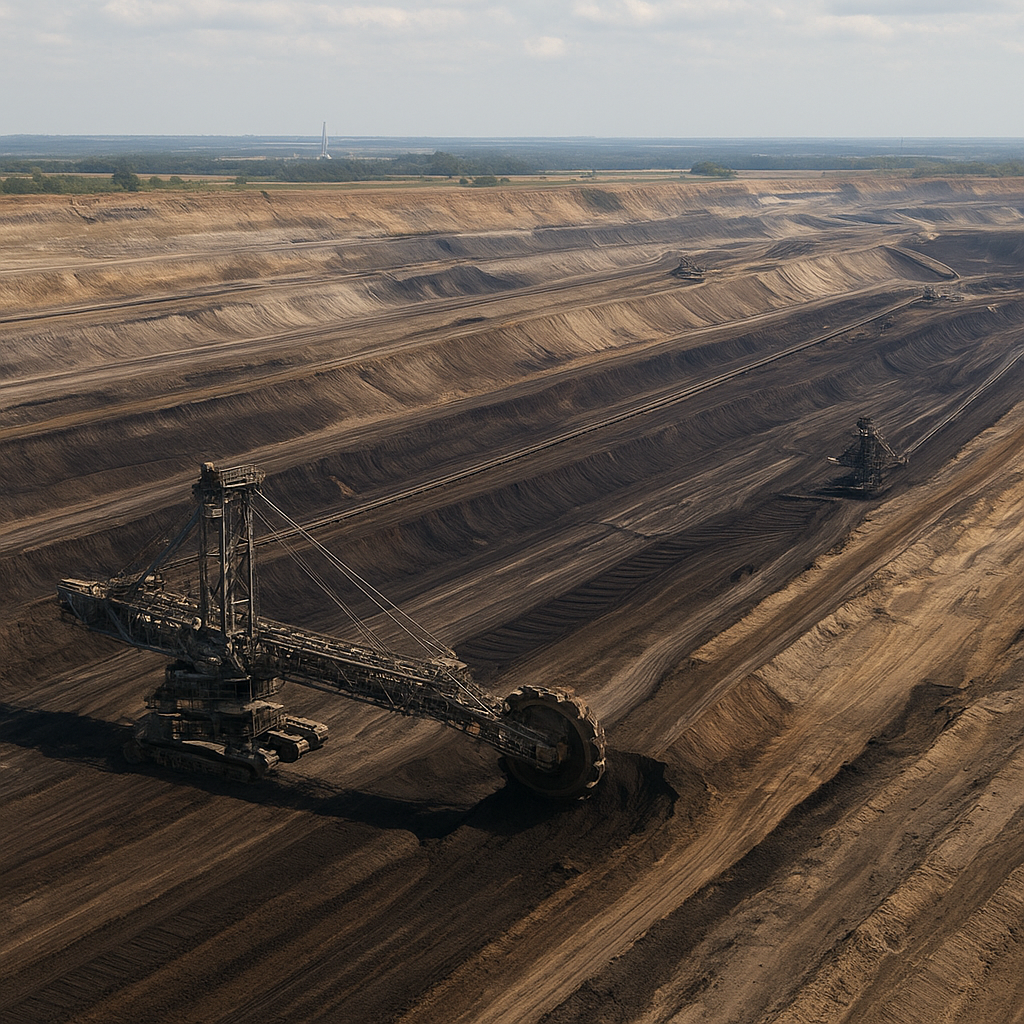
The vast excavation known as the Garzweiler mine has become one of the most visible symbols of Germany’s long relationship with brown coal. Located in the heart of North Rhine-Westphalia’s industrial landscape, this open-cast operation has shaped local communities, regional industry and national energy debates for decades. The following article explores where Garzweiler is situated, what is extracted there, why it matters economically, and several aspects that make it particularly noteworthy — from engineering feats to social controversies and plans for the future.
Location and geological setting
Garzweiler sits in western Germany, within the broader Rhenish lignite mining region that stretches across parts of North Rhine-Westphalia. The mine occupies a large expanse of the Lower Rhine Plain, an area characterised by relatively shallow sedimentary layers where deposits of brown coal formed over millions of years. These lignite seams developed during the Tertiary and Quaternary periods from dense, waterlogged vegetation in ancient marshes and peat bogs. Compared with higher-rank coals such as bituminous or anthracite, lignite contains a higher moisture content and lower calorific value, but its accessibility in thick, near-surface seams has historically made it an economical fuel for nearby thermal power stations.
The geology of the Garzweiler deposit allows large-scale surface mining: seams extend over wide horizontal distances and are not deeply buried, which makes strip-mining methods technically and economically feasible. This geological advantage underpins why the area evolved into a core energy-producing zone for decades, supplying electricity to major plants located within tens of kilometres of the pit. The landscape itself — flat fields and small villages — was reshaped as layers of soil and overburden were removed to expose the coal seams beneath.
Mining operations and what is extracted
At Garzweiler the main commodity extracted is lignite, commonly called brown coal. The operation is an open-pit mine relying on high-capacity equipment: enormous bucket-wheel excavators, conveyor systems that run for kilometres, and heavy-duty trucks and spreaders to move overburden. These machines operate continuously, enabling the mine to move millions of tonnes of material each year. The extracted coal is typically transported directly to nearby power stations via dedicated conveyor belts and rail links, minimizing costs and logistical bottlenecks.
Garzweiler has been developed in various phases; expansions and shifts in the mining front have been planned and approved over decades to match demand and regulatory frameworks. The mine does not produce refined products on site: its output is raw lignite destined mainly for combustion in thermal power plants to generate electricity and, in some cases, district heating. Some portion of the coal may be used on-site for immediate energy needs or further industrial processes, but the vast majority fuels regional power stations that supply residential, commercial and industrial consumers across the area and into wider grids.
Operational methods
- Open-cast excavation, removing topsoil and overburden to reveal lignite seams.
- Large-scale mechanical excavation using continuous mining equipment.
- Conveyor and rail transport to adjacent power generation facilities.
- Progressive reclamation and stockpiling of topsoil for later rehabilitation of exhausted areas.
These methods make large-volume extraction economically efficient but also produce significant landscape alterations. The depth and extent of the pit vary as the mine progresses; operations are planned years in advance to manage both technical and social impacts, especially in areas where communities must be relocated.
Economic importance and role in the energy system
Garzweiler has been an important component of regional industry, providing direct and indirect employment, contributing to local taxes and supporting supply chains that include engineering firms, transport companies and service providers. The mine’s significance is partly due to its role in fuel security: by providing a domestic source of energy, it reduced dependence on imported fuels and supported the electricity demands of Germany’s industrial heartland.
At the regional level, companies associated with the mine — most prominently the energy firm RWE — invested in infrastructure, roads and community projects tied to the presence of mining and power generation. Revenue from coal sales and taxation helped fund municipal services and local development for decades. Moreover, many local economies were structured around the jobs and contracts embedded in the extractive and energy sectors, creating a network of economic dependencies that made transitions away from coal complex and politically sensitive.
However, the energy landscape in Germany has been undergoing rapid transformation. National commitments to reduce greenhouse gas emissions, the expansion of renewable energy, and policy instruments such as the coal phase-out plan have put energy sourced from lignite under increasing scrutiny. These shifts affect the economic calculus for mines like Garzweiler: the long-term demand for coal is declining, and planned timelines for closures are driven by political decisions as much as by geological or operational constraints.
Social and environmental impacts
One of the most contentious aspects of Garzweiler is the human and environmental cost of extracting low-grade coal on such a scale. For communities in the path of the expanding pit, resettlement has been a reality. Entire villages have been, or are planned to be, relocated to accommodate the mine’s progression. These relocations involve not only the physical movement of homes and infrastructure but also the social disruption of moving communities with long-standing local ties and cultural heritage. Compensation, the construction of replacement housing and extensive legal and planning processes aim to mitigate impacts, but the emotional and social costs remain significant for many residents.
On the environmental front, open-pit mining alters hydrology, displaces soils and removes vegetation, with consequences for biodiversity and landscape aesthetics. Groundwater management is a major technical and ecological challenge: dewatering the pit can lower local water tables, affecting wells, wetlands and agricultural land. Dust, noise and increases in truck and train traffic also affect the local quality of life.
Beyond the local impacts, the carbon footprint of lignite combustion is a key global concern. Lignite is among the most carbon-intensive fossil fuels per unit of energy produced. The operation of large coal-fired power plants fueled by Garzweiler’s output contributed substantially to Germany’s CO2 emissions over many years. As a result, Garzweiler has become emblematic of the tension between economic benefits and the need for deep emissions reductions in line with climate goals. Protests, civil society campaigns and legal challenges have repeatedly focused on the mine as a focal point in the climate debate.
Interesting technical, historical and cultural aspects
Several features of Garzweiler and the surrounding lignite region make it noteworthy beyond its immediate industrial function. First, the scale of modern open-pit mining in Germany is technologically impressive: the huge bucket-wheel excavators and continuous conveyor systems represent decades of industrial engineering tailored to efficiency and reliability. These machines are often photographed and visited as demonstrations of heavy engineering.
Second, the mine has been the center of sustained civic action. Environmental groups, climate activists and local residents have organised demonstrations, direct actions and legal challenges against expansions and against continued coal use. These actions, particularly in the last decade, attracted national and international attention — partly because they intersect with Germany’s ambitious energy transition policies, known as Energiewende, and the politically sensitive question of how to phase out conventional coal while securing employment and energy supplies.
Third, post-mining rehabilitation plans illustrate how societies attempt to reconcile extractive legacies with future land uses. Reclamation strategies often include reshaping pit walls, redistributing topsoil and creating lakes and recreational areas after mining ceases. Some of these projects aim to restore biodiversity and offer new economic possibilities through tourism and leisure. However, the practicalities of filling large voids, managing water quality and re-establishing sustainable land uses can take decades and require careful hydrological planning.
Fourth, Garzweiler sits within a complex network of related infrastructure: large lignite-fired power plants located near the pit, high-voltage transmission lines feeding the national grid, and extensive road and rail logistics. This integrated industrial landscape is a reminder of how energy systems are spatially organised, concentrating extraction, conversion and distribution in connected nodes.
Notable points
- Garzweiler’s operations exemplify large-scale open-cast mining technology and logistics.
- The mine highlights the social dimension of energy transitions, particularly the challenge of relocating communities.
- Its contribution to regional economies contrasts sharply with its environmental footprint, making it central to national debates on climate policy.
Future outlook and contested legacies
The future of Garzweiler is intertwined with Germany’s broader commitments to reduce carbon emissions and to phase out most coal-fired power generation. Policy decisions at federal and state levels, alongside market developments in renewable energy and storage technologies, influence the operational horizon of the mine. Transition measures — including early retirement of coal plants, structural funding for affected regions and retraining programs for workers — are central to managing the social and economic consequences of shutting down coal production.
At the same time, the physical legacy of Garzweiler will persist for generations. Even after mining stops, the reclaimed pit, altered hydrology and surviving industrial infrastructure will shape local environments and economies. Some view post-mining landscapes as opportunities for ecological restoration and new economic activities; others see them as reminders of loss and displacement. The contested memory of places like Garzweiler touches on identity, heritage and how societies weigh short-term needs against long-term environmental goals.
In sum, the Garzweiler mine is more than a site of extraction: it is a focal point where geology, engineering, economics, politics and social life intersect. Its history and unfolding transition encapsulate the challenges facing regions that grew around fossil-fuel industries, offering lessons about technological adaptation, community resilience and the complexities of moving toward cleaner energy systems while addressing the human costs embedded in those changes. The story of Garzweiler thus continues to be written — in planning documents, in political debates, and in the lives of the people who live around its enormous pit — as Germany and the world negotiate the future of energy and the landscapes that have powered the past.

