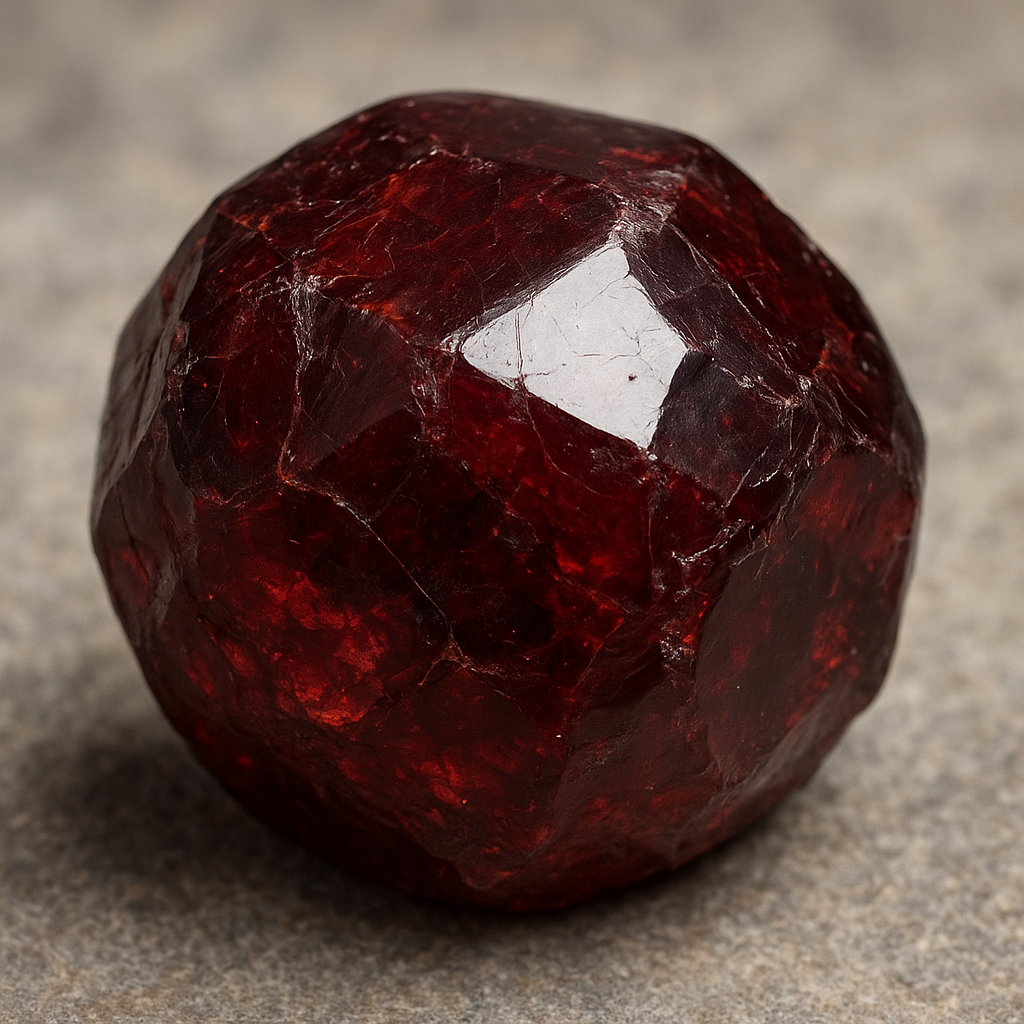
The deep red and sometimes kaleidoscopically colored mineral known as Garnet has captured human attention for millennia. It appears in jewelry cases, geological reports, industrial catalogs and mythic stories alike. Although often associated with a warm, ruby-like glow, garnet is not a single mineral but a family of closely related silicate minerals with a shared crystal structure and a wide range of chemical compositions. This article explores where garnet occurs, how it is used across industries, its varieties and identification, historical and cultural significance, and some lesser-known facts collectors and professionals find intriguing.
Geology and Natural Occurrence
Garnet forms in a variety of geological environments, making it common in metamorphic, igneous and even some sedimentary rocks. The general crystal structure of garnet allows multiple cations to substitute for one another, producing several distinct species. The most common types are almandine, pyrope, spessartine, grossular, andradite, and uvarovite, each with characteristic colors and typical host rocks.
Metamorphic Rocks
Many garnets grow in medium- to high-grade metamorphic rocks such as schists and gneisses. During regional metamorphism, minerals react to heat and pressure, concentrating aluminum, iron, magnesium, chromium, and manganese into garnet crystals. These environments often produce the deep red, dense garnets prized for jewelry and industrial applications.
Igneous Rocks and Pegmatites
Garnet can crystallize from magmas or form late in pegmatites where fluids concentrate incompatible elements. Pyrope, for instance, is commonly associated with ultramafic rocks such as peridotite and kimberlite; gem-quality pyrope is often found in kimberlite-hosted deposits and can be associated with diamonds.
Skarns and Hydrothermal Zones
Where carbonate rocks such as limestone meet intruding magmas, skarn formation can produce attractive garnets, especially grossular and andradite. Hydrothermal activity can also deposit garnet in fracture zones and veins, sometimes producing gemmy crystals with fascinating color zoning.
Notable Deposits Around the World
- India — historic source of various garnets, including almandine and pyrope, often in alluvial deposits.
- Sri Lanka — renowned for gem-quality garnets, with long-standing use in jewelry.
- Madagascar — rich in a range of garnet species and colors, including rare varieties.
- United States — garnet mounds and mines in New York (almandine), Idaho, and the western states produce both gem and abrasive material.
- Russia — Ural Mountains and Siberia yield garnets, including notable pyrope and almandine specimens.
- Africa — Tanzania, Kenya, Namibia and Mozambique produce high-quality garnets such as tsavorite (grossular variety) and rhodolite (pyrope–almandine mix).
Varieties, Colors and Gemology
The garnet group exhibits spectacular diversity of color and optical properties. The differences arise from variations in chemical composition and trace elements. Some garnets are monochrome and opaque; others are transparent, lustrous and suitable for cut gemstones.
Key Garnet Species
- Almandine — iron-rich, typically deep reddish-brown to red; common in metamorphic rocks and widely used as both gem and industrial abrasive.
- Pyrope — magnesium-rich, often deep red, known for its association with diamonds in kimberlite; rhodolite is a purplish-pink pyrope–almandine mixture prized in jewelry.
- Spessartine — manganese-bearing, vibrant orange to reddish-orange; sought after for its brilliant warm hues.
- Grossular — calcium-aluminum garnet with a wide color range including green (tsavorite), yellow, and colorless varieties; tsavorite (green) is one of the most valuable garnets.
- Andradite — calcium-iron garnet, which includes the black opaque melanite, the honey-brown topazolite, and the rare, vivid green demantoid considered one of the finest gem garnets.
- Uvarovite — chromium-bearing, typically an intense emerald-green; relatively rare as gem crystals but admired by collectors.
Optical Properties and Identification
Garnets are typically singly refractive but some varieties show anomalous double refraction. They often have high refractive indices and strong dispersion, which contributes to fire and brilliance in faceted stones. Hardness ranges from about 6.5 to 7.5 on the Mohs scale, making many garnets durable enough for daily wear. Identification involves observing color, crystal habit, refractive index, specific gravity, and sometimes advanced spectroscopy to determine chemical composition.
Industrial Uses and Abrasives
Beyond its role as an attractive gemstone, garnet is an important industrial mineral. Certain garnet varieties, especially tough, hard almandine and andradite, are crushed to produce abrasive grit used in multiple processes. This industrial side is less glamorous than jewelry but accounts for much of the mineral’s worldwide production.
Waterjet Cutting
One of the fastest-growing uses of garnet is as an abrasive medium in waterjet cutting systems. High-pressure water combined with garnet particles can slice through metals, composites, stone and glass with precision and without heat-affected zones. The angular shape and hardness of crushed garnet make it ideal for this application.
Sandblasting and Surface Preparation
Garnet abrasive is commonly used for sandblasting to prepare steel and concrete surfaces for coatings. Its relative chemical inertness and low dust generation compared to silica sand have made it a preferred choice in many industrial settings.
Filtration Media and Other Uses
Heavy garnet grains are used in multi-media water filtration systems for municipal and industrial water treatment. Its density and durability provide effective filtration layers. Garnet is also used in abrasive papers, polishing compounds and in specialty ceramics and refractory products.
History, Culture and Symbolism
Garnet has a long cultural history spanning ancient civilizations. It was used in Mesopotamia, Egypt, Greece and Rome, often carved into intaglios, set into rings and used as inlay. Its deep red hues associated it with blood, fire and vitality, and many cultures accorded it protective and healing powers.
Historical Uses
- Ancient Egyptians used garnet as inlay and jewelry, seeing it as a symbol of life and protection.
- Roman soldiers sometimes carried garnets engraved with personal symbols, using them both ornamentally and as talismans.
- In medieval Europe, garnets were believed to protect against wounds and bad dreams and were associated with the defense against poison.
Modern Symbolism
Today garnet remains a popular birthstone for January and a common gift for second wedding anniversaries. Different hues and varieties carry nuanced meanings: green tsavorite is often linked to prosperity, while red pyrope and almandine are associated with passion and energy.
Cutting, Care and the Gem Market
Garnets can be cut into a wide range of shapes and faceted designs that highlight their brilliance and color. Certain varieties such as demantoid and tsavorite command premium prices due to rarity and exceptional optical properties. Others like common almandine are more affordable and widely available.
Gem Cutting Considerations
Because garnet crystals are isotropic in many species and have strong color, cutters often emphasize color uniformity and clarity. Pleasing saturation and minimal inclusions increase value; however, some garnets with unique inclusions or horsetail-style inclusions (in demantoid) are especially prized by collectors.
Care and Maintenance
Garnets are relatively durable but can be chipped by sharp blows. Clean most garnet jewelry with warm water, mild detergent and a soft brush. Avoid ultrasonic or steam cleaning for specimens with fractures or filled stones. For heavily included stones, a gentler approach preserves integrity.
Environmental and Ethical Considerations
As with many mined minerals, garnet extraction can have environmental and social impacts. Large-scale mining for abrasive-grade garnet has prompted concerns about habitat disruption, dust, water usage, and community effects. Conversely, garnet mining is often less chemically intensive compared with metals mining, and reclamation strategies can mitigate long-term impacts.
Responsible Sourcing
Consumers and industry increasingly seek responsibly sourced garnet. This includes mine rehabilitation, fair labor practices, transparent supply chains and minimized chemical use. For gem-quality garnet, traceability programs and reputable dealers help buyers make ethical choices.
Uncommon and Fascinating Facts
Beyond its common uses, garnet has many interesting and lesser-known facets. For example, the discovery of garnet inclusions in diamonds can be used as an indicator of diamond provenance and deep mantle processes. Demantoid garnets sometimes show “horsetail” inclusions—fibrous chrysotile-like minerals radiating within the stone—which paradoxically increase desirability among collectors due to their unique appearance.
Another curiosity is the role garnet plays in geology as an index mineral: the presence of certain garnet species in metamorphic rocks can indicate the pressure and temperature conditions experienced by those rocks. Thus garnet acts not only as ornament and tool, but as a recorder of deep Earth processes.
Identification for Collectors and Enthusiasts
For hobbyists and collectors, distinguishing garnet types can be a rewarding challenge. Portable refractometers, specific gravity measurements, and observation under magnification help separate species. Color alone is not decisive; chemical tests, spectroscopy and professional gemological laboratories provide definitive identification for rare and valuable specimens.
In sum, garnet is a mineral group of remarkable versatility. It serves as a durable gemstone, an indispensable industrial abrasive, and a geological informant. From the green brilliance of demantoid and tsavorite to the rich reds of pyrope and almandine, garnets continue to be prized for their beauty, functionality and scientific value.