
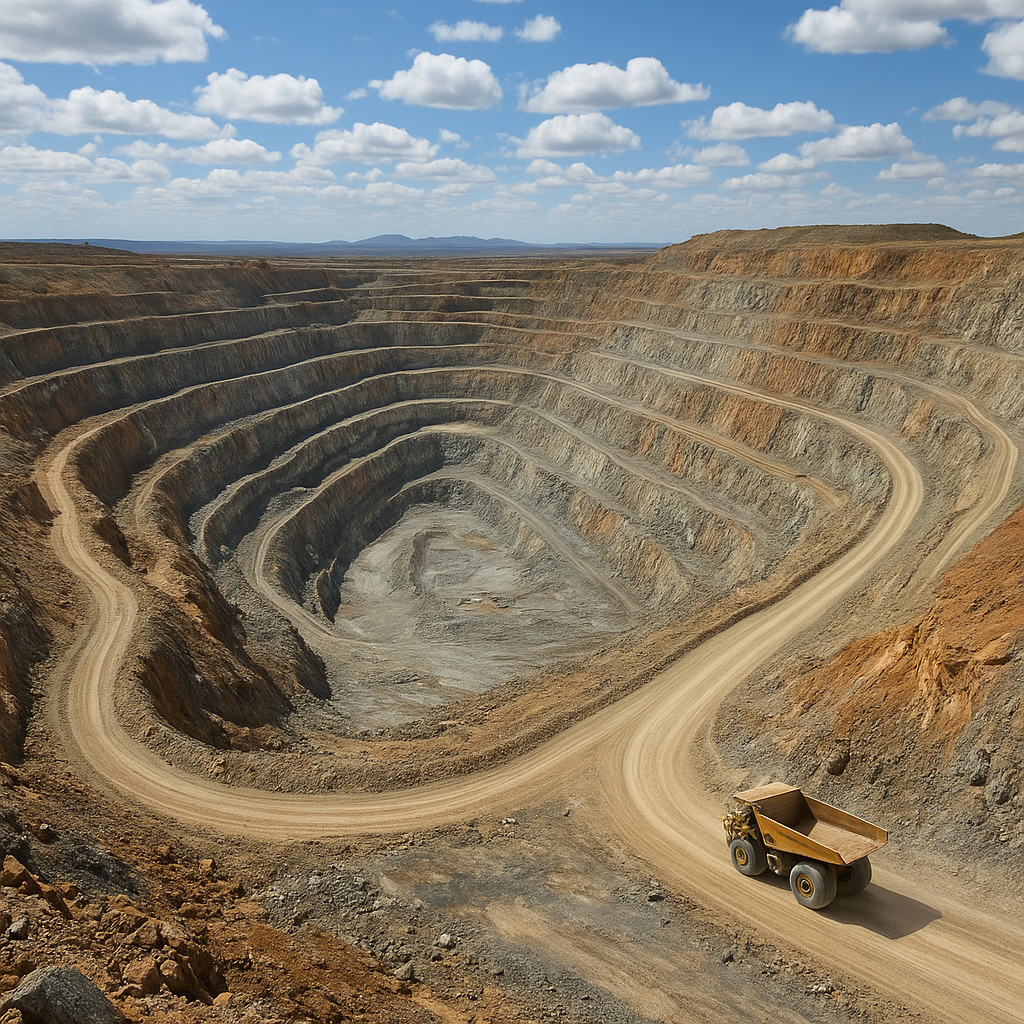
The Gamsberg Mine, situated in the dry, mineral-rich heart of South Africa’s Northern Cape, stands out as one of the country’s most significant zinc developments of the 21st century. Combining a high-quality zinc orebody, modern open-pit mining methods and a purpose-built processing plant, the mine has attracted attention not only for its contribution to global zinc supply but also for its local socio-economic impact and environmental challenges. This article explores the mine’s location and geology, the materials it produces and how they are processed, its economic significance, and several noteworthy technical and cultural aspects that make Gamsberg an interesting case study in contemporary mining.
Location and geological setting
The Gamsberg deposit is located in the Northern Cape Province of South Africa, in a remote semi-arid area known for its dramatic landscapes and sparse human settlements. The mine lies close to the small mining town of Aggeneys and within driving distance of Springbok, the regional service centre. Its setting is marked by the flat-topped Gamsberg plateau and surrounding shrublands, an environment that reflects both striking natural beauty and logistical challenges for a modern mining operation.
From a geological perspective, the deposit is hosted in stratiform mineralized lenses within sedimentary rock sequences. Such deposits are formed through the concentration of zinc (and commonly lead and silver) in specific layers during ancient sedimentary processes and later geological events. The Gamsberg orebody has been recognized for its relative continuity and substantial tonnage, characteristics that make it attractive for open-pit extraction and long-life operation.
The mineralization at Gamsberg is primarily zinc-bearing, often accompanied by smaller amounts of lead and silver. These metals occur as sulphide minerals that can be separated and concentrated using conventional mineral processing techniques. The presence of relatively simple metallurgy—compared with more refractory ores—has allowed developers to design efficient processing flowsheets that maximize zinc recovery while controlling costs.
Mining methods and processing
The operation at Gamsberg is implemented as an open-pit mine, chosen because the orebody is near the surface and extensive overburden removal is economically feasible. Open-pit mining allows for large-scale extraction, straightforward truck-and-shovel operations and predictable ore delivery to the processing plant. Because the project is located in an arid area, mining plans pay careful attention to water usage, dust control and the management of tailings and waste rock.
From ore to concentrate
Once extracted, ore from Gamsberg is transported to an on-site processing facility where it undergoes crushing, milling and flotation to produce a zinc concentrate. The crushing and milling steps reduce rock to the fine particle sizes required for effective concentration. Froth flotation then separates the zinc-bearing minerals from gangue, yielding a zinc-rich concentrate that can be transported and sold to smelters and refineries both domestically and internationally.
Although zinc is the primary product, the processing stream typically recovers lead and silver as minor constituents or valuable by-products, improving the overall project economics. The concentrate produced is shipped to smelters that extract metallic zinc through pyrometallurgical or hydrometallurgical routes. Zinc is then refined to high purity for industrial applications.
Infrastructure and logistics
Developing infrastructure in a remote region has been an important component of Gamsberg’s implementation. The project includes not only the mine and processing plant but also water supply and treatment systems, electrical supply (often tied into a combination of grid connections and on-site generation), access roads and tailings storage facilities. Transport logistics for concentrate typically involve trucking to a port or railhead for export, which requires careful scheduling and coordination to maintain steady sales to customers around the world.
Economic and social significance
The economic role of the Gamsberg Mine extends from the local to the global level. At the regional and national level, the mine contributes to South Africa’s mineral production profile by adding significant zinc output—zinc being a base metal with wide industrial use. Zinc’s primary application is corrosion protection through galvanizing, which underpins the longevity of steel infrastructure in construction, transportation and manufacturing. Secondary uses include alloys, die-casting, chemicals and, increasingly, battery technologies and renewable-energy applications where stable metal supply chains are important.
Locally, the mine provides direct employment opportunities in mining, processing and maintenance roles as well as indirect jobs in services, logistics and supply chains. Training and skills development are frequently emphasized by modern mining companies as part of their social investment strategies, enabling local residents to gain technical qualifications and experience that are transferable beyond the mine’s lifetime. Procurement of goods and services from nearby towns also stimulates small and medium-sized enterprises in the region.
Revenue from mining operations contributes to government coffers through taxes, royalties and permits, which can be channeled into infrastructure, health and education—if managed transparently and effectively. Gamsberg’s economic footprint therefore includes wages and contractor income, business opportunities for suppliers and long-term contributions to regional development when integrated with responsible public policy.
Environmental management and sustainability
Operating in a fragile semi-desert environment places a premium on careful environmental stewardship. At Gamsberg, efforts are typically focused on minimizing water consumption, managing dust emissions, controlling runoff and ensuring the safe containment of tailings and waste rock. Because the region receives limited rainfall, water used in processing is often recycled and treated to reduce demand on local sources. Evaporative losses and saline groundwater issues require robust engineering and continual monitoring.
Tailings storage facilities are designed to meet modern standards, with emphasis on structural stability, seepage control and long-term closure planning. Progressive rehabilitation—recontouring waste rock, respreading topsoil and re-establishing indigenous vegetation—helps reduce the ecological footprint over time. Biodiversity considerations are also taken into account, as even arid ecosystems host specialized plant and animal life adapted to local conditions.
Community engagement and social license to operate are integral parts of sustainable mining. Programs that support education, healthcare, local procurement and small business development help build trust and deliver tangible benefits to host communities. Transparency around environmental monitoring results and proactive grievance mechanisms contribute to better relations between the mine and nearby residents.
Interesting technical and cultural aspects
- Modern processing: The adoption of contemporary milling and flotation technology at Gamsberg demonstrates how large zinc deposits can be developed with relatively compact footprints and efficient recovery rates, compared with older, less efficient operations.
- Resource longevity: The continuity and size of the orebody suggest a multi-decade life of mine under current production scenarios, making it a strategic asset for the operator and a stable source of regional employment.
- By-product value: Even though zinc is the headline product, the recovery of lead and silver improves project economics and highlights the importance of integrated metals recovery in modern ore processing.
- Water-scarce operations: Gamsberg serves as an example of how mining can be conducted in water-limited regions through recycling, desalination (where used), and careful hydrological planning.
- Cultural landscape: The Northern Cape’s stark landscapes and clear night skies form part of the cultural and natural value of the area. Mining activities intersect with traditional land uses and heritage values, necessitating respectful consultation and often creative mitigation strategies.
Challenges and forward-looking considerations
No large mining project is without its challenges. For Gamsberg, these include the need to:
- maintain sustainable water and energy supplies in a remote setting;
- ensure tailings and waste management meet international standards for safety and environmental protection;
- foster meaningful local development that extends beyond the lifespan of the mine;
- manage commodity-price volatility that affects revenue streams and investment plans;
- adopt decarbonisation measures and renewable-energy integration to reduce the operation’s greenhouse gas footprint.
Addressing these issues requires continuous technical innovation, strong governance, stakeholder engagement and the incorporation of circular economy principles where possible—such as maximizing materials recovery and minimizing waste.
Why Gamsberg matters
The Gamsberg Mine matters for several interlinked reasons. At a commodities level, it is a meaningful addition to global zinc supply, supporting industries that rely on corrosion protection and various downstream manufacturing processes. At a national level, it represents investment in the Northern Cape’s economic base, creating jobs and infrastructure in a sparsely populated area. Environmentally and socially, it illustrates the balance that modern mining projects must strike between resource extraction and long-term stewardship of land, water and community well-being.
Finally, Gamsberg is an instructive example of how high-quality mineral deposits, when combined with contemporary engineering and governance, can be developed responsibly to deliver broad-based benefits while mitigating environmental impacts. As global demand for base metals evolves—driven by infrastructure, electrification and new technologies—the role of well-managed mines like Gamsberg in securing reliable metal supplies will remain significant.

