Galena is one of the most recognizable and historically important minerals on Earth. As the principal ore of lead and a frequent carrier of silver, it has shaped economies, technologies, and landscapes for millennia. This article explores where galena is found, how it forms, its properties and uses, and several fascinating scientific and cultural connections that make it far more than just a dense, metallic-looking rock.
Physical properties and mineralogy
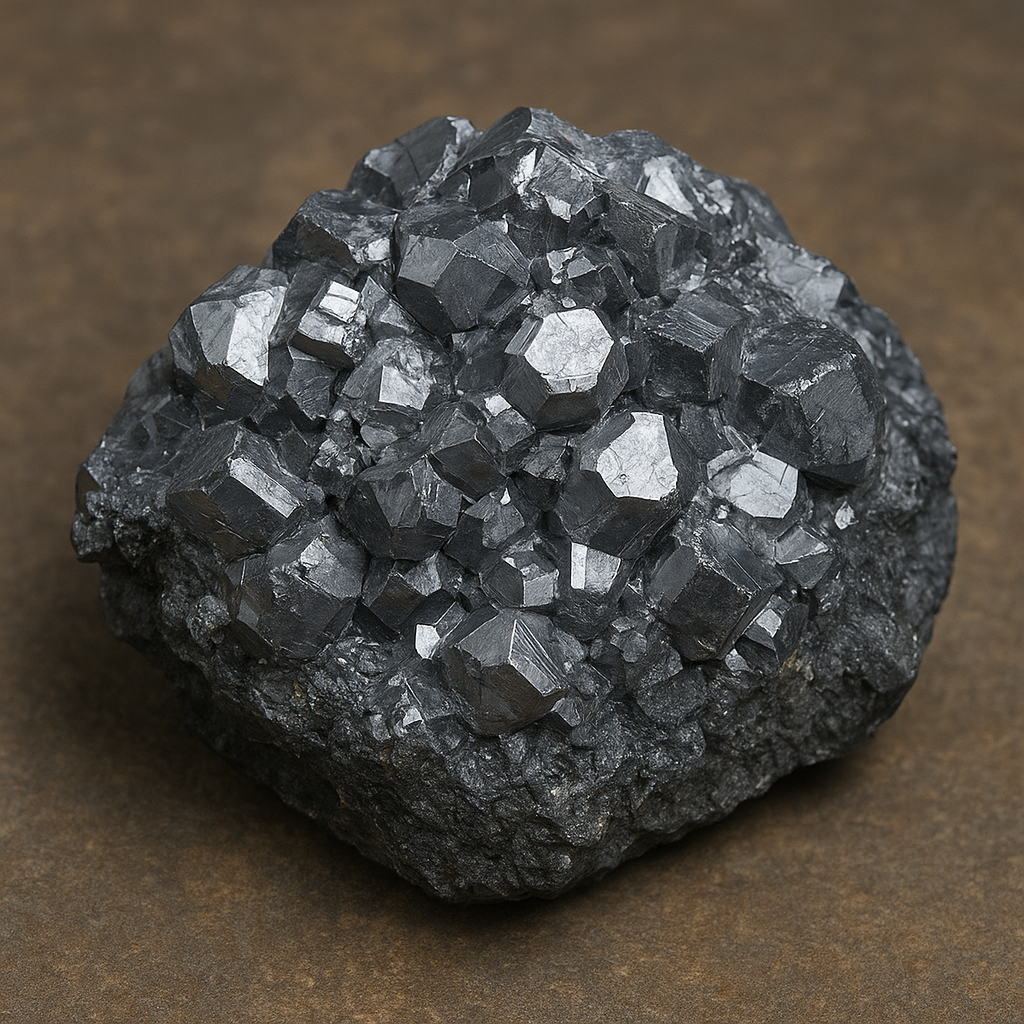
At its simplest, galena is the mineral form of lead sulfide, PbS. It crystallizes in the cubic system, commonly forming well-defined cubes and octahedra with a bright metallic luster and a characteristic lead-gray streak. Key identification features include excellent cubic cleavage (three directions at right angles), a relatively low hardness of about 2.5–2.75 on the Mohs scale, and a high specific gravity—typically around 7.4–7.6—making specimens feel notably heavy for their size.
Crystal habits and varieties
Galena often displays euhedral cubic crystal habits, from tiny grains to lustrous, polished cubes several centimeters across. It frequently forms intergrown masses and can show twinning and penetration twins. Although pure galena is metallic and silver-gray, impurities and alteration can produce varied surface iridescence, and oxidation zones may yield colorful secondary minerals.
Chemistry and physical behavior
Chemically simple as PbS, galena behaves as a dense sulfide mineral with semiconducting properties—PbS has a narrow band gap and unique optical behavior. Under weathering, galena oxidizes to form secondary lead minerals such as cerussite (PbCO3), anglesite (PbSO4), and pyromorphite (a lead phosphate-chloride), which are commonly observed in the oxidized zones above lead deposits.
Geological settings and global occurrence
Galena appears in a wide range of geological environments because lead-bearing hydrothermal fluids can migrate into many host rocks. The most important deposit types that host galena include:
- MVT (Mississippi Valley-Type) deposits: These are carbonate-hosted, sedimentary rock-hosted lead-zinc deposits formed from warm, basinal brines. Classic MVT districts—such as parts of the central United States and Europe—contain stratabound galena associated with calcite and fluorite.
- Sedimentary exhalative (SEDEX) deposits: Formed on or near the seafloor by the discharge of metal-rich brines, many ancient SEDEX systems contain large volumes of galena and sphalerite in massive sulfide strata.
- Hydrothermal vein systems: Veins cutting across host rocks—often accompanied by quartz, calcite, and sulfide minerals—are common. These veins form from high- to moderate-temperature hydrothermal fluids.
- Replacement deposits: Galena often replaces carbonate rocks or other lithologies in skarn and metasomatic systems.
- Metamorphic and contact-metamorphic contexts: In some cases, lead-rich protoliths are reworked during metamorphism to concentrate galena.
Major historical and modern producers include the United States (notably Missouri, the Appalachian and Rocky Mountain regions), Australia (Broken Hill and other districts), Canada (several deposits in British Columbia and Newfoundland), Mexico, Peru, Spain, Germany, and Poland. Some of the world’s largest lead mining districts—like Broken Hill—also carry significant amounts of silver in association with galena.
Economic importance and processing
Galena is the primary ore of lead, an element used in many industrial applications. Lead is recovered from galena through concentration and smelting processes.
Ore concentration
Most lead ores are concentrated by flotation, a process that separates sulfide minerals from gangue by altering their surface chemistry and inducing attachment to air bubbles. After milling, the lead-rich concentrates are dewatered and sent to smelters.
Smelting and refining
In smelters, galena concentrates are roasted to convert sulfides to oxides and sulfates, releasing sulfur dioxide (SO2). Modern smelting operations capture SO2 and convert it to sulfuric acid to reduce environmental emissions. Lead is then reduced from its oxides and refined. In many deposits, galena contains significant silver; during refining, silver is recovered through processes such as the Parkes process (adding zinc to remove silver) and subsequent refining steps.
Primary uses of lead
Lead’s properties—high density, malleability, corrosion resistance, and low melting point—have made it useful for centuries. Primary contemporary uses include:
- Lead-acid batteries (the largest single use worldwide), crucial for automotive and backup power systems.
- Radiation shielding in medical and nuclear applications due to lead’s ability to attenuate ionizing radiation.
- Alloys and solder historically (although many solder uses have shifted to lead-free alternatives for health reasons).
- Certain cable sheathing, weights, and ballast in specialized industrial contexts.
Historical, cultural, and archaeological significance
Galena’s history is tightly interwoven with human metallurgy. Ancient smelters processed lead ores thousands of years ago; lead artifacts, pipes, and pigments appear throughout antiquity. In ancient Egypt and the Near East, ground galena was used cosmetically as kohl eyeliner. Roman mining and smelting of galena supplied significant amounts of lead for plumbing, coins, and statuary.
Archaeologists frequently use lead isotope ratios from galena and lead artifacts to trace ore sources and trade networks. Because lead isotopes carry a fingerprint of the geological history of their source ore, studies of galena have illuminated ancient mining locations and metallurgical exchange routes.
Scientific and technological applications
Beyond metallurgy, galena has contributed to science and technology in surprising ways.
Early electronics and detectors
Galena was used as a primitive semiconductor in early radio technology. In the first decades of the 20th century, crystal radios employed a galena “cat’s whisker” detector where a fine wire contacted a galena crystal, rectifying radio signals. This simple detector exploited the mineral’s rectifying properties and helped launch the radio age.
Optoelectronics and materials research
Lead sulfide (PbS) is a narrow-bandgap semiconductor with useful infrared absorption; modern research explores PbS in thin films and quantum dot form for infrared photodetectors and photovoltaic devices. While direct use of galena crystals in high-tech devices is limited today, the chemistry and physics of PbS remain important for nanomaterials and optoelectronic research.
Geochronology and isotope geochemistry
Galena can contain trace uranium and thorium or inherit lead isotopic compositions useful for dating mineralization, providing constraints on the timing of ore formation. Lead isotope studies of galena also help reconstruct ore genesis and basin-scale fluid flow in ore-forming provinces.
Environmental and health considerations
Lead is toxic to humans and wildlife. Mining, smelting, and improper disposal of lead-bearing materials can release lead into soils, waters, and the atmosphere, posing long-term health risks including neurological damage, especially in children. Historically, emissions from smelters contaminated surrounding landscapes and urban areas.
Modern regulation and remediation
Industrial regulations now limit lead emissions and emphasize remediation of contaminated sites. Contemporary processing plants use modern pollution controls—such as sulfur capture, baghouse filters, and wastewater treatment—to minimize environmental impact. Legacy mine sites often require long-term remediation: capping tailings, stabilizing waste rock, phytostabilization, and removal or containment of contaminated soils.
Recycling and sustainability
One positive environmental note is the high recyclability of lead, especially from automotive batteries. Recycling rates in many countries are high, reducing the need for new mining and minimizing lifecycle environmental impacts. Nonetheless, vigilance is required to control lead release at all stages, from ore extraction to end-of-life recycling.
Collecting, conservation, and safety
For mineral collectors, well-crystallized galena specimens are prized for their symmetry and metallic sheen. High-quality cubes with smooth faces and sharp edges command attention in collections and museums. Because galena contains metallic lead, collectors should handle specimens with care: wash hands after handling, avoid inhaling dust if specimens are powdered or cut, and store specimens away from food preparation areas.
Handling and display
Avoid polishing galena specimens that will release dust; when cleaning, use gentle water rinses and soft brushes. For educational displays, clear labeling about toxicity and safe handling helps prevent accidental exposure, especially in contexts where children can touch specimens.
Interesting natural phenomena and lesser-known facts
Several facts about galena are likely to surprise:
- Galena is often silver-bearing; some deposits can be a major source of silver rather than just lead. Historically, many lead mines were mined primarily for their silver contents.
- As a sulfide, galena oxidizes relatively rapidly near the surface to form colorful and chemically distinct secondary minerals such as cerussite, anglesite, and pyromorphite—minerals that are themselves highly collectible.
- Lead sulfide exhibits photoconductivity: its electrical resistance changes in response to light, which is why it could function in early detectors and why PbS materials are still of interest in infrared photodetectors.
- Because of its high density, galena was sometimes used as ballast and in ancient weights.
Contemporary challenges and research directions
Research on galena and lead-bearing systems continues across several fronts:
- Improving beneficiation and extraction methods to reduce energy use and emissions from lead production while maximizing recovery of associated metals like silver.
- Advancing remediation techniques for polluted mine sites to restore ecosystems and reduce human exposure.
- Exploring PbS nanostructures for novel optoelectronic applications, balancing performance with concerns about lead toxicity in nanoscale materials.
- Using isotope geochemistry of galena to better understand ore-forming processes, fluid sources, and timings in complex geological settings.
Galena’s story connects mineralogy, metallurgy, technology, and the environment. As both a target of intense industrial use and a subject of cutting-edge research, it remains a mineral of enduring practical and scientific significance. Whether admired as a perfect cubic crystal on a collector’s shelf, processed in a battery-recycling plant, or studied with advanced isotope techniques, galena continues to influence modern life and our understanding of Earth’s geologic systems.