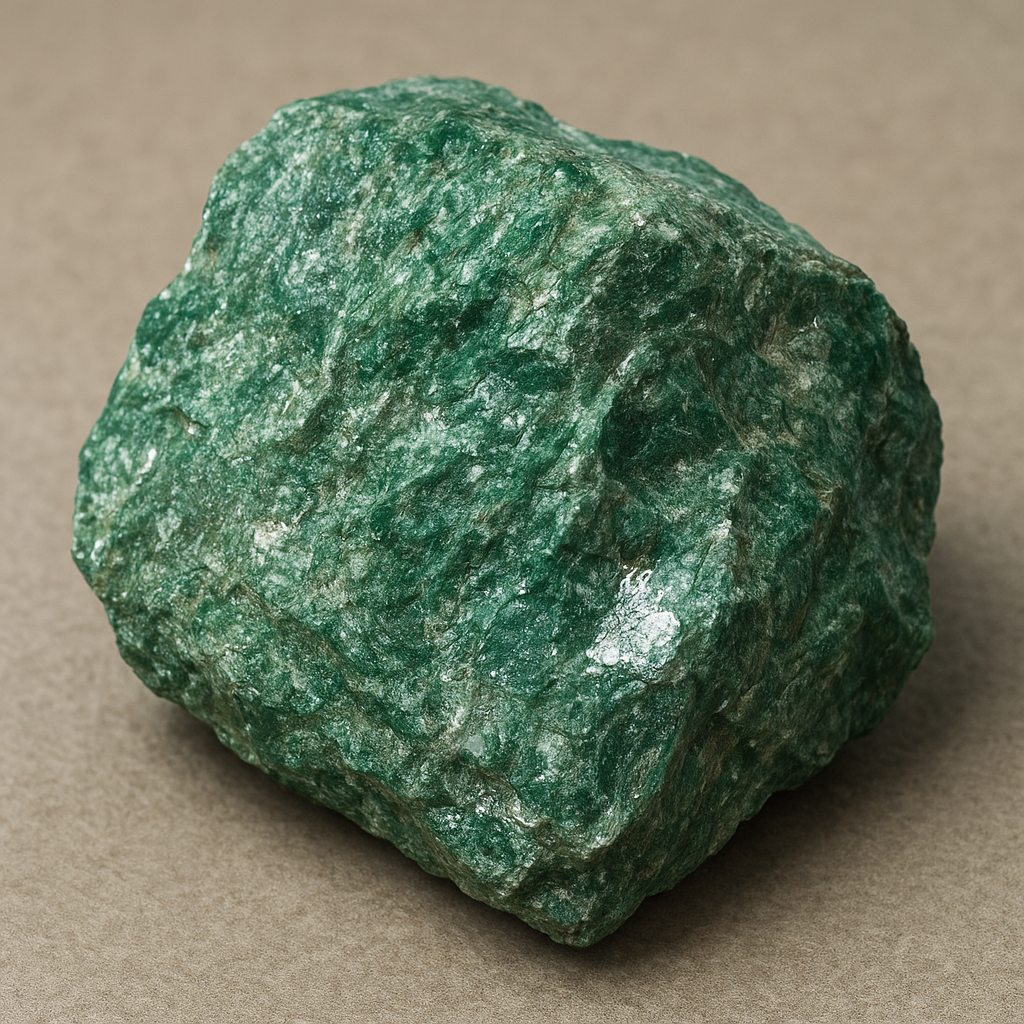
Fuchsite is a striking green member of the mica family whose vivid color and delicate flaky habit make it attractive to collectors, lapidaries, and researchers alike. This chromium‑rich variety of muscovite combines familiar physical properties of micas—perfect cleavage, pearly luster and flexible sheets—with a distinctive emerald to apple‑green hue caused by chromium substitution. Beyond aesthetics, fuchsite has geological importance as an indicator mineral, uses in ornamental stonework and metaphysical practice, and offers interesting insights into how trace elements influence mineral chemistry and appearance.
Chemistry, Crystal Structure and Physical Properties
The essential chemistry of fuchsite is that of muscovite with significant substitution of chromium (Cr3+) for aluminum in the octahedral sites. A general formula may be written approximately as K(Al,Cr)2(AlSi3O10)(OH)2, emphasizing its place in the muscovite endmember series. Like other micas, fuchsite is a phyllosilicate characterized by sheets of silica tetrahedra bonded to octahedral sheets and interlayer potassium atoms.
Crystal system and habit
- Crystal system: monoclinic, with the typical platy, flaky habit of micas.
- Cleavage: perfect in one direction, allowing thin elastic sheets to be peeled off.
- Luster: pearly to vitreous on cleavage surfaces.
- Color: ranges from pale apple to deep emerald green; intensity depends on Cr content.
Physical and optical properties
- Hardness (Mohs): typically 2.5–3, making it a relatively soft mineral for handling and cutting.
- Specific gravity: approximately 2.7–3.1, moderately light because of sheet silicate structure.
- Optical properties: generally exhibits pleochroism—varying shades of green in thin section—under transmitted light, and a distinctive green transmitted color in hand specimens.
- Stability: relatively stable as a mineral, but fine flakes can be fragile; susceptible to mechanical splitting along cleavage planes.
Geological Environments and Global Occurrence
Fuchsite typically forms in environments where chromium is available to substitute into muscovite structures. These environments are often associated with metamorphism of chromium‑bearing protoliths or with hydrothermal alteration of rocks that contain chromium minerals such as chromite. As a result, it is encountered in a variety of geological settings rather than a single unique deposit type.
Typical host rocks and formation processes
- Metamorphic rocks: Many fuchsite occurrences are in schist and phyllite formed under low‑ to medium‑grade metamorphic conditions where chromium‑bearing sediments or ultramafic protoliths were metamorphosed. Greenschist facies conditions can favor its stability.
- Serpentinites and ultramafic complexes: Alteration of ultramafic rocks that contain chromite can produce chromium‑rich micas including fuchsite within shear zones and metasomatic envelopes.
- Hydrothermal veins and quartz veins: Fuchsite may also appear as a secondary mineral lining fractures, associated with quartz, mica aggregates, and sulfides where chromium‑bearing fluids interacted with host rocks.
- Pegmatites and contact metamorphic zones: local occurrences may be associated with potassium‑rich fluids that favor mica formation and permit Cr incorporation.
Notable localities
Fuchsite has been reported from many regions worldwide. Well‑known sources include parts of:
- Brazil — occurrences in Minas Gerais and other states where chromium‑rich rocks and gemstones are abundant.
- India — especially in states with metamorphic terrains that yield green mica specimens popular with collectors and lapidaries.
- Russia — the Ural Mountains and surrounding regions have produced attractive fuchsite specimens historically collected by mineralogists.
- Zimbabwe and southern Africa — regions with extensive ultramafic complexes and chromium mineralization.
- Canada and the United States — scattered occurrences in metamorphic belts and areas of chromium‑bearing geology.
Uses, Lapidary Work and Cultural Significance
Although not a major industrial mineral, fuchsite has a variety of uses and cultural associations that keep it in demand among collectors, artisans and alternative‑healing communities. Its distinctive green color and sheety texture invite creative applications.
Gemstone and ornamental uses
- Cabochons and beads: Due to its softness and cleavage, fuchsite is best used as cabochons, tumbled stones, or beads rather than faceted gems. Cutters appreciate its attractive color, but work carefully to avoid splintering.
- Inlay and decorative stonework: Thin slabs or veneers of fuchsite are sometimes set into boxes, tabletops or decorative panels where its color can provide a dramatic contrast.
- Collectors’ specimens: Transparent to translucent sheets and aggregates with intense green color are prized by mineral collectors and displayed in cabinets and museums.
Metaphysical and cultural uses
Fuchsite enjoys popularity in metaphysical circles where its green coloration links it to the heart chakra and themes of emotional healing, vitality and connection to nature. Users attribute various non‑empirical properties, such as:
- Emotional balance and heart‑centered energy.
- Enhanced intuition and connection with natural rhythms.
- A tool for meditation and gentle energetic cleansing.
It is important to note that such uses fall into the realm of belief and cultural practice rather than scientific endorsement.
Industrial and scientific relevance
- Indicator mineral for chromium: Fuchsite’s presence can guide geologists searching for chromium‑rich zones or for associated deposits such as chromium ores and even emerald‑bearing formations, since chromium is the common chromophore.
- Research mineral: Studies of fuchsite contribute to understanding trace‑element substitution in micas, and how minor elements influence color and stability in phyllosilicates.
- Limited industrial use: Unlike common muscovite, fuchsite is not a primary mica used in electronics or insulation due to rarity and the desirability of less colored micas for industrial applications.
Fuchsite and Gemology: Care, Cutting and Identification
As a gemstone material, fuchsite has special considerations. It can be beautiful in jewelry but requires careful handling and suitable mounting to protect the soft flakes.
Cutting and polishing
- Preferred cuts: Cabochons, beads, or thin inlays minimize stress on cleavage planes. Avoid faceting that exposes cleavage and promotes breakage.
- Adhesives and stabilization: For delicate pieces, stabilization with backing or resin impregnation can improve durability, especially for jewelry intended for regular wear.
- Polishing: Use gentle abrasives and low pressure to maintain luster without delaminating sheets.
Care and maintenance
- Avoid ultrasonic cleaners and steam cleaning; these can exploit cleavage and fissures.
- Limit exposure to mechanical knocks or pressure that might split thin sheets.
- Keep away from harsh chemicals that may leach or alter the surface; wipe with a soft cloth and mild soap if needed.
Identification tips
- Color and habit: The distinctive green color and platy mica habit are primary field clues.
- Cleavage and flexibility: Thin plates will flex slightly and split along basal cleavage.
- Hardness: A scratch test will show softness (around Mohs 2.5–3), distinguishing it from tougher green gemstones.
- Association: Finding fuchsite alongside chromite, serpentine or other chromium‑bearing minerals can confirm environment and authenticity.
Scientific and Economic Relevance: Indicator Mineral and Research Topic
Beyond aesthetics, fuchsite plays a small but meaningful role in geological exploration and mineralogical research. Its chemistry and distribution offer clues to metamorphic processes and the mobility of chromium in the crust.
Exploration and ore genesis
- Exploration tool: In terrains where chromium is a target commodity, fuchsite can appear in alteration halos and metamorphic rocks as a visual indicator of chromium mobility and concentration.
- Association with gemstones: Since chromium is the coloring agent for emerald (beryl), the occurrence of chromium‑bearing micas like fuchsite may flag environments where emeralds or other Cr‑colored minerals could form under the right conditions.
Research topics and mineralogical interest
- Trace element partitioning: How and why chromium substitutes into the octahedral sites of muscovite provides insights into element partitioning during metamorphism.
- Color mechanisms: Studying the electronic transitions of Cr3+ within the mica lattice helps explain the range of green colors and can be compared with Cr in other minerals like emerald and alexandrite.
- Alteration pathways: Investigating how fuchsite weathers or alters helps understand the stability of chromium phases at Earth’s surface.
Interesting Facts and Cultural Tidbits
Fuchsite carries with it a few remarkable stories and practical curiosities that appeal to collectors and curious minds alike.
- Historical naming: The name fuchsite honors a European mineralogist/chemist (often cited in historical literature as linked to the name Fuchs), reflecting 19th‑century practices of naming minerals for prominent scientists.
- Aesthetic pairings: Fuchsite often forms attractive combinations with quartz, pyrite and other contrast minerals in decorative specimens, producing appealing “garden” or “landscape” stones for collectors.
- Collector favorites: Thin, translucent sheets with intense emerald color and good cleavage are highly sought after for display; sometimes entire cabinet specimens are valued for their visual appeal rather than rarity alone.
- Fuchsite vs. verdite: In some trade contexts, green varieties of mica‑rich rocks are sold under names like “verdite” or other lapidary trade terms. Caution is advised, as trade names can blend several related green minerals and rocks.
- Eco‑friendly aesthetic: Because it is a natural, chromium‑colored mineral, fuchsite can provide a vivid green in jewelry and ornament without requiring synthetic dyes, which appeals to some buyers seeking natural materials.
How to Collect and Evaluate Fuchsite Specimens
For collectors and enthusiasts interested in acquiring fuchsite, a few practical tips help separate desirable pieces from less impressive material.
- Color intensity: Deep, even green sheets command a premium. Look for rich, saturated color rather than washed‑out tones.
- Transparency and surface: Slight translucency and glossy cleavage faces increase appeal; opaque, weathered material is typically less valuable.
- Matrix and associations: Specimens with attractive host rock, quartz, or pyrite can be more visually striking and are often preferred for display.
- Condition: Avoid specimens with significant delamination, extensive oxidation stains, or mechanical breakage along cleavage planes.
- Documentation: Provenance and locality information add scientific and market value, especially when specimens come from historically important localities.
Further Reading and Study Directions
For those who wish to explore fuchsite in greater depth, worthwhile topics include advanced mineralogical texts on phyllosilicate chemistry, field guides to chromium deposits, and lapidary manuals addressing cutting soft micas. Museum collections and university geology departments often hold reference specimens that illustrate the range of fuchsite habits and associations.
Whether appreciated for its dramatic green color, its role as a geological clue to chromium‑rich environments, or its uses in ornamental stonework, fuchsite exemplifies how trace elements can transform a common mineral into something visually and scientifically noteworthy. Its delicate sheets and emerald hues continue to fascinate mineralogists, gem cutters and collectors around the world.