
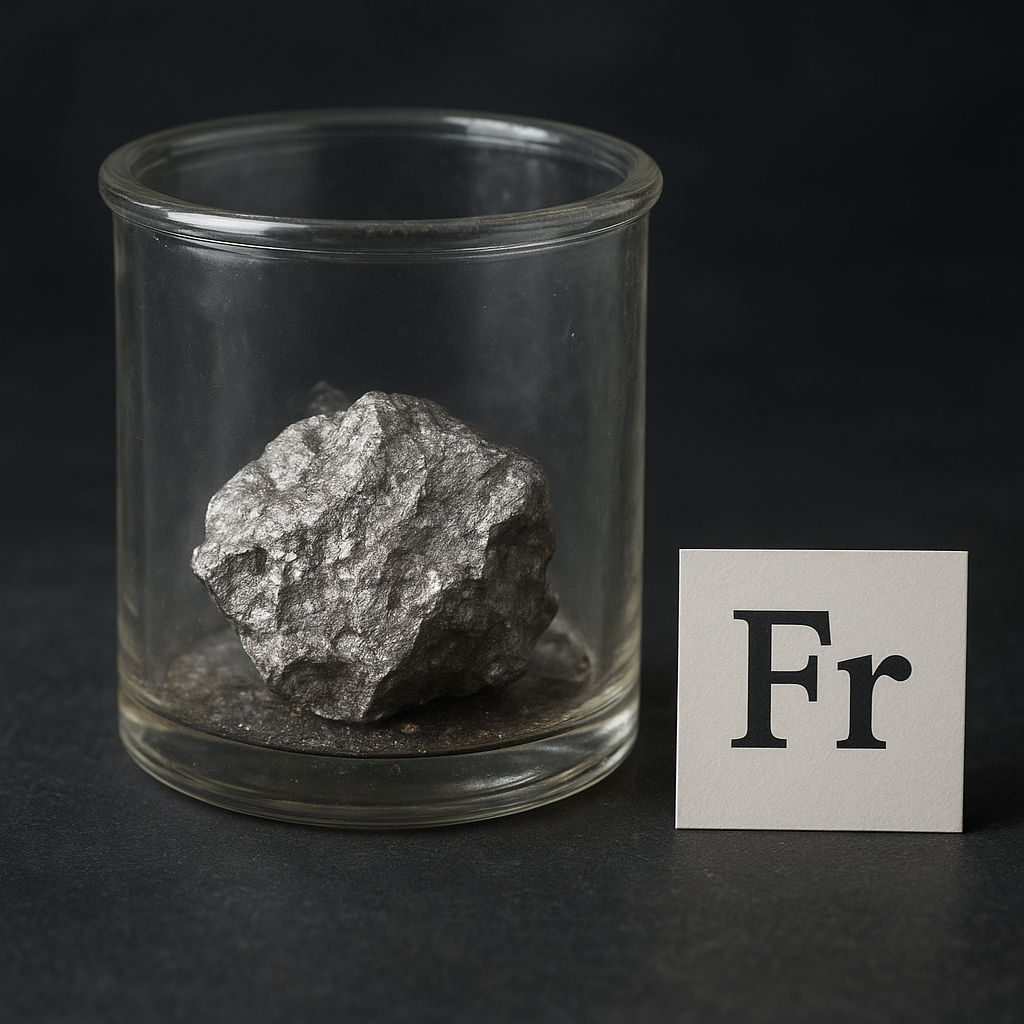
Francium is one of the most elusive and intriguing elements on the periodic table. As the heaviest naturally occurring member of the alkali metal column, it attracts attention far more for its rarity and extreme radioactivity than for any practical utility. This article explores where francium is found, what makes its chemistry and nuclear behavior special, the ways scientists produce and study it, and the curious experimental roles it plays in modern physics and chemistry.
Occurrence and discovery
Francium (atomic number 87) was first identified in 1939 by French physicist Marguerite Perey in Paris, who named it in honor of her country. It completes the row of alkali metals under cesium and is the heaviest known member of this group. Unlike sodium, potassium or even cesium, francium does not form ores or significant natural deposits; it exists only as a fleeting decay product of heavier elements.
Found in trace amounts within uranium and thorium minerals, francium appears whenever certain heavy radionuclides decay. Because its isotopes are very short-lived, any atom of francium present in the Earth’s crust decays away rapidly, and the continuous production from the decay chains is what keeps a tiny, dynamic inventory present at any moment. Estimates vary, but authors frequently cite that the total amount of naturally occurring francium at any time on Earth is extremely small — commonly stated as no more than a few dozen grams, often quoted as under about 30 grams — distributed through ores and soils.
Perey’s discovery was notable not only as the identification of a new element but also as a demonstration of how modern radiochemistry and careful separation techniques could reveal ephemeral species that were previously invisible. The element was produced by separating actinium isotopes and observing unexpected decay patterns; the new emission lines in spectroscopy and decay behavior led to its identification.
Physical and chemical properties
Francium sits in Group 1 of the periodic table and shares the principal characteristics of the alkali metals: a single valence electron, a tendency to lose that electron to form +1 cations, and strong chemical reactivity. However, experimental data are extremely limited because of the element’s scarcity and radioactivity. Most knowledge about francium’s behavior is therefore derived from theoretical calculations and extrapolations from lighter congeners such as cesium.
Atomic structure and expected appearance
The electronic configuration of francium is [Rn]7s1, placing that single valence electron in a very high principal quantum level. This leads to a very large atomic radius, low ionization energy relative to lighter alkali metals, and strong metallic character. If macroscopic quantities could be observed, francium would likely appear as a soft, highly reactive metal with a silvery or golden luster that would tarnish rapidly in air, similar to the appearance of cesium and other alkali metals.
Chemical behavior and reactivity
Predictions and small-scale experiments suggest francium would be the most reactive of the stable-group alkali metals, more so than cesium, due to the greater ease with which its outer electron can be removed. It should form +1 salts and simple ionic compounds, exhibiting chemical trends consistent with increasing metallic and reducing character down the group. However, direct chemical studies are rare; researchers generally rely on spectroscopic observations and theoretical modeling to infer bond strengths, solubilities, and coordination chemistry.
Melting and boiling points, density
Physical constants for francium are mostly theoretical estimates. Some calculations place the melting point near or slightly above room temperature, making francium potentially liquid under warm laboratory conditions, but such predictions are uncertain because they are not backed by bulk experimental observation. Similarly, density and vapor pressure values are extrapolated rather than measured.
Isotopes and nuclear properties
Francium has no stable isotopes. Dozens of isotopes have been produced in laboratories, with mass numbers ranging roughly from the low 200s down into the teens (very neutron-deficient isotopes). The nuclear lifetimes are short: the most stable isotope, francium-223, has a half-life of about 22 minutes. Other isotopes live for seconds, minutes, or even less. The predominant nuclear decay modes are alpha decay and beta decay, sometimes accompanied by emission of gamma rays.
Because of these short half-lives, any sample of francium is inherently transient; experimentalists often work with atom-by-atom quantities or tiny batches produced continuously and studied immediately. The fleeting nature of francium’s isotopes makes it an excellent subject for nuclear spectroscopy and for exploring trends in nuclear structure among heavy alkali elements.
Radioactivity and decay chains
Many francium isotopes appear in the decay series of heavier actinides. The element acts as a short-lived link connecting heavier parent nuclides and lighter daughters. Nuclear scientists study these chains to understand both the decay mechanisms and the formation rates of francium within natural and artificial environments. The radioactivity of francium means that all work with it requires shielded facilities, rapid chemical separation techniques, and remote handling in many cases.
Production and experimental study
Because natural quantities are tiny and dispersed, most experimental work uses francium generated in particle accelerators or produced in situ at specialized isotope-separation facilities. There are two general approaches: extracting francium as a daughter product from radioactive decay in a target, or creating francium directly by nuclear reactions such as fusion-evaporation and transfer reactions using beams of lighter ions on heavy targets.
Facilities with on-line isotope separation and trapping setups produce francium atoms that can be directed into magneto-optical traps and probed with lasers. These experiments are optimized for studying spectroscopy, atomic parity violation, and precision measurements of atomic structure. The extremely short half-lives place severe constraints on experiment design: production, separation, transport, and measurement must all be fast and efficient.
Laser trapping and atomic physics
Francium is particularly valuable to atomic physicists because its high atomic number amplifies relativistic and many-body effects in the atom, making certain subtle interactions — such as weak-force induced parity nonconservation — more pronounced and thus easier to measure. Techniques such as laser cooling and magneto-optical trapping allow researchers to confine and study small numbers of francium atoms long enough to perform high-precision spectroscopy. These experiments help test theoretical models of atomic structure, quantum electrodynamics, and weak interactions in heavy atoms.
Nuclear experiments and mass measurements
In nuclear physics, francium isotopes provide data points for models of nuclear deformation, shell structure, and decay rates near the heavy end of the periodic table. Mass measurements, studies of electromagnetic moments, and decay spectroscopy all contribute to understanding how protons and neutrons arrange themselves in heavy, weakly bound systems. Such work often informs broader questions about nucleosynthesis and the limits of nuclear stability.
Applications and prospects
In practical, everyday terms, francium has almost no commercial applications. Its extreme radioactivity, short half-lives, and scarcity make industrial or medical uses impractical. Humans cannot stockpile the element, and the quantities produced are far too small for any large-scale application. However, francium finds valuable roles in niche scientific research.
- Fundamental physics: Francium’s sensitivity to relativistic effects makes it an attractive probe for atomic parity violation experiments, which test the electroweak theory and search for physics beyond the Standard Model.
- Atomic structure studies: Precision spectroscopy on francium validates theoretical models that incorporate electron correlation and relativistic corrections in heavy atoms.
- Nuclear science: Producing and characterizing francium isotopes helps map the landscape of nuclear stability and decay modes near the heavy end of the nuclear chart.
There are speculative and theoretical discussions about potential medical or technological uses of very short-lived radioisotopes for targeted treatments, but francium has not emerged as a candidate due to production constraints and the availability of better-suited isotopes (such as certain alpha or beta emitters with more convenient half-lives and chemistry).
Safety, handling, and experimental constraints
Working with francium requires stringent radiological controls. Although the chemical hazards are similar to other alkali metals (reactivity with water and air), the dominant danger is radioactive exposure. Laboratories that handle francium must employ remote handling systems, efficient ventilation, containment for volatile species, and shielding to reduce exposure to beta and alpha particles as well as gamma radiation emitted by decay products.
Because francium exists in such tiny quantities, contamination of an experiment is often less of a threat than the logistical challenges of producing and transporting the atoms quickly enough to study them. Nonetheless, researchers follow standard radiochemical safety protocols to monitor and mitigate any potential exposure or environmental release.
Interesting scientific and historical notes
Beyond the technicalities, francium has a number of fascinating facets that have captured public and scientific imagination:
- Named after a nation: The name francium honors France, reflecting Perey’s nationality and the tradition of naming elements in ways that recognize discoverers or places.
- Elusive abundance: The idea that the entire Earth contains only a few tens of grams of francium at any moment emphasizes how naturally rare heavy, short-lived radionuclides are at geologic timescales.
- Testing fundamental symmetries: Because heavy atoms amplify some weak-force effects, francium experiments contribute to high-precision tests of fundamental symmetries and may constrain new physics scenarios that extend the Standard Model.
- Educational notoriety: Francium often appears in popular lists of the “rarest elements” or “most radioactive elements,” and it serves as an example in textbooks when discussing periodic trends pushed to extremes.
Where francium fits into broader scientific themes
Francium exemplifies several important themes in modern physical science: the intersection of atomic and nuclear physics, the use of sophisticated production and trapping technologies to study systems otherwise inaccessible, and the necessity of theory to predict properties that experiment cannot yet measure directly. It also highlights how the periodic table is not just a list of materials for everyday use but a map of the quantum and nuclear forces that govern matter at its most fundamental level.
Researchers continue to produce francium in specialized facilities to refine spectroscopic data, probe weak interactions, and improve our understanding of heavy-atom behavior. Although francium will likely never be an industrial mainstay, its scientific value remains high: it provides a rare laboratory for testing ideas that apply across chemistry and physics, and it acts as a bridge between nuclear processes and chemical phenomena.
Final note on nomenclature and curiosity
Studying francium is as much an exercise in ingenuity as in measurement. Scientists must cleverly combine nuclear production, rapid chemical separation, and advanced trapping and detection methods to extract meaningful data from vanishingly small samples. For students and researchers alike, francium serves as a reminder that some elements are treasured not for their commercial utility but for their unique ability to illuminate the underlying laws of nature.