
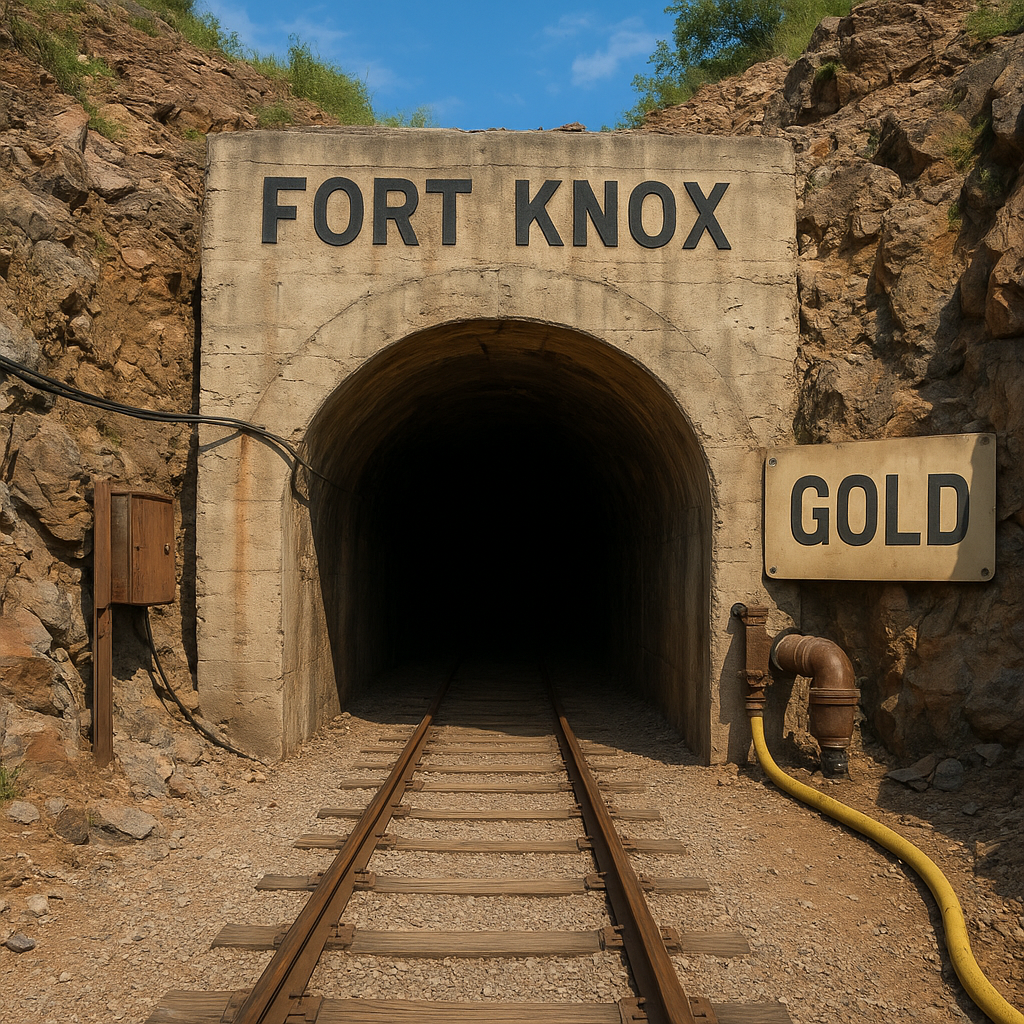
The Fort Knox Mine, located in the interior of Alaska near the city of Fairbanks, is one of the most important gold operations in the United States. Operated by Kinross Gold Corporation, the mine exemplifies modern large-scale, open-pit mining for a disseminated, low-grade gold deposit. Its strategic position in the Tintina Gold Belt, long production history, and continuing role in local and national economies make Fort Knox a focal point for discussions about resource development, environmental management, and the technological evolution of mineral extraction in subarctic environments.
Location, access, and historical context
Fort Knox lies approximately 25 kilometers northeast of Fairbanks, Alaska, on a ridge that affords both geological advantages and logistical accessibility. The site sits within the broader Fairbanks mining district, a region with a rich history of placer and hard-rock gold mining dating back to the early 20th century Gold Rush era. The mine’s modern development began in the late 20th century when exploration and feasibility work confirmed the presence of a large, disseminated gold system that could be mined economically on a bulk scale.
From a logistical perspective, Fort Knox benefits from proximity to Fairbanks, which provides an established transportation hub, power infrastructure, and a skilled workforce. Roads connect the mine year-round, although winter conditions and seasonal variability can challenge haulage and construction. The cold continental climate—characterized by long, harsh winters and short, warm summers—dictates many operational choices, from equipment specifications and maintenance schedules to tailings and water management practices designed to withstand freeze-thaw cycles.
The mine’s modern history is intertwined with corporate developments and commodity cycles. After discovery and initial development, construction and commissioning led to commercial production near the end of the 20th century. Over the decades, Fort Knox has undergone phases of expansion, mill and process upgrades, and continuous exploration aimed at extending mine life by replacing reserves and improving recovery rates. The operation is often referenced as a model of sustained production in a challenging environment and a case study in balancing economic gains with environmental stewardship and community relations.
Geology and mineralization
Fort Knox is hosted within a geological setting typical of many Interior Alaska gold deposits—part of the Tintina Gold Belt, a prolific mineralized trend that stretches across central Alaska and into northwestern Canada. Mineralization at Fort Knox is best described as a bulk-tonnage, disseminated style of gold occurrence. Gold is widely distributed through altered host rocks, occurring in fine-grained disseminations, along fractures, and within sulfide-bearing quartz veins and stockwork systems.
The host rock sequence comprises combinations of metasedimentary rocks and intrusive bodies, which provided both the structural framework and mineralizing fluids for gold deposition. Hydrothermal alteration is extensive in the deposit area, producing pervasive silicification, sericitization, and sulfide halos that are typical indicators used by exploration geologists to vector toward higher-grade domains. The result is a deposit amenable to large-scale, open-pit mining rather than narrow-vein underground extraction, enabling economies of scale that offset relatively low headline grades.
Economic geology at Fort Knox emphasizes tonnage and continuity rather than exceptionally high grades. The deposit’s characteristics allow for efficient excavation with conventional open-pit methods, followed by processing routes designed to recover gold from low-grade ore. Continuous exploration in the surrounding district aims to delineate satellite zones and deepen understanding of structural controls on mineralization, thereby providing potential for extending the operation’s life and incremental increases in recoverable ounces.
Mining method, processing, and technology
Fort Knox employs a conventional open-pit mining method characterized by large-scale truck-and-shovel operations. Stripping, drilling, blasting, loading, and hauling are executed with heavy mobile equipment adapted to subarctic conditions. The mine design focuses on optimizing pit geometry to balance ore recovery and waste stripping while also managing slope stability in rock types that may behave differently under freeze-thaw cycles.
Processing at Fort Knox is designed to treat large volumes of low-grade ore efficiently. Typical flowsheets for such deposits include crushing and grinding to liberate gold-bearing particles, followed by chemical extraction via cyanide leaching and an adsorption stage to capture gold for subsequent recovery. The plant infrastructure includes crushing circuits, grinding mills or alternative comminution equipment, leaching tanks or columns, and systems for gold adsorption and electrowinning or smelting to produce doré bars. Water management systems, closed-circuit recycling, and reagent control are critical for maintaining recovery efficiency and minimizing environmental footprint.
Over time, advances in ore characterization, comminution, and leaching chemistry have been implemented to boost recovery and lower unit costs. Continuous improvements in fleet telematics, predictive maintenance, and process automation have also helped Fort Knox increase operational reliability in a remote setting. In addition, exploration drilling, geometallurgical programs, and resource modeling work to optimize mine sequencing and mill feed blending to maintain steady plant performance and maximize overall recovery.
Production, reserves, and economic significance
Since commencing commercial production, Fort Knox has contributed significant quantities of gold to the market, producing millions of ounces cumulatively and often delivering annual production measured in the hundreds of thousands of ounces. The mine’s output has made it one of the larger gold-producing operations in the United States, providing steady revenue streams for its operator and contributing to the economic base of Alaska.
The economic significance of Fort Knox extends beyond metals sales. The operation supports local employment—both direct jobs at the mine and indirect employment through contractors, suppliers, and service providers. Taxes, royalties, and land rental payments contribute to state and municipal finances, funding public services and infrastructure. The mine’s procurement policies often prioritize local businesses where feasible, stimulating regional economic activity.
From a broader perspective, Fort Knox plays a role in the national and global gold supply. Gold produced at the mine is refined and enters the bullion and jewelry markets, and may also be used for investment-grade bars. In periods of commodity volatility, stable, long-lived operations like Fort Knox provide predictable supply, which can help moderate some market fluctuations. In addition, corporate earnings from Fort Knox influence investor sentiment and the financial performance of its owner.
Environmental management and reclamation
Operating in a sensitive subarctic environment requires Fort Knox to adopt rigorous environmental management practices. Water management is a top priority—managing contact water from open pits, processing circuits, and tailings areas to control sediment and chemical releases. The mine maintains engineered containment systems, water treatment facilities, and monitoring networks to ensure compliance with permits and to protect downstream ecosystems.
Cyanide, commonly used in gold recovery from low-grade ores, is handled according to strict standards to prevent accidental release. Fort Knox implements detoxification procedures, containment, and robust monitoring of effluents. Tailings and waste rock containment designs incorporate liners, seepage collection, and other mitigations to reduce the risk of contamination. In addition, progressive reclamation practices are used where feasible—rehabilitating waste rock surfaces, re-establishing native vegetation, and designing final landforms that blend with the surrounding landscape and remain stable through freeze-thaw cycles.
Reclamation planning at Fort Knox is an ongoing activity. Closure plans include reshaping the pit and waste rock facilities, ensuring long-term water treatment capacity where necessary, and creating post-mining land uses such as wildlife habitat. Community input and regulatory oversight shape reclamation outcomes, and performance bonds or financial assurance mechanisms are typically in place to guarantee that closure commitments will be met even if operational ownership changes over time.
Community relations, workforce, and social impact
Strong community relations are essential for any long-term mining operation, and Fort Knox has invested in programs to sustain a positive social license to operate. The mine engages with local stakeholders, including government bodies, indigenous groups, community organizations, and residents, to address concerns related to noise, dust, traffic, employment, and environmental protection. Community benefits include direct employment opportunities, training programs, scholarships, and contributions to local services.
Workforce strategies at Fort Knox focus on recruiting skilled personnel while supporting local capacity-building. Given the mine’s proximity to Fairbanks, it attracts a mix of local hires and fly-in specialists for niche roles. Health and safety training, cold-weather operational protocols, and emergency response preparedness are integral to maintaining a safe work environment in an area subject to extreme winter conditions. The operation’s employment ripple effects support accommodation providers, retail, and professional services in the Fairbanks area.
Exploration, expansion potential, and future prospects
Exploration around Fort Knox continues to be a strategic priority. The deposit model and regional geology indicate potential for additional mineralized zones at depth and laterally, which could be identified through systematic drilling, geophysics, and geochemical surveys. Discoveries of satellite orebodies could be incorporated into the mine plan to extend the life of the operation, increase annual throughput, or enable staged expansions.
Mine life has been extended at various times through a combination of reserve additions, improvements in recovery, and processing optimizations. Commodity prices also play a role: higher gold prices can render lower-grade material economic, increasing the effective reserves and enhancing project economics. Conversely, operational costs driven by fuel, labor, and regulatory requirements influence decisions about expansion and investment.
Innovations in mining and processing technologies—such as improved ore-sorting, more efficient comminution circuits, or alternative leaching chemistries—could further lower costs and environmental impact, making previously marginal rock types viable. Additionally, investments in renewable energy and electrified fleets may reduce the mine’s greenhouse gas footprint, aligning operations with evolving corporate sustainability targets and regulatory expectations.
Interesting and lesser-known facts
- Fort Knox is named after the famous U.S. Army installation in Kentucky, but it has no direct connection to the military site; the name evokes gold and security and was adopted early in the exploration history of the deposit.
- The mine operates in a region where winter conditions can be extreme. Cold-weather engineering considerations influence everything from building insulation to lubrication regimes for heavy equipment.
- Fort Knox’s location within the Tintina Gold Belt places it among a chain of important gold deposits that collectively shaped the economic development of central Alaska and adjacent Canadian territories.
- Because the deposit is a bulk-tonnage, low-grade system, the operation emphasizes continuous optimization of cost per ounce rather than chasing exceptionally high grades in narrow veins.
- Continuous environmental monitoring, including aquatic ecology studies and water quality sampling, informs adaptive management practices designed to protect streams and downstream communities.
- The mine’s visible open pit and associated infrastructure are landmarks in the landscape northeast of Fairbanks, illustrating how industrial activity can reshape natural topography over time.
- Ongoing exploration around the mine is an example of how mature mining districts can still host new discoveries when modern techniques are applied to legacy terrains.
- Fort Knox has served as a training ground for mining professionals who later take roles across the global industry, contributing expertise in cold-climate mining and bulk-mining operations.
- Reserves and life-of-mine estimates are dynamic and regularly updated as exploration results, metallurgical data, and market dynamics evolve, showing how mining is an iterative, evidence-driven process.
Concluding observations
Fort Knox stands as a prominent example of a modern, large-scale gold mine operating in a challenging environment. It combines significant production capacity with ongoing exploration and careful environmental practices to maintain economic viability and social acceptance. The mine’s interplay of geology, technology, and community engagement illustrates many of the themes common to contemporary resource extraction: the need to optimize recovery and cost-efficiency, the importance of environmental stewardship, and the value of transparent relationships with local stakeholders. As gold markets, technologies, and regulatory frameworks continue to evolve, Fort Knox’s future will be shaped by the same combination of scientific understanding, engineering innovation, and social license that underpinned its development and sustained operation to date.

