
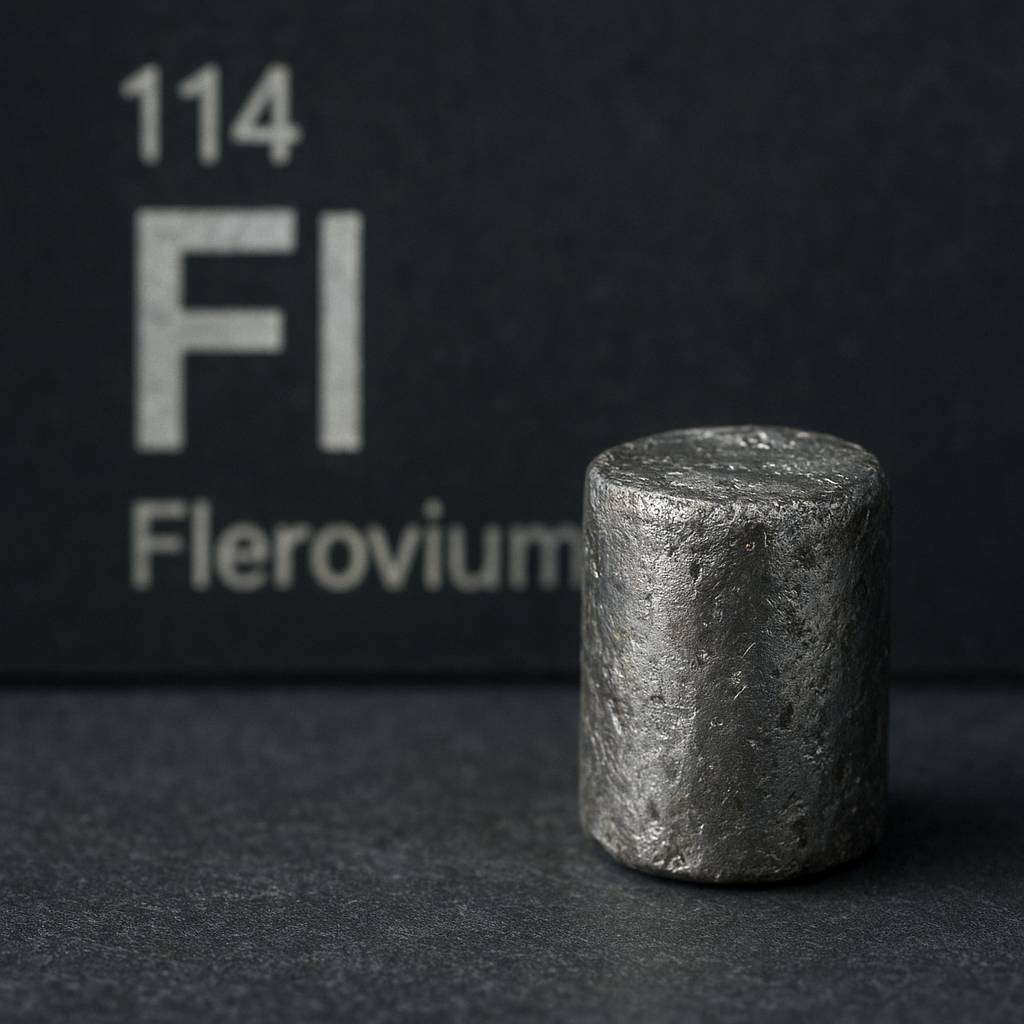
Flerovium occupies an unusual place at the edge of the periodic table: a superheavy, man-made element whose fleeting existence has opened windows onto nuclear structure, relativistic chemistry and the practical limits of element synthesis. Researchers study flerovium not because it has everyday uses, but because each atom produced is a high-value piece of experimental evidence about how matter behaves under extreme conditions. This article explores the history of its discovery, the methods used to make and study it, where it may be found (in practical terms), what scientific roles it plays, and several intriguing facts that illustrate why element 114 continues to fascinate physicists and chemists alike.
Discovery and Naming
The first report of the creation of element 114 came from the Joint Institute for Nuclear Research (JINR) in Dubna, Russia, during experiments performed in the late 1990s. By bombarding heavy actinide targets with accelerated calcium ions, teams at Dubna were able to produce a handful of atoms attributed to element 114. The discovery process for superheavy elements typically involves painstaking detection of a few decay chains and independent confirmation by other laboratories. After years of experimental work and discussion within the international community, the name flerovium was officially adopted by IUPAC in 2012, honoring the Soviet physicist Georgy Flyorov, who played an important role in founding JINR and promoting heavy-element research.
Context of discovery
The search for new elements is driven by both experimental ingenuity and theoretical ideas. Early models of nuclear shells predicted regions of enhanced stability—so-called “islands of stability”—around certain proton and neutron numbers. Element 114 attracted particular attention because some models once suggested that it could lie near a local maximum of nuclear stability. That theoretical promise, combined with advances in accelerator technology and detector sensitivity, motivated the experimental campaigns that produced flerovium atoms.
From creation to confirmation
- Production typically involves fusion reactions such as heavy actinide target nuclei being bombarded with lighter, neutron-rich projectiles.
- Detectors record the alpha-decay chains or spontaneous fission signatures that connect a newly created nucleus to known daughter nuclides.
- Independent confirmation and cross-checks across laboratories help establish discovery claims before names are proposed and accepted.
Atomic and Nuclear Properties
As element 114, flerovium belongs to the region commonly called the superheavy elements. Its atomic number places it beneath lead and flerovium is often grouped with the carbon group (group 14) in periodic table layout, though atomic and chemical behavior can differ markedly from lighter congeners due to extreme relativistic effects.
Isotopes and half-lives
Only synthetic isotopes of flerovium have been produced; none exist in nature. Produced isotopes have mass numbers in a range reported by several laboratories, and their measured half-life values vary widely. Some isotopes decay within milliseconds, while others survive for seconds or longer before decaying by alpha emission or fission. The rarity and short-lived nature of these nuclei mean that experimental data are limited, but each observed decay chain provides crucial nuclear-structure information.
- Observed isotopes have been reported across several mass numbers; production yields are extremely small, often producing only a few atoms.
- Alpha decay chains originating from flerovium nuclei connect to lighter, better-known nuclei, allowing researchers to infer properties of the parent flerovium atom.
- Spontaneous fission can compete with alpha decay, complicating detection but offering insight into fission barriers and nuclear deformation.
Electronic structure and relativistic effects
In superheavy elements, electrons near the nucleus travel at significant fractions of the speed of light. These velocities produce relativistic shifts in orbital energies, contracting some orbitals and stabilizing others. For flerovium, theoretical work predicts that the 7s and 7p1/2 electrons are strongly affected, which changes chemical bonding tendencies compared with lighter group 14 elements. These relativistic influences can make flerovium behave more inertly than expected, a factor that turns its chemistry into a testing ground for advanced quantum chemistry calculations.
Where Flerovium Is Found and How It Is Made
In practical terms, flerovium is not “found” anywhere in nature. Its extremely short-lived isotopes preclude natural accumulation. All known atoms of element 114 have been produced in laboratory settings, typically in one-of-a-kind facilities capable of intensive heavy-ion research.
Primary production methods
The common approach to produce flerovium involves a high-intensity beam of neutron-rich ions—often calcium-48—accelerated to collide with actinide targets such as plutonium or curium. The brief fusion of projectile and target nuclei can create a compound nucleus with atomic number 114. The species of reaction and the neutron richness of reactants influence both the likelihood of formation and the decay pathways of the product.
- Facilities such as JINR (Dubna), GSI (Germany), RIKEN (Japan) and collaborative teams in North America and Europe have run experiments aiming to synthesize flerovium.
- Detectors following recoil separators identify decay chains by tracking energy, time, and position of alpha particles and fission fragments.
- Typical production rates are extremely low—sometimes only a few atoms over weeks or months of beam time—so experiments demand patience and high reliability.
Why natural occurrence is impossible
Flerovium’s nuclei decay far too quickly to survive geological timescales or to be formed in quantities by natural processes such as cosmic-ray interactions. Unlike long-lived elements like uranium or thorium, flerovium nuclei have half-lives many orders of magnitude shorter, meaning any naturally produced atoms would have disappeared long ago. Therefore, synthetic production in accelerators remains the only source of flerovium atoms for research.
Applications and Scientific Roles
Flerovium has no commercial or practical applications outside of scientific research. It is produced atom-by-atom and its short-lived isotopes make technological use impossible. However, the element has several important scientific roles.
Probing nuclear theory and the island of stability
Each flerovium nucleus observed provides data about nuclear shells, pairing interactions and deformation at extreme proton numbers. The concept of an “island of stability,” where certain superheavy nuclei might live longer due to closed shells of protons and neutrons, motivates continued synthesis attempts. Flerovium sits near one historically predicted shell closure and thus occupies a strategic position in mapping the landscape of superheavy nuclei.
Testing relativistic quantum chemistry
Because electron velocities are relativistic in heavy atoms, flerovium is a crucial test case for high-precision atomic and molecular calculations that incorporate quantum electrodynamics and relativistic corrections. Determining whether flerovium behaves like an inert, volatile metal or shows unexpected chemical reactivity has implications for understanding the limits of periodic trends and for refining computational methods.
Developing experimental techniques
Working with flerovium drives innovation in accelerator operation, target chemistry, detector technology and “atom-at-a-time” gas-phase chemistry. Methods developed for flerovium studies—such as single-atom adsorption experiments, rapid chemical separation, and high-sensitivity decay spectroscopy—benefit research across the field of superheavy elements.
Experimental Techniques and Challenges
Producing and studying flerovium demands an intersection of specialized skills: designing targets that survive prolonged irradiation, running intense ion beams, and analyzing rare decay events against background signals. Laboratories use advanced instrumentation to isolate and identify single atoms from the torrent of reaction products.
Recoil separators and detection
- After a fusion event, reaction products are extracted and passed through recoil separators that discriminate by mass-to-charge ratio and velocity.
- Position-sensitive silicon detectors record alpha particles and spontaneous fission fragments, enabling researchers to link decay events into chains.
- Time correlations and energy signatures help differentiate genuine decay chains from random background coincidences.
On-line chemistry and gas-phase experiments
Because only one atom may be produced at a time, chemists use rapid, automated methods to test how a single flerovium atom interacts with surfaces or gases. These atom-at-a-time techniques can explore adsorption enthalpies and reactivity by observing whether a transient flerovium atom sticks to a surface or passes through to a detector. Such experiments have suggested that flerovium is unusually volatile and chemically inert compared to lighter group 14 elements, though results are necessarily sparse and experimental conditions demanding.
Interesting Facts and Broader Significance
Flerovium occupies a place in science that combines technical prowess, international collaboration and deep theoretical questions. Below are several points that many find compelling about element 114.
- Namesake: Flerovium honors Georgy Flyorov, who recognized the importance of coordinated nuclear research and was an early proponent of heavy-element studies.
- Extremely rare: Only a few dozen atoms of flerovium have been reported in all experiments combined, making each atom a precious data point.
- Relativistic chemistry: The element demonstrates how relativity changes chemical behavior—an extreme test of fundamental theory.
- Island of stability: Flerovium’s proximity to predicted shell closures gives it a symbolic role in the quest for longer-lived superheavy nuclei.
- International effort: Its discovery and study reflect collaborations across Russia, Europe, Japan and the United States, highlighting the global nature of modern nuclear science.
Future directions
Research will continue to push toward heavier and more neutron-rich isotopes, improve production cross-sections, and refine on-line chemical measurements. Theoretical models will evolve in tandem, constrained by experimental results. Whether these efforts will produce a dramatically longer-lived isotope of flerovium or a neighboring element remains an open question, but the pursuit itself advances instrumentation and deepens our understanding of atomic matter.
Connections to Related Topics
Studying flerovium connects to many broader areas of physics and chemistry. Nuclear astrophysics, for instance, asks how heavy nuclei form in stellar environments; while superheavy elements are not directly produced in ordinary stars, research into nuclear reaction networks and shell effects informs modeling of nucleosynthesis. Atomic physics benefits from precision measurements motivated by superheavy systems, and condensed-matter theory gets tested as chemists imagine—however speculatively—what materials built from superheavy elements might look like if long-lived isotopes were ever available.
Flerovium thus serves less as a material for industry and more as a gateway to fundamental science: a tiny, ephemeral probe that helps refine our theories about the forces that hold nuclei and atoms together, and about the relativistic fabric that shapes the periodic table at its extremes. Each experiment that produces a flerovium atom is an experiment at the edge—pushing techniques, questioning assumptions, and expanding the frontiers of what can be observed and understood.