
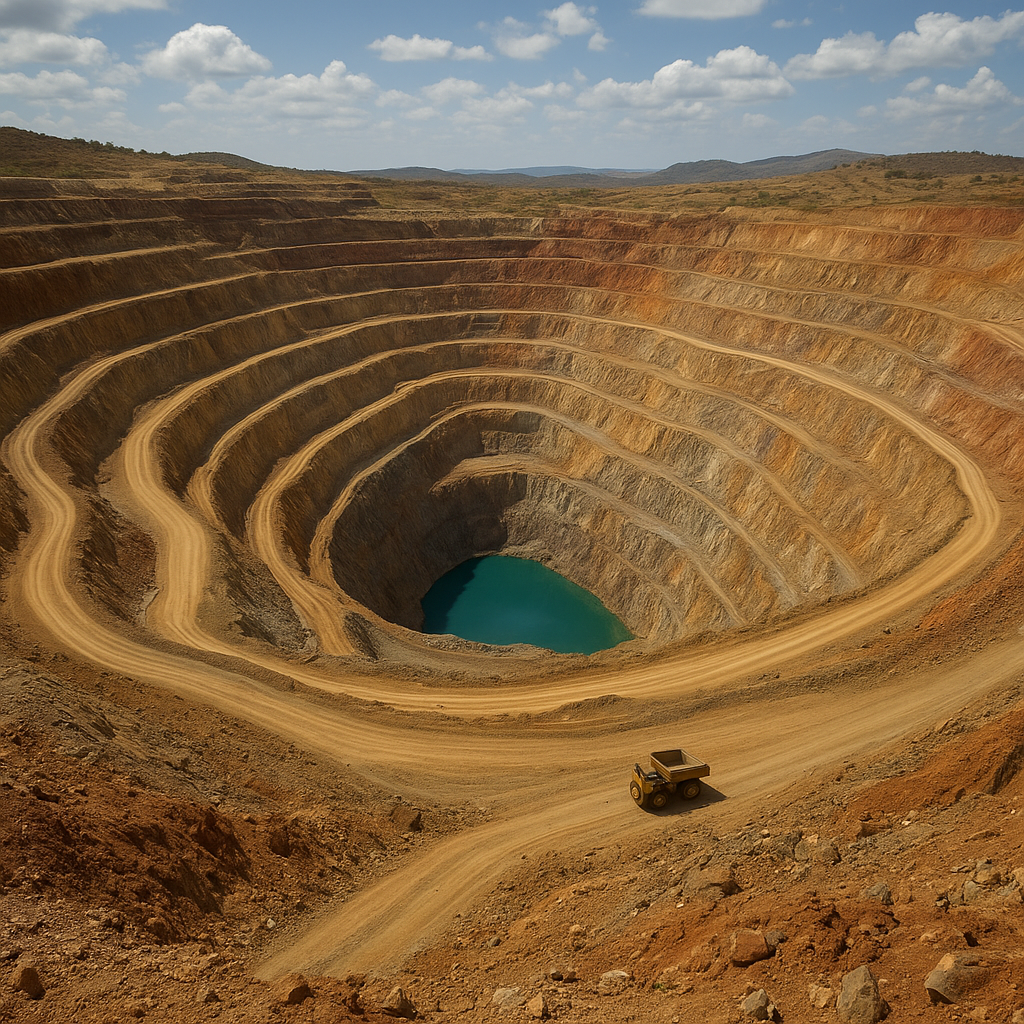
The Finsch Mine is one of South Africa’s most important diamond-producing operations. Located in the heart of a mineral-rich region, this mine has shaped local economies, contributed significantly to the global gem market, and continues to be a focus of technological and environmental innovation in the diamond industry. The following sections explore its location and geological setting, the nature of what is mined there, its economic and social impacts, and some intriguing facts that underline the mine’s unique role in the world of diamonds.
Location and geological setting
The Finsch Mine sits in the north-central part of South Africa, within the arid expanses of the country’s interior. Situated in the broader region known for kimberlite occurrences, the site benefits from geological conditions that are favourable for diamond formation and preservation. Geologists identify the deposit at Finsch as a classic example of a large kimberlite pipe — a volcanic conduit that brought material from the Earth’s mantle to the surface and, in the process, transported diamonds formed at depth.
The mine is positioned in the province that hosts much of South Africa’s traditional diamond activity. The surrounding landscape is characterized by semi-arid veld, with mining infrastructure linked to regional transport networks that facilitate the movement of ore, concentrate and finished gems. Because the deposit occurs near the surface in a relatively concentrated body, initial development took advantage of open-pit methods before transitioning to deeper, more complex extraction techniques.
Geological significance
- Kimberlite pipes such as the one exploited at Finsch are of global interest because they provide direct samples from the mantle and occasionally yield high-quality gem material.
- The deposit demonstrates a range of diamond sizes and qualities, making it relevant to both industrial studies and gemological research.
- Finsch’s geology has been the subject of extensive mapping and scientific study, providing insights into the emplacement processes of kimberlitic magmas and the preservation of diamonds through geologic time.
What is mined at Finsch — diamonds and associated materials
At its core the Finsch operation recovers natural diamonds, a mineral formed under extreme pressure and temperature deep within the Earth. The mine produces a variety of sizes and qualities, from smaller industrial-grade stones used in cutting and drilling tools to large, high-clarity gem diamonds destined for jewellery markets. Over decades of operation, Finsch has produced stones that range across the full spectrum of the diamond trade, supporting everything from mass-market polished stones to rare, high-value pieces that enter collector channels.
Mining at Finsch also results in the extraction of host-rock material, which must be transported, processed and concentrated to recover the diamonds. The ore is treated through crushing, dense media separation, and other advanced sorting technologies that maximise recovery rates while reducing waste. The shift from open-pit extraction to deeper operations required the development of underground workings, specialised haulage systems and enhanced ore-processing capability.
Types and quality of output
- Gem-quality white diamonds that are prized for clarity and brilliance.
- Fancies — stones of unusual colour or size that command higher market prices.
- Industrial diamonds suitable for abrasives, cutters and other technical applications.
- Aggregates of smaller stones that are sorted and sold through both local and international channels.
Mining methods and technological evolution
Over the life of the Finsch operation the mining methods have evolved significantly. What began as large-scale open-pit mining transitioned to a primarily underground model as the mine moved to access deeper portions of the kimberlite pipe. Underground mining presents distinct engineering challenges: ground support, ventilation, water management and safe transport become priorities. Finsch incorporated mechanised mining fleets, automated ore handling and modern processing plants to maintain efficiency and safety.
Process technology at the site also reflects industry advances. Modern diamond recovery systems use a combination of coarse and fine separation, X-ray fluorescence sorting and high-capacity dense media separation. These technologies increase recovery rates, reduce energy and water consumption per carat, and enable sorting by size and density with greater precision than earlier methods.
Economic significance and value chain
The economic impact of the Finsch Mine reaches well beyond the pit and underground workings. As a significant producer of diamonds, the operation feeds into a global value chain that includes sorting, cutting and polishing, marketing, and retail. The mine’s ongoing production contributes export revenues, foreign exchange earnings and government royalties. Employment at the mine supports local communities through wages, procurement and secondary economic activity.
At a regional level, the mine stimulates the development of services — from transport and logistics to maintenance, construction and professional services. Local suppliers benefit when mining companies invest in capacity and contracts, and workforce skills develop through training and apprenticeship programmes. Because diamonds are high-value and relatively compact, the revenue generated per tonne of ore is substantial compared with many other mined commodities, amplifying the mine’s direct economic importance.
Employment and community investment
- Direct employment provides skilled and semi-skilled jobs in operations, engineering, geology, processing and administration.
- Local procurement policies can boost small and medium enterprises in the surrounding region.
- Social investment programs in education, healthcare and infrastructure are common components of the mine’s contribution to community development.
Social, environmental and governance considerations
Like all modern mining operations, Finsch operates within a framework of environmental regulation and corporate responsibility. Managing water usage, preventing acid mine drainage, rehabilitating waste rock and tailings, and minimising the mine’s footprint are ongoing priorities. Because the site lies in a fragile semi-arid ecosystem, water management and dust control are particularly important to protect both the environment and local livelihoods.
Governance of the mine encompasses safety protocols, worker welfare, and compliance with national mining legislation and international best practices. Many operations in the diamond sector have implemented measures to increase transparency in the chain of custody for stones, ensuring compliance with conflict-free sourcing standards and traceability. Community engagement is also a central element, with structured consultation processes, local employment targets and investments in social infrastructure.
Sustainability initiatives
- Programs to reduce water consumption and recycle process water.
- Energy efficiency measures and gradual shifts to lower-emission power sources where feasible.
- Progressive land rehabilitation plans that aim to restore post-mining landscapes for future use.
- Skills development and educational programmes targeted at youth and former miners transitioning to other sectors.
Historical milestones and notable discoveries
The mine’s history includes a series of milestones typical of long-lived diamond operations. Initial discovery and development were followed by decades of steady production, periods of expansion and technological upgrade, and the eventual transition from pit-based to underground methods. Over time, Finsch has contributed to notable diamond finds — important both for their size and their quality. Such finds generate media attention and can influence perceptions of the mine’s geological richness.
Beyond individual stones, the mine’s sustained output over decades has made it a pillar of the national diamond sector. It has played a role in training generations of mining and gem professionals and in shaping industry standards in South Africa.
Interesting facts and lesser-known aspects
There are several aspects of Finsch that capture the imagination beyond its immediate industrial role:
- Geological rarity: Large, well-preserved kimberlite pipes that continue to produce significant quantities of gem-quality diamonds are relatively rare, making the mine a site of long-term geological and commercial interest.
- Technological showcase: The transition to deep-level underground mining required innovative approaches to ventilation, ore handling and worker safety, and the mine has been part of broader industry learning around these issues.
- Cultural ties: Mining creates long-standing connections between companies and local communities; in many cases, family histories in the area are intertwined with the mine’s operational life.
- Global footprint: Although diamonds are extracted locally, they enter an international market; stones from Finsch may be cut in various centres of excellence around the world and set into jewellery sold across continents.
Challenges and future outlook
Looking forward, the Finsch Mine faces the same mix of challenges and opportunities as other mature mineral operations. Resource depletion at shallower levels necessitates more complex and costly underground work, while fluctuations in global diamond demand affect prices and investment cycles. At the same time, technological advances in recovery, sorting and automation offer pathways to greater efficiency and lower environmental impact. Continued focus on sustainability, community engagement and transparent governance will be important for maintaining the mine’s social license to operate.
Strategic planning for the site includes assessing remaining reserves, optimising underground development, and identifying opportunities to extend the mine life through improved recovery techniques or the discovery of satellite deposits. Partnerships with research institutions and technology providers can accelerate these efforts, while alignment with national economic development goals ensures that the mine remains integrated with broader regional priorities.
Final observations on significance
In the broader tapestry of South Africa’s mining heritage, the Finsch Mine occupies a prominent place. Its production of high-quality diamonds supports international markets, while its presence shapes local economies in the region where it operates. Through decades of evolving mining practice, the site illustrates how geological endowment combined with engineering innovation yields sustained value. The mine’s story is one of resource extraction, technological adaptation, and ongoing negotiation between economic opportunity and environmental stewardship.
For anyone interested in the diamond industry, the Finsch operation offers a concentrated case study in the technical, economic and social dimensions of modern mining. It stands as a reminder that each stone reaching a jeweller’s showcase began a long journey from deep within the Earth — a journey shaped by people, machines and market forces acting across decades.

