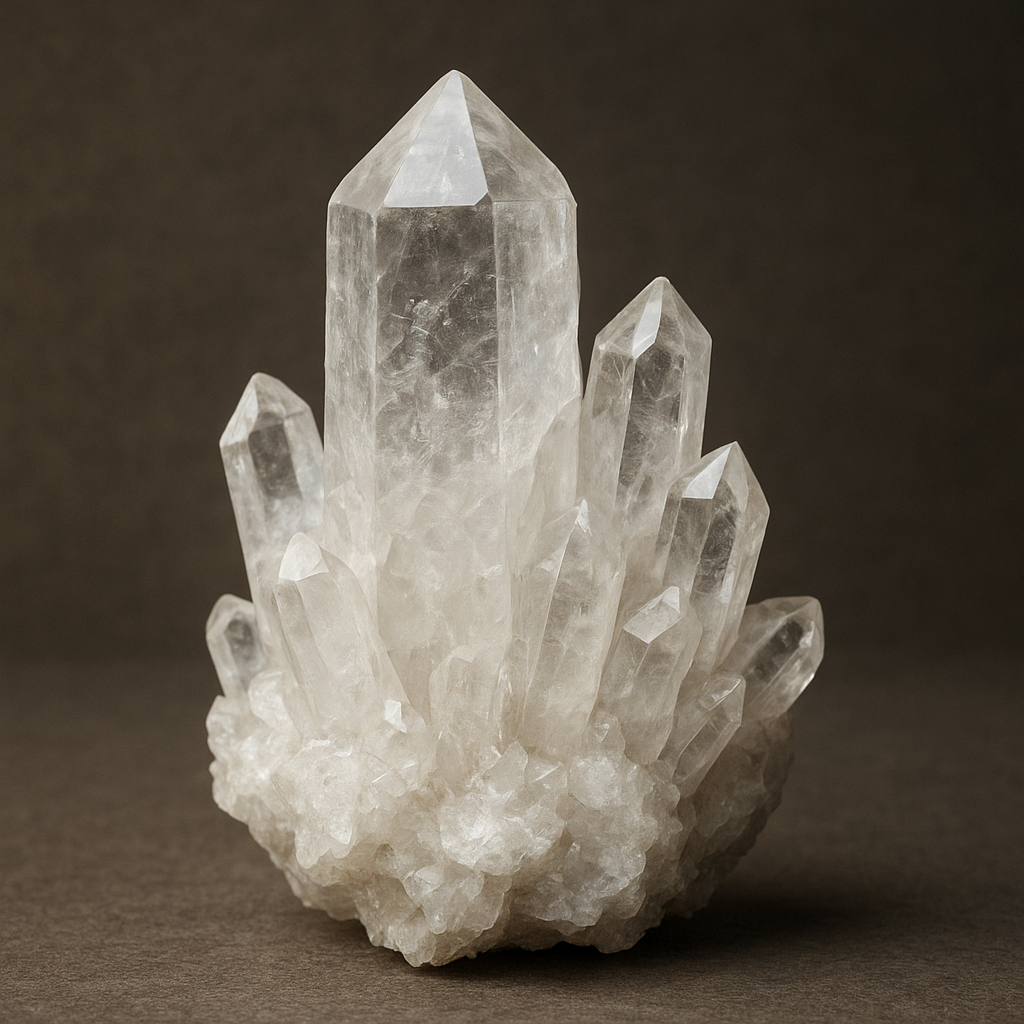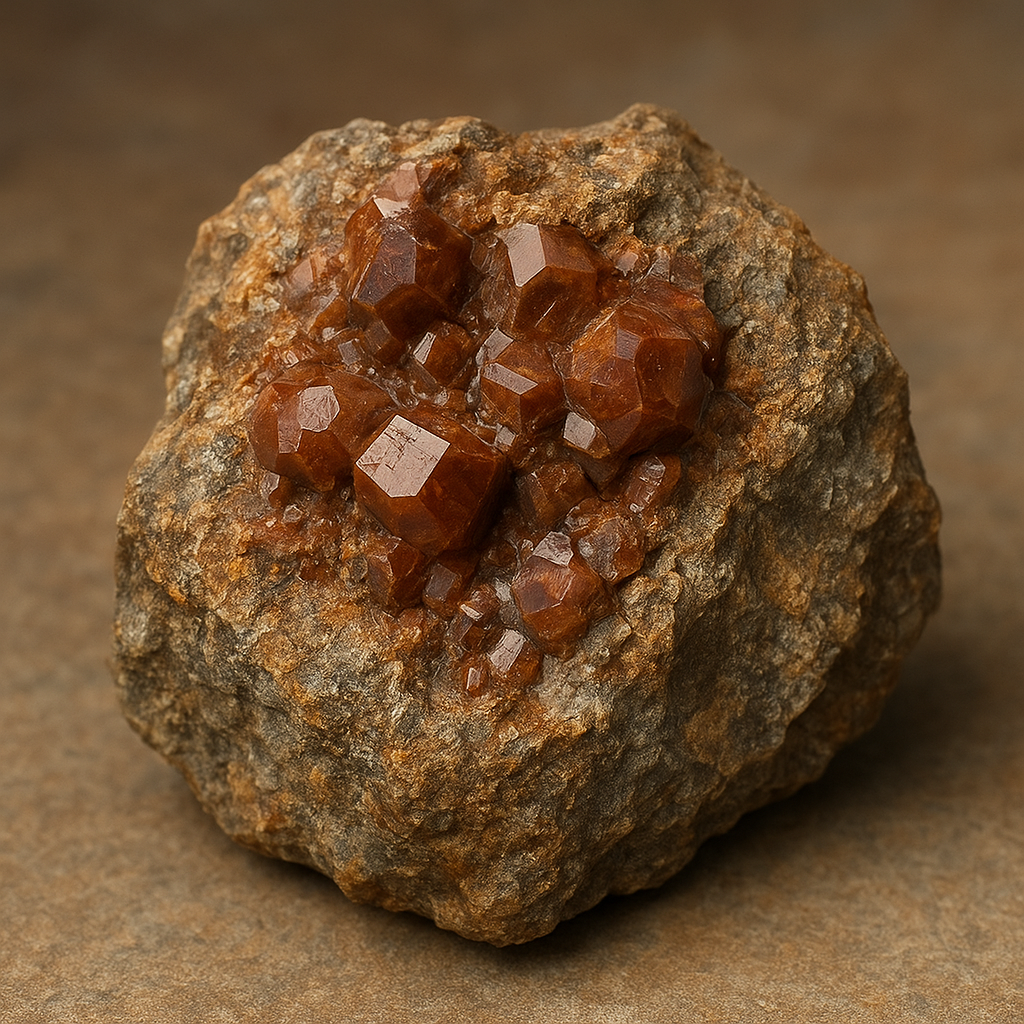
Fayalite is the iron-rich endmember of the olivine mineral group, a phase that occupies a special place in petrology, materials science and planetary studies. Its chemical formula, Fe2SiO4, contrasts directly with the magnesium-rich counterpart forsterite (Mg2SiO4), and that contrast controls much of its occurrence, behavior and practical importance. Although visually similar to other olivines, fayalite’s high iron content imparts distinct physical, chemical and thermodynamic properties that make it a useful indicator of formation conditions and a component of industrial and experimental silicate systems.
Crystal chemistry, physical properties and stability
Fayalite belongs to the olivine solid-solution series and crystallizes in the orthorhombic system, usually in compact granular aggregates or imperfect crystals. The olivine structure is built of isolated silicate tetrahedra (SiO4) linked by divalent cations occupying two distinct octahedral sites (M1 and M2). In fayalite these sites are largely occupied by ferrous iron (Fe2+), which gives the mineral a higher density and darker color than magnesium-rich olivine.
- Chemical formula: Fe2SiO4.
- Crystal system: orthorhombic, space group Pnma (common to olivines).
- Color: typically olive green to brownish-black; can be yellowish in altered material.
- Hardness: around 6.5–7 on the Mohs scale (similar to other olivines).
- Density: significantly greater than forsterite (fayalite ~4.3–4.4 g/cm3 versus forsterite ~3.2 g/cm3).
- Melting behavior: fayalite melts at substantially lower temperatures than forsterite (experimental liquidus for fayalite is near ~1200–1250 °C under many conditions).
The solid solution between fayalite and forsterite is temperature-dependent. At high temperatures a near-complete solid solution exists between Fe and Mg on olivine sites; on cooling, cations may exsolve or produce compositional zoning. Natural olivines often record this compositional history in zoning patterns, inclusions and lamellae.
Where fayalite occurs: geological settings and important localities
In contrast to the abundant magnesium-rich olivine in the Earth’s mantle, fayalite is relatively uncommon in mantle-derived rocks. It typically forms where iron is abundant and either magnesium is depleted or silica activity is unusually high. The most characteristic geological environments for fayalite include:
- Skarns and metasomatic zones: Contact metamorphism and metasomatism where iron-rich fluids interact with silica-bearing rocks often produce fayalite-bearing assemblages. Here fayalite commonly occurs with garnet (e.g., andradite), pyroxenes, magnetite and quartz.
- Late-stage igneous and pegmatitic environments: In some silica-saturated, iron-rich pegmatites and granitic systems, fayalite can crystallize as a late-stage mineral.
- Hydrothermal veins and alteration zones: Low-temperature alteration of iron-rich silicates can produce fayalite or fayalite-like compositions in veins and nodules.
- Volcanic glasses and slags: Fayalite commonly crystallizes from iron-rich silicate melts such as industrial slags and some types of volcanic glass.
- Meteorites and planetary materials: Fayalite is recognized in certain meteorites and in materials altered on parent bodies; its composition and distribution can record aqueous or thermal alteration histories.
The name fayalite comes from Faial (formerly spelled “Fayal”), an island in the Azores where it was first described. Other notable localities include skarn deposits in Europe, North America and parts of Asia, where fayalite is associated with iron ores and complex silicate assemblages. In meteorite studies, fayalite-rich olivine compositions are used to distinguish different meteorite classes and alteration processes on small bodies.
Petrogenetic significance and redox chemistry
One of fayalite’s most important roles in geological studies is as an indicator of redox conditions during rock formation. The reaction between fayalite, magnetite and quartz is the basis of a widely used oxygen-buffering assemblage:
- 3 Fe2SiO4 (fayalite) + O2 ⇄ 2 Fe3O4 (magnetite) + 3 SiO2 (quartz)
This buffer—commonly abbreviated as the FMQ buffer (Fayalite–Magnetite–Quartz)—is used to quantify oxygen fugacity (fO2) in magmatic and metamorphic systems. Because fO2 controls the valence state of iron and thereby influences element partitioning, melt structure and mineral stability, fayalite-related equilibria are central to reconstructing magmatic processes, degassing behavior and mantle–crust interactions.
At low oxygen fugacities fayalite is stable, but increasing oxidation promotes the conversion to magnetite and free silica. This behavior affects melting temperatures and melt compositions: fayalite-rich compositions have relatively low liquidus temperatures and tend to form dense iron-rich melts (or slags) that influence volcanic and industrial melt behavior.
Industrial and experimental applications
Fayalite is not only a mineralogical curiosity; it appears in several industrial contexts and experimental settings:
- Metallurgical slags and smelting: In the smelting of iron, copper and other metals, iron-silicate melts commonly crystallize fayalite. The composition and viscosity of fayalite-bearing slags are critical parameters in furnaces because they govern heat transfer, metal-slag separation and refractory wear. Controlling slag chemistry to avoid excessive fayalite crystallization or to encourage a desired slag phase is an engineering concern.
- Refractory and ceramic materials: Synthetic fayalite-like phases and fayalite-containing glass-ceramics have been investigated for refractory applications because of their thermal properties and ability to incorporate iron and other elements.
- Waste immobilization: There has been experimental work on using fayalite-type silicates to immobilize heavy metals and radionuclides. The olivine structure can host a variety of divalent cations, and synthetic fayalite materials can be tailored to combine chemical durability with the ability to sequester problematic ions.
- Experimental petrology and thermodynamics: Because of its relatively low melting point and straightforward chemistry, fayalite is frequently used in laboratory studies of silicate melts, redox equilibria and phase relations. Its role in the FMQ buffer makes it a standard component for calibrating oxygen fugacity in experiments.
Fayalite in planetary science and meteorites
Olivine compositions in meteorites provide clues to the thermal and alteration history of parent bodies. The iron content of olivine is often expressed in mole percent fayalite (Fa). Variations in Fa content among olivines in different meteorite groups help classify chondrite types and infer aqueous alteration or thermal metamorphism on asteroidal parent bodies.
In some meteorites, especially carbonaceous chondrites, fayalite-rich olivine can form through low-temperature aqueous alteration of more magnesium-rich precursors. On larger bodies, fayalite (or iron-rich olivine) can reflect local bulk composition during crystallization. Beyond meteorites, planetary remote sensing often identifies olivine on surfaces (for example, on Mars and the Moon); the detection of iron-rich olivine has implications for crustal oxidation-state, volcanic history and potential alteration processes on those planets.
Identification, alteration and associated minerals
In hand specimen and thin section, fayalite is recognized by its high density, dark green-brown color, high refractive index and tendency to be pleochroic in thin section. It is commonly associated with:
- magnetite and other iron oxides (especially where oxidation has occurred);
- pyroxenes such as hedenbergite in skarn assemblages;
- garnets like andradite in contact-metasomatic environments;
- quartz where silica saturation is high.
Fayalite is susceptible to oxidative weathering; exposure to oxygen and water can transform it into iron oxides and hydroxides and produce silica. The breakdown of fayalite can thus contribute to the formation of limonitic iron-rich weathering products and secondary silica, a factor that must be considered when interpreting surface occurrences.
Interesting research directions and lesser-known facts
Several contemporary topics make fayalite more than a museum specimen. Researchers are investigating:
- High-pressure behavior: Experimental studies explore how Fe-rich olivine behaves at high pressures relevant to planetary interiors. Differences in compressibility and phase transitions between Mg- and Fe-endmembers influence models of planetary mantles, especially for bodies with non-chondritic bulk compositions.
- Redox-sensitive element partitioning: Because fayalite is sensitive to oxygen fugacity, it is used to study how redox conditions control the partitioning of trace elements (e.g., V, Cr, Ti) between minerals and melts.
- Environmental and waste applications: Work on synthesizing fayalite-type ceramics for immobilizing hazardous constituents has shown promise; the capacity of the olivine structure to substitute divalent cations makes it a versatile host for remediation-oriented materials.
- Correction of thermodynamic databases: Accurate thermodynamic properties of fayalite are necessary for modeling natural and industrial silicate melts. Ongoing recalibration of such data improves our ability to predict melt behavior, slag formation and mineral equilibria.
- Planetary spectroscopy: Distinguishing iron-rich olivine (fayalite-bearing) from magnesium-rich olivine on planetary surfaces by remote sensing remains a challenge. Advances in spectroscopic techniques help refine interpretations of surface mineralogy on Mars, the Moon and asteroids.
How to recognize and handle fayalite samples
Collectors and researchers should note that fayalite can be visually similar to other dark olivines, pyroxenes or even chlorite-like alteration products. Useful identification practices include measuring specific gravity, optical microscopy to observe birefringence and extinction angles, and geochemical analysis (e.g., electron microprobe) to determine Fe/Mg ratios.
When studying natural fayalite, it is important to consider potential alteration: exposed samples may show partial conversion to magnetite plus silica or to iron hydroxides. In laboratory experiments, controlling oxygen fugacity is essential to preserve fayalite and prevent unwanted oxidation to magnetite.
Concluding remarks on significance and curiosity
Fayalite is a compelling mineral because it sits at the intersection of fundamental mineral chemistry, practical metallurgy and planetary science. Its strong sensitivity to iron–magnesium substitution and to the redox state of its environment gives it diagnostic power: as a recorder of formation conditions, as a participant in industrial silicate melts and as a target for advanced material synthesis. Whether encountered as a rare accessory in a skarn, as a crystalline phase in a slag, or as a compositional endmember helping to define oxygen fugacity, fayalite is more than a chemical formula—it’s a key to processes that shape rocks on Earth and beyond.