
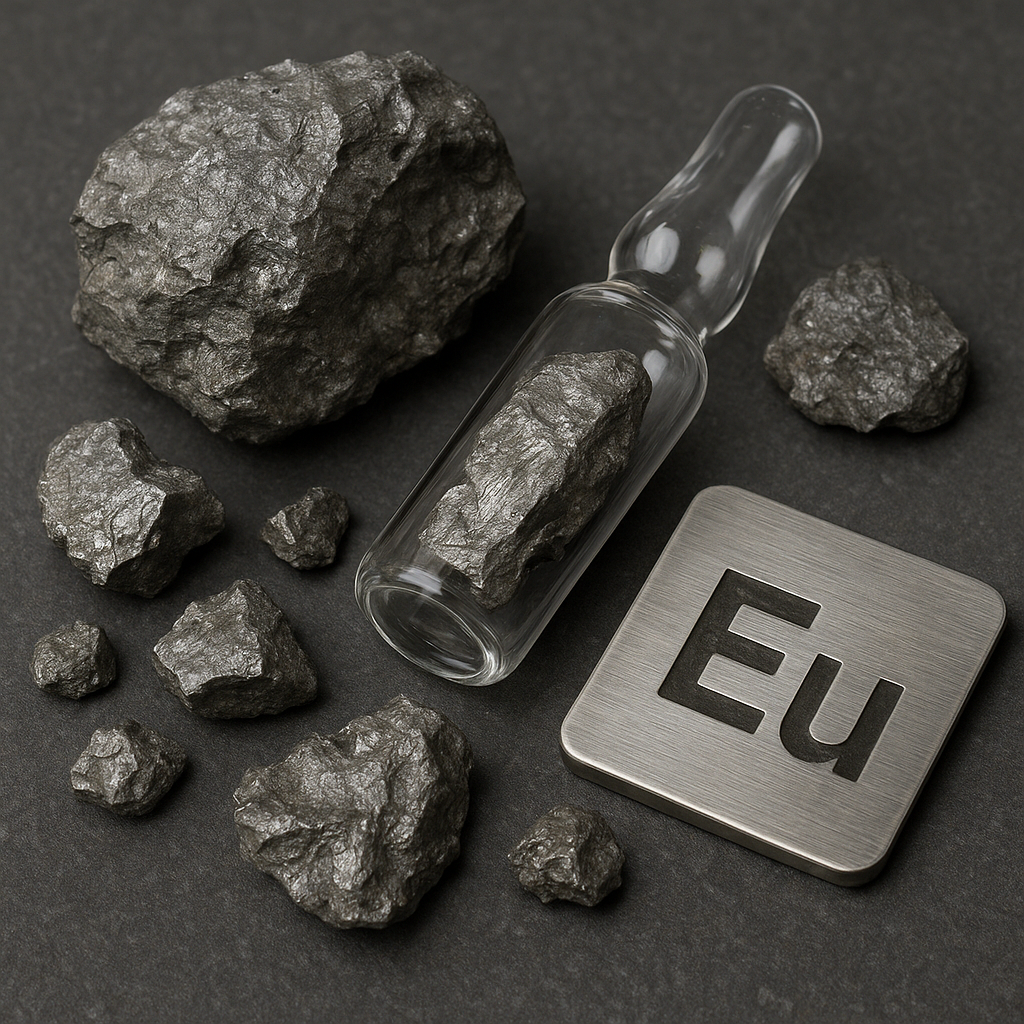
Europium is one of the more intriguing members of the rare-earth family: a soft, silvery metal with significant technological importance despite its relative scarcity. Named for its continental association, europium’s distinctive electronic structure gives rise to unique optical and chemical behaviors that have found their way into lighting, displays, security printing, and nuclear technologies. This article explores where europium is found, how it is extracted and processed, the principal and emerging applications that rely on its properties, and several lesser-known yet fascinating aspects of the element.
Occurrence, Mining and Extraction
Europium is a member of the lanthanide series and occurs naturally mixed with other rare-earth elements in a variety of mineral deposits. It is not found in concentrated ore bodies on its own; instead, it is recovered as a minor constituent of minerals such as monazite, bastnäsite, and xenotime. Most commercial europium is produced as a byproduct of mining and processing other rare-earth elements.
Geographic distribution and major producers
- China dominates global rare-earth processing and supplies most of the world’s refined europium, though occurrences exist in Australia, the United States (notably at Mountain Pass), Russia, India, Brazil, and Greenland.
- Reserves are widely distributed, but geopolitical and environmental constraints mean supply remains concentrated and occasionally volatile.
From ore to element: extraction and refining
Recovering europium from ore involves a chain of chemical separations. After initial mechanical concentration and radioactive-element removal, hydrometallurgical techniques such as acid leaching, solvent extraction, and ion exchange are applied to produce mixed rare-earth salts. Individual separation of europium from neighboring lanthanides relies on subtle differences in ionic radius and oxidation chemistry. The final metallic europium can be produced by reduction (e.g., aluminothermic methods) from its oxide or halide forms.
Chemical processing of rare-earth ores raises environmental concerns: mining can generate radioactive waste (from thorium and uranium present in some host minerals), produce chemical effluents, and require large water and energy inputs. These factors have stimulated research into improved extraction methods, closed-loop processing, and recycling of europium-bearing materials.
Physical and Chemical Properties
Europium’s place in the periodic table determines many of its useful properties. As element 63, it belongs to the lanthanide series and exhibits characteristic f-electron behavior that shapes its spectroscopy and magnetism. The element commonly adopts a +3 oxidation state, although a stable +2 state also occurs in many compounds — a feature that proves valuable for optical applications.
Optical behavior and electronic states
The luminescence of europium ions makes them valuable as optical activators. In the +3 state (Eu3+), narrow emission lines arise from f–f electronic transitions, producing sharp red lines that are especially intense under ultraviolet excitation. The transition responsible for the characteristic red emission is the 5D0 → 7F2 transition (a hypersensitive electric-dipole transition), which is frequently exploited in red phosphors.
By contrast, Eu2+ exhibits broad, allowed 4f65d1 → 4f7 transitions that produce wide-band emissions, often in the blue to green part of the spectrum depending on the host lattice. This difference between Eu2+ and Eu3+ emissions underlies many applications: Eu3+ for narrow red emission and Eu2+ for broader color tuning in phosphors.
Chemistry and reactivity
- Europium metal is relatively soft and oxidizes in air, forming an oxide layer. It reacts with water and acids to form ionic europium salts.
- Europium’s variable oxidation states permit redox chemistry that influences separation strategies and the design of luminescent materials.
- Magnetically, europium compounds can display interesting behavior: Eu2+ has a half-filled 4f shell that can give rise to significant magnetic moments in suitable compounds.
Applications — Established and Emerging
Europium’s primary value derives from its optical characteristics. The element’s ability to produce intense, well-defined emission lines and to act as an activator in phosphor matrices has kept it in steady demand, even as lighting technology evolves. Applications span everyday consumer products to specialized scientific uses.
Lighting and displays
Europium-based phosphors transformed lighting and display technologies in the late 20th century. In fluorescent lamps and early color cathode-ray tube (CRT) displays, europium-activated phosphors provided the critical red component of the color palette. The addition of europium allowed brighter, truer reds than had been otherwise achievable with other activators.
- Eu3+-doped oxides such as yttrium oxide (Y2O3:Eu) and yttrium vanadate (YVO4:Eu) are classic red phosphors used in displays and lamps.
- In modern solid-state lighting, Eu-doped nitride and oxynitride phosphors (e.g., CaAlSiN3:Eu2+) deliver deep red emission, enhancing color rendering in white LEDs.
The demand for europium in lighting fell when some technologies moved to alternative red light sources, but it remains critical for high-quality color reproduction in specialty displays, artistic lighting, and applications where saturated reds are required.
Security printing and anti-counterfeiting
Europium’s distinctive luminescent fingerprints under ultraviolet or infrared illumination make it ideal for use in security inks and coatings. Banknotes, passports, and other secure documents often incorporate europium-doped pigments that fluoresce in predictable ways, enabling quick authentication by visual or machine inspection. The use of europium-enhanced luminescence adds a covert, hard-to-replicate layer of protection against forgery.
Nuclear technology and isotopes
Some europium isotopes have significant neutron-absorption cross sections, which gives europium potential use as a neutron poison or control material in reactors. Compounds containing europium have been studied for control rod technology and for tailoring neutron economy in specialized reactor designs.
Radioisotopes of europium are also useful in scientific and industrial contexts. Certain radioactive isotopes produced via neutron activation are used as gamma-emitting calibration sources or tracers in environmental and materials studies. The predictable gamma spectra of some europium isotopes make them convenient standards for detector calibration.
Scintillators, detectors and research tools
Europium acts as an activator in some scintillator materials, which convert high-energy radiation into visible light. These scintillators are key components in medical imaging (e.g., some forms of gamma cameras), radiation detection, and high-energy physics experiments. The element’s well-resolved emission lines and compatibility with various host lattices enable customized detector responses and high signal fidelity.
Novel and niche applications
- Europium-doped materials are used in luminescent thermometry and optical temperature sensors because emission intensities and spectral ratios can be temperature-dependent.
- Quantum cutting and energy-transfer schemes using europium in concert with other rare-earth ions have been investigated to boost solar cell efficiency by converting high-energy photons into multiple lower-energy photons better matched to photovoltaic absorber bands.
- Research into europium-containing catalysts, specialty alloys, and magnetic materials continues, though these applications are generally niche compared to optical uses.
Supply, Economics and Environmental Considerations
Rare-earth supply chains are complex: mining and concentrating ores, refining mixed rare-earth salts, and performing element separations are capital- and chemistry-intensive. Because europium is a minor component in most deposits, its availability depends on the economics of extracting and processing the whole rare-earth suite.
Market dynamics and geopolitics
Global supply of europium and other rare earths has been dominated by a few producers, with concentrated processing capacity creating vulnerability to export restrictions and price volatility. Efforts to diversify supply — including new mining projects, downstream refining capacity expansion outside traditional centers, and recycling initiatives — aim to reduce strategic risk.
Recycling and substitution
Recycling europium from end-of-life products (fluorescent lamps, display panels, security inks) offers a path to reduce dependence on primary mining. However, technical and economic barriers remain: the element is dispersed among many materials, and recovery requires specialized chemical processing. Substitution strategies — developing non-europium red emitters or using design changes to minimize europium demand — are an active area of materials research.
Environmental and health aspects
Like other rare-earth processing chemicals, basic europium compounds are handled in controlled industrial contexts. Mining and refining byproducts, particularly from thorium and uranium present in some host minerals, create radioactive waste management issues. Responsible environmental stewardship, tighter regulation, and improved process technologies are central to minimizing the ecological footprint of europium production.
Historical Notes, Fun Facts and Scientific Curiosities
The element’s name pays homage to the continent of Europe, and it was identified as a distinct element at the turn of the 20th century. Its chemistry and spectroscopy played a formative role in the development of f-electron science and in deepening understanding of lanthanide electronic structure.
- Europium provides one of the clearest textbook examples of how small changes in electronic occupancy (Eu2+ vs. Eu3+) drastically alter optical properties.
- Some museum-quality luminous paints and glow-in-the-dark materials utilize europium activators to produce long-lived phosphorescence when paired with suitable host lattices and co-dopants.
- In spectroscopic studies, europium’s narrow emission lines are often used for calibrating and probing electronic environments in complex materials, because the lanthanide f-orbitals are shielded and produce relatively sharp spectral features.
- Because europium can act as a benchmark activator, it still features prominently in research exploring energy transfer mechanisms, upconversion and downconversion luminescence, and the engineering of next-generation lighting and sensing materials.
Challenges and Future Directions
Research and industry face several interlinked challenges regarding europium:
- Developing cost-effective, low-impact extraction and separation methods to reduce the environmental footprint of production.
- Improving recycling technologies and establishing circular supply chains to recover europium from discarded electronics, lamps, and special-purpose materials.
- Exploring material substitutes and new phosphor chemistries that either reduce europium content or use more abundant activators while retaining performance.
- Advancing scientific understanding of europium’s role in complex host lattices to design more efficient, stable, and tunable luminescent materials for photonics, sensing, and energy applications.
Europium occupies a unique niche where the subtleties of atomic physics meet very practical technological needs. Its optical fingerprints remain invaluable for security, imaging, and lighting, while ongoing innovation aims to reconcile demand with more sustainable and diversified supply strategies. As photonic technologies evolve, europium’s special combination of electronic and emission properties will likely keep it in the spotlight of both applied and fundamental research.