
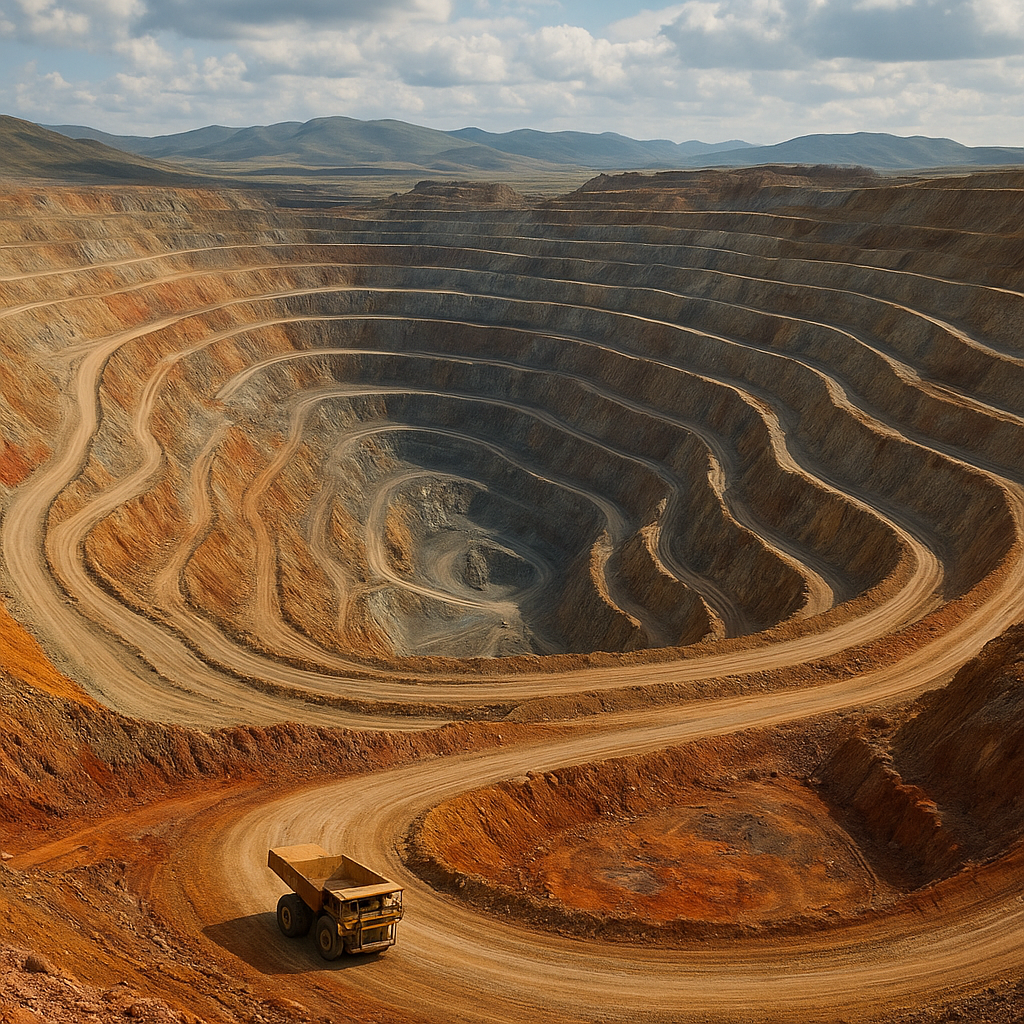
The Erdenet mining complex stands as one of Mongolia’s most important industrial landmarks, a large-scale operation built around a rich porphyry deposit of copper and molybdenum. Located in the north-central part of the country, the mine has shaped the region’s urban development, influenced national trade patterns, and remained a focal point of political and economic discussion for decades. This article explores where the mine is, what is extracted there, its economic role, and several noteworthy aspects that make Erdenet unique.
Location, founding and regional context
The Erdenet complex is located in the Orkhon Province of northern Mongolia, adjacent to the city that shares its name, Erdenet. The town and mine lie roughly northwest of the capital, Ulaanbaatar, and were planned together as an integrated industrial and residential center. For decades the operation functioned as a flagship heavy-industry project for the country, built with external technical and financial support and drawing workers, engineers and families from across Mongolia and beyond.
The mine’s placement was driven by the presence of a large porphyry deposit and by logistical considerations: access to rail and road networks that connect the region to the Mongolian interior and international export routes. Over time the city of Erdenet developed into one of Mongolia’s major urban centers, with the mine as its economic backbone. Local infrastructure — from housing and schools to hospitals and cultural institutions — was created to serve the workforce and their families, making the mine a center of regional development and modernization.
Geology and what is mined
Erdenet is centered on a classic porphyry-style mineral deposit. These deposits typically form around intrusive igneous bodies where hydrothermal fluids concentrate metals in and around fracture zones and stockworks. At Erdenet, the dominant commercial commodities are copper and molybdenum, with smaller but economically meaningful amounts of gold, silver and other trace metals recovered as by-products during processing.
- Copper: The primary product is copper concentrate. Copper occurs in disseminated sulfide minerals throughout the host rock and is recovered through large-scale open-pit mining followed by crushing, grinding and flotation in a concentrator plant.
- Molybdenum: Molybdenum typically occurs as molybdenite (MoS2) associated with porphyry intrusions. Molybdenum concentrate is separated in the comminution and flotation circuits and sold separately for industrial use, particularly in high-strength steel alloys.
- By-products: The processing streams occasionally recover precious metals such as gold and silver, which can improve the economic profile of the operation.
Mining at Erdenet has historically relied on a combination of open-pit extraction and large-scale surface material handling. Ore is delivered to a concentrator on site where flotation produces separate copper and molybdenum concentrates. These concentrates are typically exported to smelters and refineries overseas for final metal production, as Erdenet itself focuses on beneficiation rather than refining into pure metals.
History, ownership and development
The Erdenet project was initiated in the 1970s with technical, financial and construction support from what was then the Soviet Union. The enterprise was established as a joint venture conceptually designed to link Mongolia’s mineral wealth with industrial processing capacity. Construction of the mine and associated facilities led to the rapid emergence of the city of Erdenet to house workers, technical staff and administrators.
Through the transition decades of the late 20th and early 21st centuries, Erdenet remained a key asset in Mongolia’s industrial portfolio and a focal point in bilateral economic relations. Over time, the structure of ownership and commercial arrangements evolved amid political and financial negotiations. The mine continued to attract investment for modernization, optimization of mining and processing circuits, and environmental mitigation programs.
Production, processing and logistics
Erdenet operates both mining and processing facilities capable of treating large volumes of ore. The processing route is focused on mechanical and chemical separation:
- Crushing and grinding to liberate sulfide minerals.
- Flotation to produce copper and molybdenum concentrates.
- Tailings management and water handling to control environmental effects.
Concentrates produced at Erdenet are transported via rail and road to export points or to partner smelters and refineries abroad. Because the mine produces concentrates rather than refined metal, international commodity markets, freight logistics and relations with processing partners have a direct impact on the operation’s profitability.
Economic significance to Mongolia
The Erdenet complex has been one of Mongolia’s most influential economic assets. Its importance can be summarized in several areas:
- Employment: The mine and its associated services have provided thousands of direct jobs and many more indirect positions in transport, services and supply chains, supporting livelihoods in the region.
- Government revenues: Through taxes, royalties and dividends, the operation has contributed a substantial share of national resource revenues at various times in recent decades.
- Exports: Concentrates from the mine have been a major component of Mongolia’s mineral export basket, helping to generate foreign exchange and to underpin the country’s external trade position.
- Industrial development: Erdenet anchored skills development, technical training and the growth of local engineering and maintenance capacity, contributing to Mongolia’s broader industrialization efforts.
While the precise share of GDP or export value attributable to Erdenet varies year-to-year, the mine’s strategic role is clear: it has been a major driver of Mongolia’s modern economic identity and a stable source of revenue during fluctuating commodity cycles.
Social and regional impacts
Beyond direct economic metrics, Erdenet shaped social and urban development in northern Mongolia. The city evolved with schools, vocational training centers, cultural institutions and sports facilities oriented around the mine’s workforce. This social infrastructure increased regional human capital and created amenities that attracted families and professionals from across the country.
Local communities have depended on the mine for services and support. Corporate social responsibility programs have typically funded community projects, improvements to local health care, and educational initiatives. Nevertheless, the social relationship between the mine and surrounding communities has sometimes been complicated by environmental concerns, workforce transitions and changing ownership or operational strategies.
Environmental management and challenges
Large-scale open-pit mining and flotation processing create environmental challenges that require ongoing management. Key issues include:
- Tailings storage: Managing tailings ponds to prevent seepage, catastrophic failure or downstream contamination is a long-term priority.
- Water management: Treating process water and managing water balance in a continental climate with seasonal extremes are both vital to protect local water resources.
- Dust and air emissions: Dust suppression and emissions control help reduce impacts to local communities and ecosystems.
- Rehabilitation and closure planning: As mining progresses, planning for progressive reclamation and eventual closure is essential to reduce the long-term environmental footprint.
In recent decades, the company has implemented modernization programs aimed at improving resource efficiency, reducing environmental risk and adopting best-practice tailings management. These measures reflect both regulatory expectations and global shifts toward more stringent environmental performance in mining.
Exploration, reserves and future prospects
Exploration activity in and around the Erdenet complex continues as the operator seeks to extend the life of mine, identify satellite deposits and optimize ore recovery. Porphyry systems often have complex geometry, and modern exploration techniques — including geophysics, deep drilling and geochemical analysis — can reveal additional resources that support long-term production.
The mine’s future depends on several interacting factors:
- Ore grades and recoverable reserves: Continued delineation of reserves determines how long current operations can be sustained.
- Commodity markets: Prices for copper and molybdenum strongly influence investment decisions, expansions and production rates.
- Technological upgrades: Process improvements, automation and digitalization can lower operating costs and increase recovery.
- Policy and ownership frameworks: Regulatory decisions, revenue-sharing arrangements and ownership structures all affect strategic planning and investment flows.
Given global demand trends for copper — driven by electrification, renewable energy and infrastructure — and for molybdenum — used in high-strength steels and specialized alloys — the strategic relevance of Erdenet remains significant for Mongolia’s resource-driven development path.
Interesting facts and broader significance
Several points make Erdenet especially noteworthy:
- Name meaning: The word Erdenet means “treasure” in Mongolian, a fitting name for a settlement built around one of the country’s most valuable mineral deposits.
- Planned city: The city of Erdenet was established as a planned industrial town, with infrastructure and social amenities designed specifically to support a large mining operation and its workforce.
- Regional hub: Over time Erdenet developed into an educational and cultural hub in northern Mongolia, with vocational schools and technical training programs linked to mining and metallurgy.
- Strategic role: The mine has been central to Mongolia’s modern economic history, influencing bilateral relations, fiscal policy and national development strategies tied to mineral wealth.
- Technological evolution: From its construction with foreign technical assistance to modern upgrades involving automation and improved environmental controls, the mine illustrates the technological evolution of large-scale mining in the region.
Conclusion and continuing relevance
The Erdenet mining complex continues to be a cornerstone of Mongolia’s industrial landscape. As a major producer of copper and molybdenum, the operation influences employment, exports and regional development while also presenting environmental and governance challenges that require careful management. Its legacy as a planned industrial city and its ongoing role in national resource strategy ensure that Erdenet will remain a subject of economic, technical and political interest for years to come, especially as global commodity dynamics evolve and as Mongolia balances development goals with environmental and social priorities.

