
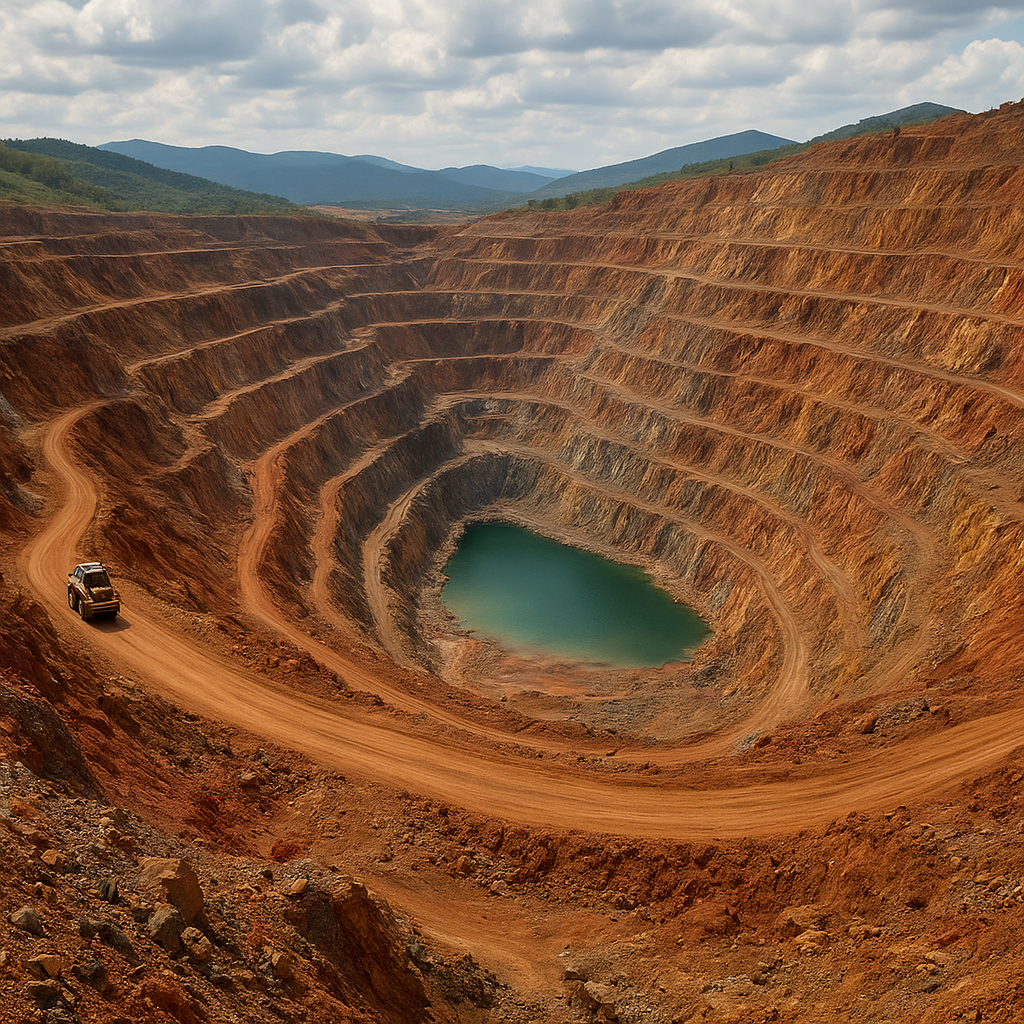
The Elatsite Mine sits in the foothills of the Stara Planina range in central Bulgaria, and has been an important node in the country’s mineral industry for decades. As one of the better-known copper operations in the region, it combines large-scale open-pit mining with modern processing methods to produce copper-bearing concentrate and associated by-products. This article explores where the mine is located, what is extracted there, its wider economic significance, and a number of intriguing technical, historical and social details that surround Elatsite.
Location and geological setting
Elatsite is located in central Bulgaria, in proximity to the towns of Zlatitsa and Pirdop, within the Sofia administrative region and near key transport corridors that link the interior of the country with the capital and the rest of the Balkan Peninsula. The mine occupies a landscape of rolling hills and forested slopes lying along the northern flanks of the Balkan Mountains, an area with a long tradition of metal exploration and extraction. Its geographic position gives it strategic advantages for logistics: road connections to processing facilities, access to workforce in nearby towns, and relatively short distances to downstream metallurgical plants.
Geology and mineralization
The deposit typifies the porphyry-style mineralization common to many copper provinces. Mineralization at Elatsite takes the form of disseminated and vein-hosted copper sulphides, frequently accompanied by minor amounts of molybdenum and traces of precious metals such as gold and silver. These sulfide minerals are hosted in altered intrusive and surrounding country rocks whose hydrothermal history controlled the distribution of ore. The geology is significant not only because it determines mining method and processing flow-sheets, but also because it influences environmental behavior—acid generation potential, metal mobility, and water chemistry all trace back to the host rocks and mineral assemblages.
What is mined and how it is processed
At its core, Elatsite produces copper ore. The mine removes large volumes of rock to extract copper-bearing material which is then crushed, milled and subjected to flotation to create a copper concentrate. This concentrate concentrates the economic metal and reduces transport costs to smelters and refineries. Typical copper concentrates from porphyry deposits contain copper sulfide minerals such as chalcopyrite and bornite and may also include molybdenum disulfide and trace precious metals, making the concentrate a multi-commodity product.
Mining methods and onsite operations
- Primary extraction at Elatsite is predominantly open-pit, a method suited to the near-surface, disseminated nature of the deposit.
- Ore is delivered to a processing plant where it undergoes comminution (crushing and grinding) and froth flotation to produce a saleable concentrate.
- Tailings management, water treatment, and progressive rehabilitation form an integral part of the operational cycle to limit environmental footprint.
Modern operational practices emphasize efficiency in material handling and energy use. Electrified conveyor systems, controlled blasting regimes, and computerized mine planning tools help optimize ore recovery and reduce waste. On the processing side, flotation circuits have been refined to improve recovery of fine mineral particles and to separate copper minerals from gangue and deleterious elements.
Economic role and regional significance
Elatsite plays a multifaceted economic role on both local and national levels. It provides direct employment to hundreds (and at peak times, thousands) of workers, and an extended supply chain of contractors, transporters, and service providers that amplifies its economic footprint across the region. The mine’s operations generate fiscal revenues through taxes, royalties and fees which contribute to municipal and national budgets. They also stimulate infrastructure development: roads, power lines and water systems that often serve broader community needs in the zone.
Contribution to exports and industry linkages
Copper and copper products are globally traded commodities. Concentrate produced at Elatsite is shipped to smelters and refineries where it is transformed into metal for electrical, construction and industrial applications. Such export earnings help Bulgaria diversify its trade balance and support downstream manufacturing sectors. The mine further fuels industrial clusters by supplying raw materials to metallurgical complexes, and by drawing on services and technologies supplied by engineering firms, laboratories, and logistics providers.
- Reserves and resource estimates anchor investment decisions, making the deposit an attractive asset for exploration and extension programs.
- Local businesses — from parts suppliers to catering firms — gain steady demand because of mine operations.
- Regional employment multipliers often convert mining wages into spending that supports retail, education and health services.
Environmental management and sustainability measures
Mining has environmental effects and Elatsite implements a range of mitigation measures to manage impacts responsibly. Emphasis is placed on water quality control, dust suppression, tailings stability, and progressive land rehabilitation. Modern mines operate under environmental permits that require monitoring and reporting; they often maintain programs to reduce energy consumption and greenhouse gas emissions.
Water, tailings and reclamation
Water management is critical. Process water is typically recycled through closed circuits to reduce freshwater drawdown, and treatment facilities are used to remove suspended solids and reduce metal concentrations before any controlled discharge. Tailings, the fine-grained waste from flotation, are stored in engineered facilities with liners, seepage collection systems and monitoring wells to prevent groundwater contamination. Reclamation work—reshaping slopes, replacing topsoil and replanting native vegetation—is typically undertaken progressively so that disturbed areas are rehabilitated as mining moves on.
To reduce the long-term environmental footprint, companies operate with an eye toward environmental stewardship: biodiversity offsets, habitat restoration and community engagement in environmental monitoring are features of best practice. Where legacy issues exist from older mining periods, investment in remediation and risk reduction is often a priority for modern operators and regulators alike.
Community relations and socio-cultural impacts
Mines are not isolated economic units; they affect everyday life in neighbouring towns and villages. Elatsite’s workforce lives in nearby communities, contributing to local tax bases and social vitality. Many mining operations support local education, health and cultural initiatives through sponsorship, training programs and local procurement policies. Engagement with residents, public consultations and grievance mechanisms are increasingly standard practices to ensure that community voices are heard in decisions that affect their environment and livelihoods.
Skills development and workforce dynamics
Mining demands a diverse set of skills: geologists, engineers, metallurgists, environmental specialists, and an array of tradespeople. Investments in training and apprenticeships help create a skilled local workforce. This not only benefits the mine but also leaves a legacy of human capital that can be redeployed in other sectors of the regional economy once mining declines or halts.
Interesting aspects, history and technical highlights
Elatsite sits within a region that boasts a long mining history, stretching back to ancient times when local populations exploited metallic ores. Several interesting points make the mine notable beyond its immediate economic outputs:
- Historical continuity: The Balkan region has been a mining landscape for millennia. Modern operations such as Elatsite can trace the lineage of metallurgy and mineral trade that once powered ancient settlements.
- Technological evolution: Techniques from open-pit earthmoving to fine-particle flotation reflect decades of technological progress, with modern instrumentation improving ore-grade control and recovery.
- Geoscientific value: The deposit is a field laboratory for geologists studying porphyry systems, alteration halos and ore-forming processes; research from such sites informs exploration globally.
- By-product economics: Even modest amounts of molybdenum, gold or silver in concentrates can add materially to the project’s financial returns, illustrating how small trace elements can impact mine economics.
- Local culture and identity: Mining becomes part of a region’s identity—festivals, museums and educational programs often celebrate the local industrial heritage and its contribution to community life.
Modern innovations and research directions
Contemporary initiatives focus on improving resource recovery and reducing environmental impacts. Examples include:
- Fine-particle flotation reagents and circuit designs that boost recovery of previously lost mineral fractions.
- Automation and digitalization in mine planning and fleet management, lowering operational costs and improving safety.
- Progress in tailings dewatering and paste backfill technologies that reduce the footprint and risk of tailings storage facilities.
- Research into alternative processing methods for low-grade material to extend the useful life of the deposit.
Operational challenges and future outlook
Like all mining projects, Elatsite faces challenges: commodity price volatility can affect margins; environmental standards tighten over time; and social expectations around benefit-sharing and transparency rise. Nevertheless, if properly managed, such operations provide sustained economic benefits and can leave behind a rehabilitated landscape and a community with improved infrastructure.
Future prospects depend on a mixture of technical innovation, responsible stewardship and alignment with national resource policies. Exploration for satellite deposits or deeper extensions could prolong activity, while investments in processing efficiency can make lower-grade material economically viable. If global demand for copper remains strong—driven by electrification, renewable energy systems and infrastructure—mines like Elatsite will continue to play a significant role in meeting that demand.

