
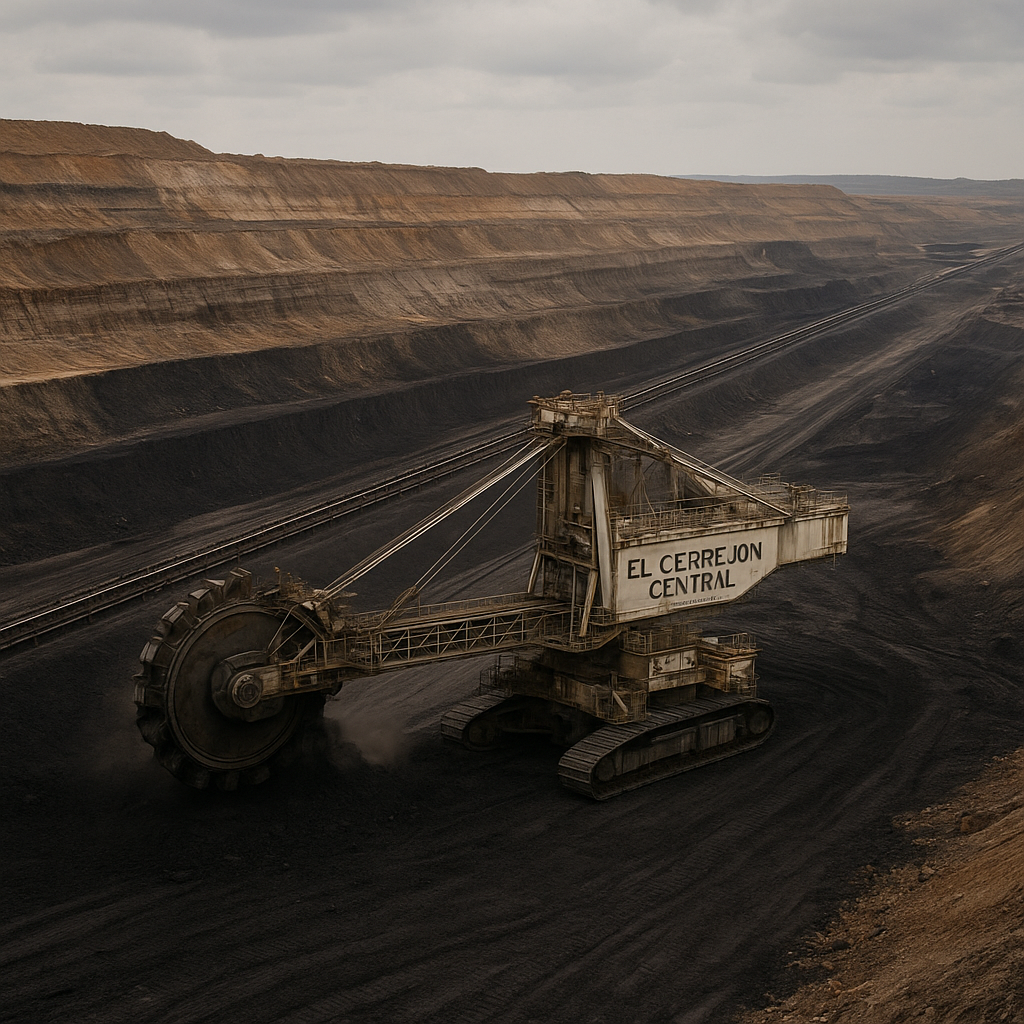
El Cerrejón is a mammoth presence in northern Colombia, a landscape-defining operation that has shaped regional economies, transport infrastructure and the national export profile for decades. Situated in the arid plains of the La Guajira peninsula, the mine extracts high-volume surface coal from one of the world’s largest open-pit deposits. The scale of activity, its logistical complexity and the social and environmental questions it raises make El Cerrejón a subject of sustained international attention. This article explores where the mine is located, what is produced there, its economic importance and several notable features that make El Cerrejón particularly remarkable.
Location and geological setting
El Cerrejón sits in the department of La Guajira, in the far northeastern corner of Colombia. The mine occupies a broad flat area of the Caribbean coastal plain, characterized by dry scrublands and semi-desert conditions. Geologically, the coal seams are part of the Cerrejón Formation, a sequence of Paleocene-age sedimentary deposits that formed in coastal and fluvial environments after the end of the Cretaceous period. The result is thick, laterally extensive seams of predominantly thermal coal that are well-suited for large-scale surface mining.
Key geographic and logistical features of the site include its proximity to the Caribbean Sea and a dedicated coastal export terminal. A purpose-built railway links the mining pits to the port, enabling the continuous movement of millions of tonnes of coal each year. The region’s relative flatness and long, uninterrupted tracts of land have allowed planners to design and operate an industrially efficient open-pit configuration, with multiple contiguous pits that are periodically expanded as mining advances.
What is mined at El Cerrejón
The primary product extracted from El Cerrejón is coal, mainly marketed as thermal coal for electricity generation. The deposit produces large quantities of medium- to low-ash thermal coal with calorific qualities attractive to utilities and cement manufacturers in export markets. Over time, the mine’s production profile has been shaped by demand from Europe, the Americas and increasingly parts of Asia.
Mining is carried out as an open-pit operation using a combination of shovels, draglines, haul trucks and ancillary earthmoving equipment. The extraction sequence follows standard surface mining practice: overburden removal, coal seam exposure, selective extraction of coal, and placement of interburden and waste in engineered dumps. Because the seams are thick and continuous, the operation benefits from economies of scale that reduce the per-ton cost of extraction compared to many underground or more fragmented deposits.
- Coal type: Predominantly thermal coal used for power generation and industrial processes.
- Mining method: Large-scale open-pit mining with extensive use of heavy mining machinery.
- Processing: On-site crushing, screening and washing circuits to meet export quality specifications.
Economic significance
El Cerrejón has been a backbone of regional development in La Guajira and an important contributor to Colombia’s export earnings. Its economic significance can be considered at multiple scales:
- Local employment and services: The mine directly employs thousands of workers and indirectly sustains jobs in logistics, maintenance, hospitality and services in nearby towns. Training programs, contractor networks and supplier relationships create a substantial local economic footprint.
- Regional infrastructure: The railway, port and associated road improvements stimulated by the mine support broader economic activity beyond mining. Roads and utilities built to service El Cerrejón have spillover benefits for other industries and communities.
- National exports: Coal from El Cerrejón represents a sizeable portion of Colombia’s coal exports, generating foreign exchange and contributing to the balance of trade. The export revenues also feed taxation and royalty streams to central and local governments.
Beyond direct financial flows, El Cerrejón’s operational scale has positioned Colombia on the map as a reliable source of thermal coal for international markets. This has implications for trade relationships and national energy policy discussions, particularly as global energy markets transition and diversify.
Logistics: how coal reaches the sea
One of the most fascinating aspects of El Cerrejón is the logistics chain that moves material from pit to ship. The company built a dedicated system connecting the mine with Puerto Bolívar, the export terminal on the Caribbean coast. The integrated logistics operation includes:
- On-site conveyor and stockpile systems to regulate feed to the rail terminal.
- A dedicated heavy-haul railway that transports coal from the mine complex to the port, allowing long, continuous trains to carry bulk cargo efficiently.
- A coastal port and loading facilities capable of accommodating large bulk carriers, with shiploaders and stockyard management to ensure steady export schedules.
This vertically integrated approach reduces handling costs and helps maintain product quality during transit. The magnitude of the infrastructure—railway corridors, port terminals and maintenance yards—creates an industrial landscape that contrasts sharply with the otherwise sparsely populated terrain of northern La Guajira.
Social and environmental dimensions
El Cerrejón’s social and environmental footprint has been the subject of considerable attention, debate and legal action. The mine’s presence in a semi-arid region inhabited by indigenous Wayuu communities has led to complex interactions between corporate operations, local livelihoods and traditional land uses. Key issues include:
- Displacement and resettlement: Land acquisition and the mine’s expansion have required resettlement of households and changes in communal land use, raising concerns about compensation, livelihoods and cultural continuity.
- Water resources: In an arid environment, water use for dust suppression, processing and community services is sensitive. Ensuring equitable and sustainable water allocation between the mine, agriculture and communities is a recurring challenge.
- Dust and air quality: Blasting, haulage and coal handling generate dust that can affect local air quality and health. Monitoring and mitigation measures are necessary to manage impacts on settlements downwind of operations.
- Biodiversity and land rehabilitation: While the mine operates in a landscape that is not densely forested, rehabilitation of disturbed areas, habitat restoration and biodiversity offsets are part of the environmental management framework.
These challenges have produced a mix of collaborative programs and conflict. On one hand, the company has invested in community projects, health and education initiatives and corporate social responsibility programs. On the other hand, civil society groups, indigenous organizations and international watchdogs have criticized aspects of the company’s approach, particularly around resettlement and environmental safeguards.
History and development of the operation
The Cerrejón deposit was developed in the late 20th century, with the modern mine coming into full operation in the 1980s and expanding through subsequent decades. Its development was part of a broader wave of resource investment in Colombia that included oil, minerals and coal. The mine built its own export facilities and progressively increased annual output by opening new pits and upgrading processing and logistical infrastructure.
Over time, international partnerships and capital inflows shaped the mine’s corporate governance. A consortium model allowed global mining companies to share risk and leverage operational expertise. Investment in rail and port infrastructure was a critical part of scaling up exports, turning Cerrejón into one of the most efficient large-scale coal exporters in the region.
Operational scale and industrial techniques
El Cerrejón is notable for the scale of its mining equipment and the efficiency of its operational systems. Typical features of the operation include:
- Large shovels and draglines capable of moving tens of thousands of cubic meters of material per day.
- High-capacity haul trucks and long train sets that move raw coal to processing and export points.
- Automated and semi-automated systems for stockpile management, blending and quality control to meet the specifications of different customers.
- Continuous environmental monitoring systems for air, water and noise to comply with regulatory limits and corporate standards.
The efficiency achieved through these systems allows Cerrejón to maintain competitive operating costs even as global coal prices fluctuate. The mine’s technical teams prioritize operational continuity, preventive maintenance and logistical scheduling to sustain high throughput levels.
Interesting and lesser-known aspects
Several features make El Cerrejón especially noteworthy beyond its raw production figures:
1. Scale and visual impact
The mine’s pits and waste dumps are vast enough to be visible from the air as striking landforms. The contrasts between industrial contours and the surrounding arid landscape highlight the transformative power of large-scale mining. Visitors and aerial photographers often remark on the geometric, almost surreal appearance of the open pits and associated infrastructure.
2. Cultural interface
La Guajira is home to the Wayuu people, a community with a distinct language, culture and social structure. The interface between traditional Wayuu livelihoods—governed by communal land norms and pastoral practices—and the industrial logic of mining creates a complex social tapestry. Initiatives aimed at cultural preservation, local employment and benefit-sharing are part of ongoing dialogue between the company and indigenous authorities.
3. Export markets and changing demand
While historically the mine’s coal has gone to European and American utilities, shifting global energy dynamics mean markets can change rapidly. The tempo of demand in Asia, policy shifts in buyers’ countries and the overarching global transition toward lower-carbon energy sources shape Cerrejón’s strategic planning. Managing a legacy heavy-emitting commodity in a decarbonizing world is one of the operation’s larger strategic puzzles.
4. Research and innovation
Large mining operations like Cerrejón often become sites for innovation in methods for dust control, groundwater monitoring, social impact assessment and remote operations management. Partnerships with universities and research institutions have supported studies on rehabilitation techniques, air quality mitigation and community development models tailored to arid environments.
Regulatory and governance context
El Cerrejón operates within a Colombian regulatory framework that includes environmental licensing, mining permits and social obligations. National and departmental governments collect royalties and taxes tied to production, and compliance with environmental impact studies and community consultation processes is legally required. Given the mine’s scale and visibility, regulatory interactions have often been under public scrutiny, with NGOs, community groups and media following developments closely.
Future outlook and challenges
Looking forward, El Cerrejón faces a mix of operational, market and social challenges. Market conditions for thermal coal are influenced by the global energy transition, competition from other suppliers, and demand dynamics in key importing countries. At the same time, local expectations regarding community benefits, water allocation and environmental remediation will continue to shape how the mine proceeds with expansions or closures of pits.
Key drivers of the mine’s future trajectory include:
- Global energy policy and climate commitments that affect long-term coal demand.
- Technological improvements that can lower emissions intensity or enhance reclamation practices.
- Community and indigenous engagement that determines the social license to operate.
- Commodity prices and operational costs that influence investment decisions.
Strategic responses may involve diversifying local economic opportunities, intensifying rehabilitation efforts, improving resource-use efficiency (particularly water), and reinforcing community partnerships to manage the social transition associated with long-term mine life changes.
Conclusion
El Cerrejón is more than a large coal mine; it is an industrial ecosystem that links geology, engineering, logistics, economics and community life. Its presence in La Guajira has altered landscapes and livelihoods, produced significant export value for Colombia, and catalyzed infrastructure that benefits a wider region. At the same time, the mine’s scale raises persistent questions about environmental stewardship, social justice and how extractive economies adapt in a world increasingly focused on low-carbon futures. The story of El Cerrejón is a window into the broader tensions and opportunities that define modern mineral extraction: immense productive capacity on the one hand, and complex social-environmental responsibilities on the other.

