
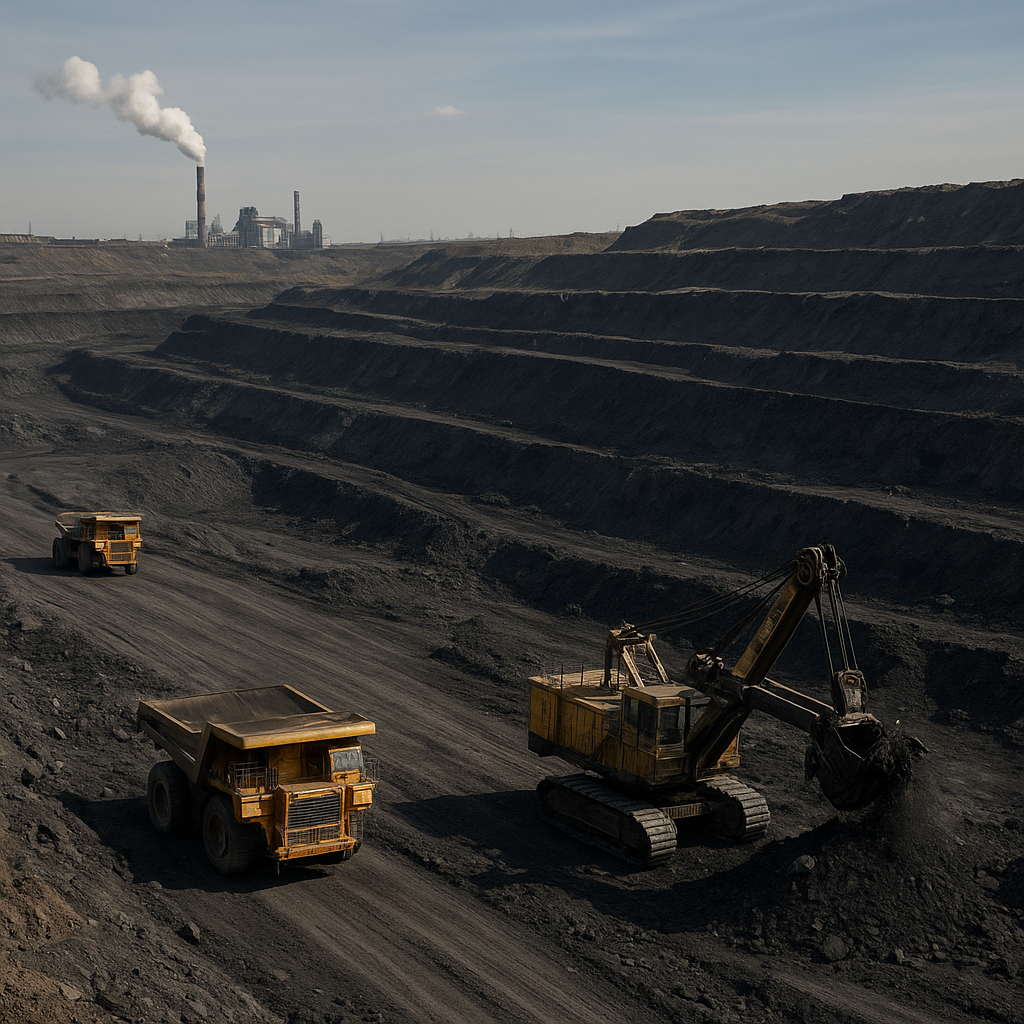
The vast coal deposits around Ekibastuz have shaped the landscape, economy and energy system of northeastern Kazakhstan for decades. Located in the Pavlodar Region, the area is home to a sprawling industrial complex built around one of the region’s most important mineral resources. This article explores the location and geology of the field, the scale and character of mining operations, the role of coal from Ekibastuz in Kazakhstan’s energy and export strategies, and some notable technical, environmental and historical aspects that make the site particularly interesting.
Location and geological setting
Ekibastuz sits in the northern part of the Kazakh Steppe, within the administrative bounds of the Pavlodar Region in northeastern Kazakhstan. The name refers both to a city and to the surrounding coal basin. Geologically, the basin is part of a larger sedimentary trough that was filled with organic-rich material during several periods in the late Paleozoic and Mesozoic eras, leading to the accumulation of extensive coal seams. The deposit is often described as one of the largest contiguous coal deposits in the region and is a defining feature of the local landscape.
The coal found at Ekibastuz ranges in rank and quality, but the basin is particularly noted for vast volumes of low- to medium-rank coals — commonly classified in the industry as brown coal or lignite in large portions of the field, with seams that vary in thickness and depth. The mineral composition tends to yield relatively high ash content, while sulfur levels are generally moderate to low. These geological characteristics have guided the choice of extraction methods and the end-use applications of the coal.
Mining operations and production characteristics
Open-pit methods and industrial scale
Because most of the economically recoverable coal lies at shallow to moderate depth, mining in the Ekibastuz basin is dominated by large open-pit operations. This mechanized, surface-mining approach allows for the movement of millions of tonnes of overburden and coal each year using heavy earthmoving fleets, conveyor systems and railheads. Open-pit mining in Ekibastuz results in expansive excavated areas, progress visible from satellite imagery, and a landscape punctuated by terraces, haul roads and spoil dumps.
Processing and quality control
Given the natural variability and the relatively high ash content of the mined material, processing is an essential part of the value chain. Coal washing and screening facilities operate to improve calorific value and to produce different coal grades tailored for power generation and industrial uses. Quality control and blending are important to ensure that coal supplied to power plants meets combustion specifications and emissions targets. Over time, investments in beneficiation technology have sought to reduce impurities and optimize fuel properties for efficient burning.
Key infrastructure and logistics
Mining at Ekibastuz is tightly integrated with transport and energy infrastructure. Conveyors, stockyards and a network of railway links connect the pits to local thermal power plants and to broader national and international rail corridors. The proximity of the coalfield to major power plants means that a large share of production is consumed domestically for electricity generation, while surplus volumes are dispatched by rail to industrial consumers and export terminals. Because of the heavy, bulk nature of coal, rail remains the backbone of the logistics chain connecting Ekibastuz to markets.
Economic significance: regional and national roles
The current and historical importance of Ekibastuz to Kazakhstan’s economy is considerable. The resource has been the backbone of the regional industry since large-scale development began, particularly during the Soviet period when the basin was intensively exploited to feed newly built thermal power stations and to support industrialization drives.
- Energy security: Coal from Ekibastuz fuels large thermal power plants that provide a significant share of regional electricity, forming a pillar of Kazakhstan’s energy mix alongside hydrocarbon-fired generation and renewables. The proximity between mines and power stations reduces transport costs and reinforces grid stability.
- Employment and social infrastructure: Long-term mining and power generation activity created towns, housing, schools and medical facilities. Ekibastuz and neighboring communities developed around the mine and plants, with the regional labor market heavily dependent on the mining complex for jobs and income.
- Exports and revenues: While much coal production supplies domestic power plants, a portion is exported. Kazakhstan’s strategic position between Russia, China and Central Asian markets gives Ekibastuz-sourced coal opportunities for cross-border trade, contributing to national export revenues and foreign-exchange earnings.
- Industrial supply chains: Coal also supports industrial consumers beyond power generation, including metallurgical and chemical industries that consume specific coal grades or use coal-derived products as feedstock.
At a national policy level, the basin’s output influences decisions about power-plant modernization, rail investment and broader economic planning. Periodic modernization programs aim to improve mine efficiency, reduce production costs and align coal quality with evolving environmental regulations.
Environmental and social considerations
Environmental footprint
Large-scale surface mining inevitably reshapes ecosystems and alters landscapes. Typical environmental issues associated with Ekibastuz operations include land disturbance, dust generation, water management challenges and the handling of high-ash residues. Coal combustion at adjacent power plants also emits greenhouse gases and airborne particulates, which has prompted attention to emissions controls and cleaner technologies.
Efforts to mitigate environmental impacts include progressive land reclamation of worked-out areas, water treatment systems for runoff and slurry management, dust suppression measures on haul roads and improvements in combustion efficiency at power plants. However, the balance between economic benefits and environmental costs remains a persistent policy and community discussion point.
Community and labor
The social fabric of the Ekibastuz area is deeply tied to mining. Generations have worked in the pits and plants, producing a local culture centered on industrial labor and mutual support institutions. At the same time, transitions in the energy sector — such as moves toward greater efficiency, automation and potential diversification of energy sources — raise questions about the future of employment and the need for economic diversification in the region.
- Worker safety has been a priority in operational planning, with modern pits relying on automated monitoring and strict safety protocols to reduce accidents.
- Programs for vocational retraining and community development have been proposed or implemented periodically to prepare the workforce for changes in technology and demand.
Role in Kazakhstan’s energy transition and modernization
As Kazakhstan aligns national policy with global climate objectives and seeks to modernize its energy infrastructure, the status of large coal basins like Ekibastuz is evolving. On one hand, existing thermal power capacity based on local coal provides a stable energy base; on the other, there is pressure to reduce emissions intensity and to introduce cleaner technologies.
Modernization options include retrofitting power plants with more efficient boilers and electrostatic precipitators, investing in flue-gas desulfurization where applicable, and exploring carbon capture readiness for major emitters. In mining, investments in more efficient equipment, improved beneficiation to lower ash and enhanced logistics can reduce the carbon intensity and environmental footprint per unit of electricity produced.
Long-term scenarios contemplate a diversified energy mix in which coal remains a managed part of the system while renewables and gas increase their shares. How rapidly Ekibastuz’s role changes will depend on policy choices, capital availability for retrofits and the pace of alternative energy deployment.
Interesting facts and historical notes
Soviet-era development and industrial architecture
The large-scale development of Ekibastuz took place during the Soviet era, when state planning prioritized the exploitation of inland mineral resources to supply heavy industry and power. That period left a legacy of monumental industrial architecture: sprawling power plants, large-scale mining terraces and ancillary towns built to house workers. Vestiges of Soviet planning remain visible in the region’s grid layout, institutional buildings and industrial facilities.
Integration with major thermal power plants
Ekibastuz coal is intrinsically linked with several major thermal power stations built to use the nearby resources. These plants represent some of the largest single-site electricity generating complexes in the country. The geographic co-location of mine and plant illustrates a classic integrated coal-to-power model that achieved logistical efficiency at scale — coal mined in the basin could be fed almost directly to boilers located nearby.
Geopolitical and trade dynamics
Located between Europe and Asia, Kazakhstan is strategically positioned for commodity trade. Ekibastuz coal has at times been part of cross-border flows linking Central Asian, Russian and Chinese markets. Rail corridors and bilateral trade agreements influence the destinations and volumes of export shipments, and geopolitical shifts can alter the attractiveness of different export markets at relatively short notice.
Challenges, opportunities and future directions
Several core challenges define the future of mining at Ekibastuz: managing environmental impacts while maintaining economic output, modernizing infrastructure under cost constraints, and navigating the global transition away from unabated coal. At the same time, opportunities exist to make the industry more efficient and sustainable.
- Upgrading wash and processing plants to increase the calorific value of marketable products can add economic value and reduce emissions per unit of energy produced.
- Investments in rail and port logistics can open new markets and improve export economics, giving producers flexibility in where they sell coal.
- Diversification of the regional economy — promoting manufacturing, services or renewable-energy projects — could reduce social dependence on mining and provide alternative employment paths.
- Adopting best-practice environmental management and reclamation techniques can restore worked areas for agriculture or recreation over time, improving local quality of life.
Ekibastuz remains an emblematic example of how a single resource can anchor regional development, provide essential energy services, and pose complex environmental and social questions. Its future will reflect both how Kazakhstan balances short- to medium-term energy needs with long-term sustainability goals, and how technology and markets evolve to shape the economics of coal production and use. The basin’s scale and integration with national infrastructure ensure that Ekibastuz will be an important case study in post-Soviet industrial evolution and the broader energy transition.

