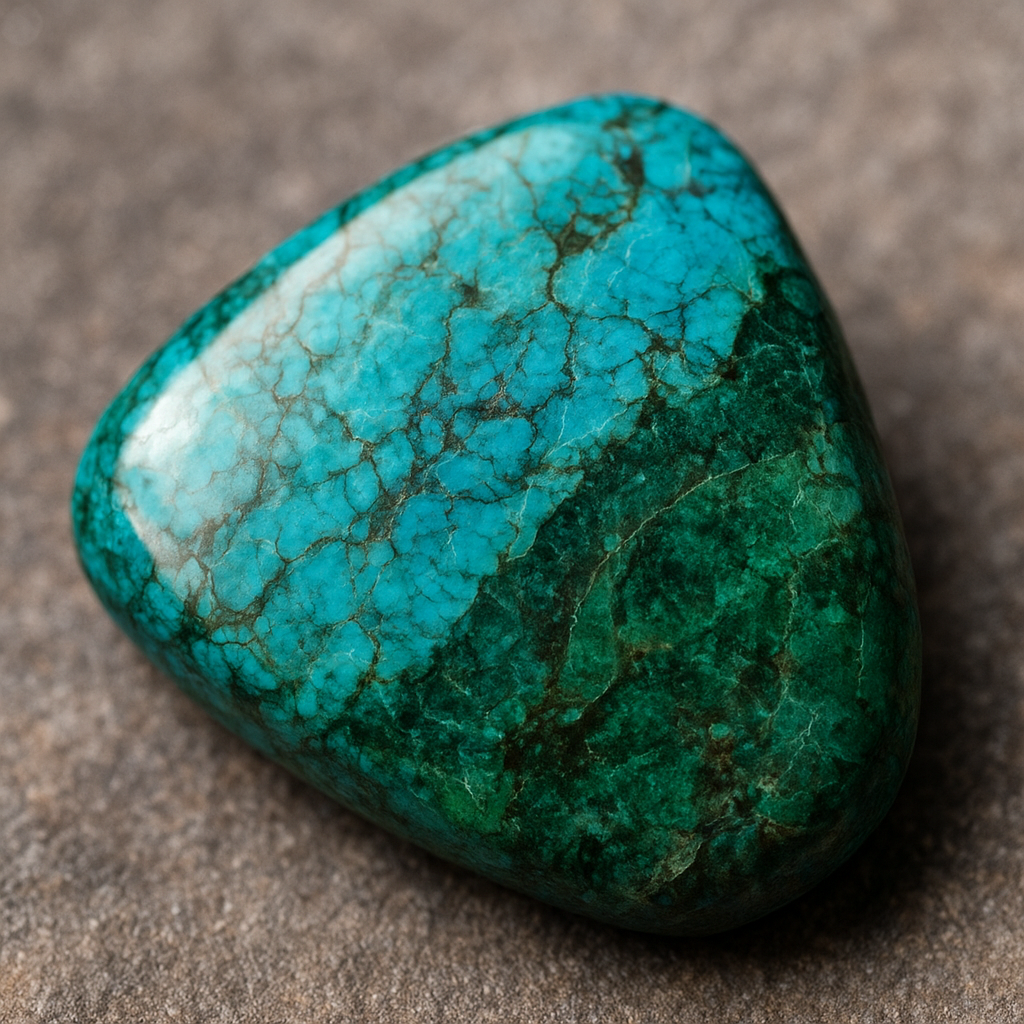
Eilat Stone is a unique and visually striking material known for its swirling shades of blue, green, and sometimes brown — a natural mosaic formed where copper-rich mineralization meets weathering processes. Valued both as a collector’s specimen and as an ornamental material, it combines several secondary copper minerals into distinctive patterns that evoke desert landscapes and ancient mining histories. This article explores where Eilat Stone is found, how it forms, its historical and cultural connections, practical uses in jewelry and decoration, identification and care, and some lesser-known facets that make it fascinating to gemologists, historians, and craftspeople alike.
Geological origin and where it occurs
The characteristic appearance of the stone arises from an aggregate of secondary copper minerals that form in the oxidation zones of copper deposits. These minerals include malachite (green), azurite (deep blue), chrysocolla (blue-green), turquoise, and sometimes cuprite or other copper oxides. Their intimate mixture, often in rounded nodules or in matrix-hosted masses, creates the variegated look associated with Eilat Stone.
Primary locations
- Timna Valley and the southern Negev region near the Gulf of Aqaba in southern Israel: Historically and culturally the most famous locality, from which the name Eilat (the nearby port city) derives.
- Sites in the Sinai and nearby regions: Similar copper-rich deposits and oxidized zones yield comparable material.
- Other copper-oxidized zones worldwide: Although “Eilat Stone” as a trade name typically refers to specimens from the Israeli region, comparable multimineral copper matrices occur in places such as the American Southwest and parts of Central Asia.
In the Timna area, the deposits are associated with ancient volcanism and subsequent copper mineralization. Over millions of years, primary copper sulfide minerals were oxidized near the surface, allowing secondary minerals like malachite and azurite to form in fractures and pore spaces. Groundwater movement leached copper and redeposited it in colorful patinas and nodules.
Geological processes and mineralogy
Two broad processes are key: primary hydrothermal deposition of copper, and subsequent supergene oxidation and weathering. In the oxidation zone, acidic groundwater alters primary copper sulfides to produce copper-bearing solutions. As conditions change (pH, oxygenation, availability of carbonate or silica), different secondary minerals precipitate.
- Malachite forms in carbonate-rich conditions and accounts for many of the green tones.
- Azurite appears as deep blue crystals or masses when carbonate is present under slightly different chemical conditions.
- Chrysocolla, a hydrated copper silicate, contributes turquoise shades and often has a more vitreous or glassy aspect.
- Cuprite and other oxides can introduce brownish or reddish accents.
Because these minerals precipitate under varying micro-environmental conditions, the result is a striking patchwork rather than a single uniform gem material. This mixed nature also affects hardness, stability, and how the material is worked.
History, archaeology, and cultural significance
The copper-rich geology of the Eilat/Timna region has been exploited since antiquity. Evidence of mining activity and smelting in the Timna Valley dates back several millennia, making the area one of the earliest known centers of copper production. Ancient Egyptians, nomadic groups, and later regional powers all interacted with the resources of the region.
Ancient use and symbolism
In Egypt and nearby cultures, blue and green stones carried symbolic meanings linked to life, rebirth, and protection. While exact identification is challenging, archaeological finds suggest that some objects attributed to ancient use of blue-green copper minerals may include materials similar in appearance to modern Eilat Stone. The vivid colors would have been prized for inlays, amulets, and ornamental pieces.
Modern discovery and naming
The term “Eilat Stone” derives from the modern town of Eilat and the general southern Israel region where trade and tourism brought attention to local lapidary materials. Collectors and jewelers popularized the name for material that combined malachite, azurite, and chrysocolla from the area. Over time, Eilat Stone became a branded identity for these colorful composite stones, linking them to the region’s deep-time mining heritage.
Uses: jewelry, decorative arts, and lapidary work
Eilat Stone is primarily used in ornamental contexts. Its vivid and variable coloration makes it a favorite for cabochons, inlay work, beads, and museum-quality specimens. Because it is not a single crystalline mineral, its lapidary handling differs from classic gemstones.
Jewelry applications
- Cabochons: Smooth, domed cabochons highlight the stone’s patterns and are commonly set in rings, pendants, and earrings.
- Inlay: Thin slices are used as inlay in silver, gold, or other materials — particularly appealing in pieces that employ high-contrast metals.
- Beads and carvings: Small beads and carved items are also popular, though the variable hardness makes fine carving more challenging in places.
Because the constituent minerals vary in hardness (for example, malachite is around 3.5–4 on the Mohs scale while chrysocolla can be softer), finished Eilat Stone jewelry is typically used in pieces that avoid heavy wear — such as necklaces and earrings — rather than rings meant for daily rough use.
Stabilization, treatments, and common practices
Because some components are relatively soft or porous, lapidaries often use consolidation or stabilization techniques. Epoxy impregnation or resin stabilization can improve durability and polish. Such treatments are common and generally accepted when disclosed, but they influence value and care instructions.
- Stabilization: Increases durability and reduces porosity.
- Backing and doublets: Thin slices may be backed with another material to strengthen them.
- Dyeing and reconstitution: Less reputable pieces may be dyed or composed of reconstituted powders — buyers should be cautious.
Identification, imitations, and ethical considerations
Because Eilat Stone is a desirable and visually distinctive material, it faces the usual marketplace issues: imitations, mislabeling, and the challenge of distinguishing genuine regional material from look-alikes. Understanding what to look for helps buyers and conservators.
How to recognize genuine material
- Look for a heterogeneous mix of mineral textures and colors — true Eilat Stone rarely displays perfectly uniform coloration.
- Surface luster varies: some areas will be vitreous, others silky or dull, reflecting the mixture of minerals.
- Under magnification, you may see small crystal faces (azurite), botryoidal (rounded) malachite forms, or glassy chrysocolla patches.
- Tests like specific gravity and simple streak tests can help: malachite gives a pale green streak, azurite a deep blue.
However, because Eilat Stone is composite, no single test is definitive. Professional gemological analysis (X-ray diffraction, Raman spectroscopy) can identify constituent minerals and confirm origin in challenging cases.
Imitations and treated materials
Common imitations include dyed howlite or magnesite, stabilized or dyed stones, and completely reconstituted composite stones made from crushed minerals and resin. While these can be attractive and inexpensive, misrepresenting them as genuine Eilat Stone is unethical. Reputable sellers will disclose treatments and origin.
Mining ethics and sustainability
Modern awareness of environmental and cultural impacts prompts buyers and institutions to consider provenance. The Timna area includes both ancient archaeological remains and fragile desert ecosystems. Collecting specimens irresponsibly, or supporting unregulated extraction, can harm heritage sites and habitats. Purchasing from reputable sources that document legal, minimally invasive sourcing helps mitigate these concerns.
Care, cleaning, and conservation
Care for Eilat Stone depends on its mineral mix and any treatments it has received. The general principle is to avoid harsh chemicals and mechanical abrasion.
- Avoid ultrasonic cleaners and steam: these can damage porous or treated areas and cause delamination in backed or doublet pieces.
- Clean gently with a soft cloth and mild soap solution, rinse thoroughly, and dry promptly.
- Store separately to prevent scratching by harder gems and metals.
- If a piece is stabilized with resin, prolonged exposure to direct sunlight or high heat can alter or discolor the resin portion.
For museum specimens or historically significant artifacts, conservation professionals will recommend treatments specific to the piece, and any stabilization should be documented.
Market value, collecting, and notable specimens
Price depends on factors such as color intensity, pattern, size, polish quality, and whether a piece is stabilized or dyed. High-quality, well-polished cabochons showing vivid interplay of blues and greens, with clear boundaries between minerals, command higher prices. Specimens that show interesting botryoidal structures or rare combinations can be sought by collectors.
Collectors and museums
Natural history museums and private collectors prize exceptional Eilat Stone specimens for both their aesthetic and scientific value. Well-documented pieces with verified provenance from historic mining areas like Timna have additional cultural and archaeological interest.
Design trends
In jewelry, Eilat Stone often features in designs that emphasize organic, earthy aesthetics — paired with oxidized silver, hammered textures, or simple bezel settings that let the stone remain the focal point. Contemporary designers sometimes combine Eilat Stone with other minerals such as jasper or lapis to create contrast.
Interesting facts and lesser-known aspects
- Eilat Stone is not a single mineral but a trade name for a mixture — that mixture is at the heart of its charm.
- The Timna Valley contains the remains of ancient smelting sites, connecting the stone to some of the earliest human metallurgical activity in the region.
- Because of its composite nature, Eilat Stone can display microenvironments that preserve tiny mineral growths, making it interesting to mineralogists as well as gem enthusiasts.
- Some modern lapidaries intentionally combine crushed copper minerals with resin to create “reconstituted Eilat” pieces for settings where cost or uniformity is desired — buyers should look for disclosure.
- In metaphysical and folk contexts, the stone is often associated with healing and balance due to its blue-green palette; while these attributions are cultural rather than scientific, they have influenced demand and design.
Practical advice for buyers and enthusiasts
If you are interested in acquiring Eilat Stone, consider these pointers:
- Ask about origin and treatment upfront. Reputable dealers will provide details about stabilization and whether the piece is natural, dyed, or reconstituted.
- Inspect under magnification for uniformity that might suggest artificial assembly. Natural Eilat typically shows varied textures.
- Consider setting and intended use: if you want a ring for daily wear, select pieces that are stabilized and protected by strong settings; for pendants, a wider range of natural pieces is suitable.
- Learn a few simple tests (visual, streak, weight) and seek lab reports for high-value acquisitions.
Resources and further study
For those wanting to delve deeper, local geological surveys, museum mineral collections, and academic publications on the Timna geology provide authoritative information. Visiting museum exhibits that showcase the Timna mining history or seeing lapidary demonstrations can also deepen appreciation for the material.
Whether admired as a piece of jewelry, a mineral specimen, or a tangible link to ancient mining landscapes, Eilat Stone occupies a compelling niche where geology, history, and craftsmanship meet. Its kaleidoscopic colors continue to attract artists, collectors, and scientists, making it a subject worth exploring from multiple perspectives.