
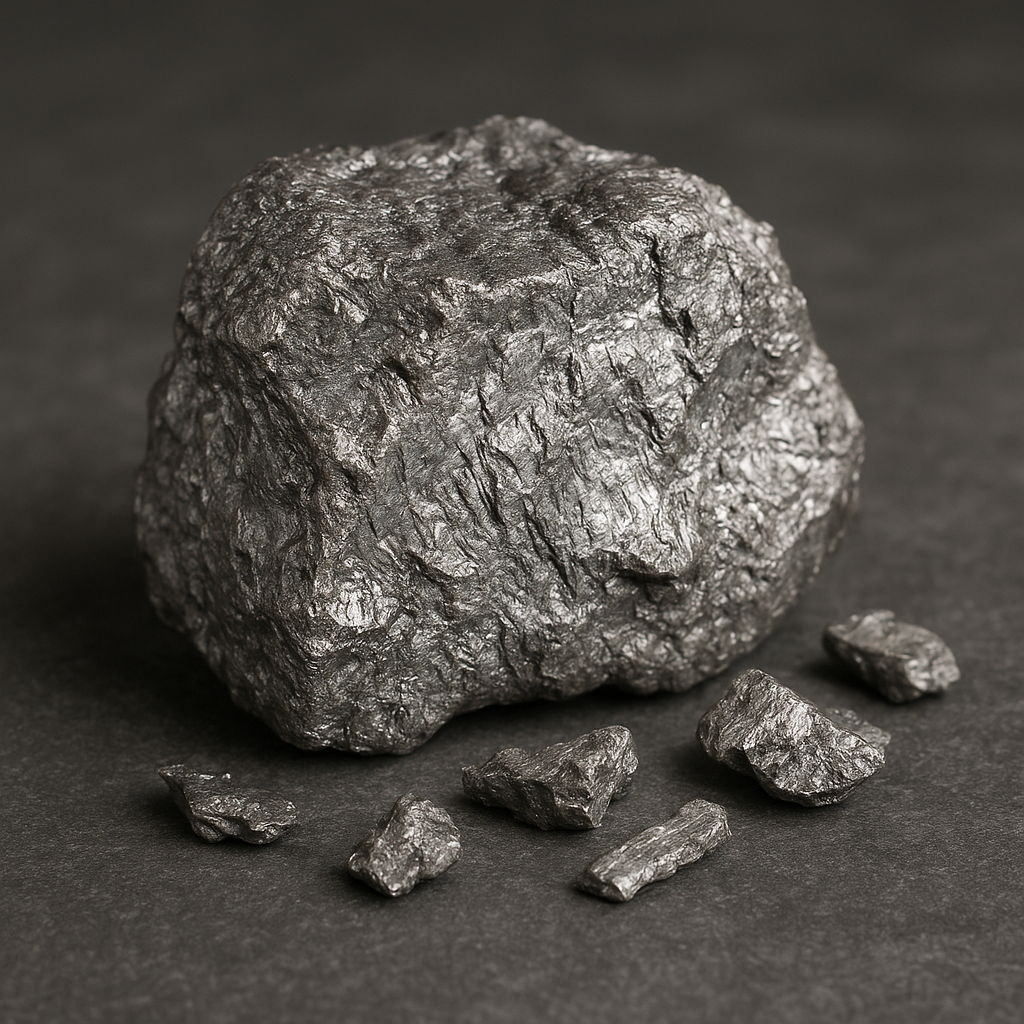
Dysprosium is a soft, silvery metal belonging to the lanthanide series of the periodic table. Although it is one of the “rare-earth” elements, its significance far outweighs its relative scarcity: dysprosium plays a pivotal role in modern high-performance technologies, from powerful permanent magnets to advanced lasers and nuclear control systems. This article explores where dysprosium is found in nature, what makes its chemistry and physics special, how it is used in industry and research, and several intriguing facts and frontier applications connected with this versatile element.
Occurrence and Geological Context
Dysprosium does not occur as a free metal in nature; it is dispersed among other lanthanides in a range of minerals. The most important hosts for dysprosium are the phosphate and carbonate minerals that concentrate the rare-earth group. Typical mineral sources include monazite, bastnäsite, xenotime, and euxenite. Extraction of dysprosium usually follows the mining and concentration of these mineral ores, where complex chemical separation is required to isolate individual lanthanides.
Geographically, dysprosium is primarily produced as part of the global rare-earth supply chain. Historically and presently, significant production and processing capacity are located in China, which controls a large fraction of the market. Other notable resources and operations exist in Australia, the United States (notably the Mountain Pass mine), Brazil, India, and parts of Southeast Asia and Africa. However, geopolitical, environmental, and technical barriers to refining make supply chains concentrated and sometimes fragile.
Because dysprosium is chemically similar to its lanthanide neighbors, its concentration in ore is usually low. This leads to economic and technical challenges:
- Low-grade ores must be processed at scale to obtain meaningful amounts of dysprosium.
- Separation from other lanthanides requires solvent extraction or ion-exchange techniques that are energy- and chemical-intensive.
- Mineral sands and associated by-products can contain radioactive impurities (thorium and uranium), imposing environmental management requirements.
Chemical and Physical Properties
Dysprosium (atomic number 66, symbol Dy) is a lanthanide metal with interesting magnetic, optical, and nuclear characteristics. Key physical properties include a relatively high atomic weight and a metallic, silvery appearance. In compounds it typically displays the +3 oxidation state, forming stable trivalent ions (Dy3+), although other formal oxidation states are occasionally encountered in specialized compounds.
Some important technical attributes:
- Magnetic behavior: Dysprosium exhibits strong magnetic moments and complex magnetic ordering at low temperatures. These properties make its ions extremely useful when large magnetic anisotropy or temperature-dependent magnetism is required.
- Electronic structure: The partially filled 4f shell in Dy3+ gives rise to sharp optical transitions and characteristic luminescence, exploited in specific lighting and laser applications.
- Neutron absorption: Certain dysprosium isotopes have high neutron-capture cross-sections, making dysprosium compounds useful in nuclear control applications.
Chemically, dysprosium forms oxides (notably Dy2O3), halides, and complex coordination compounds. Dy2O3 is a commonly encountered material in the refining chain and in many end uses. Dysprosium compounds can be incorporated into ceramics, glasses, and thin films to tailor magnetic, optical, or electronic behavior.
Primary Applications in Technology and Industry
Dysprosium’s special combination of magnetic, optical, and nuclear properties leads to a diverse set of applications. Below are the major areas where dysprosium is used today, along with some emerging uses.
Permanent Magnets and Clean Energy
One of the most important modern uses of dysprosium is in high-temperature permanent magnets. Neodymium-iron-boron (NdFeB) magnets are widely used because of their excellent magnetic strength. However, at elevated temperatures (as found in electric motors and wind-turbine generators), NdFeB magnets can lose coercivity. Adding small amounts of dysprosium into the magnet alloy markedly improves thermal stability and coercivity, enabling magnets to operate reliably at high temperatures.
This application links dysprosium to several strategic sectors:
- Electric vehicle traction motors
- Wind turbine generators
- Industrial actuators and aerospace actuators
Nuclear Control Materials
Dysprosium has a remarkable affinity for neutrons, and certain isotopes absorb neutrons strongly. This makes dysprosium-containing materials useful as control materials in nuclear reactors. Dysprosium alloys and oxides are used in control rods, burnable poisons, and neutron-shielding components in research and power reactors.
Lasers, Optics, and Lighting
Dy3+ ions produce distinctive optical transitions that support several photonic applications:
- Mid-infrared fiber lasers: Dysprosium-doped fluoride fibers can lase in the 2.8–3.5 μm region, valuable for sensing, medical, and defense applications.
- Solid-state and ceramic lasers: Dysprosium-doped crystals and glasses are studied for specialized laser wavelengths and tunable sources.
- Phosphors and lighting: Dy3+ activated phosphors can emit in visible bands, and dysprosium compounds appear in certain fluorescent lamp technologies.
Catalysis, Alloys, and High-Temperature Materials
Dysprosium can be alloyed into specialized metals to improve high-temperature performance, oxidation resistance, or magnetic properties. In catalysis, dysprosium-containing compounds are investigated for selective oxidation and other reactions, especially where rare-earth promoters improve catalyst stability.
Electronics, Data Storage, and Sensors
Because of its magnetic anisotropy and large single-ion moments, dysprosium is explored in areas such as magneto-optical recording, high-density magnetic storage, and precision sensors. In research labs, Dy-based single-molecule magnets and quantum materials are subjects of intense study for potential roles in quantum computing and spintronics.
Supply Chain, Economics, and Sustainability
Dysprosium is classified by many governments and agencies as a critical material due to its strategic importance and concentrated sources. Supply dynamics are affected by ore grades, refining capacity, export policies, and demand from the electric-vehicle and renewable-energy sectors.
Key supply and sustainability issues:
- Market concentration: Large portions of refining and separation capacity are located in a few countries, creating geopolitical risk.
- Environmental footprint: Separation chemistry for rare-earths generates significant chemical waste and can mobilize hazardous elements (thorium and uranium) from certain ores, requiring careful waste management.
- Recycling: Recovering dysprosium from end-of-life magnets (for instance, from EV motors) is technologically feasible but currently limited by economic and logistical hurdles. Financial incentives and improved recycling technologies could substantially increase secondary supply.
- Substitution and reduction: Research focuses on reducing dysprosium content in magnets, finding alternative magnet alloys, or developing thermal-stable magnet designs that minimize reliance on scarce rare-earths like dysprosium.
Policy responses include strategic stockpiling, investment in domestic processing facilities, international partnerships for diversified supply, and funding for recycling and substitution R&D. Market prices for dysprosium can be volatile and respond strongly to policy announcements and changes in demand for clean technologies.
Health, Safety, and Environmental Concerns
Like many rare-earth elements, dysprosium compounds present occupational hazards if not handled properly. Fine powders and dusts can be inhaled, and certain processing streams can produce contaminated effluents. Environmental challenges related to dysprosium extraction and processing include:
- Tailings and waste streams containing heavy metals and radioactive elements in some ore deposits.
- Chemical contamination from solvent extraction and separation plants if wastewater is not treated.
- Ecological disruption from mining activities in sensitive areas.
Industrial hygiene measures, regulated discharge limits, and modern pollution-control technologies are necessary to mitigate risks. Research into greener extraction methods and recycling aims to reduce the environmental cost of dysprosium supply.
History and Nomenclature
Dysprosium was identified in the late 19th century as chemists probed the rich chemistry of the lanthanide series. Its name derives from the Greek dysprositos, meaning “hard to get” or “difficult to obtain,” a nod to the challenge of isolating individual rare-earth elements from mineral mixtures. The element’s symbol is Dy and its chemistry is anchored in the trivalent Dy3+ ion commonly seen in compounds and materials.
Interesting Scientific and Emerging Topics
The scientific community continues to find novel and sometimes surprising uses for dysprosium. A few noteworthy research directions and curiosities:
- Single-molecule magnets and quantum systems: Dysprosium ions can produce very large magnetic anisotropies, enabling single-ion or single-molecule magnets (SMMs) with slow magnetic relaxation. These systems are model platforms for quantum information studies and fundamental magnetism.
- Complex magnetic phases: At low temperatures, pure dysprosium metal displays rich magnetic ordering, including helical and antiferromagnetic structures. These phenomena are studied to understand magnetic interactions in f-electron systems.
- Magnetocaloric effects: Dysprosium-containing alloys exhibit magnetocaloric changes in temperature when exposed to magnetic fields, a principle explored for magnetic refrigeration technologies that could offer energy-efficient cooling.
- Advanced fiber lasers: Dysprosium-doped fluoride fibers are enabling new mid-infrared laser sources used in spectroscopy, medical diagnostics, and environmental sensing.
- High-entropy and specialized alloys: Incorporating dysprosium into emerging alloy families can tune magnetic or thermal properties for extreme environments.
Practical Examples and Industry Context
Some concrete examples that illustrate dysprosium’s role in modern products:
- Electric vehicles: The performance and durability of traction motors are often improved with NdFeB magnets containing small dysprosium additions to resist demagnetization at operating temperatures.
- Wind turbines: High-performance permanent magnets used in direct-drive turbine generators can contain dysprosium to ensure long-term stability under thermal cycling.
- Medical and defense lasers: Mid-IR lasers using dysprosium-doped fibers are of interest for biomedical imaging and sensing, as well as for directed-energy research.
- Nuclear reactors: Research and some operational reactors use dysprosium-containing control elements to modulate neutron fluxes safely and reliably.
Research Challenges and Opportunities
As demand for dysprosium grows with electrification and renewable-energy deployment, scientific and engineering communities face several challenges and opportunities:
- Improving separation chemistry to lower environmental impact and reduce costs.
- Developing efficient recycling processes for end-of-life magnets and electronic components.
- Discovering magnet designs and materials that maintain high performance with reduced dysprosium content or substitute elements.
- Exploring fundamental f-electron physics in dysprosium compounds to uncover new quantum or magnetic phenomena that could lead to novel devices.
These efforts are interdisciplinary, spanning chemistry, materials science, environmental engineering, metallurgy, and policy planning. The matrix of technical constraints and strategic needs ensures dysprosium will remain a focus of attention for researchers, industry leaders, and policymakers alike.