The following article explores the mineral known as dolomite from multiple angles: its composition, geological occurrence, physical properties, industrial uses, environmental implications, and some lesser-known but intriguing aspects of its behavior and role in Earth systems. The aim is to provide a comprehensive, scientifically grounded description while highlighting practical applications and interesting phenomena connected to this versatile carbonate material.
Occurrence and Geological Setting
Dolomite as a term can mean both the chemical mineral and the rock type (dolostone) composed predominantly of that mineral. It is an abundant component of sedimentary successions worldwide and commonly forms large stratiform bodies, often interbedded with limestone, shale and evaporites. Classic exposures occur in the alpine ranges of northern Italy, the carbonate platform deposits of the Middle East, the Permian basins of North America, and numerous basins in Asia, Australia and Africa.
Dolomite is especially notable in ancient carbonate platforms where it may replace original calcite and aragonite sediments. The replacement process known as dolomitization converts calcium carbonate deposits into a mixed calcium-magnesium carbonate, typically CaMg(CO3)2. This transformation can occur at shallow, early diagenetic levels or at greater burial depths and is often associated with changes in pore fluids, salinity, temperature, and microbial activity.
Global distribution and classical localities
- The Dolomites of northern Italy — a type locality that gave the mineral its name and an extraordinary landscape sculpted from massive dolostone cliffs and pinnacles.
- Large Permian dolostone platforms in the southwestern United States and northern Mexico that host important hydrocarbon reservoirs.
- Evaporite-associated dolomites in the Middle East and Mediterranean basins where high-salinity brines promoted dolomitization.
- Carbonate successions in the Baltic and the UK that display cyclic deposition of limestone and dolostone through geologic time.
Dolomite can also be found as secondary crystals in veins, as replacement nodules, and as crystalline masses in metamorphosed carbonate rocks. Its presence in many significant aquifers and reservoir rocks makes its spatial distribution crucial to hydrogeology, petroleum geology and mining.
Chemical and Physical Properties
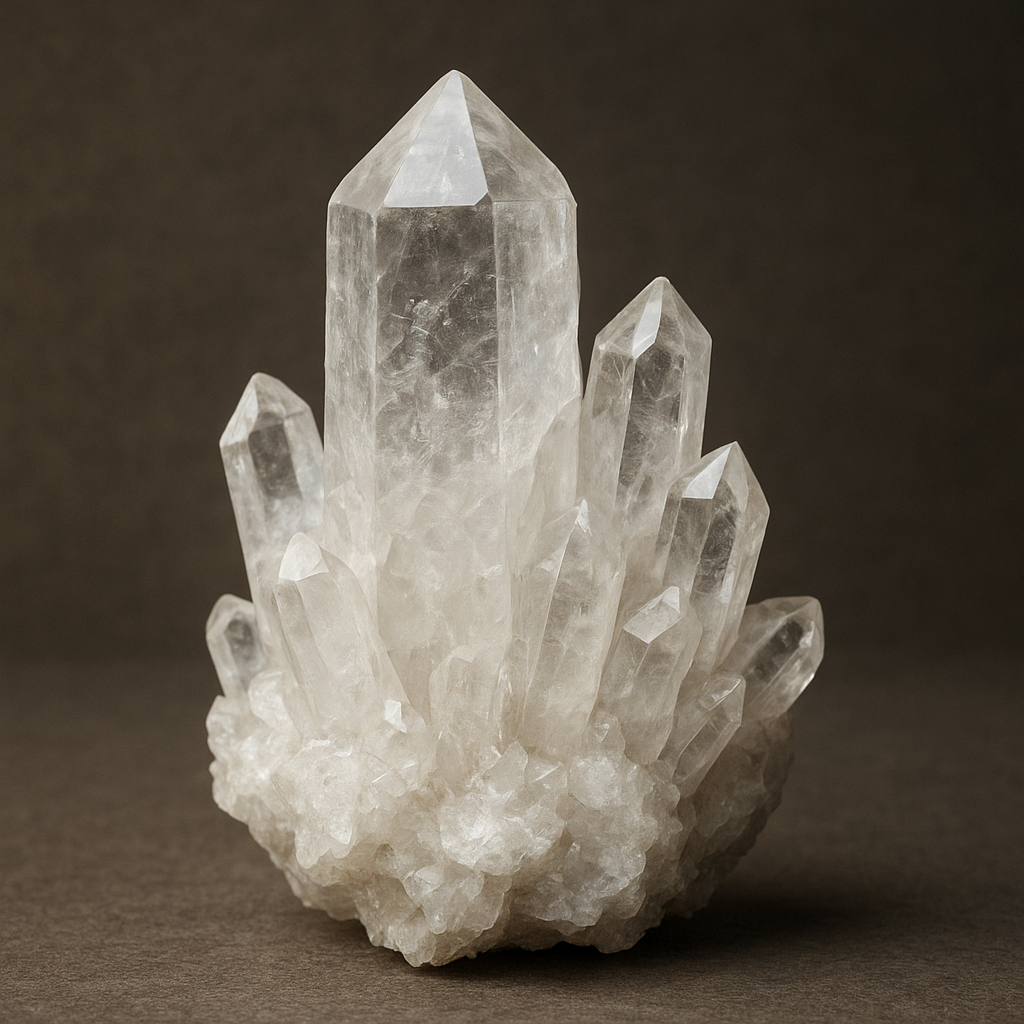
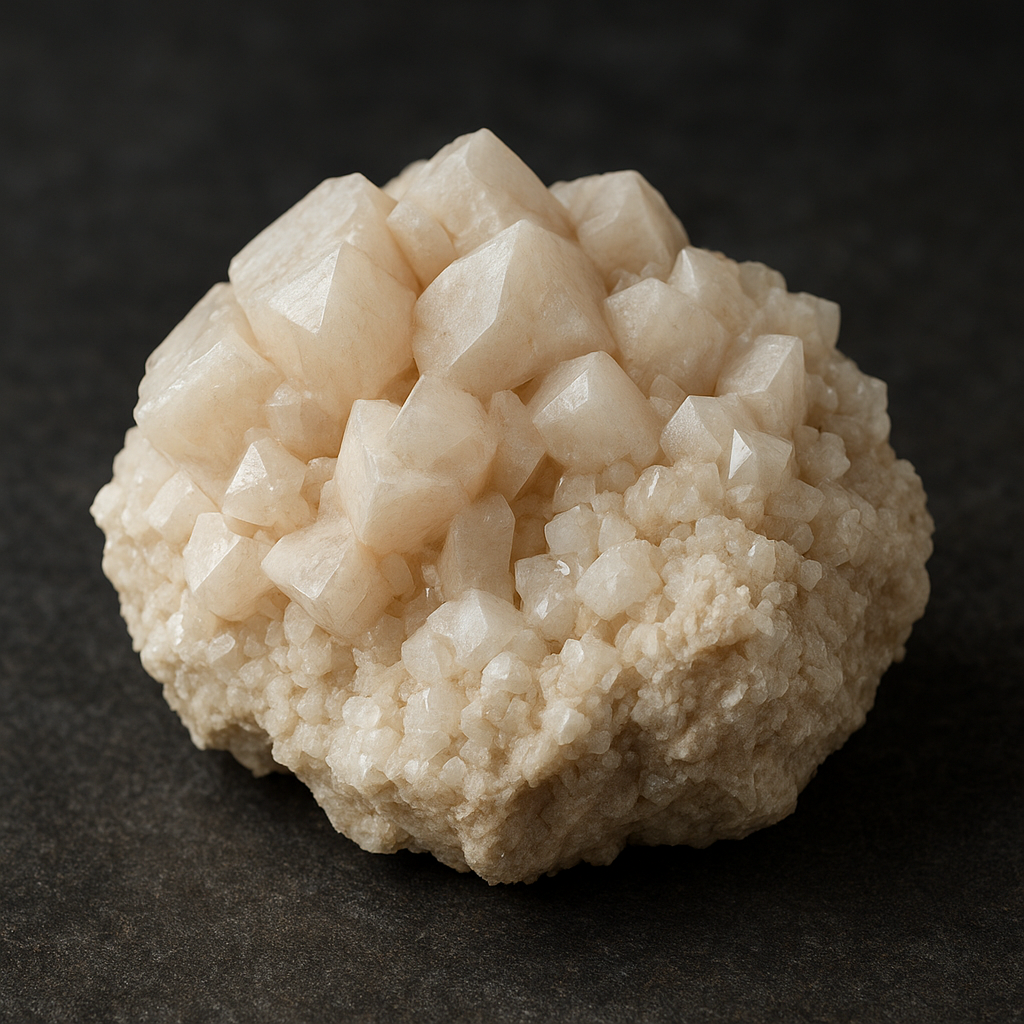
The mineral dolomite is a double carbonate of calcium and magnesium with the ideal chemical formula CaMg(CO3)2. It crystallizes in the trigonal system and often forms rhombohedral crystals, though, in natural rocks, it typically displays granular to crystalline masses. Physically, dolomite has a Mohs hardness around 3.5–4, a specific gravity of about 2.84–2.86, and shows perfect rhombohedral cleavage. When powdered, dolomite reacts weakly with cold dilute hydrochloric acid, often requiring the acid to be warmed or the mineral to be powdered for a visible effervescence, which is a practical field test distinguishing it from calcite.
Optically, dolomite can be transparent to translucent, and it occurs in colors ranging from white and gray to pink, brown and black depending on impurities. Microcrystalline and fine-grained dolostone can be very dense and compact and sometimes displays a sugary texture when composed of recrystallized crystals.
Crystal chemistry and stability
At the atomic scale, dolomite exhibits ordered cation layers: calcium and magnesium occupy alternate layers between carbonate groups. This ordering differentiates it from high-magnesium calcite, which has more random cation distributions. Thermodynamically, dolomite stability depends on temperature, pressure and fluid composition. Natural synthesis of stoichiometric dolomite at low temperatures (near-surface conditions) is relatively rare in modern environments, a fact that has historically puzzled geoscientists and motivated extensive research into microbial and geochemical pathways for dolomitization.
Formation Processes and Dolomitization Mechanisms
The conversion of limestone (calcite/aragonite) to dolomite is one of the most significant diagenetic processes affecting carbonate rocks. Several mechanisms are proposed to explain dolomitization:
- Evaporative reflux: Concentrated brines formed during evaporation sink and reflux through carbonate sediments, introducing magnesium-rich fluids that replace calcite with dolomite.
- Seawater mixing and seepage: Mixing of marine and meteoric waters or focused flow of seawater in tidal flats can produce chemical conditions favorable for dolomite formation.
- Bacterial sulfate reduction and organic processes: Microbial mediation can change redox conditions and local chemistry, promoting dolomitization at low temperatures.
- Burial and thermal fluids: At greater burial depths, higher temperatures and magnesium-rich basinal brines can cause replacement and recrystallization to dolomite.
The relative importance of these pathways varies by basin and time. Modern analogues such as sabkha (coastal evaporitic flats), certain hypersaline lagoons, and microbial mats provide insight into conditions that can generate dolomite. Experimental studies and field observations increasingly emphasize the role of fluid flow pathways, reactive transport, and microbial activity in producing dolomite-rich bodies.
Economic Uses and Industrial Applications
Dolomite and dolostone have a wide range of uses across industry, agriculture and environmental engineering. The material’s mineralogy and chemical composition make it valuable for both direct use and as a feedstock for chemical manufacturing.
Construction and aggregate
- Crushed dolostone is a commonly used construction aggregate in road building, concrete and asphalt mixes due to its hardness and durability.
- Dimension stone quarried from massive dolostone units can be used in building facades and monuments, often prized for aesthetic color and resistance to weathering.
Chemical industry and metallurgical uses
- Dolomite is calcined to produce dolime (burned dolomite), which is used as a flux in steelmaking, glass manufacture and as a sintering agent in cement production.
- It serves as a source of magnesium for producing magnesium compounds and metals; magnesium oxide derived from dolomite is an important refractory material.
Agriculture, environmental and specialty uses
- As a soil amendment, finely ground dolomite neutralizes acidic soils and supplies magnesium and calcium essential for plant nutrition.
- Dolomite is used in water treatment to adjust alkalinity and remove impurities, and in flue-gas desulfurization systems.
- Because of its carbonate nature, dolomite has been investigated for sequestration of carbon dioxide through mineral carbonation routes.
Other niche applications include use in glass and ceramic formulations, filler in paints and plastics, and as a source of magnesium sulfate in chemical processing. The material’s role in the production of refractory bricks and linings is particularly important in high-temperature industries, taking advantage of dolomite-derived magnesia’s heat resistance.
Dolomite in Petroleum Geology and Hydrogeology
Dolostone plays a crucial role as both a reservoir rock and as a sealing or confining unit in petroleum systems. The processes of dolomitization can alter porosity and permeability dramatically: early dolomitization often preserves or enhances pore space, producing excellent porosity and permeability for hydrocarbon storage and flow. By contrast, later dolomitization and recrystallization can cement pores and reduce reservoir quality.
Porosity in dolomite is commonly of several types: intercrystalline (between dolomite crystals), fabric-selective (preserving original sedimentary textures), vuggy (solution-enhanced cavities), or fracture-controlled. Understanding the timing and geometry of dolomitization is therefore essential for reservoir characterization, exploration and production strategies.
In hydrogeology, dolostone aquifers can host significant groundwater resources but may behave differently from limestone because of differences in solubility and fracture development, influencing karstification and cave formation.
Extraction, Processing and Environmental Concerns
Dolomite is extracted by quarrying and open-pit mining in most locations. After extraction, material is processed by crushing, screening and, when required, calcining in rotary kilns. The calcination of dolomite to produce a reactive magnesia involves thermal decomposition and requires significant energy input, which creates greenhouse gas emissions and other environmental impacts.
Environmental concerns related to dolomite mining and processing include landscape disturbance, dust generation, noise, habitat loss, and potential impacts on groundwater through changes in flow or contamination. Reclamation of quarries and mitigation measures such as dust suppression, water management and progressive rehabilitation are important to reduce long-term environmental footprints.
Other environmental aspects are more geochemical: dolostone terrain can host karst systems that concentrate contaminants or allow rapid groundwater transport. The chemical weathering of dolomite consumes carbon dioxide over geologic timescales, but industrial processing often emits carbon dioxide, so lifecycle considerations are essential when assessing environmental impacts.
Metamorphism, Weathering and Spectacular Landscapes
Under regional and contact metamorphism, dolomite can recrystallize to form coarse-grained marbles where crystalline textures and new mineral assemblages appear. Such marbles are used for sculpture and architectural decoration. Weathering of dolostone landscapes can lead to unique geomorphology: the Dolomites in northern Italy are a prime example where massive, erosion-resistant dolostone forms sheer cliffs, vertical towers and dramatic ridges that attract geologists, climbers and tourists alike.
Dolostone units can produce rugged karst features including towers, sinkholes, caves and underground streams. The development of karst in dolomite tends to be less aggressive than in pure calcite limestone because dolomite dissolves more slowly, yet given sufficient time and focused flow, spectacular karst systems can still form.
Scientific Curiosities and Research Frontiers
Several scientific puzzles and opportunities surround dolomite. The relative rarity of forming stoichiometric dolomite in modern sediments under ambient temperatures has been a long-standing enigma — the so-called dolomite problem. Recent research points to the importance of microbial mediation, organic templates, and fluid chemistry in facilitating low-temperature dolomite precipitation.
Other research frontiers include:
- Using isotopic signatures (carbon, oxygen, magnesium) to trace fluid sources and temperatures during dolomitization events.
- Modeling reactive transport to predict where dolomitization will occur in sedimentary basins and how it affects reservoir quality.
- Exploring dolomite-based carbon mineralization as a durable pathway for long-term carbon storage.
- Understanding the mechanical properties of dolostone for engineering applications and slope stability analyses.
Finally, dolomite shows up unexpectedly in cultural and historical contexts — from the stone used in historic buildings to the landscapes that inspired artists and mountaineers. The mineral’s interplay with life, climate and human industry makes it a subject of interdisciplinary interest.
Identification and Field Recognition
In the field, geologists recognize dolomite by its characteristic rhombohedral cleavage fragments, sugary texture, and the weak reaction with cold dilute hydrochloric acid. A practical test involves scratching the surface and applying acid; if the sample effervesces strongly only when powdered or warmed, dolomite is likely present rather than calcite. Hand samples may display characteristic saddle-shaped crystals or finely crystalline matrices. Optical microscopy and X-ray diffraction provide definitive mineralogical identification in the laboratory.
Key distinguishing attributes include crystal habit, specific gravity slightly lower than calcite-rich rocks of comparable appearance, and the presence of magnesium in chemical assays. These properties, together with textural relationships in the rock, help geologists reconstruct diagenetic histories.
Final Remarks on Importance
Dolomite is simultaneously a common and a complex component of the Earth’s crust. It plays major roles in natural systems — shaping landscapes, influencing groundwater and hydrocarbon systems — and in human economies — from construction and agriculture to metallurgy and environmental technology. Its formation pathways, varied physical behavior and industrial value ensure that dolomite will remain a focal point of geological research and practical application for years to come.