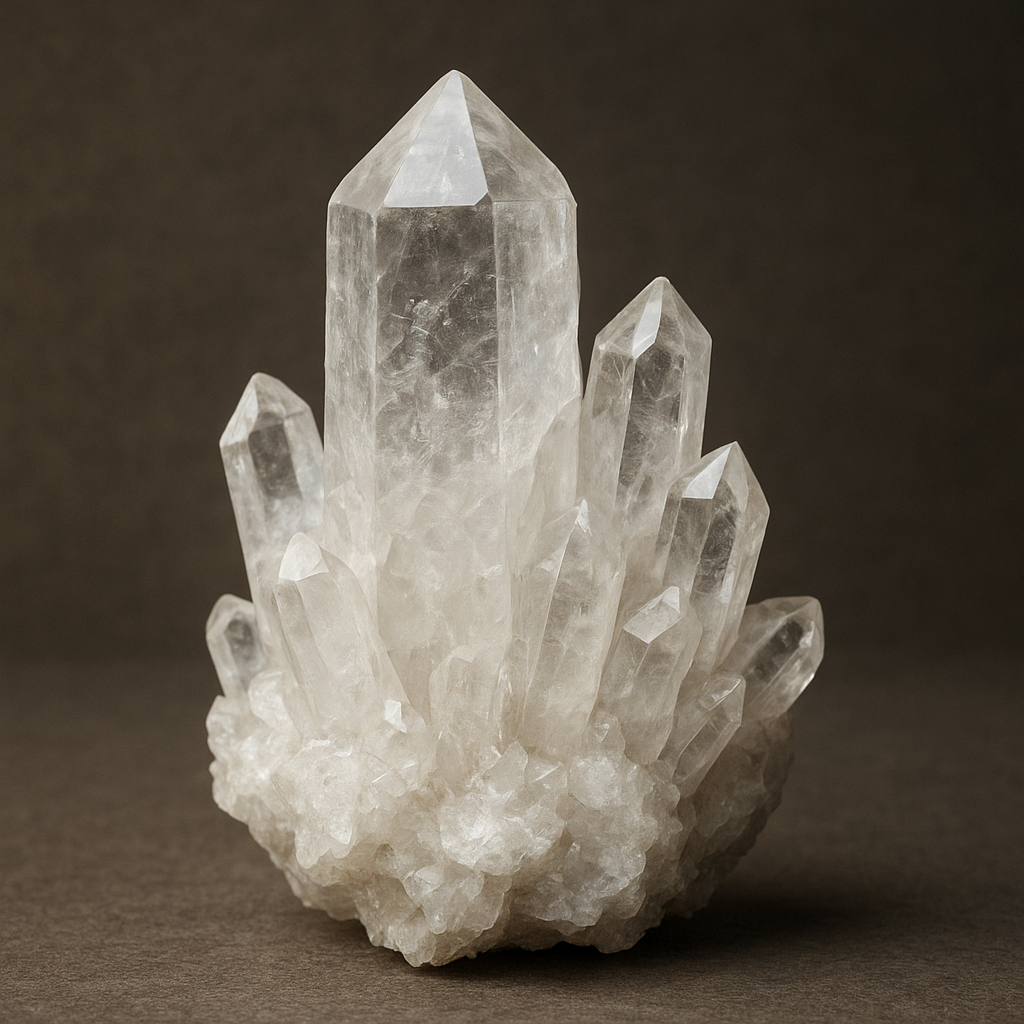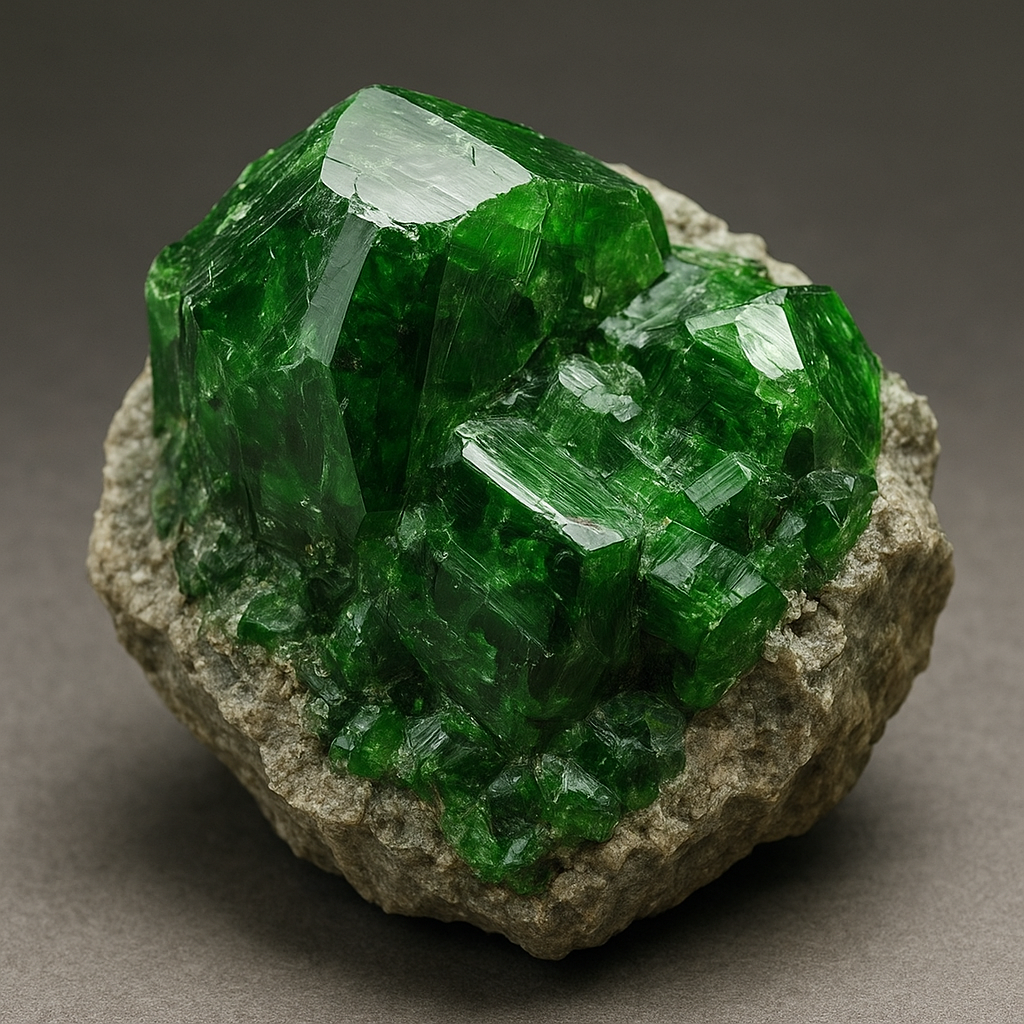
Diopside is a distinctive member of the pyroxene group whose chemical formula can be written as CaMgSi2O6. It occupies an important place in mineralogy, petrology and the gemstone market because of its diverse occurrences, clear links to deep geological processes and a number of emerging industrial and biomedical uses. This article explores what diopside is, how and where it forms, its physical and optical properties, its notable varieties (including the vivid chrome diopside), and the practical and scientific applications that make it an object of sustained interest.
What diopside is: composition, structure and classification
Diopside belongs to the clinopyroxene subgroup of the single-chain inosilicates. Chemically it is a calcium magnesium silicate that participates in a broad solid-solution series with the iron-rich endmember hedenbergite (CaFeSi2O6). In natural samples iron, aluminium and small amounts of chromium, titanium or manganese may substitute into the structure, producing noticeable color and property variations.
The mineral crystallizes in the monoclinic system and typically forms short prismatic crystals or granular to massive aggregates. Its characteristic two cleavages at angles close to 87° and 93°, inherited from the pyroxene chain silicate structure, are diagnostic. Optically diopside is a biaxial mineral with refractive indices that place it in the common range for clinopyroxenes; it shows moderate relief and an attractive vitreous to slightly greasy lustre on crystal faces.
Geological settings and global occurrence
Diopside is a mineral that forms across a wide range of geological environments. Its presence is a key indicator of particular rock types and metamorphic conditions. Principal settings include:
- Ultramafic and mafic igneous rocks: Diopside is a common constituent of gabbros, basaltic rocks and pyroxenites. In mantle-derived rocks and xenoliths, diopside compositions record processes such as partial melting and melt-rock interaction.
- Contact and regional metamorphism: In skarns and contact-metamorphosed carbonate rocks (marbles and limestones intruded by plutons) diopside forms as a product of high-temperature metasomatism where silica-rich fluids react with calcium-bearing carbonates.
- High-pressure metamorphic rocks: Diopside can occur in eclogites and garnet clinopyroxenites where it records pressures and temperatures characteristic of deep crustal and upper mantle environments.
- Hydrothermal and metasomatic deposits: Where fluids alter original minerals, diopside may crystallize as part of calc-silicate assemblages with garnet, wollastonite and other calcium-silicate minerals.
Notable localities for gem-quality and specimen diopside include areas of Russia (Siberian finds of chrome diopside), Pakistan and Afghanistan (mountain-hosted deposits producing gem material), Italy (skarn occurrences and classic localities), the Western United States (skarn and igneous occurrences), Canada and China. Diopside is also found in kimberlite-associated xenoliths and peridotite bodies, where it provides clues to mantle composition and metasomatism.
Physical and optical properties that matter
For identification and practical use, some of diopside’s most important properties are:
- Hardness: typically around 5.5–6.5 on the Mohs scale, making diopside less hard than many gem silicates but still suitable for certain types of jewelry if properly protected.
- Density: specific gravity commonly ranges from ~3.2 to 3.4 depending on Fe/Mg content.
- Cleavage: two distinct cleavages close to 87° and 93° typical of pyroxenes; this influences splitting and cutting behavior.
- Color and lustre: colors range from white, green, brown and gray to intense green in chromium-bearing varieties. Luster is generally vitreous.
- Optical character: biaxial with moderate birefringence; measurable optical data are used by gemologists and petrographers to identify diopside and distinguish it from look-alike minerals.
Varieties, gemology and care
Among diopside varieties the most widely known is the vivid green chrome diopside, colored by chromium substituting for aluminium or iron in trace amounts. This variety can be mistaken for emerald by the untrained eye because of its rich green hue, but it differs in hardness, refractive indices and cleavage behavior.
Other gem or collector varieties include parti-colored diopsides, brownish diopsides and the fibrous or acicular forms sometimes used as mineral specimens. Diopside’s relative softness and perfect cleavage mean that gem cutters must take care: cabochon cuts, careful faceting and protective settings are commonly recommended for jewelry use.
Care tips for diopside jewelry:
- Avoid ultrasonic cleaners and steam cleaning for gem-quality diopside; these can exploit natural cleavage and provoke fractures.
- Store diopside separately from harder stones to prevent scratching.
- Protect diopside rings and bracelets from knocks; pendants or earrings are often safer uses for diopside gems.
Diopside in petrology: indicator mineral and thermobarometry
In the study of igneous and metamorphic rocks, diopside is far more than an attractive mineral: it is a recorder of conditions. Because its chemical composition (notably the Mg/Fe and Ca content and trace-element inventory) varies systematically with temperature, pressure and bulk-rock chemistry, diopside compositions are used in several analytical techniques:
- Thermobarometry: Experimental calibrations of pyroxene–garnet and pyroxene exchange reactions allow geologists to estimate the formation temperature and pressure of rocks containing diopside.
- Trace element geochemistry: Rare-earth element (REE) patterns and transition-metal contents in diopside are used to reconstruct mantle source characteristics and metasomatic histories.
- Petrogenesis: The presence or absence of diopside in igneous suites helps define crystallization sequences and the role of volatiles and subduction-derived fluids in magma evolution.
Industrial and technological applications
Beyond geology and gemstones, interest in diopside has expanded into several applied fields:
- Ceramics and refractories: Because of its thermal stability and desirable properties as a calcium–magnesium silicate, synthetic diopside and diopside-containing materials have been investigated for refractory linings, high-temperature ceramics and glass-ceramic composites.
- Bioactive materials: In biomaterials research diopside has attracted attention for its potential as a bioactive ceramic for bone repair. Laboratory studies indicate that Ca–Mg silicates with diopside-like chemistry can encourage apatite formation and support cell attachment and proliferation, making them candidates for scaffolds and bone-graft substitutes.
- Glass-ceramics and waste immobilization: Diopside-type phases can be engineered to sequester problematic radionuclides and other contaminants in crystalline matrices. Some glass-ceramic wasteforms crystallize diopside or diopside-structured phases that immobilize actinides and rare metals within a robust framework.
- Industrial pigments and fillers: Finely ground diopside-rich rock can be used in specialized fillers and as a functional component in composite materials where Ca–Mg silicate chemistry is advantageous.
Diopside and environmental geology
In environmental and geochemical contexts diopside plays a role in long-term element cycling. In carbonate host rocks, formation of diopside and associated silicates transfers calcium into silicate minerals, altering the ability of the rock to react with acidic fluids. In mantle xenolith studies diopside records the addition of mobile elements by metasomatic fluids, a process with implications for carbon and volatile transfer between the crust and mantle.
There are also investigations into diopside’s reaction pathways during weathering and carbonation. Some experimental work considers how Ca–Mg silicates might be utilized in engineered carbon sequestration schemes, though natural diopside is only one of many potential mineral hosts for such reactions and practical applications require extensive further research.
Research frontiers and interesting phenomena
Several active research areas involve diopside:
- High-pressure behavior: Laboratory experiments and studies of deep-mantle samples explore how diopside behaves at extreme pressures and temperatures, including phase transitions and exsolution phenomena in pyroxenes that record cooling histories.
- Trace-element substitution and color centers: Understanding how minor elements like chromium, titanium or manganese substitute into the diopside structure helps explain color variations and creates opportunities for tailored synthetic materials.
- Bioceramic engineering: Translating lab-scale findings about diopside’s bioactivity into viable clinical materials is an ongoing interdisciplinary challenge that mixes materials science, biology and medicine.
- Nanostructured diopside and composites: Researchers are exploring nano-sized diopside powders and diopside-containing composites to create materials with enhanced mechanical, thermal or biological properties.
Collecting, identification and distinguishing from look-alikes
For mineral collectors and field geologists, diopside is usually recognized by its green to brown colors, vitreous lustre, characteristic pyroxene cleavages and typical association with garnet, wollastonite and other calc-silicate minerals in skarns or with olivine and orthopyroxene in mafic/ultramafic rocks.
Gemologists distinguish diopside from similar green gems by measuring refractive indices, specific gravity, and examining inclusions and pleochroism under a polariscope. While emerald and chrome diopside can appear superficially similar, emerald (a beryl) is substantially harder, rarer and has different optical properties. Synthetic treatments and imitations exist, so reputable gem certification is recommended for high-value stones.
Historical notes and cultural aspects
Diopside has a long mineralogical history as a recognized pyroxene species and has been used in jewelry and ornamentation where attractive green varieties are available. The striking color of chrome diopside brought renewed attention in the gem market in the late 20th and early 21st centuries as sources of vivid green material became more widely marketed. Collectors prize well-formed crystals from classic localities, and large skarn-bound crystals are sought after for museum and private collections.
Practical advice for students and professionals
If you are studying diopside in the field or lab, consider the following practical points:
- Sample context is crucial: note host rock, associated minerals and textural relationships to interpret formation conditions.
- Use petrographic thin sections to observe exsolution lamellae, zoning and intergrowths with other pyroxenes or amphiboles—these microstructures record cooling histories and metamorphic reactions.
- Combine major-element electron-microprobe analyses with trace-element data (LA-ICP-MS or SIMS) to gain a full picture of diopside’s petrogenetic story.
- In applied contexts (biomaterials, ceramics), control composition precisely: minor changes in Mg/Ca ratio and trace-element content can dramatically affect phase assemblages and properties.
Closing observations
Across geology, gemology and materials science, diopside stands out because it links deep Earth processes to practical human uses. Whether as a record of mantle metasomatism, a component of high-temperature skarns, a vivid green gemstone or a promising ingredient in bioactive ceramics and engineered glass-ceramics, diopside’s chemistry and crystal structure make it versatile and scientifically valuable. Continued research into its high-pressure behavior, substitution chemistry and applied uses is likely to expand both our understanding and exploitation of this noteworthy pyroxene.