
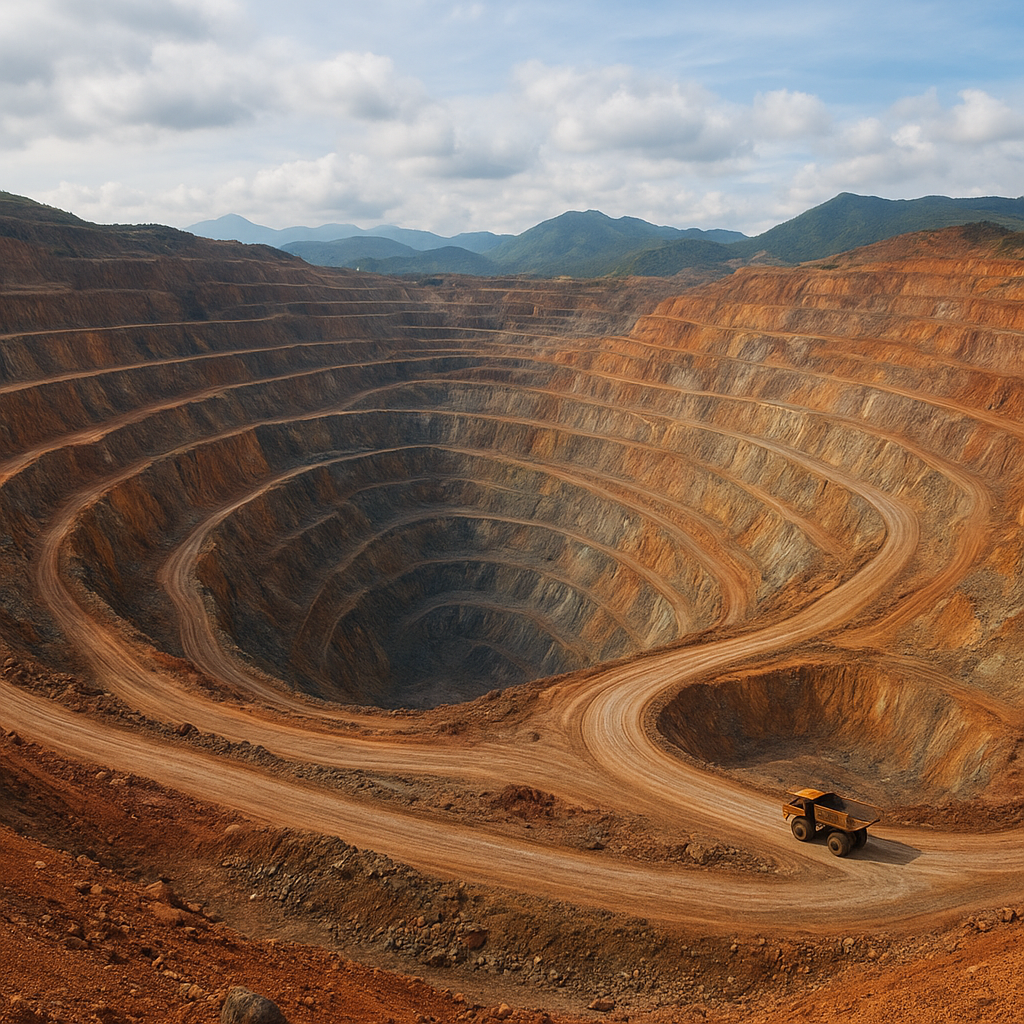
The Dexing Copper Mine is one of China’s most prominent mineral operations, noted for its large-scale extraction of copper and associated metals. Located in the eastern reaches of the country, the mine combines significant geological value with broad economic and industrial influence. This article examines the mine’s setting, the nature of its deposits and production, the economic role it plays locally and nationally, and several technical and human-interest aspects that make Dexing noteworthy.
Location and Geological Setting
The Dexing deposit is situated in the northern part of Jiangxi Province, an area that forms part of the greater metallogenic belts of eastern China. The city of Dexing and its surrounding counties have grown historically in tandem with the mining activities that characterize the landscape. The region’s terrain—hilly to mountainous with a mix of river valleys—both guided the location of mining infrastructure and posed engineering challenges during development.
Geology and Mineralization
The deposit is classically interpreted as a porphyry-style copper system. These deposits form in magmatic-hydrothermal environments associated with intrusive bodies and are often large, low-to-moderate grade orebodies. In Dexing, the principal metallic commodity is copper, hosted in disseminated sulfides and veinlets within porphyritic intrusive rocks and surrounding altered host rocks. Typical copper-bearing minerals include chalcopyrite and related sulfides; the ore also commonly contains significant byproducts such as molybdenum, as well as measurable quantities of gold and silver.
Porphyry systems like Dexing characteristically produce extensive alteration halos—sericitic, potassic and propylitic—reflecting the complex hydrothermal history. Such geology has allowed the mine to develop a long production life because of the deposit’s lateral and vertical extent. The combination of a large footprint and consistent mineralization makes these deposits economically attractive despite relatively modest grades compared with high-grade vein deposits.
Mining Methods and Processing
Dexing is primarily an open-pit operation, reflecting the geometry and near-surface expression of the porphyry orebody. Open-pit mining enables the removal of large volumes of rock economically, employing drill-and-blast, loading, and hauling fleets to deliver ore to processing facilities. Over the life of a major pit, benches, ramps, and waste dumps are carefully engineered to maintain safety and efficiency.
Ore Handling and Concentration
Following excavation, run-of-mine material undergoes comminution and concentration. Grinding mills reduce the ore to fine particles, while froth flotation is the primary method to produce copper concentrates from sulfide ores. The plant design optimizes recovery of copper while minimizing deleterious elements. A well-managed concentrator aims to recover both copper and secondary metals such as molybdenum; the molybdenite is often separated and sold as a distinct product.
Metallurgy and Smelting
Concentrates from the concentrator are typically shipped to smelters and refineries where sulfide minerals are converted to refined copper metal. Smelting and refining processes remove sulfur and other impurities, yielding cathode copper suitable for industrial use. Historically, vertical integration has been important: mines that can coordinate mining, concentration, smelting, and refining reduce logistical costs and capture a greater share of downstream value.
Economic Significance
The impact of the Dexing Mine spans local, provincial, and national dimensions. At the local level, the operation provides direct employment in mining, processing, and support services, while also stimulating secondary industries such as equipment maintenance, transportation, and housing construction. For many communities in the vicinity, mining revenues and related development have been transformative components of economic modernization.
Contribution to China’s Copper Supply
China is the world’s largest consumer of copper, driven by electrical infrastructure, construction, electronics, and increasingly, renewable energy systems. Domestic mines like Dexing play a crucial role in supplying the raw materials necessary for smelters and fabricators, reducing reliance on imports and buffering some fluctuations in global markets. Dexing’s long-lived deposit and production continuity bolster national metal security and industrial planning.
Fiscal and Industrial Roles
- Tax revenue and royalties from the mine contribute to provincial budgets and public services.
- Local procurement and contracting provide business opportunities for regional enterprises.
- The mine’s output supports downstream manufacturing and the electrical grid, aiding national goals such as the expansion of electrification and infrastructure projects.
Beyond raw metal production, mine-linked investments often fund roads, power lines, and water infrastructure that benefit non-mining economic activities. In short, a major operation like Dexing acts as both an industrial anchor and an economic multiplier in its region.
Environmental Management and Social Dimensions
Large-scale open-pit mining inevitably creates environmental and social challenges that must be managed. Common issues include landscape alteration, dust and noise, water use and water quality management, and the handling and storage of tailings and waste rock. Dexing, like other modern mines, has adopted a range of mitigation and monitoring strategies to reduce environmental footprints and comply with regulatory standards.
Water and Tailings Management
Tailings contain fine solids and process water that require secure containment to prevent downstream contamination. Contemporary practice emphasizes engineered tailings storage facilities, water recycling, and progressive rehabilitation to stabilize slopes and reduce erosion. Water treatment plants are commonly used to treat process effluents before discharge, ensuring that water quality remains within permitted limits.
Community Relations and Workforce
Mining operations must develop robust community engagement programs to address concerns such as land use, noise, and employment opportunities. Social investment—schools, clinics, vocational training—can strengthen long-term relations with local residents. On workforce issues, large mines employ a combination of skilled technical staff and local labor, boosting incomes and imparting transferable skills.
Interesting Technical and Cultural Aspects
Several details about the Dexing operation are notable both technically and in terms of broader context.
- Scale and engineering: Open-pit porphyry mines can become vast engineered landscapes. Bench designs, slope stabilization, and haul road logistics are optimized to move millions of tonnes of rock safely and efficiently.
- Polymetallic output: While copper is the chief product, the recovery of molybdenum, gold, and silver as byproducts enhances the economic profile of the deposit and can improve project resilience when copper prices are volatile.
- Role in electrification: Copper is indispensable for electrical wiring, motors, and renewable energy systems. The mine’s output supports the broader technological transition to electrified transport and grid expansion—an example of how a single mine can intersect with global trends in energy and industry.
- Technology adoption: Modern processing plants employ increasingly sophisticated sensors, automation, and data analytics to enhance recovery rates and reduce energy consumption. Such innovations can significantly influence the environmental footprint per tonne of metal produced.
- Rehabilitation and land reuse: Progressive reclamation—recontouring waste dumps, capping tailings, soil amendments, and replanting—aims to return parts of the site to productive or recreational land over time. This long-term planning is a growing focus in mine lifecycle management.
Future Prospects and Challenges
The long-term viability of a major mine like Dexing depends on orebody continuity, market conditions, technological improvements, and environmental permitting. Continued exploration in adjacent areas can extend mine life by identifying satellite deposits or deeper mineralization. Technological advances—in ore sorting, energy efficiency, and water recycling—can lower costs and environmental impacts, enhancing competitiveness even when commodity prices are subdued.
However, the sector faces challenges: fluctuating global commodity markets, stringent environmental regulations, and community expectations for sustainable development. Mines must strike a balance between maximizing recoveries and minimizing impacts. Strategic planning—covering closure, post-mining land use, and diversification of the local economy—will shape how Dexing’s legacy is perceived by future generations.
Wider Significance
Beyond its immediate economic footprint, the Dexing Copper Mine exemplifies broader themes in modern mining: the role of large porphyry deposits in global metal supply, the integration of mining with downstream metallurgy, and the imperative of responsible environmental and social management. Its contributions to national copper availability and regional development illustrate how a single resource operation can influence industrial trajectories and community fortunes. Observing how the mine navigates technological change, market shifts, and sustainability demands offers valuable lessons for mining elsewhere.

