
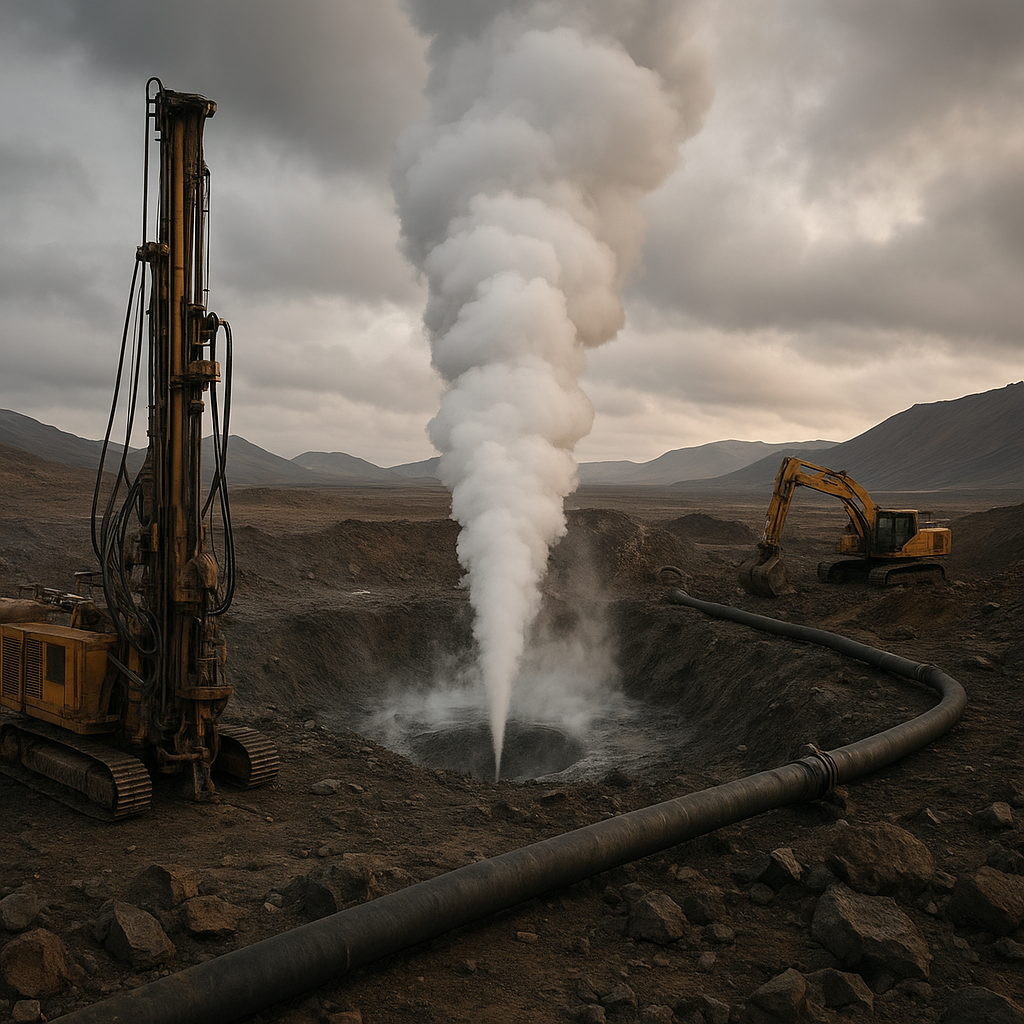
Deep geothermal mining is emerging as a promising frontier at the intersection of renewable energy production and critical mineral supply. By accessing high-temperature reservoirs deep below the Earth’s surface, engineers and geoscientists propose not only to extract heat for power and heating but also to mobilize and recover valuable elements dissolved in geothermal fluids or hosted in mineral veins. This article explores the geological drivers, the technical pathways, the environmental trade-offs, and the socio-economic implications of deploying deep geothermal operations as a future source of minerals.
Geological potential and mineralization processes
Understanding the subsurface is essential to identifying promising targets for deep geothermal mining. High-temperature geothermal systems form where magmatic or tectonic activity heats circulating fluids, creating reservoirs that can reach temperatures well above 200°C at depths of several kilometers. These fluids interact with surrounding rocks, dissolving and transporting a variety of elements, from common metals like copper and zinc to critical constituents such as rare earths, lithium, tellurium, and germanium.
Types of mineral occurrences
- Hydrothermal mineralization: Precipitation of sulfides and oxides around faults and fracture zones can concentrate metals into mineable veins or disseminated deposits.
- Brine-hosted metals: Saline geothermal fluids can carry high concentrations of dissolved minerals, including lithium and boron, particularly in closed-basin or sedimentary geothermal systems.
- Magmatic-hydrothermal systems: Proximity to intrusive bodies can increase the inventory of economically valuable elements due to magmatic differentiation and fluid exsolution.
Exploration requires integration of geophysical surveys, geochemical sampling, and structural geology to delineate zones of focused fluid flow and element enrichment. Novel downhole sensors and real-time geochemical analysis increasingly enable better characterization of the in-situ exploration environment, improving the odds of discovering high-grade targets suitable for combined heat, power, and mineral recovery.
Technologies and methods for deep geothermal mining
Converting geothermal systems into mineral sources demands adaptation and innovation across drilling, fluid management, and extraction technologies. Several approaches are under consideration and pilot testing:
- Co-production of heat and minerals: In this model, geothermal brines pumped to the surface for energy use are processed to remove dissolved metals before being reinjected.
- In-situ leaching and recovery: Injecting tailored solvents or enhancing fluid chemistry in the reservoir to mobilize target elements, then recovering them at the surface without large-scale excavation.
- Enhanced Geothermal Systems (EGS) with mineral recovery: Stimulating low-permeability rock to create a productive heat exchanger and designing circulation schemes to maximize mineral yield as well as heat extraction.
Advances in materials science are critical because geothermal fluids can be highly corrosive and scaling-prone. Cutting-edge membranes, sorbents, and selective ion-exchange materials are being developed to isolate particular elements (lithium, rare earths, etc.) efficiently at high temperatures. Additionally, digital monitoring using downhole sensors, machine learning for predictive maintenance, and closed-loop process control help optimize combined production streams.
Drilling and well design
Deep geothermal mining places exceptional demands on drilling technology: long-reach wells, high-temperature tooling, and zonal isolation to access discrete mineralized horizons. Directional drilling and multi-lateral wells can increase contact area with productive zones, while packers and flow control devices allow selective extraction from layers with differing chemistries. Reducing drilling costs and improving drilling rates are essential to make projects financially viable.
Environmental and socio-economic considerations
Deep geothermal mining promises lower surface disturbance compared with traditional hard-rock or open-pit mining, but it is not without environmental challenges. Managing geothermal fluids, avoiding induced seismicity, and ensuring responsible waste handling are top priorities.
- Sustainability: Responsible reinjection strategies can maintain reservoir pressure and limit subsidence, enabling long-lived operations with reduced surface footprint.
- Water and chemical management: Treatment of produced brines is necessary to prevent contamination. Technologies that recover metals while returning chemically balanced fluids to the subsurface reduce environmental risk.
- Induced seismicity: Stimulating deep fractures can trigger seismic events. Robust monitoring networks and adaptive stimulation protocols help mitigate seismic risk and build community trust.
From a socio-economic perspective, the ability to produce both energy and critical materials locally can enhance supply security, reduce dependence on geopolitically concentrated mining regions, and create skilled jobs in geoscience and engineering. Local communities, however, must be engaged early: concerns about subsidence, noise, and potential chemical spills are real, and inclusive benefit-sharing models increase the likelihood of social license to operate.
Economic feasibility and market implications
Whether deep geothermal mining becomes a major mineral source depends on resource quality, capital costs, and market dynamics. The value proposition strengthens when heat or power generation offsets operational expenses. Key economic drivers include:
- Concentration of target elements in the brine: Higher grades reduce processing costs and make extraction quicker to reach break-even.
- Energy co-production credits: Revenue from electricity or district heating improves project cash flow and accelerates returns on investment.
- Technological maturity: Lower-cost, high-selectivity separation technologies will determine how broadly geothermal brines can be exploited for critical elements.
Market impacts could be significant for elements facing tight supply chains, such as lithium and certain rare earths. Diversifying supply through geothermal-derived sources would potentially stabilize prices and foster regional industrial development. Investors and governments must weigh long lead times for exploration and drilling against the long-term benefits of secure, low-carbon material sources.
Policy, regulation, and research priorities
Concerted policy support will accelerate responsible deployment of deep geothermal mining. Regulations need to address combined resource extraction, covering water rights, subsurface property, waste handling, and seismic risk mitigation. Public funding for pilot projects and demonstration plants is critical to de-risk the technologies.
Research and innovation focus areas
- Geochemical modeling to predict element mobility and design targeted recovery strategies.
- High-temperature, selective sorbents and membranes that operate economically at scale.
- Improved seismic monitoring and real-time control algorithms for stimulation operations.
- Life-cycle assessment (LCA) tools tailored to combined heat-and-mineral projects to quantify true environmental benefits.
International collaboration can accelerate learning curves by sharing datasets, best practices, and standardized permitting frameworks. Public-private partnerships will be especially valuable in establishing early demonstration sites that provisionally validate the technical and economic assumptions behind geothermal mineral recovery.
Technological integration and future trajectories
Realizing deep geothermal mining at scale will require systems thinking—integrating subsurface engineering, chemical processing, energy systems, and socio-environmental safeguards. Potential future trajectories include:
- Hybrid facilities that supply baseload power while feeding battery and electronics industries with domestically sourced metals.
- Modular, transportable separation units that can be deployed rapidly to new wells, reducing capital intensity.
- Closed-loop urban-industrial symbioses where district heating is paired with mineral recovery for local manufacturing clusters.
Advances in computational modeling, material science, and remote sensing will shorten exploration cycles and reduce operational risks. As the world seeks rapid decarbonization and resilient supply of strategic materials, geothermal systems offer a pathway that aligns extraction with low-carbon energy production and a nascent circular industrial model.
Community engagement and ethical considerations
Technical success alone will not guarantee adoption. Ethical frameworks that prioritize transparency, equitable benefit distribution, and thorough environmental stewardship must guide project development. Early and meaningful consultation with affected stakeholders, clear communication of risks and benefits, and mechanisms for conflict resolution are essential. Training programs can ensure that local workforces gain the skills to participate fully in a high-tech geothermal mining sector, fostering long-term community resilience.
Combining lessons from traditional mining, geothermal energy, and chemical processing, the emerging practice of mining the deep geothermal realm could redefine how societies source the elements required for electrification and digitalization. Its promise lies in aligning resource supply with low-carbon objectives, but responsible governance, sustained innovation, and social legitimacy will determine whether it becomes a mainstream component of future mineral supply chains.
