Cuprite is a striking and scientifically important mineral whose vivid red color and distinctive crystalline forms have captured the attention of collectors, miners, and researchers alike. Known chemically as copper(I) oxide, it occupies a central role in the supergene zones of copper deposits and has found renewed interest in modern materials science. This article explores the mineral’s mineralogy, natural environments, historical and industrial importance, and contemporary technological applications.
Mineralogy and physical properties
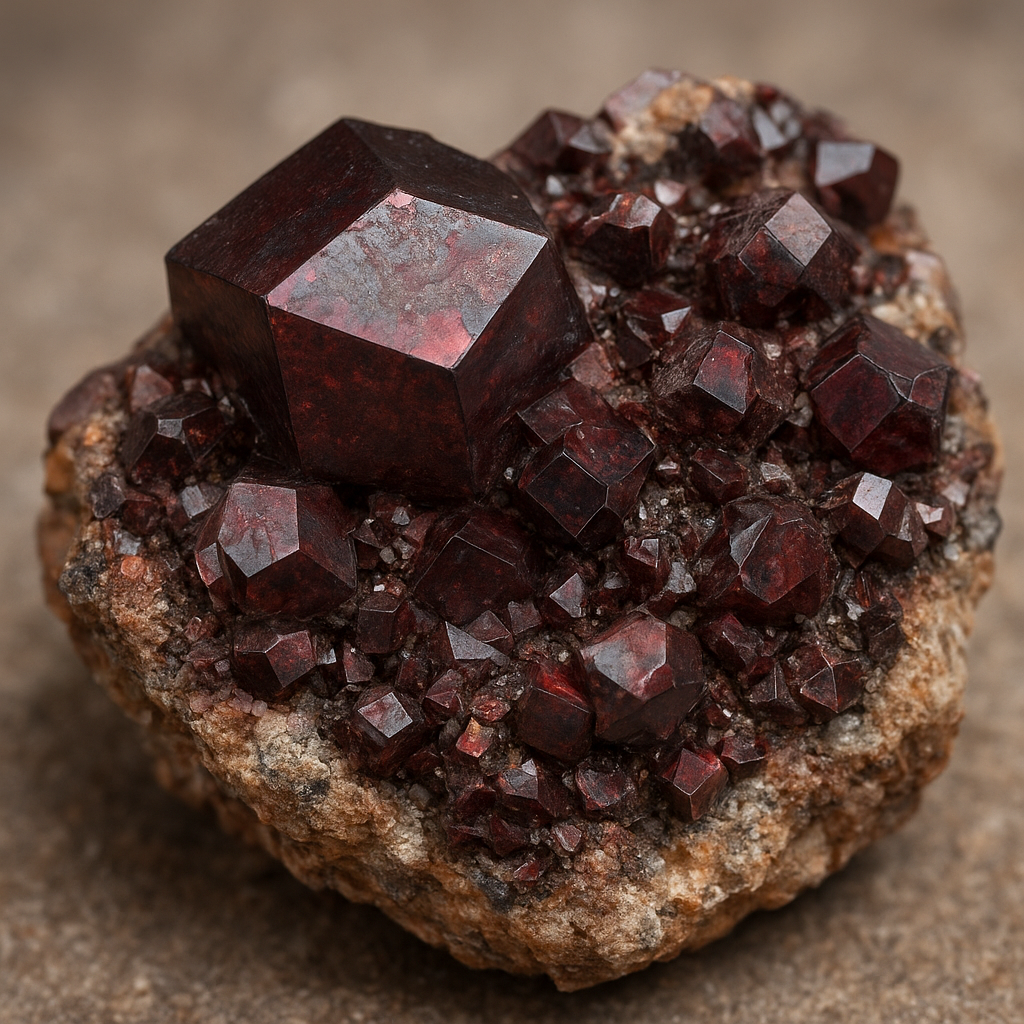
Cuprite, with the chemical formula Cu2O, is a simple oxide of copper in the +1 oxidation state. It crystallizes in the isometric (cubic) system and commonly forms well-defined cubes, octahedra, or more complex crystal aggregates. Its most eye-catching attribute is an intense red to deep garnet-red color that can appear almost metallic in massive specimens or brilliantly transparent in rare gem-quality crystals.
Key physical characteristics
- Color: Ruby-red to brick-red or almost black in dense masses.
- Luster: Adamantine to sub-metallic; can be brilliant on fresh crystal faces.
- Hardness: Typically 3.5–4 on the Mohs scale.
- Specific gravity: Approximately 6.0, reflecting the heavy presence of copper.
- Streak: Brownish-red.
- Cleavage: Poor or absent; fracture is usually conchoidal to uneven.
- Optical behavior: Isotropic as a cubic mineral; translucent to opaque.
Because of its intense color and occasional transparency, gem-quality cuprite crystals are sometimes cut into small stones and marketed as collector gems. Their high refractive quality and unusual hue make them distinct but they remain fragile because of the low hardness and brittleness.
Geological occurrence and formation processes
Cuprite is predominantly a product of supergene alteration — the chemical weathering of primary copper sulfide minerals such as chalcopyrite, bornite, and chalcocite. In the oxidized zones above or adjacent to primary sulfide bodies, circulating meteoric waters and oxygen-rich conditions facilitate the breakdown of primary minerals and the precipitation of secondary copper oxides and carbonates.
Typical paragenesis and associated minerals
- Primary copper sulfides (e.g., chalcopyrite) provide the copper source.
- Oxidation leads to intermediate phases such as chalcocite and covellite, then to copper oxides like cuprite and tenorite (CuO).
- Further interaction with carbonate-bearing waters can form malachite and azurite, while chloride-bearing solutions may produce atacamite or other copper chlorides.
Cuprite commonly occurs together with native copper, malachite, azurite, chrysocolla, and other secondary minerals. It tends to form under relatively oxidizing but not excessively acidic conditions — a balance that favors the stability of copper(I) rather than copper(II) phases.
Notable geological settings
Although cuprite can be found globally wherever copper deposits have been weathered, it is most spectacular in arid or semi-arid climates where supergene enrichment processes concentrate and preserve colorful secondary minerals. Classic localities known for high-quality or abundant cuprite include historic copper districts and famous museum specimens from mines where extensive oxidation produced aesthetic crystals.
Distribution and famous localities
Cuprite has a worldwide distribution and appears in many copper mining districts, but a few regions are particularly celebrated for outstanding specimens:
- Tsumeb, Namibia — Famous for a bewildering diversity of secondary minerals, Tsumeb has produced cuprite crystals with exceptional color and form.
- Arizona, USA — Districts such as Bisbee and Morenci are well known for attractive cuprite associated with the oxidation zones of large porphyry and hydrothermal copper deposits.
- Cornwall and Devon, UK — Historic copper mining in southwest England yielded fine cuprite specimens among other copper minerals.
- Other notable occurrences include certain Chilean deposits, parts of Mexico, some European mining districts, and various localities in Australia and Russia.
Collectors prize euhedral cuprite crystals and well-formed masses for both their rarity and intense coloration. Museum collections often contain specimens that illustrate the geometric beauty of cubic or octahedral cuprite forms.
Historical and economic significance
Throughout history, oxidized copper minerals — including cuprite — served as important indicators of potentially economic copper deposits. In many mining districts, the visible red and green secondary minerals guided early prospectors to richer sulfide ores at depth. As an ore of copper, cuprite contributed to metal extraction, especially where concentrations were sufficiently high in weathered zones to be exploited by shallow mining.
The etymology of the mineral connects to the metal itself: the name cuprite derives from the Latin root cuprum, meaning copper. Its presence is often associated with the supergene enrichment that enhances copper concentrations and thus has direct economic implications.
Modern technological applications and research directions
Outside its role as an ore and collector’s mineral, cuprite — chemically Cu2O — has attracted scientific interest because of its electronic and chemical properties. As a naturally occurring p-type semiconductor with a direct band gap of around 2.0 eV, Cu2O is the subject of diverse research efforts:
- Photovoltaics: Cu2O has been investigated for low-cost solar cells and heterojunction devices. Its band gap is suitable for visible-light absorption and early research explored simple Cu2O-based solar junctions.
- Photoelectrochemistry: Cu2O photocathodes have been tested for solar-driven water splitting (hydrogen production), often combined with protective coatings to limit photocorrosion.
- Catalysis and photocatalysis: Nanostructured cuprite shows promise for reduction and oxidation reactions under light irradiation, including selective organic transformations and degradation of pollutants.
- Gas sensing and electronics: Thin films and nanowires of Cu2O are evaluated for sensor applications due to changes in electrical resistance with gas adsorption.
- Antimicrobial coatings: Copper oxides as a class have antimicrobial properties; research explores Cu2O nanoparticles for coatings and materials that inhibit microbial growth.
Developing stable and controllable Cu2O materials requires careful synthesis: electrodeposition, thermal oxidation of copper metal, solution-phase reduction of copper salts, and vapor deposition techniques are among the methods used to produce films and nanostructures tailored for specific functions.
Synthetic cuprite, nanostructures, and materials challenges
Creating reliable Cu2O devices faces a significant challenge: the material’s tendency to oxidize further to copper(II) oxide (tenorite) or to reduce to metallic copper under certain conditions. Stabilization strategies include surface passivation, protective overlayers, and careful control of stoichiometry. At the nanoscale, cuprite nanoparticles can demonstrate enhanced reactivity and unique optical properties, prompting active investigation for environmental and energy technologies.
Nanostructure advantages
- Increased surface area enhances catalytic and sensing performance.
- Quantum confinement effects can modify optical absorption and electronic behavior.
- Facile chemical synthesis at relatively low temperatures allows integration into composite materials.
Researchers also explore doping and heterostructures (combining Cu2O with other semiconductors) to tune electronic properties and improve charge separation in photoactive devices.
Identification and practical handling
In the field or the lab, recognizing cuprite involves a mix of simple physical tests and more advanced analyses. Its distinctive red streak and high specific gravity are useful field indicators, while crystal habit and color guide visual identification. X-ray diffraction, electron microscopy, and spectroscopic methods (Raman, infrared) provide definitive confirmation and help characterize synthetic variants or nanostructures.
When handling specimens, collectors should be cautious: cuprite’s softness and brittleness make sharp-crystalline faces susceptible to damage. Because it can darken or alter if exposed to certain chemicals or strong oxidants, specimens are best stored in stable, low-humidity conditions away from corrosive agents.
Environmental interactions and mine-site implications
Cuprite’s formation reflects the oxidation history of a deposit and thus provides clues about local geochemistry. In mine environments, the development of copper oxides like cuprite and tenorite affects metal mobility: some compounds immobilize copper as relatively insoluble phases while other pathways can lead to mobilization and transport in solution. Understanding these transformations is crucial for mine remediation and environmental monitoring.
- Supergene mineral assemblages can serve as sinks for metals, but under changing pH and redox conditions metals may be remobilized.
- Monitoring secondary minerals at waste rock piles and tailings can inform risk assessment and guide remediation tactics such as neutralization and phytostabilization.
- The colorful secondary minerals often visually indicate zones of active weathering and metal release, alerting managers and scientists to potential environmental issues.
Collecting, aesthetics, and market considerations
Among mineral collectors, cuprite occupies a special place because of its color and crystal forms. Transparent, gemmy cuprite crystals are rare and command attention at mineral shows and auctions. Specimen value depends on color saturation, crystal perfection, and size. Because cuprite is relatively soft and brittle, cabinet specimens often require careful conservation and gentle cleaning methods to preserve delicate faces.
For those interested in acquiring cuprite, provenance matters: specimens from canonical localities such as Tsumeb or historic Arizona mines typically carry premium status. Additionally, the aesthetic contrast between red cuprite and green malachite or blue azurite in the same specimen makes for dramatic display pieces.
Interesting scientific and cultural notes
Cuprite is not only visually arresting but also scientifically instructive. Its straightforward composition and well-defined electronic structure make it a model material for exploring fundamental questions in solid-state chemistry and semiconductor physics. The mineral sits at an intersection of geology, metallurgy, and materials science, illustrating how a natural mineral can inform and inspire technological advances.
On a cultural level, the deep red of cuprite evokes associations with ruby and garnet, and the name “ruby copper” has occasionally been used in the gem trade. While it never rivaled traditional gemstones in widespread use, its unique hue and rarity in gem form have ensured a niche appeal.
Further reading and study directions
For readers intrigued by cuprite’s role in energy materials, look for literature on Cu2O-based photocathodes, heterojunction devices, and nanostructured catalysts. Geologists and mineral collectors will find field guides and monographs on supergene mineral assemblages useful for understanding how cuprite fits into the broader story of copper ore formation and alteration.