
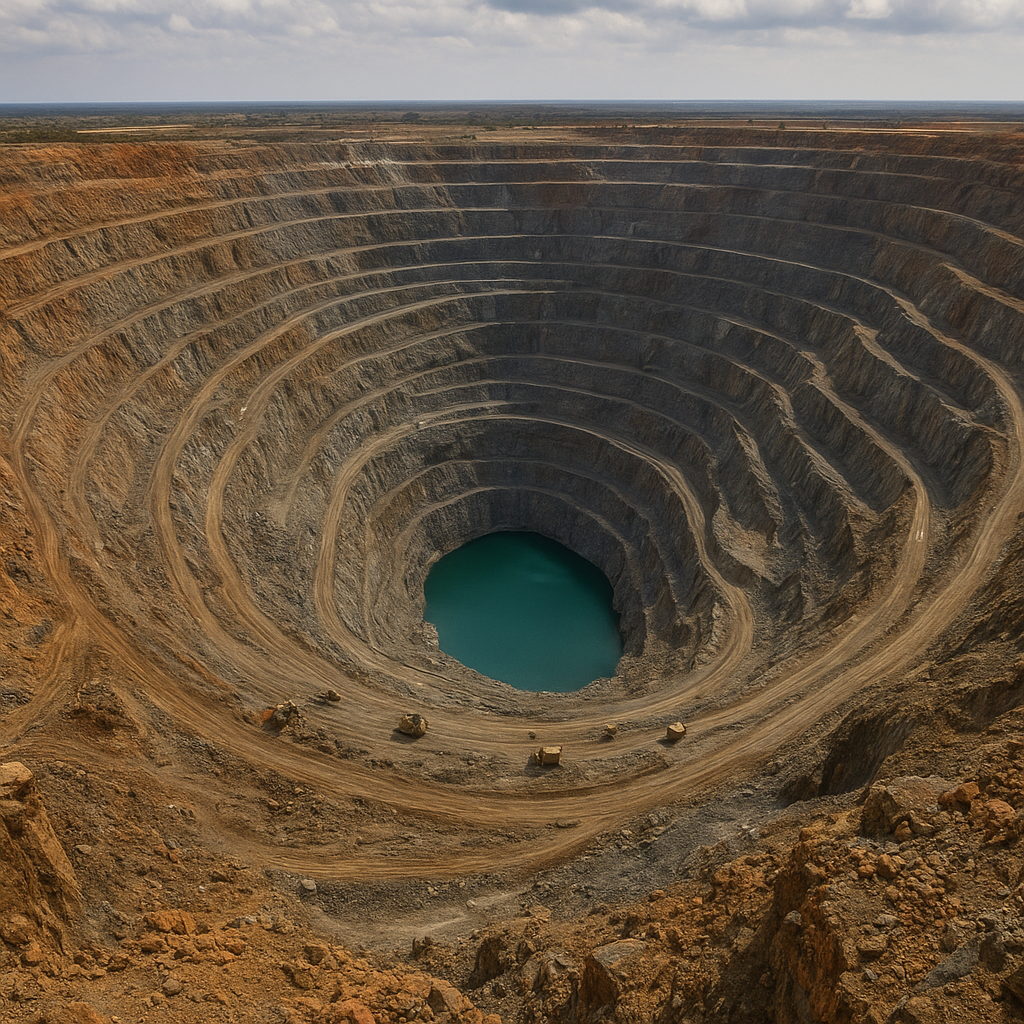
The Cullinan Mine, set in the rolling hills east of Pretoria, occupies a central place in the global history of gem mining. Famous for producing some of the largest and most historically significant gemstones ever found, the site has shaped not only the map of mineral wealth in southern Africa but also royal and cultural collections around the world. This article explores where the mine is located, what is extracted there, its broader economic importance, and a number of compelling and lesser-known facts that make the Cullinan Mine a subject of enduring fascination.
Location, Geology and the Nature of the Deposit
The Cullinan Mine lies near the small town of Cullinan in the Gauteng province of South Africa, approximately 40 kilometers east of the city of Pretoria. The deposit is not a sedimentary or alluvial deposit where diamonds are washed and concentrated; instead, it is hosted in a classic kimberlite pipe, a vertical geological structure formed by a deep, violent volcanic eruption that transported material from the Earth’s mantle to the surface.
Kimberlite pipes are the most important primary source of natural diamonds, and the Cullinan pipe is one of the most productive known. The kimberlite at Cullinan is renowned for its unusually high proportion of gem-quality stones rather than industrial-grade material. Over a century of extraction has demonstrated that this pipe can yield exceptionally large and clean crystals, which is why the mine stands out among many other diamond-producing sites around the world.
Geologists study the Cullinan pipe to understand not only the concentration of diamonds but also the thermal and chemical processes that preserve large gem-quality crystals. The host rock contains xenoliths and mantle-derived minerals that record the conditions under which diamonds formed deep within the Earth—conditions of extreme pressure and temperature sustained over geological timeframes.
History of Discovery and Early Production
The mine’s modern history began at the turn of the 20th century when prospecting and industrial-scale extraction were expanding rapidly across the region. The mine soon acquired global prominence with the discovery, in 1905, of the single largest gem-quality rough diamond ever found at the time: the raw stone that would be called the Cullinan Diamond, weighing approximately 3,106 carats (about 621 grams). This extraordinary find quickly made headlines around the world and set a standard for the mine’s reputation.
The rough Cullinan was purchased and presented to the British monarch, and the task of cutting and polishing was entrusted to expert lapidaries. The diamond was cleaved and cut into several major stones—most famously the Cullinan I and Cullinan II—which are now set in the British Crown Jewels as the Great Star of Africa and the Second Star of Africa, respectively. The cutting work was undertaken by the Asscher family firm in Amsterdam, which had to invent new techniques and tools to handle such a monumental stone.
From those early decades onward, the mine continued to produce large, high-quality diamonds. While the early twentieth century was characterized by extensive open-pit operations, over time mining practices shifted to deeper underground work as the accessible surface ore was exhausted. Throughout its history, the mine has been associated with both artisanal skill and industrial engineering as operators sought to extract value while managing increasing depth and complexity.
What Is Extracted — The Diamonds and Their Characteristics
The principal product of the Cullinan Mine is, of course, natural diamonds. Unlike deposits that primarily yield industrial-quality stones for cutting, drilling or grinding, the Cullinan pipe has produced a high percentage of gem-quality material suitable for jewelry and collectors. Among the characteristics valued from Cullinan diamonds are their clarity, size, and the occasional presence of exceptional colorless or near-colorless stones.
Gemologists distinguish stones by cut, clarity, color and carat. Cullinan-origin stones have historically excelled in carat and clarity. The original Cullinan rough yielded multiple major polished stones in the hundreds of carats—an extraordinarily rare outcome. Over more recent decades, smaller gem-quality stones have been common as well, feeding the global diamond cutting, polishing and jewelry supply chain.
- Gem-quality focus: The mine is prized for producing diamonds that are suitable for high-value jewelry.
- Size potential: The pipe has yielded a disproportionately high number of large crystals.
- Clarity and color: Many stones from the pipe exhibit favorable clarity and color grades.
- Varied output: The mine produces a range of sizes, from large collector stones to smaller goods used by the jewelry trade.
Economic Significance to the Region and Country
The Cullinan Mine contributes to the local and national economy in several ways. First, the extraction, sorting and sale of diamonds generate foreign exchange earnings through exports—an important component for a mineral-rich economy. Second, the mine creates direct employment at the site and indirect jobs in related sectors such as transport, security, administration, and the downstream cutting and polishing industry. Third, it contributes to local economic infrastructure, including roads, housing and community services that are often associated with long-lived mining operations.
Mining regions in South Africa typically face a balancing act between the inflow of capital and the need to ensure that benefits accrue to local populations. At Cullinan, as with many other mines, revenues have supported municipal budgets and local enterprises while also fueling broader national contributions in taxes and royalties. The prominence of the mine also helps to attract attention and investment to the region, which can stimulate other economic activity, including tourism and heritage initiatives.
Because diamonds are a high-value, low-volume commodity, the mine’s output—especially when large stones are found and sold—can represent significant intermittent inflows of revenue. Auctions and private sales of large, rare stones can fetch multi-million-dollar prices, meaning that individual finds can have outsized economic effects compared to the tonnage of ore processed.
Mining Methods, Operations and Technological Adaptation
Over its long operational life the Cullinan Mine has transitioned through a number of mining methods. Initially exploited as an open pit, the mine moved to underground mining as surface ore was depleted and as the economics favored exploiting deeper ore bodies. Underground mining is more capital and technology intensive: it requires sophisticated ventilation, rock support, ore-handling systems and dewatering controls.
Processing plants associated with the mine are designed to recover diamonds from kimberlite-mass material through a sequence of crushing, screening, dense media separation and X-ray sorting or grease tables. Modern operations combine mechanical processing with sensor-based sorting to increase recovery rates and reduce energy use. Environmental management has also become a core operational requirement, with attention to tailings management, land rehabilitation and water treatment.
Technology plays a role in extending the productive life of the deposit. Remote sensing and geophysical surveys help to delineate ore, and computer modeling improves the efficiency of extraction. The integration of modern health and safety standards and automation has altered the workplace profile of the mine compared to early twentieth-century operations.
Social and Environmental Considerations
Like all significant mining projects, Cullinan has social and environmental footprints. Environmental concerns include landscape alteration, biodiversity impacts, and water usage. Operators are expected to manage these impacts through progressive rehabilitation, closure planning, and continuous environmental monitoring. Water stewardship is particularly important in South Africa’s climate context, making efficient water recycling and treatment systems essential components of responsible mining.
On the social side, mining brings employment and economic opportunity but also social change and challenges. Housing, health services, education and local governance can be strained by the rapid growth associated with mining towns. Over the decades, community engagement and corporate social responsibility initiatives have sought to mitigate adverse effects and create longer-term benefits, such as skills development, small-business support and social investments in healthcare and schooling.
Cultural Significance and Famous Stones
Few diamond mines have an associated narrative as rich as that of Cullinan. The discovery of the original colossal rough stone made an indelible mark on philately and royal pageantry; the major polished stones—especially the Great and Second Stars of Africa—remain central pieces within the British Crown Jewels. The story touches on empire, craftsmanship and international trade, linking geological happenstance to cultural heritage.
Other notable stones and finds from the mine over the decades have fed museums and private collections. The allure of discovering a stone of exceptional size or clarity continues to draw both prospectors and major mining companies. The laborious and expert work of cutting and polishing great stones—often requiring new techniques and painstaking craftsmanship—adds another layer to the mine’s legend.
Interesting Facts and Lesser-Known Details
- Origin of the name: The mine and the nearby town take the name Cullinan, after a figure associated with the original development of the property.
- Biggest gem-quality rough at the time: The 1905 find remained the largest known gem-quality rough diamond for many years and defined an era in gemology.
- Asscher cutting: The challenge of cutting the Cullinan rough was assigned to master cutters in Amsterdam, whose family firm pioneered techniques used specifically to manage such an immense crystal.
- Shift to underground: The mine’s operational life has been extended through a transition from surface to underground methods, a pattern common at mature deposits.
- Educational value: The geological and mineralogical specimens from the pipe have proven valuable to science and education, illuminating deep-Earth processes.
- Tourism draw: The mine’s legacy and its museum pieces attract tourists, collectors and students, contributing to local cultural tourism.
Future Prospects and Challenges
The future of the site depends on a combination of remaining ore quality, mining economics, commodity prices and social license to operate. Technological advances in ore extraction and processing, along with improved environmental practice, can extend productive lifetimes and reduce operational risk. However, declining ore grades, rising costs with depth, and the global market’s sensitivity to synthetic diamonds and changing consumer preferences present ongoing challenges.
At the same time, large and exceptional diamonds remain culturally and monetarily prized; occasional remarkable finds continue to be capable of generating significant revenue and global attention. The mine’s storied past keeps it at the center of discussions about how historical mining sites can be preserved not only as working enterprises but as parts of national and cultural heritage.
Why Cullinan Still Matters
Cullinan is more than a mine; it is a crucible where geology, history, economics and culture intersect. The diamonds extracted there have adorned crowns, sparked innovations in cutting and handling, and sustained economic activity in regions of South Africa. Today the site serves as a reminder of the concentrated value that mineral resources can provide, as well as the responsibilities that come with extracting them.
From the geologist’s lens the pipe offers a window into mantle processes and the transport mechanisms that bring rare materials to the surface. From the jeweler’s perspective, the mine is a supply source of high-end stones that shape markets. Economically, it underscores the role of mining in creating jobs and foreign exchange. And culturally, the Cullinan story—centered on an extraordinary stone—continues to captivate a global audience.
Selected key terms highlighted in this article
- Cullinan
- Premier Mine
- diamonds
- South Africa
- Cullinan Diamond
- kimberlite
- Asscher
- Petra Diamonds
- economy
- heritage

