Crocidolite has a complex and often controversial place in the history of geology, industry and public health. This article explores the mineral from multiple angles: its chemical nature and appearance, where it forms and is mined, how humans have used it and reacted to its risks, and some lesser-known or curious aspects connected to the mineral. Throughout, attention is paid to the scientific, economic and social implications of a substance that is at once visually striking and dangerously toxic.
Mineralogy and physical characteristics
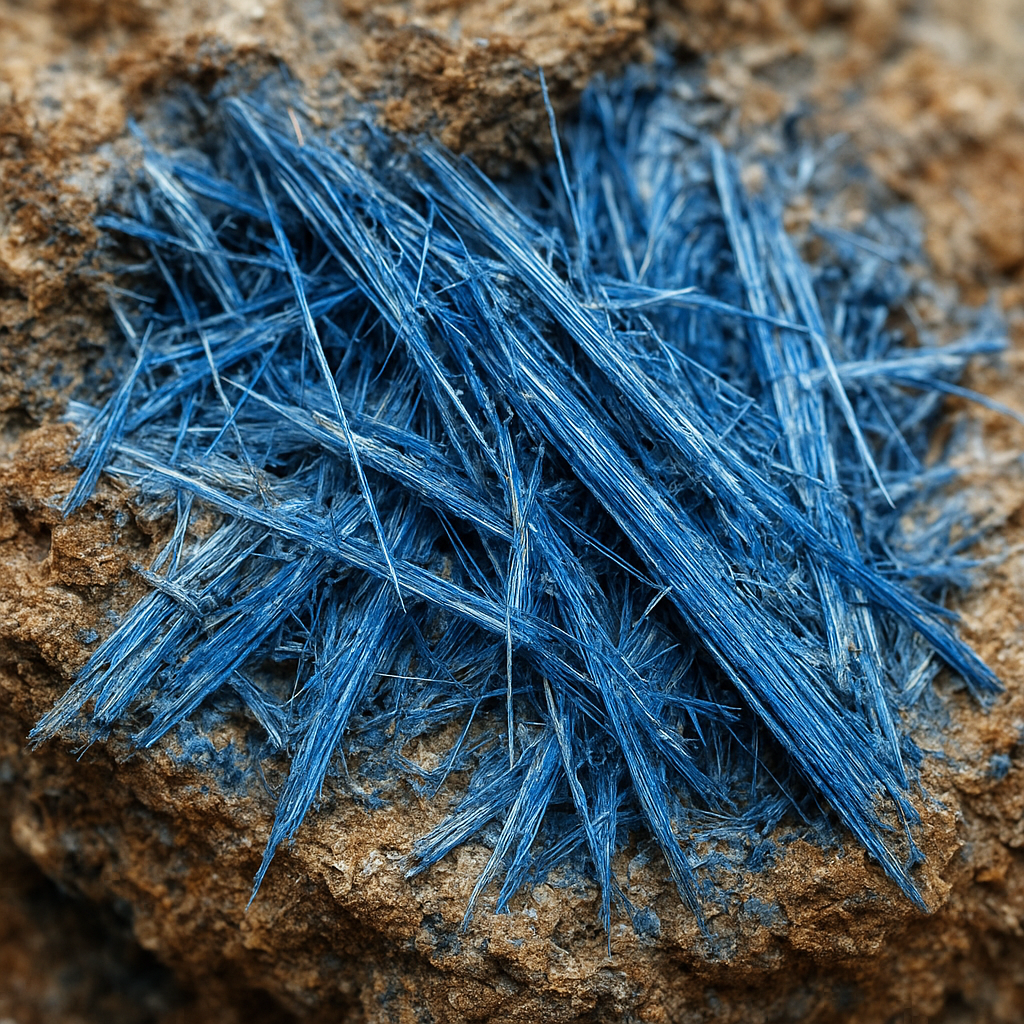
Crocidolite is an amphibole mineral belonging to the riebeckite group. The term crocidolite historically refers to the fibrous, asbestiform variety of riebeckite, a sodium-rich silicate with iron and magnesium in its structure. In hand specimens it is often notable for a striking blue to bluish-gray color, and when it occurs as asbestos it forms long, fine, flexible fibers rather than blocky crystals.
Key features include:
- Crystal system: monoclinic (for riebeckite)
- Luster: vitreous to silky in fibrous forms
- Hardness: typically around 5–6 on the Mohs scale for massive riebeckite, though asbestiform varieties feel softer due to fibrous habit
- Typical color: shades of blue to gray; brownish varieties occur where iron oxidation is present
- Cleavage and fracture: amphibole cleavage directions and splintery fracture for fibers
Crocidolite fibers are extremely thin — often on the scale of micrometers in diameter — and can split longitudinally into still finer fibrils. This microstructure contributes directly to both the exceptional durability of the fibers in biological tissues and their health hazards when inhaled.
Geological settings and global occurrences
Crocidolite forms in specific geological environments where sodium-rich, iron-bearing fluids interact with host rocks under suitable temperature and pressure conditions. It is typically associated with metamorphic rocks and with some hydrothermal systems. Notable occurrences have been documented on several continents.
Major deposits and localities
- South Africa: The renowned Wittenoom deposit in Western Australia is actually in Australia — apologies for prior regional confusion — but South Africa also has recorded occurrences of riebeckite and asbestiform amphiboles. South African deposits contributed historically to asbestos mining in the region.
- Western Australia: The town of Wittenoom and surrounding areas hosted the most famous crocidolite mine in the 20th century. The blue asbestos mined there was used widely before the health impacts were fully understood.
- Bolivia: Some pre-Cambrian metamorphic terranes in South America contain amphibole asbestos, including crocidolite-bearing rocks.
- Other localities: Small occurrences have been reported in parts of Europe, North America, and Asia where suitable metamorphic or altered igneous rocks are found.
Because asbestiform riebeckite is relatively rare compared to other asbestos types (like chrysotile), the global distribution of crocidolite deposits is more limited. Nonetheless, when present, it has attracted intense mining interest because of its desirable material properties prior to widespread regulation.
Historical uses and industrial applications
Before the health consequences of asbestos exposure were fully recognized, crocidolite had multiple uses due to its heat resistance, tensile strength and chemical stability. The fine, flexible fibers could be woven into textiles or mixed into composites, and the blue color made it distinctive in some decorative applications.
- Insulation: Crocidolite was used in thermal and electrical insulation products for industrial machinery and building materials.
- Gaskets and seals: Its heat resistance made crocidolite useful in high-temperature sealing applications.
- Textiles: In specialized contexts, asbestos fibers were spun or incorporated into fireproof cloths and suits.
- Building materials: Products such as roofing, cement, and pipe lagging occasionally contained amphibole asbestos.
- Consumer goods: Historically, some consumer items incorporated asbestos fibers for durability or heat resistance, although crocidolite’s distinct blue color sometimes limited its aesthetic use.
Perhaps the most notorious commercial product associated with crocidolite is the mining and export from the Wittenoom region in Australia. During the mid-20th century, a significant quantity of blue asbestos was produced there and used in industrial settings across the world.
Health hazards and medical consequences
The most serious aspect of crocidolite’s legacy is its role in occupational and environmental disease. Fibrous asbestos types differ in pathogenicity, and crocidolite is widely regarded as among the most hazardous. The small diameter and rigidity of crocidolite fibers enable them to penetrate deeply into lung tissue and persist for decades.
Health conditions linked to crocidolite exposure include:
- Mesothelioma: A malignant cancer of the pleural or peritoneal lining, strongly associated with amphibole asbestos exposure and particularly linked to crocidolite.
- Asbestosis: Progressive pulmonary fibrosis caused by retained fibers provoking chronic inflammation.
- Bronchogenic lung cancer: Increased risk in exposed individuals, with asbestos exposure acting synergistically with smoking.
- Pleural plaques and thickening: Non-malignant but disabling pleural disease common among exposed populations.
Epidemiological studies of mining communities and exposed workers — notably those from the Wittenoom mine and other crocidolite-producing areas — documented elevated rates of mesothelioma and other asbestos-related diseases. These outcomes led to major public health responses, compensation programs and litigation.
Regulation, bans and legacy issues
Because of the clear causal link between amphibole asbestos exposure and serious disease, many countries implemented strict regulations or outright bans on crocidolite and other asbestos forms. The regulatory environment varies by jurisdiction, but common elements include restrictions on mining, manufacturing, import/export, and mandatory abatement protocols for buildings containing asbestos.
Key regulatory and policy features:
- Prohibitions on mining and sale in many jurisdictions
- Strict occupational exposure limits where limited removal or management is permitted
- Mandatory notification and controlled removal of asbestos-containing materials in buildings
- Compensation schemes for affected workers and communities
- Environmental remediation programs addressing contaminated sites
Regulation has also driven technological and commercial shifts: replacements for asbestos in insulation, fireproofing and gaskets include ceramic fibers, mineral wool, glass fibers and synthetic polymers. Public awareness campaigns and monitoring efforts remain essential, particularly in regions where legacy contamination persists.
Environmental contamination and remediation
Sites of former crocidolite mining or manufacturing can present long-term environmental concerns. Asbestos fibers released into soil, sediments or structures can be a continuing source of exposure unless properly managed or remediated.
Remediation approaches
- Containment: Encapsulation of contaminated soils or materials to prevent fiber release.
- Removal: Carefully controlled abatement and disposal by licensed professionals following strict protocols to minimize airborne fibers.
- Stabilization: Chemical or physical stabilization to bind fibers into matrices that reduce friability.
- Land-use controls: Restrictions and monitoring to prevent disturbance of contaminated areas.
Remediation is complex and costly because activities that disturb asbestos-bearing materials can increase exposure risks. As a result, remediation projects require specialized planning, community consultation and long-term monitoring.
Social, legal and economic impacts
The crocidolite story intersects with occupational safety, environmental justice and legal accountability. Mining towns that prospered on blue asbestos often later faced severe disease burdens and economic decline as mining ceased and compensation issues unfolded.
Legal cases related to crocidolite exposure contributed to the development of modern product liability law and workers’ compensation frameworks in several countries. Corporations and governments faced litigation and public scrutiny over their roles in exposing workers and residents to hazardous materials. These legal proceedings have had lasting effects on corporate practices and regulatory policy.
Collecting, identification and museum specimens
Outside the industrial and medical context, crocidolite can attract interest from mineral collectors and museums because of its distinctive color and fibrous habit. However, collecting and handling such specimens require caution.
- Identification: Geologists use optical properties, X-ray diffraction and chemical analysis to distinguish riebeckite/crocidolite from visually similar minerals.
- Handling precautions: Because specimens may release hazardous fibers, museums and collectors follow containment and stabilization procedures, and many institutions avoid displaying friable asbestos specimens without proper safeguards.
- Educational value: Exhibits about crocidolite often emphasize the balance between mineralogical interest and public health history, using specimens to tell a broader story about industrialization, science and regulation.
Related minerals and terminology
The term crocidolite traditionally refers to asbestiform riebeckite, but amphibole minerals include several other asbestiform species such as amosite (amosite is an asbestiform variety of cummingtonite-grunerite) and tremolite/actinolite. Chrysotile, the serpentine group asbestos, is structurally different and predominated in many industrial uses; it remains controversial but is generally considered less strongly associated with mesothelioma than amphiboles.
Understanding the broader mineralogical family helps explain differences in pathogenicity, mechanical properties and historical usage patterns. Modern mineralogical analysis relies on electron microscopy, spectroscopy and diffraction methods to characterize fiber chemistry and morphology.
Interesting historical and cultural notes
The story of crocidolite intersects with notable historical episodes:
- Workplace narratives: Memoirs and oral histories from miners and factory workers provide firsthand perspectives on working conditions in asbestos industries.
- Public campaigns: Grassroots activism by affected communities and trade unions helped catalyze regulatory change in several countries.
- Art and architecture: In a few cases, asbestos-containing materials featuring crocidolite found their way into mid-century architectural details; these features now pose challenges for preservationists balancing heritage with safety.
There are also linguistic and etymological tidbits: the name crocidolite comes from Greek roots meaning “nap” or “tuft”, referring to the fibrous, wool-like appearance of the mineral in some forms.
Ongoing scientific research and open questions
Research into crocidolite and related amphibole asbestos continues in multiple disciplines:
- Medical science: Investigations into the molecular mechanisms of fiber-induced carcinogenesis aim to improve diagnosis and treatment for asbestos-related diseases.
- Environmental science: Studies on fiber transport, weathering and long-term persistence inform remediation and risk assessment.
- Material science: Researchers explore safe alternatives to asbestos and ways to immobilize or neutralize asbestos fibers.
Advances in microscopy and molecular epidemiology help refine exposure assessment and link specific fiber types to disease outcomes. This ongoing work has implications for policy, compensation and prevention programs.
Further reading and resources
For those seeking more detailed technical information, authoritative sources include peer-reviewed journals in mineralogy, occupational health agency publications, and government regulatory guidance on asbestos management. Museums and university geology departments may offer access to curated specimens and educational materials that present the mineralogical and historical dimensions of crocidolite while emphasizing safety.
If you would like, I can provide a list of scientific references, regulatory documents, or suggestions for museums and online resources where you can see images or learn more about specific localities and the health literature related to crocidolite.