The mineral covellite (chemical formula CuS) is a striking and scientifically rich copper sulfide that has fascinated mineralogists, collectors and materials scientists for more than a century. With its deep indigo-blue to metallic black color, layered crystal habit and unusual electronic behavior, covellite occupies a special place at the intersection of traditional economic geology and cutting-edge materials research. This article surveys where covellite is found, how it fits into copper ore systems and metallurgical processing, its modern and emerging applications, and several curious features that make it noteworthy beyond being simply another ore mineral.
Occurrence and geological settings
Covellite is typically a secondary or late-stage copper sulfide, formed under specific geochemical conditions associated with the supergene enrichment of copper deposits and in hydrothermal systems. It commonly appears as thin, foliated masses, minute rosettes or irregular coatings, often replacing earlier copper sulfides such as chalcopyrite, chalcocite or bornite.
Main geological environments
- Supergene enrichment zones above, around or below primary sulfide bodies, where near-surface oxidation and subsequent reducing conditions concentrate copper.
- Hydrothermal veins and replacement deposits, where late-stage sulfur- and copper-rich fluids precipitate covellite in open spaces and fractures.
- Contact and volcanic-hosted massive sulfide (VHMS) environments, though less commonly than in supergene settings.
Notable localities for covellite include major copper provinces and historic mine districts. Significant occurrences are reported from South America (especially Chile and Peru), North America (Montana and other portions of the United States), Mexico, parts of Europe (including Romania and Italy), Australia and Japan. In many of these districts, covellite appears as a component of the complex paragenesis of copper ores and can be an indicator of particular redox or fluid evolution conditions.
Physical and chemical properties
Covellite’s distinct visual and crystallographic properties make it easy to recognize in hand specimen and under the microscope, yet its atomic-scale structure is complex and important for its electronic behavior.
Appearance and basic properties
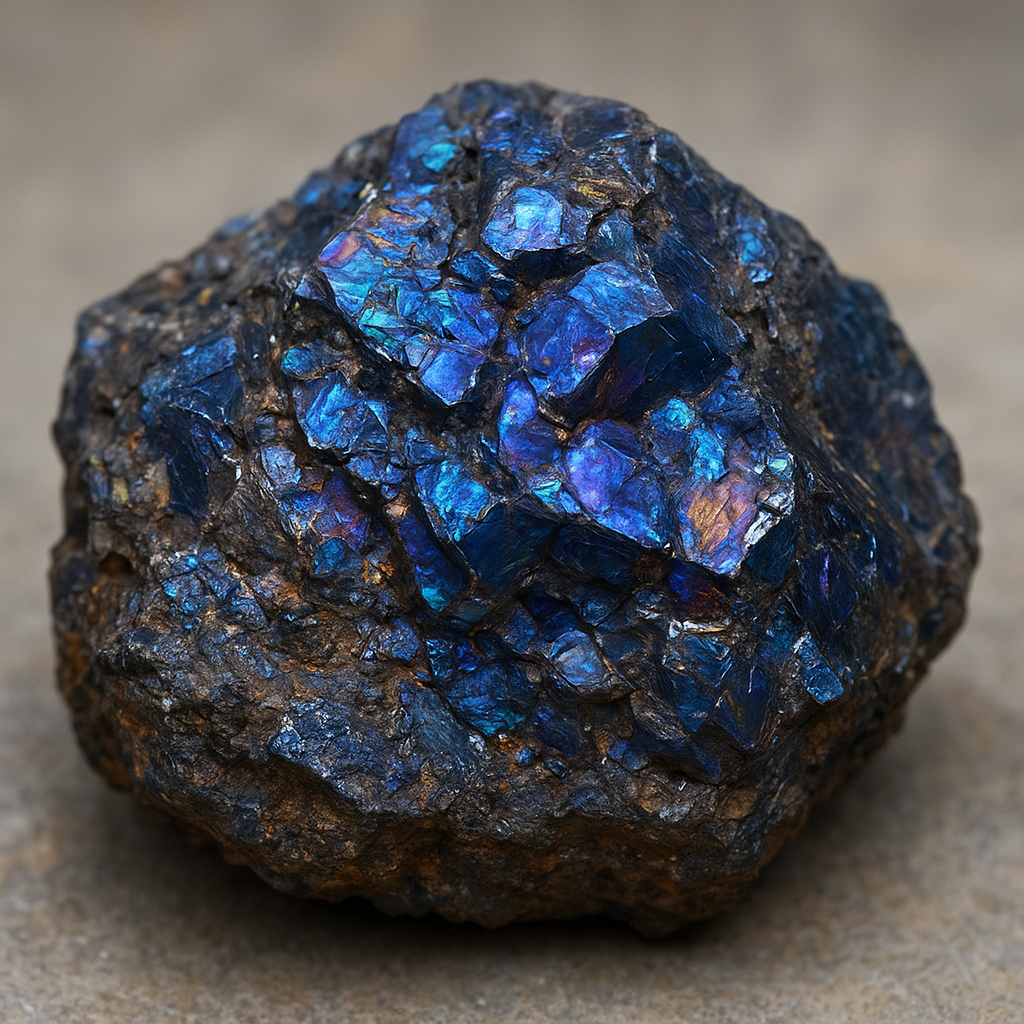
- Color: deep indigo-blue to lead-gray or black; specimens often show iridescent blue tarnish.
- Luster: metallic to submetallic.
- Hardness: relatively soft (Mohs about 1.5–2).
- Specific gravity: moderately high, typically around 4.6–4.8.
- Crystal system: hexagonal; commonly forms thin platelets and foliated aggregates rather than large euhedral crystals.
Chemistry and structure
With the nominal formula CuS, covellite is a copper sulfide that displays structural layers and variable bonding motifs. Studies have shown that its structure contains both sulfur atoms in different coordination environments and short S–S contacts, producing a layered arrangement. These layers stack along a crystallographic axis and give rise to anisotropic (direction-dependent) properties.
Electronically, covellite occupies an intermediate role between classical semiconductors and metallic conductors. Its band structure and charge distribution are unusual: copper can exhibit mixed valence-like behavior and the presence of S–S interactions influences the density of states at the Fermi level. Because of this, covellite can exhibit significant in-plane conductivity and has been a subject of condensed-matter research.
Economic significance and metallurgical processing
Although not one of the most abundant copper minerals in all deposits, covellite can contribute meaningfully to copper grades in certain ores and plays a practical role in mining and processing.
As an ore mineral
Covellite may occur as a minor to locally important copper ore. When present in sufficient quantity, it is recovered together with other copper sulfides during ore concentration and smelting. Typical beneficiation methods include crushing and grinding followed by froth flotation, which concentrates sulfide minerals. Because covellite is fine-grained and can form coatings on other sulfides, its recovery efficiency depends on liberation and reagent regimes during flotation.
Refining and metallurgical behavior
In smelting and hydrometallurgical circuits, covellite behaves similarly to other copper sulfides but can influence processing due to its fine texture and potential for forming refractory particles. In some concentrate smelts, covellite-rich material can contribute to slag chemistry or require specific adjustment of fluxes and reducing conditions. Hydrometallurgical leaching can oxidize copper sulfides to soluble copper, but the kinetics depend on mineralogy: covellite is often more resistant to simple acid leaching than more reactive sulfides, meaning pre-oxidation steps or specialized bioleaching approaches may be applied.
Modern applications and materials research
Beyond its role as an ore, covellite has attracted attention in several advanced technology fields. Researchers explore its unique combination of layered structure and electronic properties for applications in energy, catalysis and nanotechnology.
Nanomaterials and two-dimensional (2D) analogs
Thin covellite platelets and nanosheets have been synthesized by chemical and exfoliation methods. These nanomaterials show promising properties:
- High in-plane electrical conductivity useful for electrodes.
- Strong optical absorption in the visible to near-infrared, enabling photothermal or photodetector roles.
- Catalytic surface activity that can be exploited in electrocatalysis.
Because covellite is naturally layered, it serves as a candidate for two-dimensional-material research parallel to transition metal dichalcogenides. Exfoliated covellite nanosheets combine conductivity and catalytic function in a single composition, which is attractive for compact device architectures.
Energy storage and conversion
Experimental studies have tested covellite-based electrodes in lithium- and sodium-ion batteries, where copper sulfide phases can serve as high-capacity conversion electrodes. Advantages include high theoretical capacity and electronic conductivity, but challenges include volume changes during cycling and long-term stability. Researchers often convert covellite to composite phases with carbon or conductive polymers to mitigate degradation.
In electrocatalysis, covellite-derived materials have been evaluated for reactions such as the hydrogen evolution reaction (HER), oxygen reduction and CO2 reduction. Their sulfide chemistry and accessible surface sites can provide active centers for these reactions, though optimization and stability remain active areas of research.
Environmental aspects and processing challenges
Mining and processing of sulfide minerals like covellite have environmental implications that must be managed carefully. Understanding the weathering behavior of covellite helps predict acid rock drainage and metal mobility at mine sites.
Weathering and acid mine drainage (AMD)
When exposed to oxygen and water, sulfide minerals oxidize to release sulfate and dissolved metals. Covellite can contribute to these processes, especially where fine-grained or surface-exposed material increases reaction rates. Management practices—such as preventing oxygen ingress, neutralizing drainage with alkaline materials, or controlled disposal—are standard mitigants.
Remediation and resource recovery
On the positive side, covellite-containing wastes can sometimes be treated to recover copper via bioleaching or other hydrometallurgical methods, reducing environmental burden while reclaiming value. Emerging remediation technologies look to couple metal recovery with water treatment to address both pollution and resource efficiency.
Interesting scientific and historical notes
Covellite has a number of attributes that make it particularly interesting to collectors and researchers alike.
- Color and iridescence: The vivid blue iridescence of many covellite specimens makes them prized in mineral collections. This visual effect arises from thin-film interference on oxidized surfaces or microscopic surface textures.
- Complex electronic behavior: Covellite challenged early models of metal–sulfide bonding and continues to be studied by physicists investigating low-dimensional conductors and correlated electronic systems.
- Specimen rarity: Fine euhedral covellite crystals are uncommon; most occurrences are massive or foliated. Exceptional specimens command high interest from collectors.
- Cultural connections: In regions with historic copper mining, covellite and other copper minerals have long been used as educational tools, mineralogical symbols and, occasionally, as pigments or curiosities.
Laboratory and analytical techniques
Modern characterization of covellite uses a range of tools that reflect its complexity:
- X-ray diffraction (XRD) to determine layered crystal structure.
- Electron microscopy (SEM/TEM) to observe nanoscale morphology and stacking.
- Spectroscopic methods (XPS, Raman, EELS) to probe oxidation states and bonding, particularly S–S interactions.
- Transport measurements and angle-resolved photoemission spectroscopy (ARPES) to study electronic band structure and conductivity anisotropy.
How collectors, miners and scientists intersect over covellite
From a collector’s perspective, covellite is prized for its striking color and the rarity of well-formed crystals. From a mining perspective, it is one of several copper sulfides that must be managed in the ore-processing chain. For scientists, covellite is a fertile subject: its layered arrangement, mixed bonding character and potential for nanoscale engineering make it attractive for fundamental and applied research.
In applied research, bridging the gap between mineralogy and materials science, covellite serves as an example of how naturally occurring compounds can inspire or directly provide advanced functional materials. Work on covellite-derived catalysts, electrodes and nanostructures illustrates a broader trend: minerals once valued mainly for their metal content are increasingly recognized for their intrinsic structural and electronic features that can be harnessed in modern technologies.
Whether encountered as a deep-blue specimen in a collector’s cabinet, a minor ore phase in a copper deposit, or a nanosheet being optimized in a materials lab, covellite continues to occupy a compelling niche. Its combination of geological interest, processing relevance and potential technological utility ensures that covellite will remain a subject of attention across multiple disciplines.