
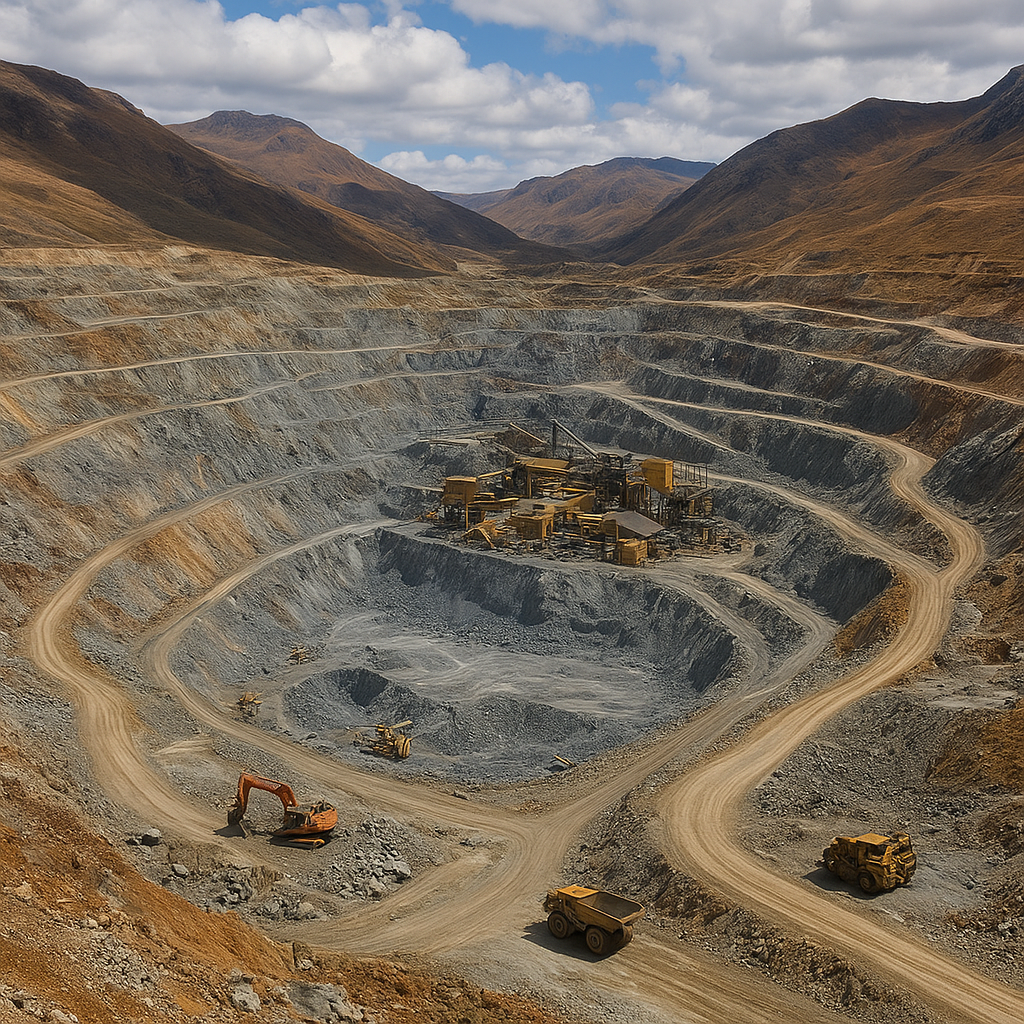
The Corani project is one of the most prominent undeveloped silver-rich polymetallic deposits in Peru. Situated high on the Andean Altiplano, it has attracted international attention for its large tonnage and potentially high-grade mineralization dominated by silver, zinc and lead. This article outlines where the deposit is located, the nature of its mineralization, its projected production and processing methods, and the broader economic, social and environmental implications that accompany the development of such a major mine. The Corani project exemplifies both the opportunities and challenges associated with modern mining in highland South America.
Location, access and regional setting
Corani lies in southern Peru, within the administrative region of Puno, on the high plateau that stretches along the borderlands of Peru and Bolivia. Its elevated setting — thousands of metres above sea level — places it in a high-Andean environment of puna grasslands, wetlands, and glacially influenced terrain. The immediate surroundings are characterized by rugged topography, fractured sedimentary and volcanic rock sequences, and limited infrastructure compared with coastal or lowland regions.
Access to the site is typically via regional roads that connect to larger provincial centres. Any major mining development at Corani requires considerable upgrades to transport networks, including the improvement or construction of highways, bridges and possibly logistics hubs to move heavy equipment, supplies and, ultimately, mineral concentrates to export ports on the Pacific coast. Power and water supply are also essential considerations: grid extension or dedicated power generation (including diesel, gas or renewable hybrid solutions) is usually assessed in prefeasibility and feasibility studies. Because of the project’s elevation and remoteness, seasonal weather and high altitude working conditions affect construction schedules and operational planning.
Geology and type of mineralization
Corani is best described as a polymetallic deposit, featuring substantial concentrations of silver, lead and zinc, along with smaller but economically meaningful quantities of base and precious metals such as copper and occasional gold credits. The deposit is hosted in a sequence of sedimentary and volcanic rocks typical of the Andean orogeny, where hydrothermal fluids circulated along structural pathways and replaced host lithologies with sulphide minerals.
Mineralogy typically includes a mix of sulphides such as galena (lead sulphide), sphalerite (zinc sulphide) and argentiferous sulphides or silver-bearing mineral phases. These minerals form in veins, breccias and replacement bodies with variable geometry, which affects how the ore is mined. The presence of silver as a major metal distinguishes Corani from some other Andean deposits where copper dominates; silver often occurs both as native or electrum phases and within complex sulphide assemblages.
Exploration and resource estimates
Exploratory work at Corani has included systematic drilling, trenching, geophysical surveys and geochemical sampling. These programs aim to delineate mineral resources and to upgrade them from inferred to indicated and measured categories through infill drilling. Typical technical studies for a project of this scale include mineral resource estimation, metallurgical testing, mine design and economic modelling.
Although readers should consult the latest technical reports for exact figures, Corani has historically been reported as containing hundreds of millions of ounces of silver-equivalent in inferred and indicated resources — making it a deposit of national significance. Resource models commonly show both high-grade veins amenable to selective mining and broader, lower-grade zones that could be processed through bulk-mining methods.
Mining methods and processing
Given the deposit geometry reported in technical summaries, a combination of underground and open pit mining methods is often considered. Selective underground mining can target higher-grade zones, while bulk open pit extraction may be used for more disseminated mineralization. The choice depends on resource depth, grade distribution and economic trade-offs evaluated in a feasibility study.
Processing of Corani ores would typically involve crushing and grinding followed by flotation circuits to produce concentrates: a silver-lead concentrate and a zinc concentrate are common product streams for polymetallic deposits. Flotation allows for separation of sulphide minerals into marketable concentrates that can be shipped to smelters and refiners. Metallurgical testing is crucial: it determines recoveries for each metal, reagent regimes, concentrate grades and potential penalties related to deleterious elements (for example, excessive iron, barium or antimony can affect concentrate marketability).
- Primary crushing and milling to achieve the required particle size.
- Bulk and differential flotation to separate sulphide species.
- Thickening, filtering and concentrate handling for transport.
- Tailings management, typically involving engineered tailings storage facilities with water recovery.
Economic significance
The development of a mine like Corani has multiple layers of economic impact, from local employment and procurement to national export revenues. At the project level, capital expenditures for construction and commissioning are substantial: they cover mine development, processing plant construction, power and water infrastructure, tailings facilities, and the mobilization of a specialized workforce. During operations, the project generates direct employment (miners, engineers, technical staff) and indirect jobs through contracting for services such as catering, transport and maintenance.
From a macroeconomic perspective, polymetallic mines contribute to foreign exchange earnings because concentrates are typically exported to international smelters and refiners. Taxes, royalties and mining-related levies provide public revenues that can fund regional development projects — provided that governance frameworks ensure transparent and effective allocation. For regional economies, the injection of salaries and business activity can stimulate local commerce, housing, healthcare and education services, albeit sometimes creating inflationary pressures on local prices.
Globally, metals such as silver, zinc and lead have industrial roles that link a project like Corani to wider supply chains. Zinc is critical for galvanizing steel and for alloys; lead has specialized uses in batteries and radiation shielding; silver plays roles in electronics, photovoltaics, photography and as an investment metal. Large new supplies can influence market balances, albeit Corani would be one mine among many in a complex global market.
Social and environmental considerations
Large-scale mining invariably raises environmental and social questions that must be addressed through comprehensive studies and ongoing stakeholder engagement. At high elevation, water is a particularly sensitive resource. Issues around water abstraction, potential impacts on wetlands (bofedales), and the management of acid-generating materials are central to environmental permitting. Tailings storage requires robust design to avoid catastrophic failures and to ensure long-term stability, especially in seismically active Andean settings.
Community relations are equally important. Indigenous and local communities in the Puno region have long-standing ties to the land through pastoralism and agriculture. Effective consultation processes, benefit-sharing agreements and local hiring and training programs are essential to securing a social licence to operate. Projects that invest in local infrastructure (schools, clinics, roads) and that create transparent channels for grievance airing tend to perform better in the long term.
- Environmental management: baseline studies, biodiversity protection, water quality monitoring.
- Social programs: local employment targets, supplier development, education and health initiatives.
- Regulatory compliance: environmental impact assessments, permitting and closure planning.
- Financial assurance: bonding for mine closure and long-term site care.
Logistics, markets and downstream value
Concentrates produced at Corani would likely be transported to Pacific ports for export or delivered to domestic smelters if capacities allow. Logistics planning must consider high-altitude road conditions, seasonal weather constraints and the need for secure transport corridors. Marketability of concentrates depends on metal grades, impurities and global demand. Long-term offtake arrangements with smelters or traders can help de-risk revenue streams for developers and financiers.
There is also potential to capture more value locally by encouraging domestic smelting or refining, though such investments require significant capital and face environmental and energy challenges. Some policy frameworks encourage downstream processing to increase national value capture, but practical and commercial factors must be weighed.
Risks, challenges and mitigation strategies
Major challenges for the Corani project include technical, social and market risks. Technically, high-altitude construction and mining demand specialized equipment and acclimatised workforces, and geotechnical constraints may increase costs. Socially, lack of community consent can halt or delay projects. Market volatility in metal prices affects project economics; metal price assumptions are a sensitive input in feasibility studies.
Mitigation strategies commonly applied include:
- Extensive and transparent stakeholder engagement programs to build trust with local communities.
- Comprehensive environmental baseline studies and adaptive management plans to protect water and biodiversity.
- Phased development strategies that reduce initial capital intensity and allow for ramp-up as infrastructure is improved.
- Hedging or establishing offtake agreements to manage commodity price exposure.
- Investment in local workforce training and supplier development to maximise local economic benefits.
Interesting facts and broader context
Corani is noteworthy not only for its size but for how it illustrates the changing face of mining in the Andes. The project sits at the intersection of traditional livelihoods and global commodity markets. Its high silver content makes it particularly interesting for investors and metal market analysts because silver often exhibits different supply-demand dynamics compared to larger base metals like copper. In addition, polymetallic deposits like Corani require nuanced processing approaches, because the metallurgical complexity can create both opportunities (multiple revenue streams) and challenges (interdependent recovery rates).
Another fascinating aspect is the interplay between modern mine engineering and ancient Andean landscapes shaped by millennia of human adaptation to high-altitude life. Projects that succeed tend to blend robust technical design with culturally sensitive engagement strategies, recognising that local knowledge and priorities must inform how benefits are shared.
Finally, Corani highlights how mining projects contribute to national growth narratives in resource-rich countries. If developed responsibly, with rigorous environmental safeguards and equitable economic frameworks, such projects can be engines of development. Conversely, if mismanaged, they can deepen inequalities and create lasting environmental legacies. The outcome depends heavily on governance, corporate conduct and sustained dialogue among all stakeholders.

