Cobaltite is a striking mineral that occupies a small but important place in the story of industrial metals, mineralogy and environmental geology. With a characteristic metallic sheen and a chemical formula that binds cobalt with arsenic and sulfur, cobaltite is both a scientific curiosity and an economically significant ore mineral. This article explores where cobaltite forms, how it is recognized and processed, the roles it has played in history and modern industry, and the environmental and social issues that accompany its extraction and use.
Geological occurrence and typical settings
Cobaltite (CoAsS) is usually found in high-temperature hydrothermal veins and in some metamorphosed sulfide deposits. It commonly forms as part of complex sulfide assemblages in environments where hot, metal‑rich fluids migrate through country rock and precipitate sulfide minerals as they cool. Such fluids derive from magmatic sources or deep crustal circulation and often concentrate other metals such as iron, nickel and copper. Cobaltite is frequently associated with minerals including arsenopyrite, pyrite, chalcopyrite, skutterudite, native silver and various sulfosalts.
Important geological environments for cobaltite include:
- Hydrothermal vein systems in metamorphic terranes, especially those with abundant arsenic-bearing fluids.
- Magmatic-hydrothermal deposits where cobalt is mobilized together with nickel and copper.
- Metamorphosed sedimentary exhalative (SEDEX) and volcanogenic massive sulfide (VMS) deposits where local geochemistry promotes arsenic-sulfide mineralization.
Some famous localities for cobaltite include old mining districts in Europe and North Africa, as well as classic localities in North America. In many of these places cobaltite appears in coarse, lustrous crystals or as granular aggregates within veins and replacement bodies. The mineral tends to occur in veins that cut through host rocks such as schists, gneisses, altered volcanic rocks and carbonate units that have been chemically receptive to ore-forming fluids.
Physical and chemical properties
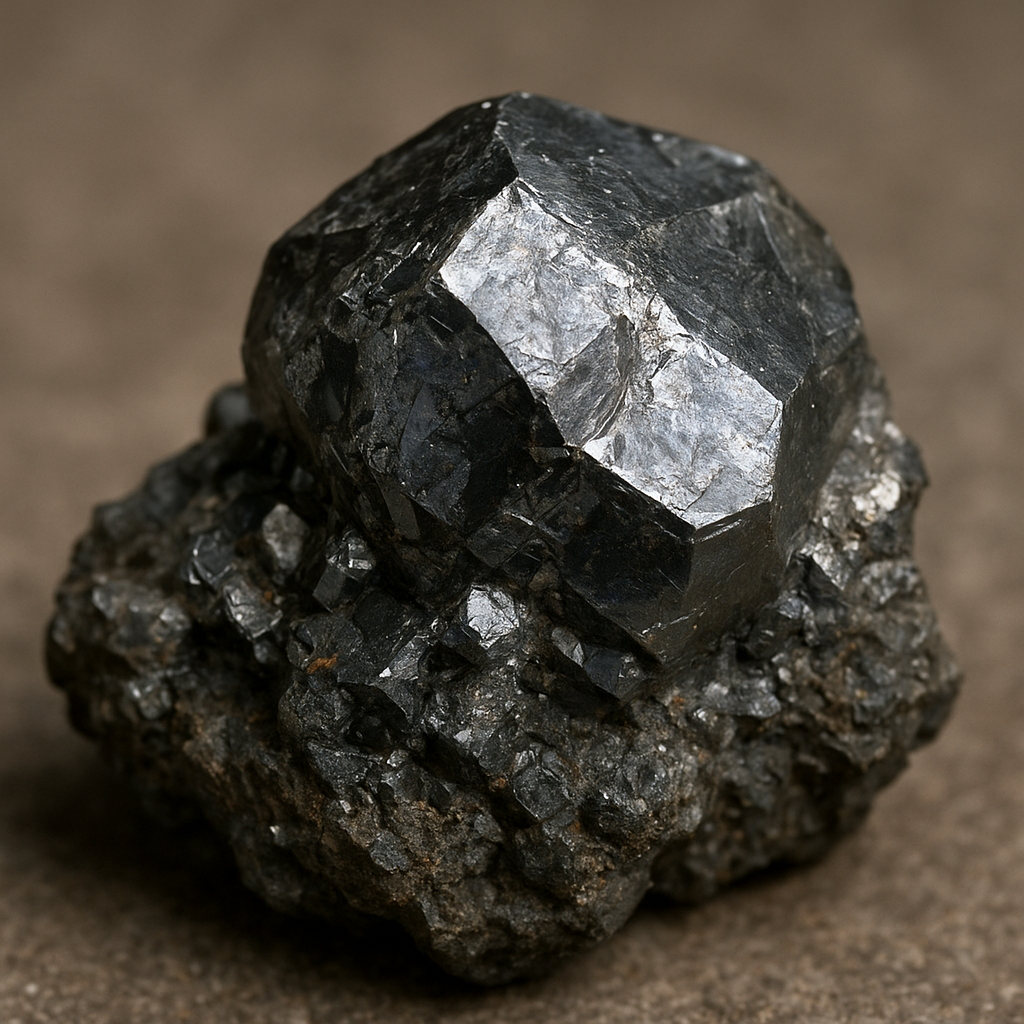
Cobaltite belongs to the isometric (cubic) crystal system and often forms simple cubic or dodecahedral crystals, though it may also appear in massive, granular or disseminated habits. Its physical and diagnostic properties include a metallic luster, a silver-white to steel-gray color, a black streak, and a relatively high density. Typical hardness is around 5.5 on the Mohs scale, making it harder than many common sulfide minerals but softer than many silicates.
Chemically, cobaltite is a sulfarsenide with the simplified ideal formula CoAsS. Because arsenic and sulfur occupy related structural sites, cobaltite is chemically close to minerals such as skutterudite (CoAs3), and natural compositional variations and solid solution with other Co–Fe–Ni phases are common. Trace impurities of nickel, iron, and sometimes silver or gold can be present, and these trace elements influence both the mineral’s physical appearance and its metallurgical behavior during ore processing.
Diagnostic tests and laboratory identification
Field identification relies on color, streak, crystal habit and associations, but laboratory techniques are required for definitive classification. X-ray diffraction (XRD) confirms the cubic crystal lattice. Electron microprobe analysis and scanning electron microscopy with energy-dispersive spectroscopy (SEM–EDS) are commonly used to determine precise chemical composition and trace-element content. Bulk rock assays by atomic absorption or ICP-MS provide quantitative metal contents, and mineralogical mapping with automated mineralogy systems helps quantify cobaltite abundance within an orebody.
Economic importance and applications
Cobaltite is an important source of metallic cobalt, a metal with a wide range of industrial applications. Historically, cobalt was valued for its coloring properties in glass and ceramics, producing intense blue pigments that were prized by artists and manufactories. In modern industry, cobalt’s most visible use has been in electrochemical energy storage: cobalt-containing cathodes in lithium-ion batteries (notably NMC and NCA chemistries) have driven demand for cobalt in the past two decades. For this reason, ores that supply cobalt—whether cobaltite, skutterudite, or lateritic cobalt minerals—have become strategically significant.
Other important applications of cobalt derived from cobaltite include:
- High-performance superalloys used in jet engines and gas turbines, where cobalt contributes to high-temperature strength and corrosion resistance.
- Hard-facing alloys and tools where cobalt improves wear resistance.
- Catalysts for chemical synthesis and petroleum refining, where cobalt salts and oxides facilitate reactions such as Fischer–Tropsch synthesis and hydrodesulfurization.
- Magnetic materials, pigments (such as cobalt blue), and specialized electronic components.
Despite this range of uses, the precise role of cobaltite as a raw source depends on the deposit scale and the feasibility of extracting and refining cobalt economically and safely, given the arsenic content of the mineral.
Mining, extraction and processing challenges
Processing cobaltite-bearing ore requires metallurgical routes that address both metal recovery and environmental safety. Because cobaltite contains arsenic, direct smelting without arsenic control creates toxic emissions and arsenic-rich slags. Historically, arsenic fumes from smelters caused acute and chronic pollution problems in mining regions, prompting regulatory controls and changes in processing techniques.
Common processing steps and considerations include:
- Comminution and concentration: crushing, grinding and concentration by flotation or gravity to produce a cobalt-rich sulfide concentrate.
- Roasting and arsenic stabilization: controlled roasting can oxidize arsenic into stable arsenate phases that are easier to capture, or convert arsenic into forms that can be sequestered in slag.
- Hydrometallurgical recovery: leaching (acidic or alkaline) and solvent extraction methods can selectively dissolve cobalt and separate it from arsenic and other metals. Hydrometallurgy has become important for treating complex concentrates and for minimizing airborne emissions.
- Pressure oxidation and autoclave leaching: in some cases, high-pressure oxidative leaching is used to break down sulfide matrices and free the cobalt for subsequent recovery.
- Refining and electrowinning: after purification steps, cobalt is precipitated and refined to produce metallic cobalt or cobalt salts suitable for industrial use.
Researchers and engineers continue to refine methods to handle the arsenic safely, recover byproduct metals, and lower energy consumption. In many modern operations, cobalt is recovered as a byproduct of copper or nickel production because primary cobaltite deposits are relatively rare and often small in tonnage.
Environmental and health issues
The combination of cobalt and arsenic in cobaltite creates a complex environmental and health profile. Arsenic is a well-known toxicant and carcinogen; processing and weathering of arsenic-bearing minerals can release soluble arsenic into groundwater and surface water, posing risks to ecosystems and human communities. Mines and tailings that contain cobaltite or arsenopyrite require careful management to avoid acid mine drainage and arsenic mobilization.
Key environmental and health topics related to cobaltite include:
- Arsenic mobilization: oxidation of arsenic-bearing minerals can produce arsenate and arsenite species that migrate in water; management strategies include encapsulation, neutralization and long-term monitoring.
- Airborne emissions: smelting and roasting historically emitted arsenic-rich fumes; modern plants use gas-cleaning and capture systems to minimize emissions.
- Occupational exposure: miners and plant workers can be exposed to dust and fumes; personal protective equipment and health surveillance are essential.
- Remediation: abandoned mines with cobaltite require targeted remediation that addresses both metal contamination and community safety.
Balancing the demand for cobalt in high‑tech applications with responsible environmental practice is a continuing challenge. This tension has spurred innovations in ore treatment, stricter regulation, and growing investments in alternative materials and recycling programs.
Famous localities and historical anecdotes
A number of classic mineral localities are well known for cobaltite and related minerals. The Cobalt district in Ontario, Canada, is famous historically for its rich veins of silver and cobalt minerals that were mined aggressively in the early 20th century, giving the town its name. In parts of Europe—particularly in certain Swedish and German mines—well‑formed cobaltite crystals were prized by collectors. The Bou Azzer district in Morocco is notable for cobalt-rich arsenide and sulfide minerals and has been an important modern source of cobalt-bearing ores.
Historically, the wider family of cobalt minerals influenced the naming of the metal itself: the word “cobalt” is derived from the German kobold, meaning “goblin” or “evil spirit,” because cobalt-bearing ores often produced noxious fumes and spoiled the smelting of other metals. Early miners and smelters regarded these ores as mischievous and hazardous until chemistry clarified their composition and processing methods improved.
Some localities are also mineralogical classics because they preserve exceptional crystal specimens, unusual parageneses, or striking associations of cobalt minerals with silver, native arsenic, and complex sulfosalts. For collectors and researchers, these sites provide both aesthetic specimens and geological insight into ore-forming processes.
Analytical techniques, research directions and interesting scientific questions
Modern study of cobaltite spans mineralogy, geochemistry, mining engineering and environmental science. Analytical tools that have advanced understanding include high-resolution XRD for precise structural determination, electron microprobe and LA-ICP-MS for trace-element mapping, and isotopic studies that help constrain the source and evolution of ore-forming fluids.
Contemporary research questions and directions include:
- Understanding the mobility of cobalt in hydrothermal systems and the role of arsenic and sulfur speciation in mineral precipitation.
- Developing lower-impact processing methods that avoid releasing arsenic and reduce the carbon footprint of cobalt production.
- Optimizing recovery of cobalt from complex concentrates and from secondary sources such as recycled batteries and electronic scrap.
- Investigating microbial interactions with cobalt and arsenic species for potential applications in bioleaching and bioremediation.
One particularly active area is the development of selective leaching and purification chemistries that allow cobalt to be recovered with minimal co-dissolution of arsenic. Another promising approach is closed-loop recycling of cobalt from spent batteries, which reduces pressure on primary ores and mitigates environmental risks associated with mining arsenic-bearing minerals.
Practical notes for collectors, students and professionals
Collectors should be aware that cobaltite specimens often contain arsenic and can be hazardous if powdered or heated. Handling whole, intact specimens with gloves, avoiding inhalation of dust, and storing samples in well‑ventilated areas are sensible precautions. For academic study and industrial testing, strict laboratory protocols for arsenic handling must be observed.
For geologists and mining professionals, cobaltite is a mineral marker indicating the potential for cobalt enrichment in a deposit, but its presence also signals the need for careful environmental planning. Economic evaluation of cobaltite-bearing deposits must consider not only metal grade and tonnage but also metallurgical complexity and the costs of arsenic management.
Concluding observations on cobaltite’s place in the modern world
Cobaltite sits at an intersection of mineral science, industrial demand and environmental responsibility. As a notable source of cobalt, it has contributed to technologies ranging from pigments to high-performance alloys and batteries. Yet the presence of arsenic in its structure complicates extraction and creates environmental risks that cannot be ignored. Ongoing advances in hydrometallurgy, safer roasting and leaching methods, and expanded recycling infrastructure promise to change how cobaltite and other cobalt-bearing minerals are valued and managed. Meanwhile, classic localities such as Langban, Cobalt, Ontario and Bou Azzer remain important both for their mineral specimens and as natural laboratories where scientists can continue to study the geological processes that concentrate strategic metals.
The story of cobaltite is therefore multidimensional: it is a mineralogical specimen, an ore with industrial significance, a subject of environmental concern, and a focus for technological innovation. For anyone interested in economic geology, mineralogy or the sustainable supply of critical metals, cobaltite provides a compelling case study that links Earth’s deep processes with modern human needs—and the obligations that come with them. The balance between extraction, technological application (including batteries and catalysts), and environmental stewardship will determine how cobaltite and its cobalt are used in the decades to come. Observing this balance offers insight into broader shifts in resource management, from raw-ore dependence toward smarter processing and enhanced material recovery.