Cinnabar is one of the most visually striking and historically important minerals on Earth. Known for its deep, luminous red and its role as the principal ore of mercury, cinnabar has fascinated miners, artists, alchemists and scientists for millennia. This article explores where cinnabar is found, how it forms, its many uses — from the sacred and artistic to the industrial — and the environmental and health issues that accompany a mineral that is at once beautiful and dangerous. Along the way we will touch on the chemistry behind its brilliant color, notable deposits and mining histories, conservation challenges for artworks that contain it, and modern scientific interest in its properties.
Formation, Geology and Typical Occurrences
Cinnabar is the mineral form of mercury(II) sulfide, chemically written as HgS. It typically forms in low-temperature hydrothermal environments where mercury-bearing fluids interact with sulfur. These fluids travel along faults, fissures and other pathways and precipitate cinnabar when temperatures and chemistry are favorable. Typical host settings include fractures in siliciclastic and carbonate rocks, around hot springs and in volcanic regions with active or recent fumarolic activity.
Common geological associations for cinnabar include quartz, calcite, realgar and orpiment (arsenic sulfides), pyrite and other sulfides. Because mercury is relatively mobile in hydrothermal fluids, deposits can occur as vein fillings, replacements of host rock, or as disseminated specks and crusts lining cavities. In some geothermal systems, cinnabar forms at or near the surface where reduced hydrothermal fluids meet oxidizing conditions, often creating spectacular, vivid red coatings along fault surfaces.
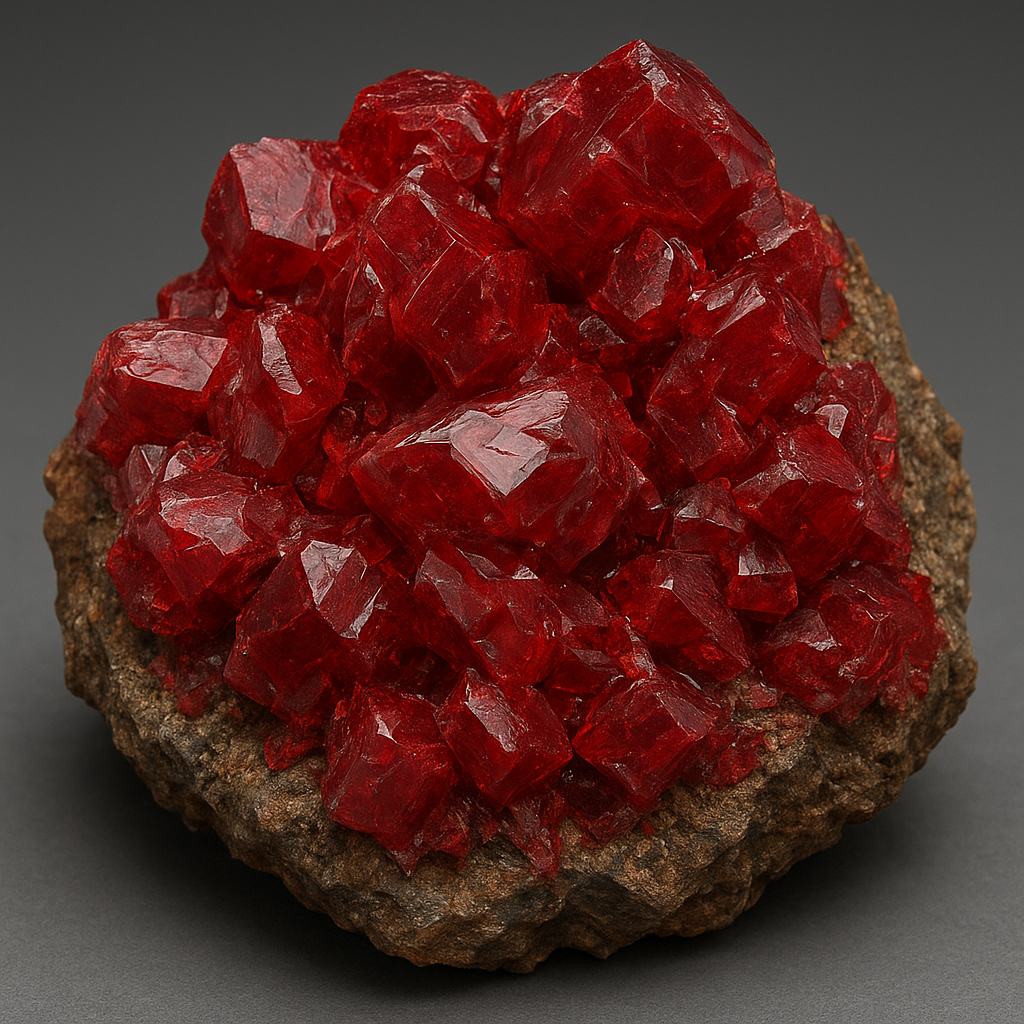
Cinnabar typically appears as bright red to brownish-red crystals or massive granular aggregates. Its crystals are often rhombohedral to tabular in the trigonal crystal system, though massive and earthy forms are common. Key physical traits include a low hardness (about 2–2.5 on the Mohs scale) and a high specific gravity (around 8.0–8.2), which is why cinnabar fragments feel unusually heavy for their size.
Physical and Chemical Properties
At the atomic level cinnabar is a sulfide of mercury in which each mercury ion is bonded to sulfide ions in a distinctive structure that produces its vivid red hue. This is the so-called alpha form of HgS; a different crystalline form, the black cubic polymorph metacinnabar (beta-HgS), can be produced by heating or chemical transformation. The transition from red to black is important both scientifically and conservationally because it can alter the appearance of pigments and geological specimens.
Some important physical and chemical facts:
- Formula: HgS
- Crystal system: trigonal (alpha-cinnabar), with a cubic modification (metacinnabar) possible under certain conditions
- Color: bright red to brownish-red (cinnabar) or black (metacinnabar)
- Mohs hardness: ~2–2.5
- Specific gravity: ~8.0–8.2
- Chemical reactivity: heated in air, cinnabar decomposes and releases mercury vapor and sulfur dioxide, hence cinnabar was historically roasted to extract metallic mercury
The classical laboratory reaction for extracting mercury from cinnabar is simple in stoichiometric form:
- HgS + O2 → Hg + SO2
When cinnabar is heated in oxygen this reaction releases elemental mercury (which condenses as liquid mercury) and sulfur dioxide gas, a toxic byproduct that must be controlled in industrial settings.
Historic, Cultural and Artistic Uses
Cinnabar’s most famous non-industrial use has been as the source of the red pigment known as vermilion. For thousands of years artists and artisans prized the pigment for its luminosity, opacity and permanence (when stable). Natural cinnabar was ground to a fine powder and used as a pigment in frescoes, murals, panel paintings and lacquerware. In China, cinnabar lacquer — a thick coating colored with powdered cinnabar — became a signature decorative material for boxes, furniture and ritual items across dynasties.
In many cultures cinnabar also held symbolic and ritual importance. Its intense red made it a color of blood, life and sanctity, and it was used in burial practices, religious objects and talismans. In ancient alchemy and early medicine cinnabar was associated with the search for elixirs and immortality; paradoxically, this led to mercury poisoning in some historical figures who consumed mercury-based concoctions or kept mercury-containing substances close to the body.
Art conservators today often confront the legacy of cinnabar in historical artifacts. Although vermilion is chemically stable under many conditions, exposure to light, pollutants and chlorine-containing compounds can induce chemical transformations that darken or alter the pigment. These changes may involve conversion to metacinnabar or formation of other mercury compounds, which alters the intended appearance and complicates restoration efforts. Analytical tools such as X-ray diffraction (XRD), Raman spectroscopy and X-ray fluorescence (XRF) are essential for identifying cinnabar in artworks and selecting appropriate conservation strategies.
Industrial Applications and Modern Uses
Cinnabar’s primary industrial role has historically been as the principal ore for obtaining metallic mercury. Large-scale mercury production fueled processes such as gold and silver amalgamation, hat making (felt processing with mercuric nitrate), thermometers, and various industrial catalysts. Many of these applications have declined sharply due to awareness of mercury’s severe health and environmental effects and because safer alternatives have been developed.
Modern uses of mercury and therefore of cinnabar-derived mercury are now restricted by law in many countries, and international agreements such as the Minamata Convention aim to reduce mercury use and release globally. Mercury from cinnabar remains important in niche applications, specialized instruments, and scientific work, but its broad employment has been curtailed.
Aside from bulk mercury extraction, scientific interest in cinnabar and HgS continues. Mercury sulfide has unique optical and electronic features, and researchers have investigated HgS nanoparticles and thin films for photonic, sensor and catalytic experiments. Practical adoption of these materials is limited by toxicity concerns, but the underlying materials science helps broaden fundamental understanding of semiconductor behavior and surface chemistry.
Notable Deposits and Mining History
Several historic cinnabar deposits have shaped regional economies and cultures. World-renowned mining centers include:
- Almadén, Spain — often cited as the largest and longest-producing mercury mine in the world; recorded production stretches back to Roman times and modern exploitation continued into the 20th century. The mining heritage remains prominent in Spanish industrial history.
- Idrija, Slovenia — another major historic source of mercury with significant mining infrastructure dating to the 16th century; Idrija is a UNESCO-listed site for its industrial heritage.
- Huancavelica, Peru — a colonial-era mercury center that played a key role in silver amalgamation mills of Spanish America.
- New Almaden, California, and various Nevada districts in the United States — important during the 19th-century mining booms and closely tied to the gold and silver industries that used mercury for amalgamation.
- Monte Amiata, Italy — important mercury mining district in Tuscany with a long history of production.
Mining cinnabar has left a global legacy of contamination. Tailings and mine wastes often concentrate mercury, which can leach into soils and waterways, become methylated by microorganisms, and bioaccumulate in fish and wildlife. Commissioning of remediation and long-term monitoring is a central environmental challenge for former cinnabar mining regions.
Health, Environmental Impacts and Conservation Challenges
No discussion of cinnabar would be complete without addressing its toxicity. Mercury is a potent neurotoxin. Exposure to mercury vapor (inhalation) or to methylmercury via contaminated fish can cause severe neurological effects, developmental harm to fetuses and children, and damage to kidneys and other organs. Historically, miners and workers who processed cinnabar were at high risk of mercury poisoning, and communities downstream of mining operations have experienced persistent contamination.
Environmental processes can convert inorganic mercury from cinnabar into organic forms like methylmercury in aquatic environments, which then magnify up the food chain. This is why many regions with mercury legacy pollution have fish consumption advisories and ongoing remediation programs. Approaches to cleanup include removal of contaminated sediments, capping, in-situ stabilization, phytoremediation trials, and treatment to prevent methylation. The complexity and cost of remediation mean that many affected areas face long-term management rather than quick fixes.
From a conservation perspective, artworks and historical objects containing cinnabar present both technical and ethical challenges. Cleaning or treating cinnabar-containing surfaces requires extreme care to avoid producing mercury vapor or dispersing fine toxic dust. Moreover, interventions that alter the red pigment’s chemistry can permanently change an artifact’s appearance or structure. Conservators must combine precise chemical analysis with tailored, minimally invasive treatments and safety protocols to preserve cultural value while protecting people and the environment.
Identification, Analysis and Distinguishing Features
Identifying cinnabar in the field or lab can be straightforward with the right tools. Visual inspection reveals a distinctive red color and high density. A streak test (streak color red) and softness (can be scratched with a copper coin) help, but laboratory techniques provide definitive identification:
- X-ray diffraction (XRD) distinguishes alpha- and beta- forms by their crystal lattices.
- Raman spectroscopy and Fourier-transform infrared spectroscopy (FTIR) detect characteristic vibrational modes of Hg–S bonds.
- X-ray fluorescence (XRF) provides elemental signatures and can detect mercury in artworks and mineral samples nondestructively.
- Scanning electron microscopy (SEM) with energy-dispersive spectroscopy (EDS) offers morphology and composition down to micron scale.
When distinguishing cinnabar from visually similar minerals (e.g., realgar or hematite), beware that realgar is arsenic sulfide (AsS) and tends to be softer and orange to red but often weathers to a yellow powder; hematite is iron oxide and much harder and widely used as an iron ore.
Interesting Historical and Scientific Anecdotes
– Cinnabar’s cultural footprint is broad: Chinese imperial tombs and lacquerware, Roman and Byzantine frescoes, medieval illuminated manuscripts and Renaissance panels all bear its mark. In some archaeological sites, entire burial chambers are stained red with powdered cinnabar applied as ritual paint or preservative.
– Early alchemists and physicians often mistook the apparent restorative properties of mercury for medicinal virtue; some rulers and practitioners died from the repeated ingestion of mercury-containing elixirs. The allure of the red mineral’s symbolic power was thus entangled with very real danger.
– Scientific interest in the optical properties of HgS continues. Although practical applications are limited by mercury’s toxicity, the mineral’s electronic band structure and photonic interactions remain subjects of research, especially in controlled laboratory studies of nanomaterials.
Practical Advice and Safe Handling
If you encounter cinnabar in the field, in an old painting, or as part of a collection, treat it with respect. Do not inhale dust, do not grind samples, and avoid heating or otherwise disturbing material that could release mercury vapor. Museums and laboratories follow strict protocols including glove use, containment, fume hoods and dedicated disposal pathways for mercury-bearing wastes. For collectors, professional appraisal and safe storage are essential, and objects suspected of containing cinnabar should be handled only with appropriate precautions.
Because cinnabar bridges geology, art, chemistry and history, it remains a rich subject for interdisciplinary study. Its beauty and cultural resonance are overshadowed by the environmental and health consequences of mercury extraction and use, which is why ongoing research, careful conservation and responsible stewardship of affected sites and artifacts are so important.