
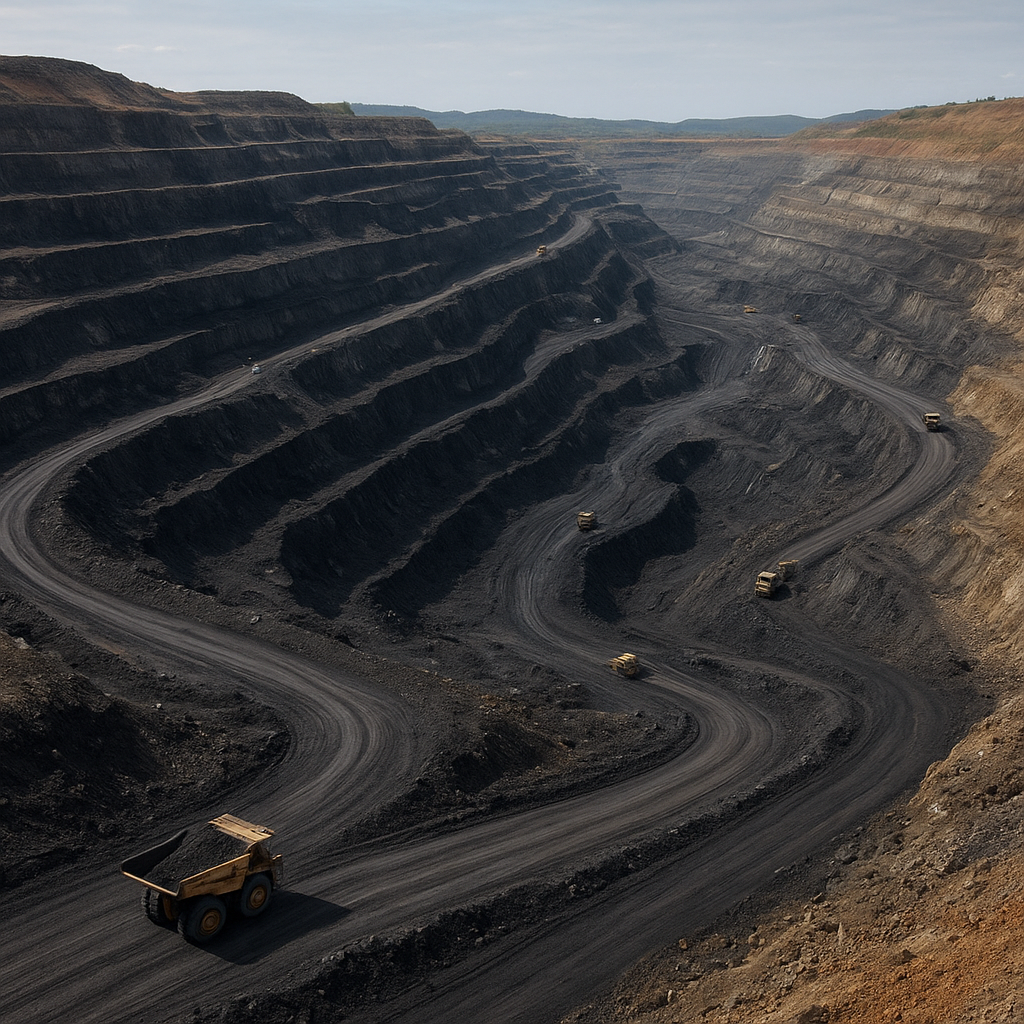
The Cerrejón mine, located in the arid plains of La Guajira in northern Colombia, is one of the world’s largest single-site surface coal operations. Its massive open pits, the long string of hopper cars on a private railway, and the coal-loading facilities at Puerto Bolívar combine to make Cerrejón a landmark industrial complex. This article outlines where the mine is situated, what kinds of coal and materials it produces, why it matters economically for Colombia and international markets, and several notable and often debated aspects of its operation.
Location, geology and physical footprint
Cerrejón lies in the northeastern corner of Colombia, in the department of La Guajira, a region characterized by a dry climate, scrub vegetation and a landscape shaped by both desert and coastal influences. The mine operates within a broad sedimentary basin where thick seams of thermal coal were deposited millions of years ago. Because of this geology, the coal seams are relatively near the surface and amenable to large-scale open-pit extraction.
The mine’s physical footprint is immense: multiple contiguous pits spread across a rural area, connected by haul roads, conveyor systems and the private rail line to the export terminal at Puerto Bolívar on the Caribbean coast. The rail connects the mine site with the port via an engineering corridor that includes bridges and dedicated loading facilities. The combination of mine, rail and port forms an integrated logistics chain designed primarily for export markets.
Geologically, the coal at Cerrejón is predominantly thermal (steam) coal rather than metallurgical (coking) coal. It is known for relatively low sulfur and low ash content compared with other thermal coals, which has made it attractive for power generation in many international markets. Seam thickness, lateral continuity and the ease of access from the surface have enabled economies of scale that characterize Cerrejón’s operations.
Mining methods, production and product quality
Production at Cerrejón relies on conventional large-scale surface mining techniques: the removal of overburden using excavators and trucks, progressive development of open pits, and the use of heavy equipment such as shovels, draglines and large haul trucks. Coal is extracted in benches, transported to primary crushing and handling facilities, and then moved by conveyor and rail to the port for stockpiling and ship loading.
Product characteristics
- The primary product is thermal coal used for electricity generation. Its calorific value and relatively low levels of impurities have been selling points in export negotiations.
- Coal at Cerrejón is typically screened and, where required, beneficiated to meet product specifications demanded by utilities and traders.
- Multiple grades may be produced depending on customer requirements, blending practices at the port, and seasonal logistical considerations.
Over its operational history, annual production has fluctuated with market demand, logistics constraints, and corporate strategy. At times the mine has shipped tens of millions of tonnes per year; these high-volume operations depend on the seamless functioning of the mine-rail-port chain and favorable global coal prices.
Economic significance and role in exports
Cerrejón has been a major industrial engine for Colombia’s export economy. As a commodity operation focused on international markets, the mine has generated substantial foreign exchange earnings, contributed to national and regional tax and royalty streams, and supported a network of service providers, contractors and related industries.
Key economic contributions include:
- Exports — Coal from Cerrejón has been exported to power utilities and traders around the world, historically including destinations in Europe, North America, and increasingly in Latin America and Asia. Those exports have made Cerrejón a significant component of Colombia’s commodity export portfolio.
- Employment — The mine has directly employed thousands of workers over time and indirectly supported many more through local procurement, contractors and service industries. Training and skills development associated with mining operations have been important in areas where alternative formal employment is limited.
- Infrastructure and investment — The integrated investments in a private railway and an export terminal represent long-lived infrastructure that supports large-scale movement of bulk commodities and has raised the logistical profile of the region.
- Local and national revenues — Royalties, taxes and fees paid by the operating company have contributed to municipal and national budgets, financing public services and development projects (though debates exist about the sufficiency and distribution of those revenues).
From a strategic perspective, the presence of a low-sulfur thermal coal source like Cerrejón has affected international fuel supply portfolios. While global energy trends are shifting, thermal coal remains a component of baseload power in many markets, and operations like Cerrejón have historically been important suppliers.
Social and environmental issues: impacts and responses
The scale of Cerrejón’s operations inevitably raises significant environmental and social questions. Large open pits, stockpiles, dust generation and changes to surface and groundwater regimes create environmental pressures that must be managed. In parallel, the mine’s presence has created complex interactions with local communities, particularly indigenous and Afro-Colombian populations whose livelihoods, land use and cultural landscapes are tied to the region.
Some of the most prominent concerns include:
- Displacement and land rights — As the mine expanded, there were cases of land acquisition, resettlement and negotiation with local families and communities. Questions about adequate compensation, cultural loss and long-term livelihoods have been raised by community leaders and advocacy groups.
- Water and ecosystems — Mining alters surface drainage and can affect access to water for domestic use and livestock. Dust deposition on soils and vegetation, as well as the footprint on native habitats, have implications for biodiversity.
- Health and quality of life — Dust, noise and changes in local economic structures can influence public health and social cohesion. There have been calls for stronger monitoring and mitigation measures to address these impacts.
- Community relations — The operator has maintained social investment programs, infrastructure projects and employment initiatives intended to benefit local populations, but the effectiveness and sufficiency of such programs remain topics of debate.
These social and environmental issues have prompted both regulatory scrutiny and civil society activism. Legal challenges, mediation processes and negotiated agreements have occurred over the years, reflecting the complexity of balancing large-scale resource extraction with the rights and aspirations of local people. Progressive mine closure planning and reclamation commitments are also part of ongoing discussions, as stakeholders weigh the mine’s finite lifespan against the need for a sustainable transition for the region.
Infrastructure and logistics: the mine-rail-port chain
One of the defining features of Cerrejón’s operational model is its integrated logistics system. The private railway linking the mine to Puerto Bolívar is a critical artery, enabling continuous shipments of coal to bulk carriers. At the port, specialized ship loaders and stockyards allow for efficient blending and dispatch of large cargoes. The combination reduces reliance on public logistics capacity and enables the high throughput necessary for a mine of this scale.
Operational reliability of these assets is essential. Weather events, maintenance, labor issues or regulatory constraints can all affect throughput and, consequently, the mine’s revenue stream. Investment in port and rail maintenance, automation and safety measures has been a recurring theme for management and investors.
Governance, ownership and corporate responsibility
For decades, Cerrejón was operated by a consortium structure involving major international mining corporations. This ownership model shaped corporate practices, investment strategies and the approach to international customers. Over time, ownership and corporate governance arrangements have evolved and often sparked discussion about accountability and the distribution of benefits.
Corporate responsibility measures—ranging from environmental management systems to community development programs—have been central to the company’s public narrative. Auditing, third-party monitoring, and engagement with NGOs and local actors have formed part of the governance landscape. Nonetheless, critics have argued for stronger enforcement of environmental standards and more inclusive consultation processes for affected communities.
Economic transitions, commodity cycles and future perspectives
The future of large thermal coal operations like Cerrejón is influenced by several interrelated trends. Global energy policies and climate commitments are shaping demand for thermal coal in many markets. At the same time, demand in other regions may remain robust for years, creating a complex picture for producers.
Key considerations for the future include:
- Market dynamics — Prices, demand from importing countries and competition from other coal suppliers will influence production strategies and investment decisions.
- Regulatory environment — Domestic environmental standards, permitting processes and international climate policies can affect the cost and acceptability of continued operations.
- Social license to operate — Community acceptance and social stability are increasingly recognized as critical for sustained operations. Meaningful engagement, fair compensation and long-term development planning are often cited as necessary elements.
- Rehabilitation and closure planning — Responsible decommissioning and land restoration will be crucial at the end of the mine’s life to ensure environmental recovery and to support alternative livelihoods in the region.
Interesting and lesser-known aspects
Beyond the headline facts, several features of Cerrejón are particularly noteworthy:
- Scale of integration — Few mines combine the scale of pit operations with dedicated rail and port infrastructure in a single, contiguous project. This integration has been a defining competitive advantage.
- Engineering and logistics — The private rail line is an engineering achievement in a challenging environment; maintaining continuous flows of bulk material over that distance requires precise scheduling and robust equipment.
- Local cultural context — La Guajira is home to the Wayuu people and other communities with deep historical ties to the land. The cultural landscape of the region intersects in complex ways with industrial development, and that intersection shapes dialogues about rights and future development.
- Adaptive practices — The mine has experimented with reclamation techniques, dust suppression, water management and social investment programs. The success and shortcomings of these initiatives offer lessons for other large-scale mining projects worldwide.
- Visibility in policy debates — Cerrejón often appears in national discussions about the balance between resource extraction, sustainable development and Colombia’s economic diversification, making it both an economic asset and a focal point for environmental advocacy.
Concluding considerations
The story of Cerrejón is multi-faceted: it is at once a major industrial complex that has contributed substantially to Colombia’s export economy and a contested site where environmental concerns, indigenous rights and the realities of modern commodity cycles converge. The mine’s scale and integrated logistics network make it a notable player in the global coal market, while its social and environmental footprint ensures that questions about fairness, sustainability and long-term planning remain central to any assessment. How Cerrejón navigates changing market conditions, regulatory demands and community expectations will shape both the mine’s legacy and the future of the region it occupies.

