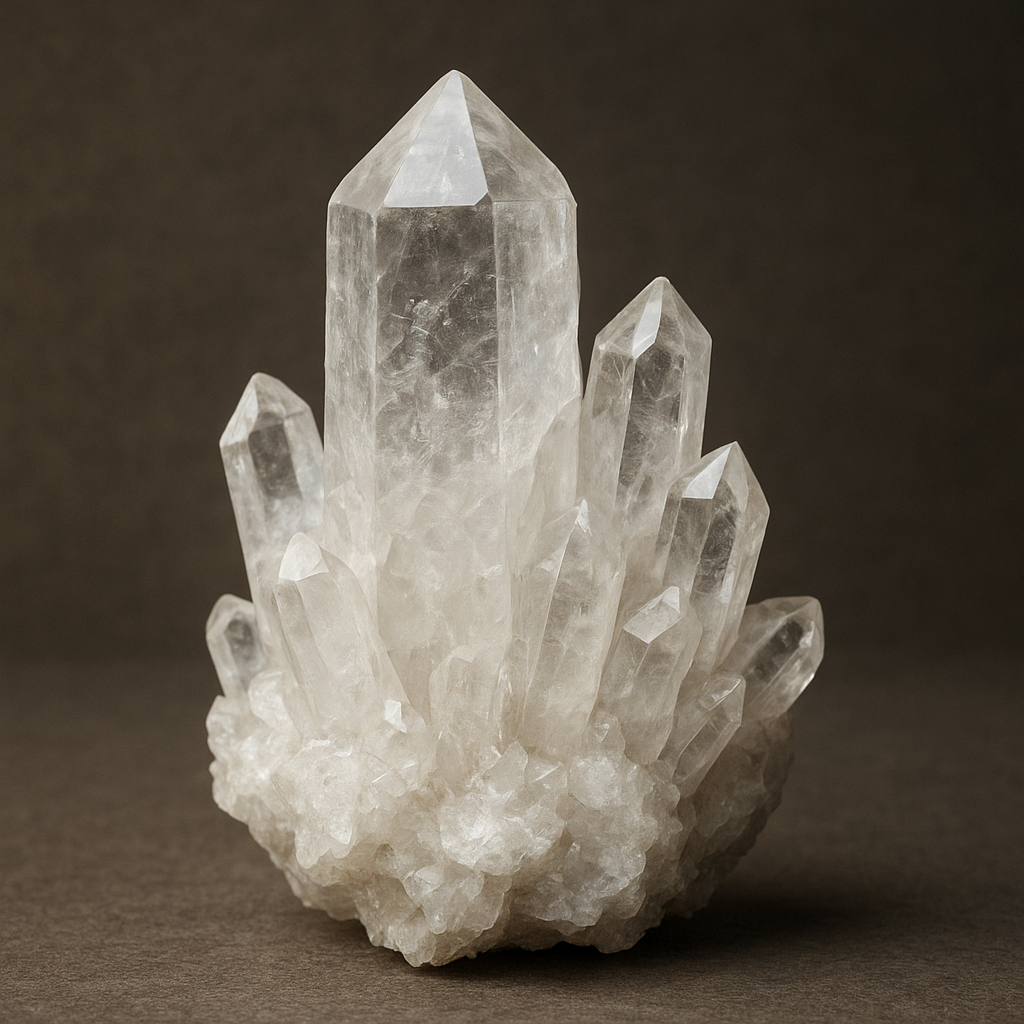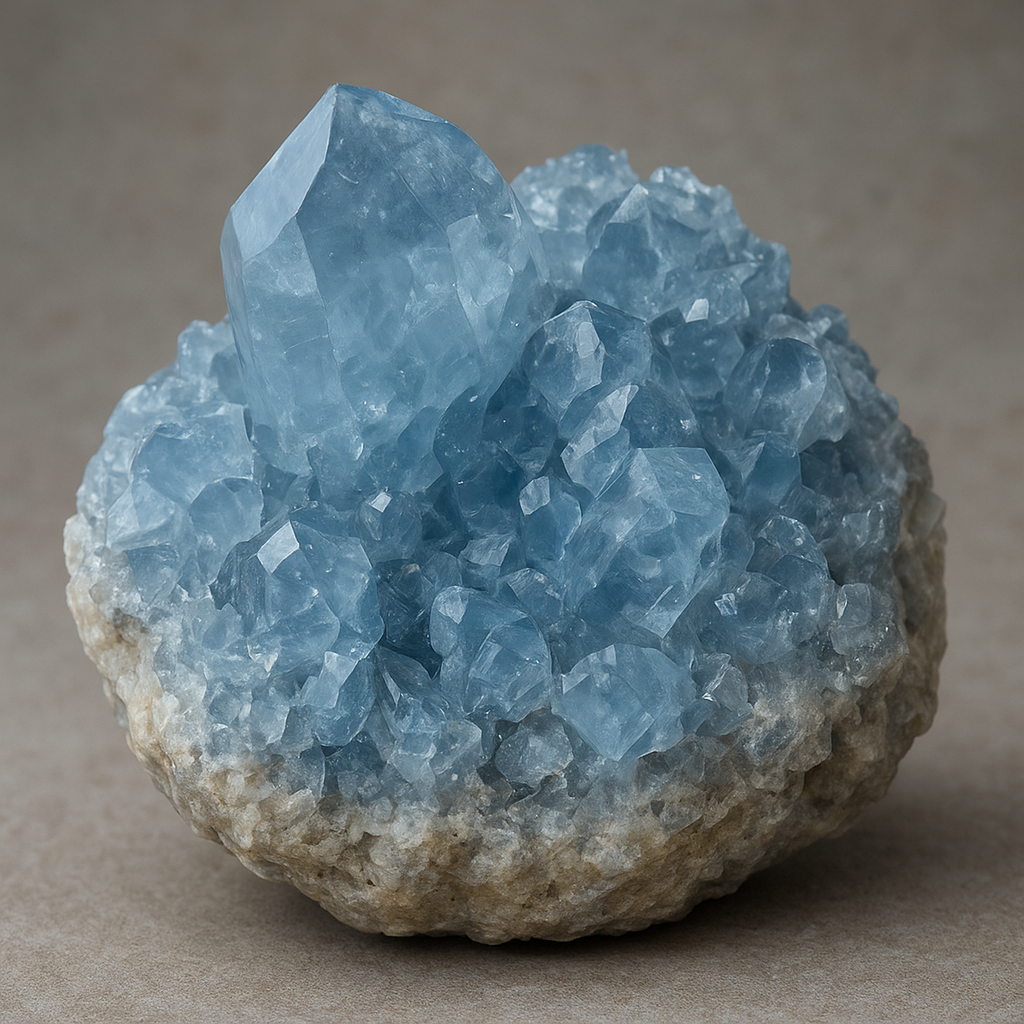
Celestite is a striking and scientifically important mineral known for its often delicate sky-blue crystals and its role as the principal ore of strontium. Beyond its visual appeal, celestite is tied to a variety of industrial, geological and cultural uses — from serving as a source for strontium chemicals used in ceramics and pyrotechnics to providing clues about past environments when studied by geoscientists. This article explores celestite’s nature, where it forms, how it is used, and other fascinating aspects that make this sulfate mineral noteworthy to collectors, industry and researchers alike.
What is celestite?
Celestite (also spelled celestine) is a mineral composed of strontium sulfate, with the chemical formula SrSO4. It crystallizes in the orthorhombic system and commonly forms tabular to prismatic crystals, fibrous masses, and celestine-filled geodes. The name derives from the Latin caelestis, meaning “heavenly,” a reference to the frequent pale blue coloration that evokes the sky. Although blue is the most celebrated and sought-after color, celestite can also be white, colorless, gray, yellowish, pale red or even brown depending on impurities and inclusions.
Chemically, celestite is a member of the sulfate mineral group and is closely related to other divalent-metal sulfates such as barite (BaSO4) and anglesite (PbSO4). Unlike some soluble sulfates, celestite is relatively insoluble in water under normal conditions, which contributes to its preservation in sedimentary environments. Its hardness on the Mohs scale ranges around 3 to 3.5, making it relatively soft and fragile compared with many collector minerals.
Occurrence and notable localities
Celestite forms in a variety of geological environments, but it is most commonly associated with sedimentary rocks, particularly within evaporite deposits and in cavities of carbonate rocks like limestone and dolostone. It may precipitate directly from sulfate-rich brines during evaporation or form through diagenetic processes where strontium is mobilized and precipitated. Hydrothermal activity can also produce celestite in veins and vugs.
- Madagascar — One of the richest and most famous sources of dramatic, gemmy blue celestite is the island of Madagascar. Large geodes filled with lustrous sky-blue crystals, some weighing hundreds of kilograms, make Madagascar specimens highly prized by museums and collectors.
- Sicily, Italy — Historically important deposits in Sicily have produced exceptionally colored crystals and significant ore volumes. Sicilian celestite is linked to sedimentary evaporite sequences and has educated the development of mineralogy in the Mediterranean region.
- United States — Celestite is found in a number of states: Ohio (notably around the town of Put-in-Bay), Michigan’s sedimentary basins, and Utah where it occurs in evaporitic sequences. Ohio’s nodular celestite and Michigan’s occurrences are commonly associated with strata of Paleozoic age.
- Mexico and Canada — Several Mexican deposits produce collectible specimens. In Canada, celestite appears in evaporitic basins and hydrothermal contexts.
- United Kingdom and Germany — Both countries contain smaller but scientifically interesting occurrences, often within older sedimentary basins or as nodules in limestone.
In many of these localities, celestite forms as nodules or crystal-lined cavities within sedimentary rock layers. Geodes from Madagascar and Sicily often exhibit well-formed, translucent crystals with attractive hues, while other occurrences may produce fibrous or massive forms used primarily for industrial extraction of strontium compounds.
Physical and chemical properties
Crystallography and appearance
Celestite belongs to the orthorhombic crystal system and commonly forms short prismatic to tabular crystals. Habit can vary widely: euhedral crystals in geodes, compact granular masses, fibrous aggregates, and even stalactitic or botryoidal forms are all known. The mineral’s luster ranges from vitreous to pearly on cleavage surfaces.
Chemical and mechanical properties
- Chemical formula: SrSO4
- Specific gravity: typically 3.9–4.0 (relatively heavy due to strontium content)
- Mohs hardness: about 3–3.5 (somewhat soft; scratches easily)
- Cleavage: perfect on one plane and good on another, which contributes to its fragility
- Solubility: very low in water; soluble in concentrated acids with effervescence depending on impurities
Because of its strontium content, celestite is often compared with barite (barium sulfate) and anglesite (lead sulfate), and identification in the field sometimes requires careful observation or simple chemical tests to distinguish these heavier sulfates.
Extraction and industrial uses
The most important industrial role of celestite is as the primary mineral source of strontium. Strontium extracted from celestite is converted into a variety of chemicals that find use in multiple industries:
- Pyrotechnics and fireworks — Strontium nitrate and other strontium salts impart brilliant red hues and are essential ingredients in red flares and fireworks. The reliability and intensity of red coloration make strontium compounds commercially valuable to the pyrotechnic industry.
- Glass and ceramics — Strontium carbonate is used in glass formulations (for example, in cathode-ray tube glass historically) and certain ceramics to modify optical and mechanical properties.
- Pigments and ferrite materials — Strontium compounds are used in specialized pigments and in the manufacture of ferrite magnets and components for electronic ceramics.
- Metal and chemical production — Strontium is a precursor for other compounds used in chemical synthesis, while industrial processes may utilize strontium in refining or alloying operations in niche applications.
Historically, celestite-derived strontium was particularly important in the manufacture of cathode-ray tubes (CRTs) and in certain optical glass. Although CRTs have largely been replaced by modern displays, other uses for strontium persist, and celestite remains an economic mineral in regions where commercial concentrations are accessible.
Uses in collecting, lapidary and decoration
Beyond industry, celestite has a strong presence in the world of mineral collecting and decorative objects. Large geodes with intact crystal linings are exhibited in museums and sought by collectors for their dramatic appearance. Cabochons and small polished pieces are sometimes made from compact, translucent varieties, though the mineral’s softness limits its application in jewelry that receives regular wear.
- Specimens — Quality factors for collectors include color intensity (with deep sky-blue favored), crystal transparency, size, matrix contrast, and provenance. Well-preserved geodes and display specimens can command high prices in the market.
- Lapidary work — Because of celestite’s fragility and low hardness, lapidary work is limited. Polished pieces and small carvings are possible for display but require careful stabilization and are not suitable for rings or items prone to abrasion.
- Interior decor — Large celestite geodes may be used as statement pieces in homes and public spaces, appreciated for their color and crystal form. Proper placement away from direct sunlight and humidity extremes helps preserve color and reduce deterioration.
Care, preservation and handling
Because celestite is relatively soft and can exhibit good cleavage, handling and storage demand caution. Key care recommendations include:
- Avoid dropping or banging specimens — crystals fracture easily.
- Keep dry and avoid prolonged exposure to humidity or water that could, over long time periods, affect luster or lead to surface alteration.
- Limit exposure to strong sunlight for delicate blue varieties, as prolonged UV exposure can sometimes fade color in certain minerals (though celestite is not as prone to fading as some dyes and gem materials).
- Clean gently with a soft brush and, if necessary, mild soapy water; avoid harsh chemicals that may react with strontium compounds.
- Store specimens individually padded to prevent scratching and chipping.
Scientific and environmental relevance
Celestite has scientific value beyond its economic role. Strontium fixed in celestite crystals can be analyzed isotopically to reveal information about fluid sources, diagenetic histories and sedimentary basin evolution. Variations in strontium isotope ratios (87Sr/86Sr) preserved in celestite and associated minerals have been used in paleoenvironmental reconstructions and to trace the provenance of sediments.
In evaporitic sequences, celestite occurrences provide evidence about the chemistry of ancient brines. Geochemists study such minerals to reconstruct salinity, temperature, and the balance of dissolved ions in depositional environments. In hydrothermal settings, the presence of celestite can indicate fluid compositions and temperatures during mineralization events.
Historical, cultural and metaphysical aspects
The aesthetic appeal of celestite has fostered cultural associations and metaphysical claims. The mineral’s name, meaning “heavenly,” has led to its adoption by some spiritual practitioners who value the stone for themes of calmness, communication and connection to higher realms. While these beliefs are not supported by scientific evidence, they contribute to celestite’s popularity among collectors interested in the metaphysical market.
Historically, high-quality celestite specimens from Sicily and other areas were described and cataloged by early mineralogists, contributing to the broader understanding of sulfate minerals. In modern times, large geodes from Madagascar have helped raise public interest in mineralogy and inspired geological outreach, museum displays and conservation efforts around unique deposits.
Related minerals and identification tips
Celestite’s association with other evaporitic and sulfate minerals means field identification sometimes requires care. Useful distinguishing markers include:
- Color and luster — celestite’s characteristic pale blue and vitreous luster when crystalline.
- Specific gravity — heavier than many common non-metallic minerals due to the strontium content.
- Cleavage — good to perfect cleavage that may show as flat, reflective surfaces.
- Simple tests — flame tests on isolated strontium salts produce a crimson color (performed only in controlled laboratory settings), distinguishing strontium-bearing minerals from barite or anglesite when careful chemical analysis is permissible.
Laboratory methods such as X-ray diffraction (XRD), electron microprobe analysis, and inductively coupled plasma (ICP) techniques provide definitive identification and compositional data when necessary.
Economic and conservation considerations
Commercial extraction of celestite for strontium chemicals requires economically viable concentrations and accessible deposits. Mining operations can be small-scale or larger industrial endeavors depending on deposit size and location. As with any mineral extraction, environmental management is important: excavation of celestite-bearing evaporite beds can impact groundwater regimes, local ecosystems, and sediment stability if not managed properly.
Conservation-minded collectors and institutions prioritize documentation of provenance, responsible sourcing and avoiding illicit collection from sensitive sites. In some areas, large celestite geodes are protected or collected under regulated arrangements to balance scientific, commercial and heritage interests.
Final remarks on appreciation and study
Celestite remains a mineral that appeals on multiple levels: scientifically, as a source of strontium and a recorder of environmental conditions; industrially, where its derivatives support specific applications such as fireworks and specialty glass; and aesthetically, where its translucent, sky-blue crystals capture the imagination of collectors and the public. Whether appreciated as a museum-quality specimen, studied by geochemists, or used as a raw material in manufacturing, celestite occupies a distinct place among sulfate minerals and continues to inspire interest across disciplines.