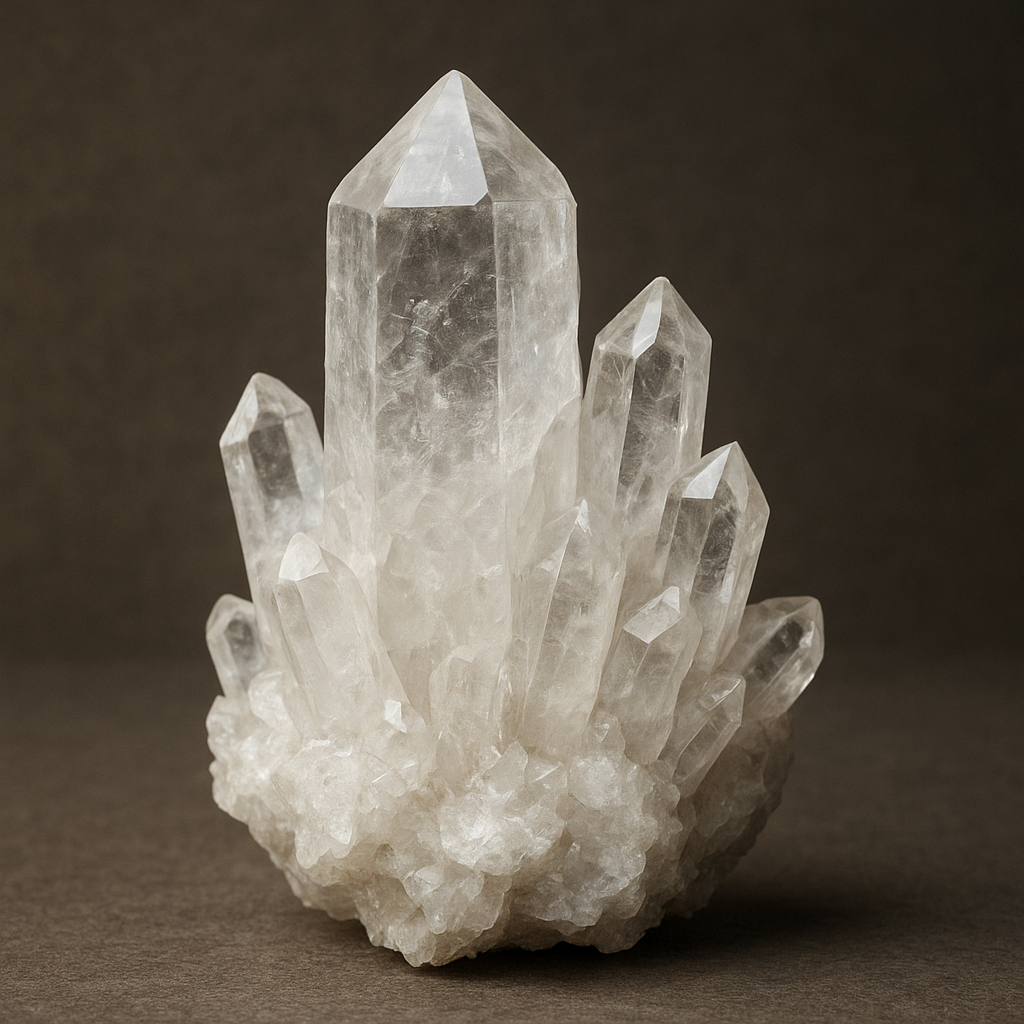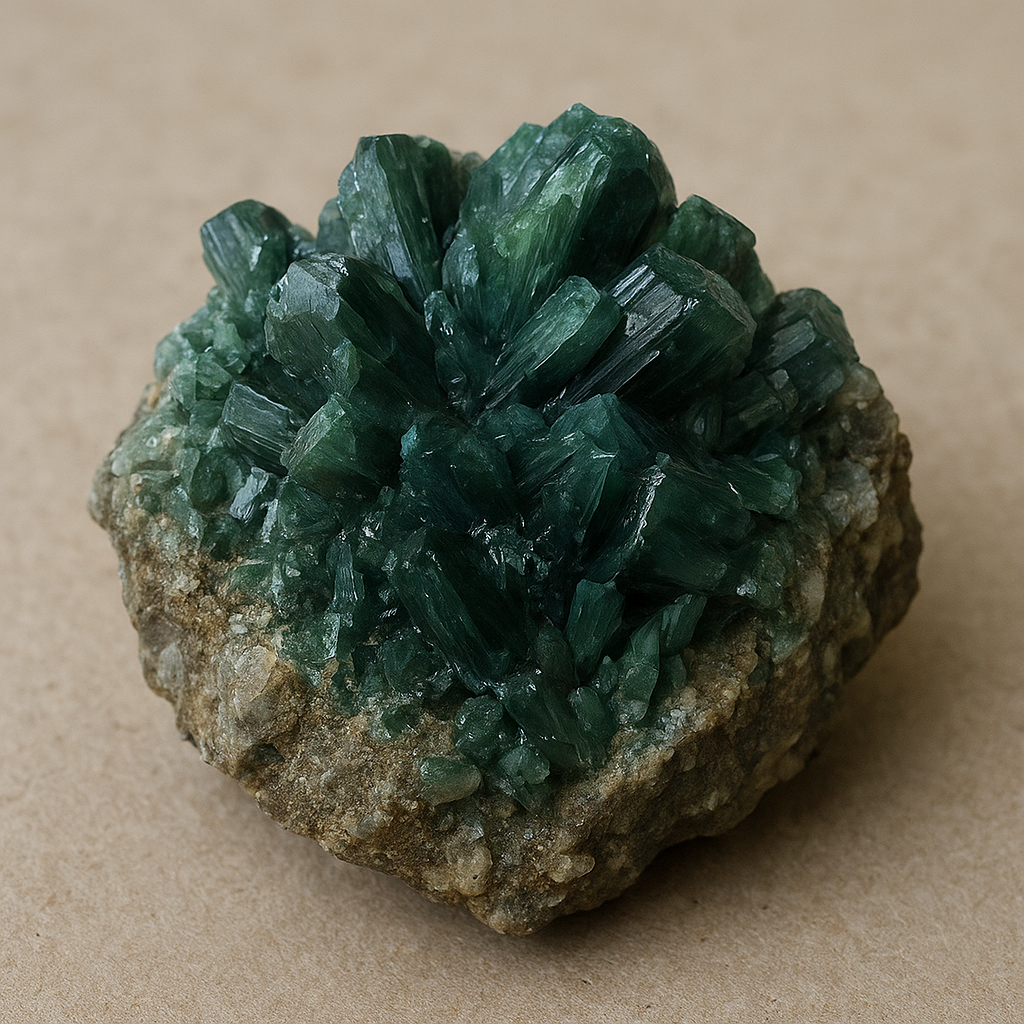
Celadonite is a subtle yet fascinating mineral whose muted green tones have linked it to art, geology and planetary exploration. Formally classified as a fine-grained, mica-like phyllosilicate, celadonite appears in a variety of low-temperature geological settings and plays outsized roles in fields as diverse as ceramic glaze history, marine diagenesis studies and remote sensing of planetary surfaces. The following article explores where celadonite forms, how it is recognized and used, and several surprising applications and research topics in which this mineral proves important.
Overview and mineral identity
At the mineralogical level, celadonite is a potassium-bearing, sheet-silicate whose general chemistry places it among the trio of minerals commonly called green earth minerals. Its characteristic color ranges from pale olive to deep bluish-green, a hue linked to the presence of iron in the crystal structure. The idealized chemical formula is frequently written to emphasize its key constituents: K(Mg,Fe2+)(Fe3+,Al)Si4O10(OH)2. This composition highlights the presence of potassium and mixed-valence iron together with magnesium and aluminium in a layered lattice.
Despite its mica-like habit, celadonite typically forms as very fine-grained masses, coatings, or fills in cavities rather than as well-developed crystals. It commonly occurs in intimate association with chlorite, glauconite and other alteration minerals, and it may form continuous solid solutions with some of them depending on iron and magnesium content. The mineral’s name recalls the pale green glazes of East Asian pottery: celadonite’s color connection to the term “celadon” is more than cosmetic — it ties the mineral to important cultural and industrial traditions.
Where celadonite occurs and how it forms
Celadonite is a mineral of low-temperature alteration and authigenesis. It forms commonly by the alteration of volcanic glass and mafic minerals in basalt and other potassium-poor volcanic rocks, through low-grade hydrothermal activity or marine diagenesis. Two broad environments stand out:
- Altered basalts and volcanic glass — In vesicles, fractures and the fine-grained groundmass of basaltic lavas, celadonite often develops as a product of chemical alteration by cool, potassium-bearing fluids. The transformation from volcanic glass to a clay- or mica-like mineral is driven by interaction with circulating seawater or hydrothermal fluids at relatively low temperatures (generally below ~200 °C).
- Marine sediments and authigenic greensands — In certain continental shelf and slope settings, celadonite may grow within sediments as an authigenic phase where conditions favor slow diagenesis under reducing or mildly reducing conditions. It commonly appears together with or as a precursor to glauconite in so-called greensand deposits.
Because celadonite incorporates potassium into its structure, its formation is geochemically significant: it can act as a sink for K in alteration zones and thus influence the mobility of elements during diagenesis. The balance between magnesium, iron (divalent and trivalent) and aluminium during formation determines whether a green earth mineral will tend toward celadonite or toward glauconite/chlorite end-members. Celadonite-rich alteration is typical of island arcs, submarine basalt flows, and the upper parts of the oceanic crust where seawater-rock interaction is common.
Physical and chemical properties important for recognition
In hand sample celadonite is usually soft and earthy to scaly. It rarely forms large, well-formed crystals; instead it is found as compact to scaly aggregates, coatings within vesicles, or fine-grained lenses and replacements. Key diagnostic aspects include:
- Color: typically green — olive to sea-green hues that can appear dull or slightly shiny depending on grain size and surface texture; this characteristic green shade makes it visually distinct among many alteration minerals.
- Luster and habit: ranges from dull earthy to micaceous, with a greasy sheen when in thin flakes; massive or botryoidal textures are common.
- Hardness and density: relatively soft (low on the Mohs scale) and with moderate specific gravity compared to denser iron oxides.
- Chemical behavior: contains exchangeable cations and a layered structure typical of phyllosilicates; it shows spectral features in the visible-to-near-infrared that allow remote and laboratory identification.
Analytical identification is typically made using X-ray diffraction (XRD) for structural confirmation, combined with electron microprobe or SEM-EDS for composition. Spectroscopic methods such as infrared (IR), Raman and Mössbauer spectroscopy are valuable for determining iron oxidation states and distinguishing celadonite from compositionally similar minerals.
Applications and uses in art, industry and science
Although celadonite is not a major industrial commodity on its own, it has several important applications—some historic and artisanal, others scientific and technological.
Historical pigments and painting
One of the most culturally resonant uses of celadonite is its role in the traditional green earth pigments. For centuries, painters used mixtures of celadonite and related minerals as stable green pigments for underpainting, flesh tints, and landscape work. These pigments, collectively known as green earth, were prized for their muted, earthy greens and excellent lightfastness. They were staples in medieval panel painting and Renaissance fresco technique long before synthetic greens existed.
Ceramics and the story of celadon glazes
The pale green ceramic glazes known as celadon have fascinated potters and collectors for generations. While the classic celadon color in high-fired stoneware is primarily produced by iron in the glaze under reducing kiln atmospheres, the presence of celadonite-bearing clays in the ceramic body or glaze raw materials can affect hue and stability. The association of the mineral’s name with the pottery tradition underscores the intersection of natural mineral coloration and human craft. Potters and conservators study the mineralogy of clays and glaze residues to better understand traditional firing recipes and to reproduce historical colors.
Geochronology and dating of alteration
Because celadonite incorporates potassium into its structure, it can be used for geochronological purposes. K-bearing alteration minerals like celadonite are sometimes dated by K–Ar or Ar–Ar techniques to constrain the timing of low-temperature alteration events in volcanic and oceanic crust. This makes celadonite valuable in tectonic, hydrothermal and paleoenvironmental reconstructions: where it forms as an authigenic phase, its age may record episodes of fluid circulation, seafloor alteration, or diagenesis.
Environmental and geochemical significance
Celadonite influences element cycling in alteration zones. By sequestering K and other cations, it can affect pore-water chemistry and the evolution of diagenetic mineral assemblages. In marine systems, the presence of celadonite (and related glauconitic minerals) is often interpreted as evidence for slow sedimentation rates and specific redox conditions, and thus can act as a proxy in paleoenvironmental studies.
Planetary science and remote sensing
One of the more exciting modern developments is the detection of celadonite-like spectral signatures on Mars. Spectrometers on orbiters and rovers have identified phyllosilicate signatures consistent with celadonite and related minerals in a few Martian localities. The presence of such minerals on Mars is important because they indicate past interactions with water under neutral to mildly reducing conditions. In other words, finding celadonite on another planet points to episodes of aqueous alteration that are central to reconstructing planetary habitability and surface chemistry.
Associated minerals and geological settings
Celadonite is commonly found in association with a suite of low-temperature alteration minerals. Typical mineral partners include:
- Glauconite — a green iron-rich mica-like mineral common in marine greensands; celadonite and glauconite form a compositional continuum in many settings.
- Chlorite and smectite-group clays — common products of alteration of mafic minerals.
- Zeolites, calcite and other secondary minerals in vesicles and veins within basaltic rocks.
Geological settings that favor celadonite formation are those with abundant mafic glass or minerals exposed to circulating hydrothermal or seawater-derived fluids at low temperatures. That includes submarine basalts, altered pillow lavas, and some volcaniclastic sedimentary environments. In sedimentary basins, slow sedimentation and reducing pore-water conditions promote the authigenic growth of celadonite-like green minerals.
Methods of study, extraction and challenges
Because celadonite is often fine-grained and intermixed with other clays, its study requires a combination of careful petrography, mineral chemistry and spectroscopy. Typical analytical workflows include:
- X-ray diffraction (XRD) to identify the basal spacings and confirm a layered structure.
- Scanning electron microscopy (SEM) with energy dispersive spectroscopy (EDS) for morphology and constituent element mapping.
- Transmission electron microscopy (TEM) for nanometer-scale structural analysis when grains are extremely fine.
- Mössbauer, Raman and infrared (IR) spectroscopy to probe iron oxidation states and cation ordering.
- Stable isotope and geochemical analyses to infer formation conditions and fluid sources.
Extraction of pure celadonite for industrial use is uncommon — the mineral is typically too rare and fine-grained to be quarried as a standalone commodity. Instead, it is most often studied in situ in rock cores, museum specimens, glaze residues or sediment matrices. The fine grain size and intimate mixing with other clays present a persistent analytical challenge, requiring high-resolution and complementary techniques to distinguish celadonite from visually similar minerals.
Historical, cultural and artistic connections
The cultural resonance of celadonite extends beyond mineralogy into art history. The muted greens of ceramics known as celadon became emblematic of certain East Asian traditions, particularly in Korea and China, where potters refined reduction-firing techniques to produce serene, jade-like glazes. Art historians and archaeometrists examine the mineralogy of sherds and glaze powders to reconstruct trade, technology and raw material choices in ancient ceramics production.
In painting, the so-called green earth pigments made from celadonite and glauconite were valued for their permanence and subtle color. As synthetic pigments proliferated in the 19th and 20th centuries, natural green earths declined in commercial importance, but they remain essential to conservationists and historical painters seeking authentic palettes.
Intriguing research directions and lesser-known facts
Several modern research themes make celadonite particularly interesting:
- K-Ar and Ar-Ar geochronology of celadonite used to date low-temperature alteration events provides constraints on seafloor processes and hydrothermal histories. Because celadonite can form after primary volcanic cooling, its age often postdates eruption and records subsequent fluid activity.
- Remote detection of celadonite-like phyllosilicates on Mars raises possibilities for selecting landing sites for in-situ investigation of ancient aqueous environments. These detections have intensified interest in spectral libraries and laboratory analog studies.
- Nanostructural studies reveal how cation ordering and defects in the layered structure influence color and stability, an area with implications for both materials science and conservation.
- Geoenvironmental research investigates celadonite’s role in immobilizing trace metals in alteration zones, with potential implications for natural attenuation of contaminants in basalt-hosted aquifers.
Another lesser-known fact is that celadonite-bearing alterations can affect the mechanical and diagenetic behavior of volcaniclastics and basaltic sediments; by modifying porosity and cementation, celadonite accumulations may influence reservoir properties in certain geological settings. Such subtle engineering-relevant effects are increasingly studied where volcaniclastics are part of hydrocarbon or geothermal systems.
Practical notes for collectors and researchers
Collectors who encounter celadonite should be aware that it often occurs in fragile, easily disaggregated textures. Specimens from basalt vesicles and alteration rims are prized for their fine green colors but may require consolidation for long-term preservation. For researchers, sample preparation must minimize contamination by other clays and secondary minerals: careful micro-sampling, thin-section studies, and the selection of multiple complementary analytical methods are the best practices to reliably characterize celadonite.
Finally, the cross-disciplinary interest in celadonite — from conservators recreating historical pigments, to geologists studying seafloor alteration, to planetary scientists searching for past water on Mars — makes it an excellent example of how a seemingly modest mineral can connect disparate domains of inquiry and culture. Whether encountered in a museum palette or a submarine basalt core, celadonite quietly records geochemical and human histories alike.