Cavansite is one of the most visually striking and sought-after secondary minerals among collectors and researchers. Its electric blue color, uncommon crystal habits and close associations with zeolite-filled basalts make it a fascinating subject for mineralogy, gemology and even art. This article explores cavansite’s chemistry and appearance, the geological settings where it forms, its uses and cultural significance, and practical advice for collectors and conservators.
What cavansite is: chemistry, appearance and physical properties
Cavansite is a hydrated calcium vanadium silicate. Its idealized chemical formula is often written as Ca(VO)Si4O10·4H2O, reflecting the presence of calcium and vanadium within a silicate framework and several waters of hydration. The vanadium component is responsible for much of cavansite’s characteristic color and has attracted scientific interest because vanadium occurs in a limited number of minerals with such vivid hues.
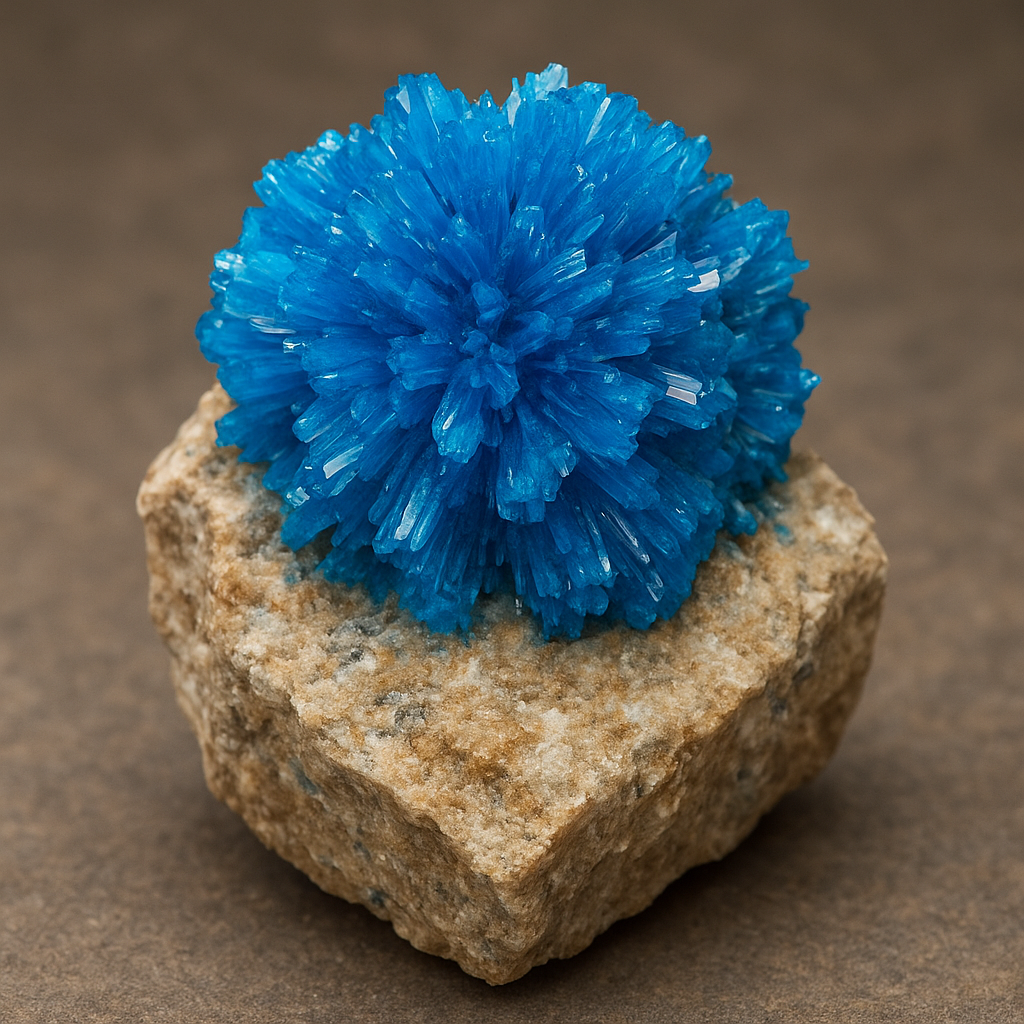
In hand specimen and under magnification, cavansite most commonly appears as compact, radiating aggregates or spherical rosettes composed of needle-like crystals. These aggregates can be quite small (millimetres) or large and showy enough to be central display pieces. The crystals are usually transparent to translucent with a vitreous to slightly pearly luster that enhances their intensity when well-formed.
- Color: distinctive vivid blue, sometimes with greenish or teal tones depending on vanadium content and trace elements.
- Crystal habit: acicular (needle-like), radiating spheres, sprays and occasional tabular forms.
- Hardness: about Mohs 3–4, which makes it relatively soft compared to many gem materials.
- Density: low to moderate specific gravity, typically around 2.2–2.4.
- Luster and transparency: vitreous to pearly; transparent to translucent.
Because of its softness and commonly delicate, needle-like crystals, cavansite is comparatively fragile. It can be damaged by abrasion, repeated handling or exposure to solvents that might affect secondary minerals or matrix components in specimens.
Where cavansite occurs: geology and notable localities
Cavansite is a secondary mineral, meaning it forms through alteration processes rather than crystallizing from primary magmas. It is typically found in the vesicles (gas cavities) of basaltic and andesitic volcanic rocks, where late-stage hydrothermal fluids rich in silica, calcium and vanadium precipitate a suite of secondary minerals. These cavities are often lined with zeolites, calcite and apophyllite, and cavansite commonly grows in intimate association with these minerals.
Classic and important localities
- India (Pune district, Maharashtra) — The most famous and prolific source of cavansite is the Pune region, especially near Wagholi and the Pune Deccan basalt exposures. Specimens from this area often show exceptional color and well-formed radiating clusters on zeolite matrices. Because of the volume and quality of finds here, Indian cavansite dominates the commercial market and museum collections.
- Mont Saint-Hilaire, Canada — This classic mineral locality in Quebec has produced cavansite specimens that are prized for their associations and aesthetic combinations with other rare minerals. Mont Saint-Hilaire is famed for a wide variety of unusual secondary minerals, and cavansite there occurs in complex assemblages.
- Other occurrences — Smaller, less famous occurrences have been reported from parts of the United States (notably in the Pacific Northwest), New Zealand and other basaltic provinces. These localities are sporadic and typically produce smaller or less vividly colored specimens than the Indian finds.
Geologically, cavansite is associated with low-temperature hydrothermal alteration of basaltic rock. The same fluids that form zeolites, apophyllite and calcite can carry trace elements like vanadium in solution; under appropriate pH and redox conditions, cavansite precipitates as the fluids evolve and cool within cavity walls.
Associated minerals and formation processes
Cavansite rarely occurs alone. Its most common partners are zeolite-group minerals such as stilbite, heulandite and scolecite, along with apophyllite, calcite and various manganese and iron oxides. These associations form because the same hydrothermal solutions that deposit cavansite are rich in silica and compatible cations (Ca2+, K+, Na+), and zeolites crystallize under similar temperature and pressure conditions.
Formation environment and mineral paragenesis
- Primary basalt or andesite cools and forms vesicles (gas cavities) during or after eruption.
- Later, low-temperature hydrothermal fluids—often meteoric water heated by residual magmatic heat or circulating through fractures—move through the rock, dissolving and carrying silica, calcium, alkalis and trace vanadium.
- As the chemistry of these fluids changes (e.g., temperature drops, pH shifts, oxidation state changes), minerals begin to precipitate. Zeolites and apophyllite often form early and provide attractive matrices for later cavansite growth.
- Cavansite grows as needle-like crystals in radial sprays, sometimes coating zeolite crystals or filling small cavities where nucleation sites are favorable.
Microscopically, cavansite’s habit reflects directional crystal growth from a central point, giving rise to the rosette morphology prized by collectors. The precise controls on crystal size and habit include fluid saturation, local ion concentration, and the presence of impurities or templating surfaces on other mineral crystals.
Uses and applications: scientific, aesthetic and cultural
Because cavansite is both rare and visually appealing, its primary uses are in scientific research and the collecting / display market rather than in industrial applications. Below are the main areas where cavansite is valuable.
Scientific research
- Mineralogy and crystallography: cavansite provides an interesting case study of a vanadium-bearing hydrated silicate with uncommon crystal habits. Structural studies help researchers understand how vanadium is incorporated into silicate frameworks and how hydration stabilizes certain crystal forms.
- Geochemistry and ore-formation studies: cavansite occurrences inform models of how trace elements like vanadium behave during low-temperature alteration processes in basaltic terrains.
- Spectroscopy and materials research: the vivid blue color has led to spectroscopic analyses (UV-Vis, Raman, IR) to explore electronic transitions and bonding environments. While cavansite itself is not an industrial source of vanadium, understanding its chemistry contributes to broader knowledge of vanadium mineralogy.
Collectors, display and jewelry
Cavansite is most celebrated as a specimen mineral. Museum-quality clusters perched on contrasting zeolite matrices are highly sought after, and exceptional pieces command strong prices on the mineral market. For hobbyists and dealers, cavansite specimens are prized for composition, color saturation and aesthetic arrangement with companion minerals.
Use in jewelry is limited by cavansite’s fragile nature and low hardness. Cabochons and set pieces are sometimes made from stabilized fragments or backed slices, but such items are more novelty than durable gems. When used, cavansite jewelry requires careful setting and protective mounting to minimize abrasion and impacts.
Metaphysical and cultural interest
In metaphysical circles, cavansite is often associated with clarity, insight and communication—qualities attributed to its crisp blue color. These uses are cultural and subjective rather than scientifically validated, but they do contribute to the mineral’s popularity among collectors who value both aesthetic and purported energetic properties.
Collecting, conservation and ethical considerations
Collecting cavansite specimens can be rewarding but requires knowledge of best practices to preserve specimen integrity and ensure ethical sourcing.
- Handling and storage: Because cavansite crystals are delicate, specimens should be handled minimally and stored in padded boxes or display cases away from vibration and dust. Avoid exposure to aggressive cleaning agents or ultrasonic cleaners.
- Cleaning: Gentle dusting with a soft brush and occasional compressed air is usually sufficient. If water-based cleaning is necessary, test a small area first and allow slow drying to prevent dissolution or alteration of associated minerals.
- Display considerations: Use secure mounts and avoid direct sunlight for long periods, as some secondary minerals can fade or alter under prolonged UV exposure.
- Ethical sourcing: Purchase specimens from reputable dealers who can document provenance. Some mining areas are sensitive environmentally or socially; responsible collection practices and fair compensation for local workers are important to support sustainable mineral trade.
Market, valuation and collecting tips
The market value of cavansite specimens varies widely depending on size, condition, color intensity, and aesthetic presentation. Small, modest clusters fetch affordable prices for hobbyists, while large, museum-quality rosettes on contrasting zeolite matrices can achieve significant sums. A few practical tips for prospective buyers:
- Inspect color and saturation—deep, uniform blue is most desirable.
- Examine crystal completeness—broken needles reduce value.
- Consider matrix contrast—cavansite on white or pale stilbite or apophyllite matrices tends to present dramatically.
- Ask about provenance—specimens from classic localities (notably the Pune region) often command premiums.
Interesting facts, history and research highlights
Cavansite was first described in the mid-20th century and quickly drew attention for its unusual color and habits. Its name is derived from its chemistry—reflecting Ca (calcium) and V (vanadium) components—hence the commonly cited etymology linking chemical constituents to the mineral’s designation.
Several aspects of cavansite continue to intrigue researchers:
- Color mechanisms: the precise electronic transitions responsible for its brilliant blue are tied to vanadium’s oxidation state and coordination environment; spectroscopic studies continue to refine this understanding.
- Crystallography: cavansite provides a model for how hydrated silicate frameworks can incorporate transition metals and water molecules, with implications for synthetic materials that mimic such structures.
- Geological indicators: because cavansite forms under specific low-temperature hydrothermal conditions, its presence can signal particular alteration histories in volcanic terrains, aiding field geologists in reconstructing past fluid activity.
Practical advice for photographers and exhibitors
Capturing cavansite’s color and texture accurately can be challenging but rewarding. A few practical pointers:
- Use diffuse, daylight-balanced lighting to bring out true color without glare; avoid strong direct light that can produce hotspots on glossy surfaces.
- Macro lenses and focus-stacking techniques help reveal needle detail and three-dimensionality in rosettes.
- Background contrast matters—neutral or dark backgrounds often make blue cavansite pop, while lighter matrices may benefit from subdued backdrops to emphasize crystal form.
Final thoughts on cavansite’s appeal
Cavansite’s combination of vivid color, elegant crystal habits and close relationships with zeolite minerals has established it as a standout in the mineral world. Whether studied for its geochemical implications, admired as a collector’s showpiece, or used sparingly in protective jewelry designs, cavansite continues to fascinate. For those drawn to bright natural colors and delicate forms, a well-preserved cavansite specimen offers both scientific interest and aesthetic reward.