
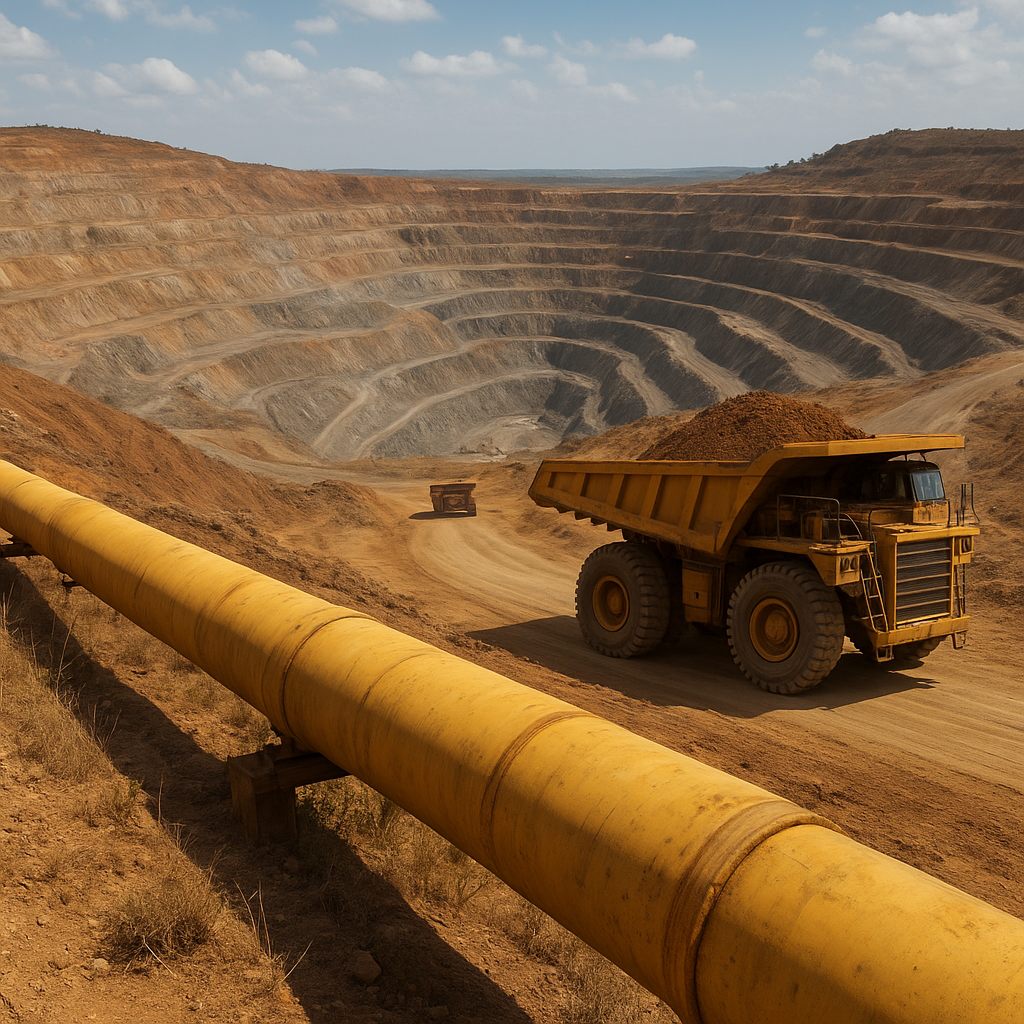
The Catoca mine is one of the most important and visually arresting mineral operations on the African continent. Located in the heart of southern Angola, the site combines geological rarity, large-scale industrial mining and a complex web of economic and social impacts. This article examines where Catoca sits on the map, what it produces, how it is mined and processed, and why it matters to Angola and to the global diamond market. It also highlights intriguing technical, historical and human stories that surround one of the world’s most significant diamond deposits.
Location and geological setting
Catoca is situated in the eastern part of Angola, within the province known today as Lunda Sul. This region forms part of the greater Angolan Lunda geological district, which extends across national boundaries into the Democratic Republic of the Congo and is globally renowned for diamond-bearing formations. The mine itself is set on a large, near-surface kimberlite pipe — a vertical igneous intrusion that brought material from the deep mantle toward the surface during explosive eruptions many millions of years ago. These pipes are the principal primary sources of gem-quality diamonds worldwide.
The local landscape is characterized by savannah and open woodlands, intersected by seasonal rivers and dotted with small agricultural communities. Historically, the Lunda region has been both a center of artisanal alluvial diamond extraction and the site of major industrial projects; Catoca represents the latter on a very large scale. Its location, several hundred kilometres from Angola’s Atlantic coast, means mineral logistics, road and rail connectivity, and energy supply have all been central planning considerations for the operation.
Mining methods, production and processing
Catoca is an open-pit operation exploiting a high-grade kimberlite pipe. The mine was developed to extract primary kimberlite ore rather than the alluvial gravels that historically yielded diamonds in riverbeds of the region. Large earthmoving fleets remove overburden and ore in benches; the material then undergoes crushing and a series of concentration steps to recover diamonds.
- Primary crushing reduces the ore to manageable fragments before size separation.
- Dense media separation and other gravity-based techniques concentrate heavier diamond-bearing material.
- Final recovery frequently uses sorting technologies including X-ray and sensor-based systems to separate diamonds from host rock.
Output from Catoca includes both industrial-quality and gem-quality diamonds. While the composition of stones varies from year to year, the mine is known to produce a wide spectrum of sizes, including occasional very large stones weighing hundreds of carats. The mix of qualities makes Catoca strategically important: it supplies raw material used both in industrial applications and in the high-value gem market.
On a national scale, Catoca is one of Angola’s largest single sources of diamond production. Its throughput and recovery rates have made it a cornerstone of the country’s polished and rough diamond supply chain. Processing facilities adjacent to the pit are designed for continuous, high-volume operation, and the company has invested in modern mineral-processing technology to maximize recovery while controlling costs.
Ownership, governance and economic role
The mine is operated by a large joint venture involving the Angolan state diamond company Endiama and international partners. Historically, foreign partners have included major international diamond companies and investors who contributed capital, technical expertise and access to global markets. The involvement of the state through Endiama means a substantial portion of revenues from Catoca flows to the Angolan government, giving the mine outsized importance in national economic planning.
Economically, Catoca plays several critical roles:
- It is a major exporter of rough diamonds, generating foreign-exchange earnings essential for Angola’s balance of payments.
- It contributes directly to national and provincial revenue through taxes, royalties and dividends distributed via the state shareholder.
- It provides formal employment and supports a chain of contractors and service providers, increasing local employment opportunities relative to artisanal mining alone.
Beyond direct fiscal flows, the mine has knock-on effects on transport infrastructure, housing, health and education services in the region. Large-scale mining projects often spur improvements in local roads, power supply and communications, albeit sometimes concentrated around the mine site rather than spread equitably across communities.
Social and environmental impacts
The scale of Catoca’s operation has meant a correspondingly large social and environmental footprint. On the environmental side, open-pit mining affects landscapes, surface water and local ecosystems. Waste rock and tailings must be managed to avoid contamination of rivers and groundwater. Mine operators typically maintain rehabilitation plans and monitoring programs, but balancing production goals with environmental stewardship remains an ongoing challenge.
Socially, the mine has been both a source of opportunity and tension. It provides stable jobs with more predictable incomes than artisanal mining, and it supports local procurement and small businesses. However, there are also complex issues around land access, resettlement of affected communities, and the relationship between industrial operations and traditional livelihoods such as smallholder agriculture and artisanal diamond digging. In resource-rich regions like Lunda Sul, governance frameworks and transparency in revenue allocation are critical to ensuring benefits reach a broad base of the population.
Market significance and the global diamond industry
Catoca’s output feeds into the global diamond pipeline at several points: rough stones are sold to trading houses and diamond cutters, some stones enter specialized auctions for exceptionally large or high-quality gems, and a portion is used in industrial markets. Because the mine can produce large stones and a diverse size distribution, it has strategic importance for both gem and industrial segments.
The revenues from Catoca and similar large operations help determine Angola’s position among diamond-producing nations. Diamonds are a major export for Angola, and the presence of a high-profile, well-capitalized mine like Catoca supports the country’s negotiating leverage with buyers, investors and international partners in the sector.
Interesting technical and historical notes
Several aspects of Catoca make it noteworthy beyond its production numbers:
- Geological rarity: Kimberlite pipes that are both large and near-surface enough to be economically mined at scale are uncommon — Catoca is an excellent example of this fortunate combination.
- Large stones: Over the years the mine has yielded several exceptionally large rough diamonds, underscoring the deposit’s potential to produce high-value gems.
- Technology integration: Modern recovery methods, sensor-based sorting and controlled blasting techniques have allowed Catoca to boost recovery while lowering the environmental footprint compared with older methods.
- Regional significance: The mine has catalyzed regional development in Lunda Sul, creating a hub of mining-related activity in an area with a long history of artisanal diamond work.
Challenges and future prospects
Looking forward, Catoca faces several challenges that are common to large mining operations in developing contexts. Maintaining sustainable production levels requires continued investment in equipment, efficient processing, and skilled personnel. Market volatility in diamond prices, changes in demand for industrial versus gem-quality stones, and competition from other producing regions affect the mine’s commercial outlook.
Governance and transparency are also pivotal. The distribution of benefits — between local communities, provincial authorities and the national government — influences social license to operate and long-term stability. Investment in community development, environmental rehabilitation and workforce training can help align the mine’s operations with broader development objectives.
Technologically, there is room for further improvement. Advances in remote sensing, automated haulage, and cleaner processing chemistries could reduce operating costs and environmental impacts. Similarly, improved value-chain integration — for example, local cutting and polishing facilities — could capture more value inside Angola rather than exporting rough stones only.
Notable human and cultural dimensions
Beyond geology and economics, Catoca has human stories: workers who moved from artisanal mining to formal employment, families reshaped by new income patterns, and global gem professionals who have traced rare stones from the pit to auction houses. The mine’s presence has intersected with local traditions and livelihoods in complex ways, and projects to document and support cultural continuities alongside economic change have been part of the wider social conversation around the operation.
Catoca also exemplifies how a single mine can become a focal point in national development strategies. Its revenues and strategic importance give Angola leverage but also place responsibility on policymakers to manage resource wealth wisely. The mine’s continued operation will likely remain central to debates about resource governance, transparency and sustainable development in the country.
Final remarks
As one of the leading diamond producers in Angola and a major name in the global diamond landscape, Catoca blends the technical complexity of kimberlite mining with the social and economic dynamics of resource extraction in a developing nation. Its large-scale open-pit operations, the diversity of diamonds extracted, and its role in regional development make it a case study in both the opportunities and responsibilities that accompany rich mineral endowments. For geologists, miners, economists and local communities alike, Catoca remains an enduring and fascinating subject — a place where deep time, industrial machinery and human aspiration meet.

